Imagine having a digital assistant that doesn’t just answer your questions — but actually takes action and helps get things done for you. That’s exactly what AI Agents are beginning to do in 2026, and businesses and individuals alike are starting to recognize how powerful this technology can be.
1. What Are AI Agents?
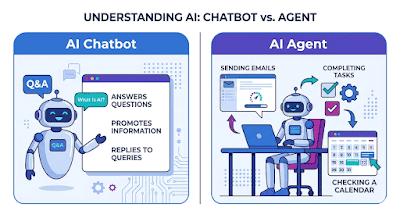
Most people are familiar with AI chatbots — you type a question, and you get an answer. AI Agents are far more capable. An AI Agent is an artificial intelligence system designed to understand goals, make decisions, and take actions to help complete tasks with limited human input.
Think of the difference this way: a regular AI is like a smart encyclopedia. An AI Agent is more like a capable digital assistant. It doesn’t just provide information — it can help carry out tasks and workflows.
Industry analysts estimate that by the end of 2026, a growing number of enterprise applications may include some form of AI agent capability. Interest in agentic AI has accelerated significantly as companies look for ways to automate repetitive work and improve productivity.
2. How Do AI Agents Actually Work?
At the core of most AI Agents is a large language model (LLM) — the same technology behind tools like ChatGPT and Claude. What makes an AI Agent different is its ability to connect with tools, software, and external systems to complete tasks.
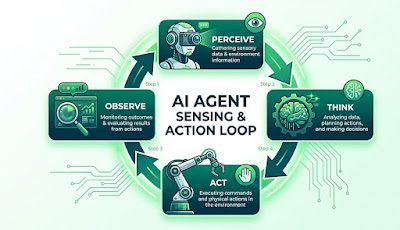
Here is a simple breakdown of how an AI Agent typically operates:
The AI Agent Loop
Step 1 — Perceive: The agent receives a goal or task from a user. Example: “Research the top 5 competitors and create a report.”
Step 2 — Think: The agent breaks the goal into smaller steps and decides what to do first.
Step 3 — Act: The agent uses tools — such as web browsing, data analysis, code execution, or integrations — to complete actions.
Step 4 — Observe: The agent evaluates outcomes and adjusts its next actions if needed.
Step 5 — Repeat: This process continues until the task is completed.
3. Real-World Examples in 2026
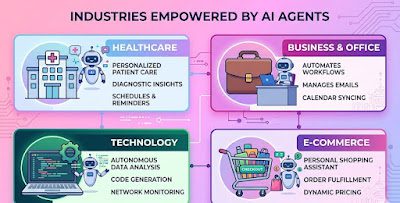
AI Agents are no longer just a concept discussed in research papers. Businesses are already experimenting with them in areas such as healthcare, software development, customer service, and productivity workflows.
Healthcare
AI agents can assist doctors by reviewing patient information, identifying unusual patterns in test results, and helping automate administrative tasks such as appointment scheduling. While human oversight remains essential, these systems may help improve efficiency and reduce workload.
Business & Sales
Sales teams are increasingly experimenting with AI tools that research potential customers, generate personalized emails, assist with follow-ups, and help update CRM systems. Tasks that once took hours can sometimes be completed much faster.
Software Development
Development tools such as GitHub Copilot and agentic coding assistants can help developers analyze codebases, identify bugs, suggest fixes, and assist with documentation or pull requests.
E-Commerce
Online shopping platforms are exploring AI-powered assistants that can help users compare products, analyze preferences, and recommend relevant purchases based on shopping behavior.
Growing Adoption
Many organizations are actively investing in AI agents to automate workflows and improve productivity.
Faster Workflows
Teams using AI-powered tools often report faster completion of repetitive tasks.
4. How They Are Changing the Workplace
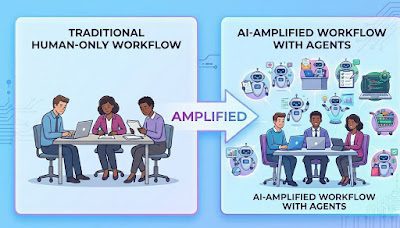
Many industry leaders describe AI as a new era of collaboration between humans and technology. Rather than replacing workers entirely, AI agents are increasingly being used to support productivity, automate repetitive work, and help smaller teams accomplish more.
Key Insight
AI agents are not replacing humans in most cases — they are helping teams work more efficiently. Small teams equipped with the right tools may now be able to handle workloads that previously required much larger teams.
Researchers and business leaders suggest that one important competitive advantage may come not only from using powerful AI models, but from how effectively organizations integrate AI tools into their workflows.
5. Benefits for Businesses and Individuals
Whether you run a business or simply want to be more productive in your personal life, AI agents can offer several practical benefits:
Save Time
Tasks that once required hours — such as research, organizing information, writing drafts, or sorting emails — can often be completed much faster with AI assistance.
Reduce Costs
Small businesses can now access tools that help automate customer support, content creation, reporting, and data analysis without requiring large teams.
Improve Consistency
Unlike humans, AI systems do not experience fatigue in the same way, making them useful for repetitive tasks that require consistency and speed.
24/7 Assistance
AI-powered systems can assist with customer support, monitoring workflows, processing requests, and handling repetitive tasks around the clock.
6. Should You Be Worried? The Risks of AI Agents
As AI agents become more capable, experts also point to important risks that organizations and individuals should understand. Like any powerful technology, responsible use matters.
Key Risks to Know
- Security: Malicious actors may attempt to manipulate AI systems into taking unintended actions, including through techniques such as prompt injection.
- Job Displacement: Some repetitive and routine tasks may become increasingly automated, potentially changing the nature of certain jobs.
- Accountability: When an AI system makes a mistake, responsibility and oversight can sometimes become unclear.
- Over-Reliance: Depending too heavily on AI without human review may reduce critical thinking or introduce avoidable errors.
Cybersecurity experts often recommend treating AI agents like digital employees: define clear permissions, limit access to sensitive information, and regularly monitor performance.
7. What’s Next for AI Agents?
The pace of AI innovation continues to accelerate. Researchers are increasingly exploring the idea of physical AI — robots and machines powered by AI systems that can operate in real-world environments such as warehouses, hospitals, factories, and homes.
In the future, AI agents may become more deeply integrated into everyday life — helping with shopping, scheduling, healthcare support, productivity, and decision-making. However, human oversight will likely remain an important part of how these systems are used.