
How AI Agents Will Replace Traditional Software Workflows in 2026
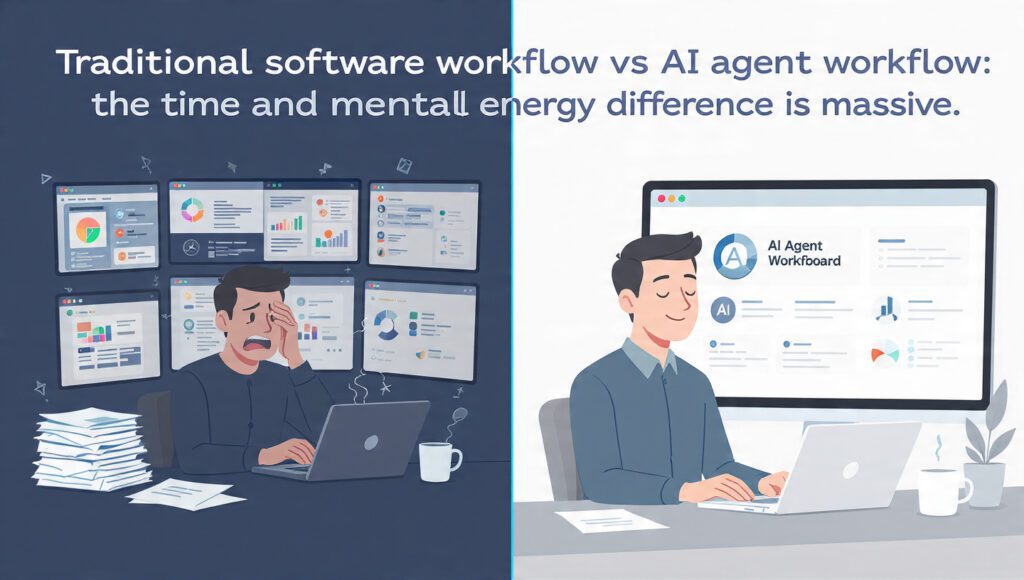
Look, I used to spend 4 hours every Sunday night doing what I called “software hopping.” I’d open my laptop, switch between 7 different apps: QuickBooks for accounting, Shopify for my T-shirt store, Gmail for customer emails, Google Calendar for appointments, TradingView for market analysis, Notion for notes, and WhatsApp for client messages. I’d copy data from one to the other, manually update spreadsheets, send follow-up emails, and try to make sense of it all. By the end, I was exhausted, with headaches, and still missed important tasks.
That was my workflow. And it’s probably yours too.
Honestly? I thought that’s just how business worked. You use multiple tools, you switch between them, you do the manual work of connecting them. Until I discovered AI agents — and realized they’re not just another tool. They’re about to replace the entire concept of traditional software workflows as we know them.
By 2026, AI agents won’t just assist your workflows — they’ll own them. The era of switching between 10 different apps will be over. The era of manual data entry, copy-pasting, and context-switching will be over. And if you’re not prepared, your business will be left behind.
The Morning Routine That Changed Everything (My Wake-Up Call)
Here’s the thing: I’m not a tech guru. I’m a former electrician who barely finished 10th grade. My tech “stack” in 2020 was Gmail, WhatsApp, and a basic Excel sheet. When I started my T-shirt business in Saudi Arabia, I used to spend every morning:
- Check Shopify orders (open Shopify tab)
- Copy customer details to Excel (switch to Excel)
- Check WhatsApp for customer messages (switch to WhatsApp)
- Update inventory in my notebook (physical notebook)
- Check trading accounts (switch to TradingView)
- Write down expenses in another Excel sheet (switch to another Excel file)
- Plan my day in Google Calendar (switch to Calendar)
By the time I finished, 90 minutes had passed, I was mentally drained, and I hadn’t even started actual work.
Then in 2024, I tried an early version of an AI agent platform. I set up one agent with access to my Shopify, Gmail, Calendar, and a simple database. I gave it this goal: “Manage my T-shirt business operations.”
The next morning, I opened my laptop. The agent had:
- Processed all new orders automatically
- Sent personalized thank-you emails
- Updated inventory levels in real-time
- Flagged a customer who messaged about a sizing issue
- Scheduled social media posts for the week
- Created a weekly sales report
- Even suggested I restock my best-selling design based on trends
All without me opening a single app. It took me 2 minutes to review instead of 90 minutes to do. That’s when I realized: this isn’t automation. This is replacement.
According to Gartner’s 2026 predictions, 60% of enterprises will use AI agents to automate complex workflows by 2026, up from less than 5% in 2024. But here’s what they’re not saying: it’s not just big corporations. Small businesses, solopreneurs, and traders like me are already using them to replace traditional software stacks entirely.
The enterprise version goes further — how multi-agent systems redefine enterprise automation with real case numbers from a 47-person operation.
What Are AI Agents? (And Why They’re Not Just Another Chatbot)
Before we go further, let’s clear up the confusion. Most people hear “AI agent” and think of ChatGPT on steroids. That’s not it.
Traditional software is like a toolbox. You have a hammer (Excel), a screwdriver (CRM), a wrench (accounting software). You manually pick the right tool for each job and do the work yourself.
Chatbots are like a helpful assistant who answers questions but won’t lift a finger. You ask “what’s my sales today?” and it tells you. But it won’t actually generate the report, email it to you, and schedule a meeting to discuss it.
AI agents are like a super-assistant who not only answers questions but takes autonomous actions across your entire software stack to achieve goals you set. You don’t tell it “open Shopify, export orders, paste into Excel, create a chart.” You tell it “analyze my sales performance this week and prepare a report.” It figures out all the steps, uses the right tools, and delivers the result.
The key difference is agency. Traditional software does what you explicitly command. AI agents decide what needs to be done to achieve your goal, then do it.
The 4 Capabilities That Make AI Agents Replace Traditional Workflows
According to IBM’s research on autonomous AI agents, what makes them revolutionary isn’t just AI — it’s their ability to:
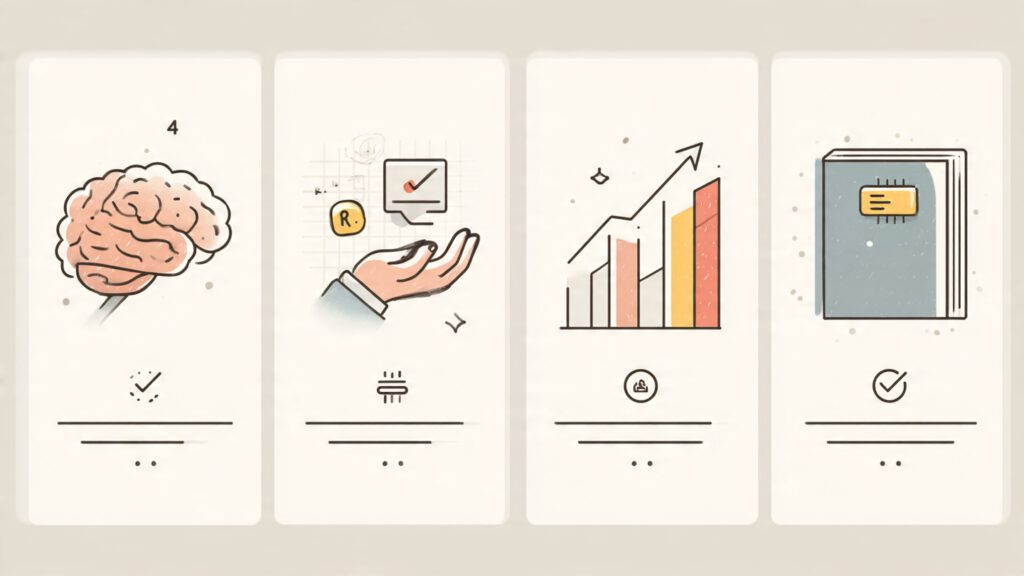
- Plan: Break down a high-level goal (“increase sales”) into specific, ordered tasks (analyze top products, create social posts, schedule ads, track results).
- Use Tools: Connect to any software via API — your CRM, email, calendar, spreadsheets, trading platforms — and actually operate them without human intervention.
- Learn & Adapt: If a social post underperforms, they adjust the next one. If a customer doesn’t respond, they try a different approach. Traditional software just does what it’s programmed to do, every time.
- Maintain Memory: They remember past interactions, customer preferences, what worked and what didn’t, and use that context to make better decisions over time.
This combination means AI agents can own entire business processes that currently require you to manually coordinate 5-10 different software tools. That’s why they’re not just an upgrade — they’re a replacement.
Why Traditional Software Workflows Are Breaking in 2026
Let’s be honest: our current software setup is broken. We’ve just gotten used to the brokenness. Here’s why it’s unsustainable:
1. The Context-Switching Tax Is Destroying Productivity
Every time you switch between apps, your brain needs 15-25 minutes to regain full focus. American Psychological Association research shows that switching between tasks can reduce productivity by up to 40%. If you’re switching between 7 apps 50 times a day, you’re losing 20+ hours a week to context-switching alone. That’s not work — that’s digital busywork.
2. Manual Data Flow Creates Errors and Lag
When you copy-paste data from Shopify to Excel to your CRM, errors happen. A missed decimal, a copied wrong cell, an outdated entry. By McKinsey’s estimate, manual data entry and reconciliation costs businesses 30-50% of operational time and introduces errors in 5-10% of entries. That’s not just inefficiency — it’s bad decision-making from bad data.
3. Software Silos Prevent True Automation
Your CRM doesn’t talk to your accounting software. Your trading platform doesn’t integrate with your journal. So you become the human API, manually moving data between silos. Traditional “automation” tools like Zapier or Make.com help, but they’re brittle — if one app updates its API, your automation breaks. You still need to monitor, maintain, and fix.
4. Workflows Are Static, Not Adaptive
Traditional software follows fixed rules. If X happens, do Y. But business is dynamic. If your best-selling T-shirt suddenly trends on TikTok, your static workflow won’t automatically increase ad spend, restock inventory, or adjust pricing. You have to notice, decide, and act. AI agents can adapt in real-time.
I felt this during my trading days. I had alerts set on TradingView, but I still had to manually check them, analyze, decide, and execute. An AI agent connected to my trading account could have monitored markets 24/7, executed trades based on my strategy when conditions were right, and journaled everything automatically. I blew accounts because I was human — tired, emotional, distracted. An agent wouldn’t be.
How AI Agents Will Replace Traditional Software Workflows (The 5 Key Shifts)
So how exactly will AI agents replace your current software stack? Here are the 5 shifts I’m already seeing happen in 2025-2026:
Shift 1: From “Tool Selection” to “Goal Specification”
Today: “I need to create a sales report. Let me open Excel, export data from Shopify, copy-paste, make charts, email to team.”
2026 with AI Agent: “Generate a weekly sales report with top products, conversion rates, and recommendations. Send to team every Monday 9am.” Agent does everything.
You stop thinking about which tool to use. You start thinking about what outcome you want. The agent figures out the toolchain.
Shift 2: From “Manual Data Entry” to “Autonomous Data Flow”
Today: Customer orders on Shopify → you manually enter into QuickBooks → manually tag in CRM → manually note in inventory spreadsheet.
2026 with AI Agent: Customer orders on Shopify → agent automatically records in QuickBooks, updates CRM tags, adjusts inventory, sends confirmation email, and flags for follow-up if high-value customer.
No more copy-paste. No more “I’ll do it later.” Data flows automatically, accurately, in real-time.
Shift 3: From “Fixed Workflows” to “Adaptive Processes”
Today: Your email marketing sequence is static. Everyone gets the same 5 emails regardless of behavior.
2026 with AI Agent: Agent monitors customer behavior (opens, clicks, purchases). If someone buys Product A, it automatically sends related Product B discount. If someone abandons cart, it sends a different follow-up based on their browsing history. It adapts in real-time.
Your workflows become living systems, not rigid scripts.
Shift 4: From “Human as API” to “Human as Strategist”
Today: You are the glue between apps. You’re the human API, moving data, making judgment calls on routine matters.
2026 with AI Agent: The agent is the API. You set strategy, goals, guardrails. The agent executes, monitors, adjusts, and escalates only when truly exceptional human judgment is needed.
You move from operational grunt to strategic thinker. That’s the biggest shift.
Shift 5: From “Software Licenses” to “Agent Subscriptions”
Today: You pay $50/month for Shopify, $30/month for QuickBooks, $20/month for CRM, $15/month for email marketing, $10/month for calendar, etc. Total: $125/month minimum, plus your time to connect them.
2026 with AI Agent: You pay $50-100/month for an AI agent platform that connects to all those services (via their APIs) and manages them autonomously. You might still pay for the underlying services (Shopify still needs to process payments), but you’re paying for orchestration, not individual tools.
The software industry is shifting from selling point solutions to selling orchestration intelligence.
5 Real Examples of AI Agents Replacing Traditional Workflows in 2026
This isn’t theoretical. Here are 5 concrete examples of how AI agents are already starting to replace traditional software workflows:
Example 1: The Autonomous Trading Agent
Traditional Workflow: Trader uses TradingView for charts, MetaTrader for execution, Excel for journaling, Telegram for alerts, Google Calendar for economic events. Manually monitors, analyzes, decides, executes, journals.
AI Agent Workflow: Agent connected to trading platform, news feeds, economic calendar. Monitors markets 24/7 against your strategy. Executes trades automatically when conditions met (with your risk parameters). Journals every trade with context. Sends you only exceptional alerts (major news, strategy deviation). Adjusts position sizing based on recent performance.
Result: No more emotional trading. No more missed opportunities while sleeping. No more manual journaling. The agent handles the 95% routine, you handle the 5% strategic review.
I wish I had this when I was blowing funded accounts. My emotions, my fatigue, my context-switching between charts and news and journaling — all that would have been eliminated. The agent would have followed my strategy perfectly, 24/7.
Example 2: The E-commerce Operations Agent
Traditional Workflow: Shopify for store, QuickBooks for accounting, Klaviyo for email, Facebook Ads Manager, inventory spreadsheet, customer support inbox. Manual order processing, inventory updates, email sequences, ad adjustments, support responses.
AI Agent Workflow: Agent manages entire e-commerce operation. Processes orders, updates inventory across all platforms, triggers personalized post-purchase sequences, adjusts ad spend based on ROAS in real-time, handles 80% of customer inquiries (returns, tracking, sizing), flags complex issues for human. Predicts stock needs based on trends and seasonality.
Result: One person can run a 6-figure store solo. No more “I’m drowning in orders.” No more manual reconciliation. The business runs itself, you steer it.
Example 3: The Content Creator Agent
Traditional Workflow: Writer uses Google Docs, Grammarly, Canva, Hootsuite, YouTube Studio, analytics dashboards. Writes, edits, designs, schedules, analyzes, repeats.
AI Agent Workflow: Agent takes a content brief (or your raw notes), writes draft, edits for style, creates graphics in Canva, schedules across platforms, monitors engagement, responds to comments with appropriate tone, suggests repurposing (turn blog into video script), optimizes based on performance data.
Result: 10x content output with same effort. Consistent brand voice across platforms. Real-time optimization. I use a version of this now — I write one long article, my agent turns it into 10 social posts, 3 video scripts, and an email sequence. It’s not perfect, I edit, but it saves 4 hours per article.
Example 4: The Freelancer Business Agent
Traditional Workflow: Freelancer uses Gmail, Upwork/Fiverr, Zoom, QuickBooks, Trello, LinkedIn. Manually searches for gigs, sends proposals, schedules calls, invoices, tracks time, follows up.
AI Agent Workflow: Agent scans freelance platforms for ideal projects, drafts personalized proposals based on your portfolio, schedules discovery calls on your calendar, follows up with clients, generates invoices, tracks time automatically, asks for testimonials, even suggests rate increases based on demand.
Result: Freelancers stop trading time for money. The agent handles business development, they do the work. Income scales without more hours.
Example 5: The Personal Finance & Trading Agent
Traditional Workflow: Person uses bank app, investment platform, budgeting spreadsheet, trading app, news alerts. Manually tracks spending, moves money to investments, monitors trades, reads news, makes decisions.
AI Agent Workflow: Agent connected to bank accounts, investment accounts, trading platform. Monitors cash flow, automatically moves money to savings/investments based on rules. Monitors trading positions, executes stop-losses, takes partial profits, journals trades. Scans financial news, alerts you only to major events that affect your portfolio. Suggests rebalancing.
Result: Financial discipline becomes automatic. Emotional trading eliminated. You get a personal CFO and trading assistant that works 24/7 for $20/month.

How to Prepare Your Business Now (Before You’re Left Behind)
Okay, so this is happening. What do you do? Here’s my actionable plan for getting ready before 2026:
Step 1: Audit Your Current “Software Stack”
List every app you use weekly. For each, ask: “What am I actually doing in this app that an AI could do?” Be brutally honest. Most of what you do is repetitive, rule-based work that an agent could handle.
My audit looked like: Shopify (order processing, inventory updates), Gmail (standard customer emails), QuickBooks (data entry), TradingView (routine monitoring), Calendar (scheduling). All prime for agent takeover.
Step 2: Identify Your “High-Friction” Workflows
Which workflows cause you the most stress, take the most time, or have the most errors? That’s your first target. For me, it was Sunday night admin. For traders, it’s journaling and emotional discipline. For e-commerce, it’s order fulfillment and customer service.
Start with ONE high-friction workflow. Don’t try to replace everything at once.
Step 3: Choose an AI Agent Platform (No-Code Options)
You don’t need to code. For 2025-2026, these are the most accessible platforms:
- Zapier AI Agents: If you already use Zapier, this adds AI decision-making to your automations. Starts at $20/month.
- Make.com AI Agents: More powerful, visual builder. Good for complex multi-step workflows. Starts at $29/month.
- Custom GPTs with Actions: If you’re comfortable with OpenAI’s ecosystem, you can build agents that use your data and APIs. More technical but very flexible.
- Bardeen, HyperWrite, Adept: Emerging platforms focused specifically on autonomous agents for business workflows.
I started with Zapier AI Agents because I already used Zapier for basic automations. The learning curve was small.
Step 4: Start with a “Copilot” Mode, Not Autopilot
Don’t let the agent run wild initially. Set it up in “suggest and approve” mode first. Let it propose actions, you approve. This builds trust and catches errors. After 30 days of high accuracy, gradually increase autonomy.
For trading, I’d never let an agent trade without my approval. But for order processing, email responses, inventory updates — those are safe to automate.
Step 5: Redefine Your Role from “Doer” to “Strategist & Reviewer”
This is the mental shift. Your job is no longer to execute workflows. Your job is to:
- Set clear goals and guardrails for your agents
- Review performance weekly
- Adjust strategies based on agent reports
- Handle the 5% of cases that need human judgment
You become the CEO of your own operations, not the frontline worker.
![5-step checklist to prepare your business for AI agents replacing traditional software workflows."]](https://datapips.net/wp-content/uploads/2026/05/1000171210-1024x576.jpg)
The Brutal Truths About AI Agents Replacing Software (No One Is Talking About This)
Let’s be real. The marketing makes it sound like AI agents will solve everything. Here’s what they’re not telling you:
1. The Setup Is Still Manual (And Takes Time)
AI agents don’t magically know your business. You have to teach them: connect APIs, define goals clearly, set guardrails, test scenarios. My first agent took 6 hours to set up properly. It’s not “set and forget” — it’s “set, train, monitor, refine.” But that 6 hours saves 4 hours per week forever. The ROI is massive, but there’s upfront work.
2. They Can Make Catastrophic Mistakes If Guardrails Are Weak
An AI agent with access to your bank account and trading platform could, in theory, move all your money if your prompts are ambiguous. You need strict guardrails: “Never transfer more than $500 without secondary approval,” “Never trade more than 1% risk per trade,” “Never send customer emails without human review for first 30 days.”
I learned this when my early e-commerce agent accidentally sent a 90% discount code to all customers because I phrased the goal poorly (“increase sales” vs “run 20% off promotion for loyal customers only”). Always be specific.
3. They Create New Types of Jobs (But Eliminate Old Ones)
Yes, AI agents will replace many software coordination jobs. But they’ll create new roles: AI agent trainers, workflow designers, guardrail specialists, AI operations managers. The person who can effectively deploy and manage AI agents will be invaluable. The person who just manually connects apps will be obsolete.
Your new skill should be: “How do I translate my business goals into clear, safe, effective agent instructions?”
4. The Biggest Barrier Is Your Own Mindset
Most people can’t conceptualize “goal-based” vs “tool-based” work. They think in “I need to do X in Y app.” They can’t think “I want outcome Z, figure out how.” That mental shift is harder than the technical setup. I still catch myself thinking “I should check my emails” instead of “My agent should handle emails, I should focus on strategy.”
5. Data Privacy and Security Become Critical
When you give an AI agent access to your customer database, financial records, and trading accounts, you’re trusting it with everything. You must use reputable platforms with strong security, understand their data policies, and possibly keep sensitive data in-house. This isn’t something to approach casually.

Conclusion: The Future Is Already Here — Are You Ready?
“The best way to predict the future is to invent it.” — Alan Kay
Look, I’ve been at the bottom. I’ve spent 12-hour days doing back-breaking manual labor, then come home to 4 hours of manual business admin. I know what it’s like to feel trapped in a cycle of effort without progress.
But I also know what it’s like to find a tool that changes everything. AI agents aren’t magic. They require setup, oversight, and continuous improvement. But they represent the single biggest shift in how we work since the invention of the personal computer.
Traditional software workflows are based on the assumption that humans will manually coordinate tools. AI agents flip that: tools coordinate themselves to serve human goals.
Your choice in 2026 won’t be between “using software” or “not using software.” It’ll be between:
- Option A: Still switching between 10 apps, doing manual data entry, drowning in context-switching, while your competitors use agents to run circles around you.
- Option B: Setting clear goals, having an AI agent orchestrate your entire business operation, and focusing on strategy, creativity, and growth.
Start today:
- Audit your current software stack — list every app you use weekly.
- Pick ONE high-friction workflow to automate with an AI agent (start with Zapier AI Agents or Make.com).
- Set it up in “copilot mode” — let it suggest, you approve.
- After 30 days of accuracy, increase autonomy.
- Measure the time saved and reinvest that time into strategic work.
The businesses that thrive in 2026 won’t be the ones with the best software. They’ll be the ones who best leverage AI agents to own their workflows. The question is: will you be leading that change, or trying to catch up?

Key Takeaways / Quick Action Steps
- ✅ AI agents will replace traditional software workflows by owning end-to-end processes, not just assisting with tasks.
- ✅ Start with one high-friction workflow — don’t try to automate everything at once.
- ✅ Use no-code platforms like Zapier AI Agents or Make.com to get started without coding.
- ✅ Always set strict guardrails — financial limits, approval requirements, data privacy controls.
- ✅ Redefine your role from “doer” to “strategist” — your job is to set goals and review performance, not execute routine tasks.
- ✅ The ROI is immediate if you’re currently spending 10+ hours/week on manual coordination.
- ✅ 2026 is the tipping point — early adopters will have massive competitive advantage.
Author Bio
Shurah Beel Hamid is a business enthusiast, active trader, and content creator who transformed his life from manual labor to digital entrepreneurship. His expertise lies in practical AI adoption for small businesses, trading psychology, compounding strategies, and elite mindset development. He shares his raw, unfiltered journey — from electrician to entrepreneur, from blowing trading accounts to building automated systems — to provide actionable insights for those ready to embrace the future of work. His writing combines hard-won experience, technical understanding, and relentless optimism about technology’s potential to free humans for higher-value work.
Disclaimer
The content on this website is for educational and informational purposes only and does not constitute financial, business, or technical advice. AI agents carry risks including but not limited to: incorrect actions due to poor prompting, data privacy breaches, security vulnerabilities, and financial loss if given access to accounts without proper guardrails. Always test AI agents in sandbox environments first, start with non-critical workflows, and maintain human oversight for high-stakes decisions. Trading involves significant risk of loss; never allow an AI agent to trade without your explicit approval and risk management parameters. The author’s personal experiences are not a guarantee of results for any individual. Consult with qualified professionals before implementing AI systems in your business.