Ask someone to guess what $1,000 becomes after 30 years at 15% annual compound interest, and most will answer somewhere in the $5,000 to $15,000 range. The actual figure is roughly $66,000. That gap isn’t the interesting part. The interesting part is this: when researchers asked the same people how confident they were in their answer, they were confident. Not hesitant. Not “I’m guessing.” Confident.
That’s the whole problem in one sentence, and it’s the part every “power of compounding, start early!” article skips entirely.
The Definition, Then We Move On
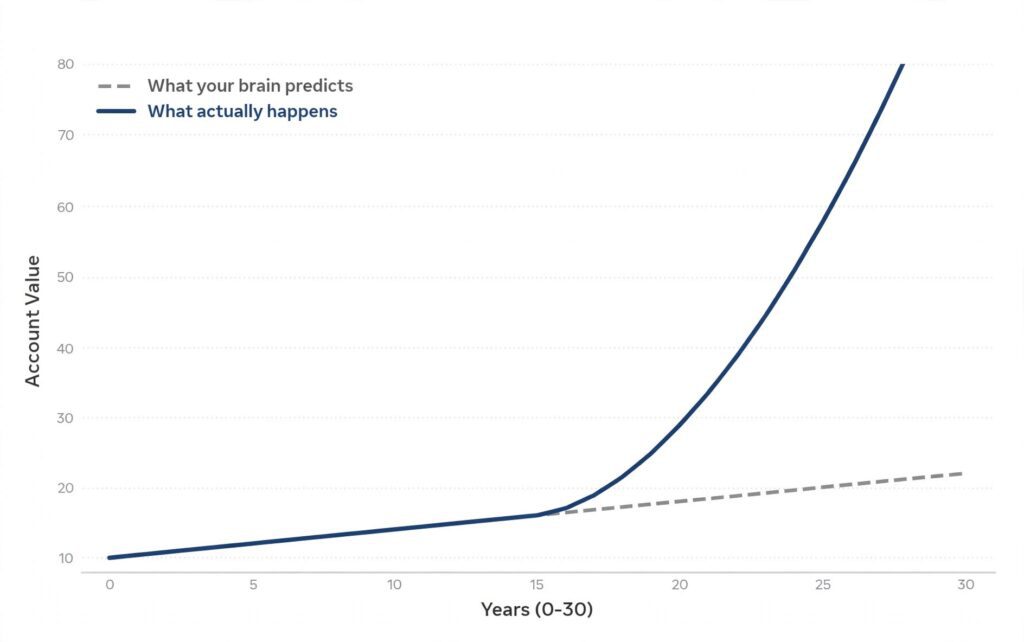
Exponential growth bias is the systematic human tendency to underestimate compound growth by projecting it as a straight line instead of a curve. Your brain sees the first few steps of a compounding process, draws a mental ruler through them, and extends it forward. Compounding doesn’t travel in straight lines, so the ruler is wrong — and it gets more wrong every year you extend it. That’s the definition. Every article on this topic gives you that, plus a chessboard-and-rice-grains story, plus “so start investing early.” Here’s what they don’t tell you.
The Bias Isn’t the Problem. Not Knowing You Have It Is.
Here’s where I’d push back on almost every piece of financial-education advice on this topic: the standard prescription is “learn about compounding.” Read the explanation, see the chart, understand the math. Fine. But experimental research on this bias found something that makes that prescription mostly useless on its own — people don’t just estimate exponential growth badly, they’re overconfident about their ability to estimate it. They were also overconfident about their ability to get the right answer using a spreadsheet.
Sit with that for a second. If you knew your mental arithmetic was unreliable, you’d reach for a calculator. The researchers framed this directly: the reason a market solution to this bias never emerged is that nobody thinks they need one. There’s no demand for a tool to fix a problem you don’t believe you have.
So the actual failure mode isn’t “I don’t understand compounding.” It’s “I understand compounding, and I still trust my gut estimate of what my savings will be worth in twenty years.” Understanding the concept and correctly estimating a specific number are two completely different skills, and having the first one convinces you that you have the second.
How Common Is This, Really?
Not a fringe cognitive quirk. In a study of over 2,300 people examining retirement savings behavior, roughly 69% either underestimated compound interest or ignored it entirely — perceiving growth as flatly linear. Only about 22% perceived exponential growth accurately. Roughly a third of samples in this research area treat compound interest as if it were simple interest, meaning they mentally strip out the entire mechanism that makes compounding work.
And this holds up in educated, financially literate populations. One experiment found the bias persisted even among subjects who were highly educated and explicitly aware that exponential growth bias exists. Knowing about the bias did not protect them from it.
The Fix That Actually Has Evidence Behind It
This is the part I’ve never seen in a general personal finance article, and it’s the single most practical finding in the research.
That same experiment tested two ways of communicating the same growth. One group got it expressed as a growth rate — “7% per year.” The other got it expressed as a doubling time — “this doubles roughly every ten years.” The result: the bias was much smaller when doubling times were used.
Same information. Same math. Different framing, dramatically better intuition.
Which means the practical move isn’t “learn about compounding” — it’s stop thinking in percentages and start thinking in doublings. Instead of “my money grows at 8% a year,” think “my money doubles roughly every nine years.” Instead of “this card charges 24% APR,” think “this balance doubles in about three years if I don’t touch it.” Your brain handles doublings far better than it handles rates, so give it the format it’s actually good at. The Rule of 72 exists precisely for this conversion, and it’s worth memorizing not because the arithmetic is hard but because it changes the format your intuition receives.
Where the Bias Costs You Most — And It’s Not Where You Think
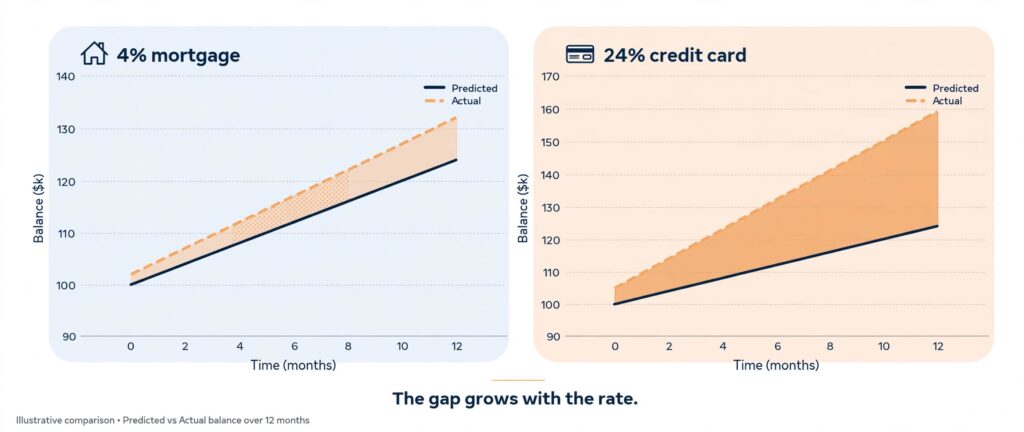
Every article frames this as an investing problem: you underestimate growth, so you save too little, too late. True, and I’d add a wrinkle — the same research suggests the bias is most severe at higher rates, not lower ones.
Read that again with debt in mind.
Your 4% mortgage is where your intuition is least wrong. Your 24% credit card is where your intuition is most wrong. The bias scales up exactly where the stakes scale up. Researchers have documented this directly — exponential growth bias leads consumers to borrow more than they otherwise would, because the future cost of that borrowing simply doesn’t register at the size it will actually reach.
So if you’re going to deploy one correction, deploy it on the debt side first. That’s the asymmetry nobody mentions: on the investing side, this bias costs you upside you never had. On the debt side, it costs you money you already have. I’ve written separately about how debt compounds while you sleep, and it’s the same mechanism running in reverse — with your brain equally blind to it.
Why “Just Start Early” Is Incomplete Advice
The standard conclusion drawn from this bias is “start early.” I don’t disagree with it, but it’s a conclusion you can’t act on retroactively, and it does nothing for the person reading it at 40. Worse, it treats the bias as a one-time motivational problem — get convinced once, start investing, done.
It isn’t a one-time problem. The bias reasserts itself every time you make a new decision: whether to take a loan, whether to raise a contribution, whether the extra 1% in fees matters, whether to cash out during a flat stretch. Each of those is a fresh exponential estimate, and your intuition is freshly wrong each time.
The more useful framing is that this is a permanent perceptual defect requiring a permanent workaround — like needing glasses. You don’t cure it by understanding optics. You put the glasses on every time you read. For this bias, “the glasses” is a simple rule: never make a decision involving multi-year growth using a mental estimate. Run the actual number, or convert it to a doubling time. Every time.
The Part That Makes This Genuinely Hard
Here’s the uncomfortable bit that the motivational version of this topic hides.
Compounding’s most dramatic returns arrive at the far end of the curve — the years where your intuition is most wrong are also the years furthest away. Which means during the early stretch, your accurate perception and your biased perception look almost identical. There’s no feedback. Nothing punishes you for being wrong for the first eight or ten years, because in that window, the straight line and the curve are still nearly on top of each other.
That’s why this bias survives contact with experience. Most biases get corrected by consequences. This one delivers its consequences twenty years after the decision that caused them, which is far too late to teach you anything. I’ve covered this specific stretch in more depth in why compounding feels slow during the lag phase — the psychological problem isn’t the math, it’s staying committed through a period that offers no evidence you’re right.
And it compounds — appropriately — with other biases. Present bias makes the future feel less real; exponential growth bias makes it look smaller than it is. One tells you the future doesn’t matter much, the other tells you there’s less of it to care about. In the retirement study above, over half the sample showed present bias and roughly seven in ten showed exponential growth bias, and having one didn’t predict having the other. Plenty of people carry both.
What I’d Actually Do About It
Not a list of tips — a sequence, in order of how much each one is worth.
First, apply it to debt before investments. Convert every debt you carry into a doubling time. A 24% balance doubles in about three years. A 7% loan doubles in about ten. That single conversion will reorder your priorities faster than any budgeting exercise, and it’s the highest-value use of this knowledge. If you’re weighing which debts to attack first, this pairs directly with the snowball versus avalanche decision.
Second, distrust your own confidence specifically. The overconfidence finding means the feeling of “I’ve got a rough sense of this” is itself the warning sign, not reassurance. When a multi-year number feels obvious, that’s precisely when to check it.
Third, run the number rather than picturing it. Not because the math is difficult — because your mental version and the calculated version will differ by more than you expect, and the discrepancy is the point.
Fourth, translate rates to doublings by default. Every rate you encounter — returns, fees, inflation, interest — gets converted before you reason about it. This is the reframing the research actually supports, and it’s nearly free to adopt.
Fifth, and only fifth, apply it to your own long-horizon plan. This is where the standard advice starts, and it’s genuinely valuable — but it’s the slowest-acting item on this list, which is exactly why it shouldn’t be the first thing you do. Consistent compounding returns covers what this looks like sustained over decades, and inflation’s effect on savings is worth understanding alongside it, since inflation is itself an exponential process running against you while you estimate it linearly too.
Key Takeaways
- The dangerous part of exponential growth bias isn’t the miscalculation — it’s that people are confident in their wrong estimates, so they never seek a correction.
- Understanding compounding conceptually does not protect you; the bias persists in educated people who know it exists.
- Expressing growth as doubling times instead of percentage rates measurably reduces the bias. This is the highest-leverage practical fix available.
- The bias is worst at high rates, which makes it more expensive on credit card debt than anywhere in your investment portfolio.
- “Start early” is incomplete advice — this bias resurfaces at every new financial decision, not just the first one.
- The bias survives experience because its consequences arrive decades after the decisions that cause them.
Disclaimer: This article is for general informational purposes only and is not financial advice. Interest rates, returns, and doubling-time estimates used here are illustrative approximations, not projections of any actual product. Consult a qualified financial professional regarding your specific situation.
Questions Worth Asking
If I know about exponential growth bias, am I still affected by it?
Almost certainly yes. Research has found the bias persisting in samples that were both highly educated and explicitly aware the bias exists. Awareness reduces neither the misestimate nor the confidence behind it — which is why the workaround has to be procedural (convert or calculate every time), not attitudinal.
Should I use doubling times even when I have a calculator right there?
Yes, for a reason that isn’t about accuracy. A calculated figure is a number you read; a doubling time is something your intuition can actually hold onto and reason with later, away from the calculator. Use the calculator for the decision and the doubling time for the mental model you carry around.
Does this bias mean I’m underestimating my investment returns too?
Probably, though that’s the less urgent half. Underestimating growth on savings costs you motivation and contributions. Underestimating growth on debt costs you actual money already in hand, and the misestimate is larger there because high rates produce bigger errors. Fix the debt side first.
Why doesn’t experience eventually correct this bias on its own?
Because the feedback arrives too late. In the early years of any compounding process, an accurate projection and a linear projection look nearly identical, so nothing signals that you were wrong. By the time the divergence is obvious, the decisions that mattered were made a decade or more ago.
Is it worth acting on this if I’m starting late?
The correction is arguably more valuable when you’re starting late, not less — because a shorter runway makes rate differences, fee drag, and high-interest debt matter proportionally more, and those are exactly the places where linear intuition fails hardest.