Key Takeaways
- Short-term thinking optimizes for this month’s number. Long-term thinking optimizes for the business that still exists in ten years.
- Most business decisions that look “aggressive” or “slow” are really just a difference in time horizon, not a difference in skill.
- Chasing broad appeal is a short-term instinct — building something a small group is obsessed with is the long-term play.
- Short-term thinking feels safer because the feedback is immediate; long-term thinking feels riskier because the feedback is delayed, even when it’s actually the safer path.
- Most burnout and business collapse traces back to optimizing for a horizon shorter than the goal actually required.
- Long-term thinking isn’t about ignoring today — it’s about refusing to sacrifice tomorrow for a marginally better today.
I’ve sat in rooms where two business owners looked at the exact same opportunity and made opposite decisions — one took the quick win, one walked away from it entirely. Neither was wrong about the numbers. They were just answering two different questions: “what helps me most this quarter” versus “what does this decision cost me five years from now.”
That gap — between optimizing for right now and optimizing for what still exists later — is the actual difference between short-term and long-term thinking in business. It’s rarely about intelligence. It’s about which clock you’re checking when you make the call.
Why Short-Term Thinking Feels Safer Than It Is
Short-term decisions get rewarded with immediate, visible feedback. Cut a corner, hit this month’s target, close the deal fast — the win is real and it’s real now. Long-term decisions rarely offer that same instant validation. Building something meant to last a decade doesn’t show up as a clean win on this month’s numbers, which makes it feel riskier even when it’s structurally the safer path.
This is really a form of delayed gratification playing out at the business level rather than the personal level. The businesses that survive long enough to matter are usually run by people willing to accept a worse-looking month in exchange for a stronger-looking decade.
Long-term thinking is easy to praise and hard to practice — why delayed gratification builds wealth gives it a shape you can actually follow: two hard years now in exchange for a lifetime later.
“Short-term thinking asks what wins this quarter. Long-term thinking asks what still exists after the quarter is forgotten.”
The Trap of Optimizing for Broad Appeal Too Early
One of the clearest places this shows up is in how a business chooses who to serve. The short-term instinct is to chase the widest possible audience — appeal to as many people as fast as possible, because bigger numbers feel like faster progress. But scaling something people merely like, rather than something a smaller group is genuinely obsessed with, tends to lose money faster once that broader audience realizes there’s nothing deep enough to keep them coming back.
The long-term move is almost the opposite instinct: build something a small, specific group loves enough to return to and refer others toward, even if it means staying invisible to everyone else for a while. Being unknown early isn’t a weakness in this framing — it’s the exact space needed to become genuinely undeniable later, once that core group has proven the model is real. Scaling too early on borrowed interest instead of proven obsession is one of the most common ways a short-term mindset quietly wrecks a long-term outcome.
Comparison: Short-Term Instinct vs Long-Term Discipline
| Business Decision | Short-Term Instinct | Long-Term Discipline |
|---|---|---|
| Choosing an audience | Appeal to as many people as possible | Build deep loyalty with a smaller, specific group first |
| Handling a mistake | Hide it or downplay it to protect this month’s image | Admit it fast and fix it, protecting years of trust instead |
| Pricing decisions | Undercut competitors to win deals now | Price for sustainable margin that funds future growth |
| Team and hiring | Delay hiring to protect this quarter’s margin | Invest in people before the workload demands it |
| Measuring success | This month’s revenue number | Whether the business still exists and compounds in ten years |

What Nobody Tells You
Here’s the part that rarely gets said honestly: long-term thinking isn’t the same as ignoring today’s problems or pretending short-term pressure doesn’t exist. A business still has to make payroll this month regardless of how beautiful the ten-year plan looks on paper. The actual skill isn’t choosing long-term over short-term entirely — it’s refusing to sacrifice the long-term outcome just to make the short-term number look slightly better than it needs to.
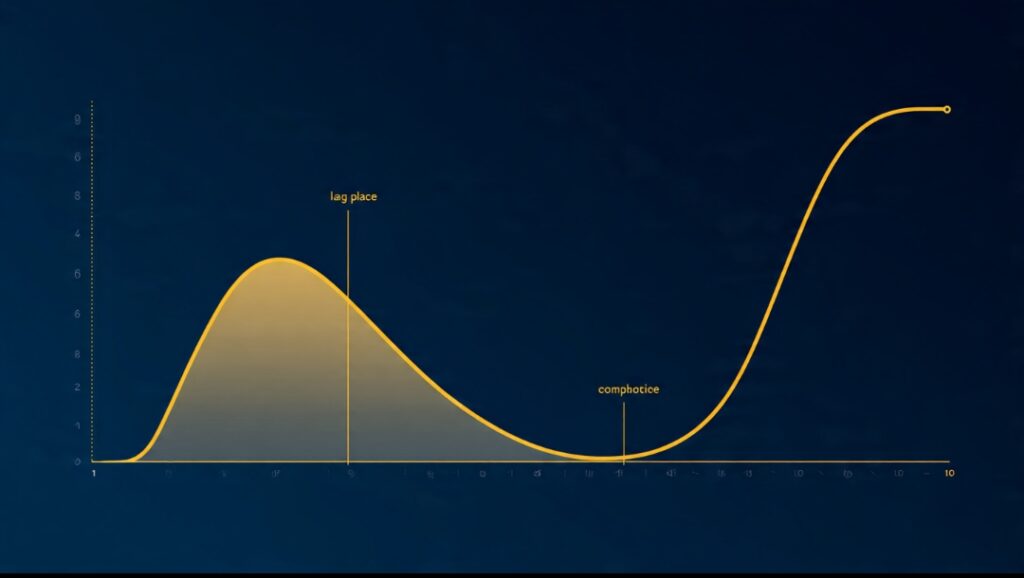
This connects to why compounding feels slow in its early lag phase — the visible results of long-term thinking often don’t show up for a while, which makes it tempting to abandon the approach right before it would have started paying off. Most people who “gave long-term thinking a try” actually just didn’t stay in the lag phase long enough to see it work.
Why Employee Mindset and Owner Mindset Diverge Here
Time horizon is one of the sharpest lines separating a businessman mindset from an employee mindset. An employee is often measured, fairly or not, on monthly or quarterly output — that’s simply the structure of most jobs. A business owner has no such externally imposed short-term scoreboard forcing their attention, which means the temptation to invent one — chasing vanity metrics, obsessing over this week’s numbers — is entirely self-generated, and entirely optional to give in to.
Owners who never break that habit end up running their own business with an employee’s time horizon, reacting to short-term pressure that nobody actually imposed on them except their own anxiety about the present moment.
“Nobody is grading your business quarterly except you. Stop grading yourself on someone else’s clock.”
Building Long-Term Thinking as an Actual Habit
Long-term thinking isn’t a personality trait some people are born with — it’s a habit built through repeated, deliberate practice of pausing before reactive decisions. This is closely tied to the consistency principle of small, repeated actions eventually reshaping something solid — a single drop of water does nothing to a stone, but the same drop repeated with patience eventually wears through it. Long-term thinking works the same way: no single long-term decision looks dramatic in the moment, but the accumulation of consistently choosing the decade over the day is what actually reshapes a business.
A useful practical filter is asking, before any major decision, “will I still think this was the right call in five years, regardless of how this quarter turns out?” If the honest answer is no, that’s usually a sign short-term pressure has quietly taken over the decision, whether or not that’s how it was originally framed.
Long-Term Thinking and Generational Business Building
The clearest proof of this mindset shows up in businesses actually built to last across time, rather than built to be sold or abandoned once the founder gets bored or burned out. Building a business for generational wealth requires treating every decision as one link in a much longer chain, rather than an isolated event measured only against this quarter’s results.
This is also where net worth as a concept becomes a genuinely long-term measurement rather than a short-term scoreboard — real net worth compounds through consistent decisions over years, not through any single quarter’s performance, no matter how impressive that one quarter might look in isolation.
Now It’s Your Move
- Before your next major decision, ask whether you’ll still agree with it in five years, regardless of how this quarter turns out.
- Identify one area where you’re chasing broad appeal instead of building deeper loyalty with a smaller, specific group.
- Notice when you’re grading yourself on a quarterly clock nobody actually imposed on you as a business owner.
- Expect a lag phase before long-term decisions show visible results, and don’t abandon the approach right before it would have paid off.
- Treat consistency as a compounding habit, not a single dramatic decision — small repeated long-term choices reshape a business the way water reshapes stone.
- Review your last quarter’s decisions and honestly separate which were made for the decade versus which were made purely for this month’s number.
- Build at least one system or relationship this month that won’t pay off for years, as a deliberate practice in long-term thinking.