Picture this: grinding away at a dead-end job, clocking in at 9 AM sharp, dreaming of financial freedom while staring at trading charts after hours. One bad trade — panic sell. The position was right. The psychology was wrong. That was the employee mindset operating in a place that requires a completely different mental framework.
Then the switch flipped. Not overnight. Not from reading one book. Through deliberate, uncomfortable, daily work on how I thought about risk, failure, money, and ownership. Everything changed — trading consistency, side income, the relationship with work itself.
This article breaks down exactly what the businessman mindset is, why the employee mindset silently kills the ambitions of talented people, and how to build the mental framework that actually produces results in business and trading.

What Is a Businessman Mindset?
A businessman mindset is not about the suit, the office, or the title. It is about how you process the world — as a place full of opportunities to create value, rather than a system to navigate safely until retirement.
In the context of trading and business, it means treating every position like a calculated business investment rather than a gamble, and treating every failure like data rather than a verdict on your worth.
The businessman mindset starts with seeing every transaction as arbitrage — buy low, sell high, repeat — applied to labor, services, and products alike.
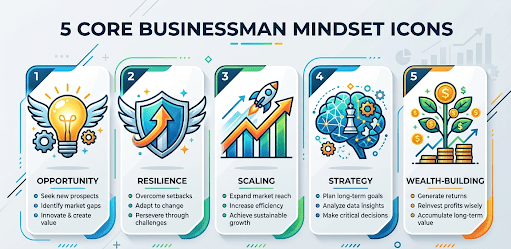
Core Traits of the Businessman Mindset
- Opportunity Hunter: Problems are profit machines to the businessman mindset. Where others see a market crash, they see entry points. Where others see a saturated market, they see a positioning opportunity.
- Risk Calculator: Calculated bets, not blind jumps. The businessman mindset does not avoid risk — it quantifies it, sizes it appropriately, and takes it deliberately. The employee avoids risk. The businessman manages it.
- Owner’s Accountability: No blame game. No “the market was against me” or “my manager didn’t support me.” Your results are yours — the good and the bad. This accountability is uncomfortable and also transformative.
- Long-Term Vision: Building systems and assets, not chasing paychecks. The question is not “how do I earn more this month?” but “what am I building that will work without me?”
- Learning Machine: Failure is curriculum, not condemnation. The pattern is fail, extract the lesson, adjust the system, execute again. Not fail, feel bad, repeat the same mistake emotionally.
As Robert Kiyosaki articulates in Rich Dad Poor Dad: “The rich don’t work for money. They make money work for them.” That single reframe — from earning to building — is the core of the businessman mindset.
The Employee Mindset Trap
There is nothing wrong with employment as a life choice. But the employee mindset — when it leaks into trading, business, and financial decision-making — is a silent killer of potential.
The employee mindset trades time for money with no concept of scale. It seeks approval before acting. It treats failure as something to be avoided rather than navigated. It optimizes for the next paycheck rather than the next decade.
The experience of living in that mindset while trying to trade was this: every loss felt like a personal failure rather than a statistical event in a probabilistic system. Every drawdown produced emotional decisions — closing positions too early, revenge trading, holding losers hoping they would recover. All of it rooted in the same place: a mindset built for security rather than calculated risk.
How the Employee Mindset Holds You Back
- Trades time directly for money — no leverage, no scale, a ceiling that arrives faster than expected
- Seeks external validation before making decisions — waiting for permission that a businessman never needs
- Avoids discomfort that is necessary for growth — and therefore avoids growth itself
- Focused on the next paycheck rather than the next asset — short-term security over long-term wealth
- Treats failure as defeat rather than data — which means lessons are never extracted and mistakes repeat
Businessman vs Employee: The Real Differences
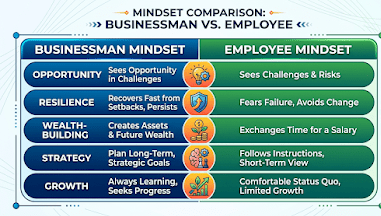
| Area | Businessman Mindset | Employee Mindset |
|---|---|---|
| Risk | Calculated and sized appropriately | Avoided for safety |
| Income | Multiple sources built over time | Single paycheck from single source |
| Failure | Data — extract lesson, adjust, continue | Defeat — evidence of inadequacy |
| Time | Leveraged through systems and teams | Traded directly for income |
| Focus | Value creation and long-term building | Task completion and next paycheck |
| Accountability | Full ownership of outcomes | External circumstances blamed |
The Personal Journey: From Employee to Businessman
In the early trading years, losses felt personal. A stop loss hit was not a statistical event in a probabilistic system — it was evidence that something was fundamentally wrong. That emotional response led to predictable behaviors: revenge trading, holding losing positions hoping for recovery, sizing up after losses to “make it back faster.”

The shift happened through a specific change in how trading records were kept. Treating each trade like a business transaction — with a reason for entry, a defined risk, an expected outcome, and a post-trade review — removed the emotional charge from individual outcomes. A losing trade reviewed calmly as a business expense produced a lesson. The same loss experienced emotionally produced a revenge trade.
Six months of that discipline, applied consistently, produced results that years of undisciplined trading had not. Not because the market changed — but because the psychology changed. The system became consistent because the person executing the system became consistent.
Real talk: the first three months of that transition were genuinely uncomfortable. Sitting with a losing day and not revenge trading. Closing a position at the stop loss even when everything in you wants to hold it. Following rules you wrote when calm, even when in the moment they feel wrong. That discomfort is not a sign of failure. It is the actual work of building a businessman mindset in trading.
How to Build Your Businessman Mindset — Practical Steps
- Audit Your Thinking for One Week: Write down every significant decision you make and classify it honestly — was this decision made from an ownership mentality or from a fear/security mentality? The pattern that emerges tells you exactly where the work needs to happen.
- Reframe Your Goals: Not “earn more money” — that is an employee goal. “Build three income sources that produce $X combined by this time next year” — that is a business goal. The specificity matters because vague goals produce vague actions.
- Deliberately Embrace One Uncomfortable Thing Per Week: Cold outreach to a potential client. A trade you have analyzed correctly but keep avoiding. A conversation you have been postponing. The businessman mindset is built through repeated exposure to chosen discomfort, not through reading about it.
- Build Your Network Intentionally: Find communities of people operating at the level you want to reach. In trading, this means forums and groups where serious traders discuss process and psychology — not signals. In business, it means connecting with people who are building, not just complaining.
- Read and Immediately Apply: Knowledge that is not applied is entertainment, not education. Read one chapter of a mindset or business book, then immediately identify one thing from it you can apply to your actual situation this week. That application creates the neural pathway. Reading alone does not.
What Nobody Tells You About Making This Mindset Shift
Every mindset book tells you to “think like an entrepreneur.” Nobody tells you what that actually feels like in practice when it conflicts with your financial reality.
The shift feels irrational before it feels powerful. When you start making decisions based on long-term building rather than immediate income — staying in a trade you are uncomfortable with because your analysis is sound, or investing time in a skill that will not pay off for six months — it feels genuinely stupid in the moment. Your brain, conditioned by years of employee thinking, screams that you are being reckless. That discomfort is the transition. It does not mean you are wrong.
People around you will misunderstand the change. When you stop complaining about your boss and start talking about building something, some people in your life will react negatively. Not because they want you to fail — but because your change implicitly challenges their own choices. Expect this. Do not argue with it. Let the results respond eventually.
The businessman mindset does not eliminate emotion — it changes your relationship with it. You will still feel fear before a big trade. You will still feel discouragement after a losing streak. The difference is that you no longer act from those emotions automatically. You feel them, acknowledge them, and then execute your system anyway. That gap — between feeling and acting — is built through consistent practice, not through a single decision to “think differently.”
Most people overestimate what they can change in a month and underestimate what they can change in a year. The six-month timeline mentioned above is real. Do not expect a dramatic breakthrough in week two. Expect small shifts that compound. Expect moments of genuine progress followed by regression. Expect the full messy non-linear reality of genuine psychological change — not the clean narrative version that books describe.
The mindset shift is not the destination — it is the vehicle. A businessman mindset does not guarantee results. It creates the conditions under which results become possible. You still need a skill, a system, consistent execution, and enough time in the market or in business to let the compounding work. The mindset just stops you from sabotaging those things before they have a chance to produce outcomes.
Frequently Asked Questions
Q: What is a businessman mindset in simple terms?
It is a way of thinking that takes ownership of outcomes, treats problems as opportunities, builds income rather than just earning it, and processes failure as data rather than defeat. In trading, it means executing a system rather than reacting to emotions.
Q: Can anyone develop a businessman mindset?
Yes — but it requires deliberate, consistent practice over months, not a one-time decision. Start with one habit: reviewing your decisions weekly with complete honesty about what drove them. That audit alone begins to shift the pattern.
Q: How does the entrepreneur mindset differ from the employee mindset?
At the core: ownership versus security. Entrepreneurs create and own value. Employees execute tasks within systems others have built. Neither is morally superior — but they produce fundamentally different outcomes when applied to business and trading.
Q: What is the biggest employee mindset trap for traders specifically?
Treating losses as personal failures rather than statistical events. This produces the worst trading behaviors — revenge trading, moving stop losses, sizing up after losses — all rooted in the same place: an emotional relationship with outcomes that should be managed as data.
Q: How long does it realistically take to shift to a businessman mindset?
Three to six months of daily deliberate practice to see meaningful change. Not because the ideas are complex — they are not. Because rewiring ingrained psychological patterns requires consistent repetition over time. Anyone who promises a faster timeline is selling something.
Q: Is mindset really 80% of trading success?
The specific percentage varies by trader and study, but the consensus in trading psychology — documented extensively by researchers including Van Tharp — is that psychology accounts for the majority of the gap between traders who are profitable and those who are not. Technical knowledge is necessary but insufficient. Most people who blow accounts do not lack technical knowledge. They lack psychological discipline.

Final Thought
The businessman mindset is not a personality type you either have or do not have. It is a set of mental habits — practiced consistently, built deliberately, tested in real conditions over real time.
If you are stuck in employee mode right now, you have the map. Pick one thing from this article and act on it today — not tomorrow, not after you have read more about it. The mindset is built in action, not in preparation for action.
Let’s build something real.
About the Author
Shurah Beel Hamid is a business enthusiast, active trader, and content creator who transformed his life by training his brain from an electrician’s mindset to an entrepreneur’s mindset. His expertise lies in practical brain training for entrepreneurship, trading psychology, compounding strategies, and elite mindset development. He shares his raw, unfiltered journey — from suicidal thoughts to strategic patience, from blowing trading accounts to consistent profitability — to provide actionable insights for those tired of theoretical advice and ready for real change. His writing combines hard-won experience, neuroscience-backed techniques, and relentless optimism.
Disclaimer: This article is for educational purposes only. Trading involves significant risk of loss. Past performance does not indicate future results. Always conduct your own research before making financial decisions.