If you are struggling to make your mark in the digital world, LinkedIn Lead Generation is one of the highest-demand, highest-value skills you can build in 2026 — and it requires no technical degree, no expensive setup, and no prior business experience to start.
Lead generation bridges the gap between struggling freelancers and professional entrepreneurs. It is not just a service — it is the lifeblood of every B2B business on the planet. Companies cannot grow without a pipeline of qualified prospects. The people who can build that pipeline reliably and accurately are paid very well for doing it.
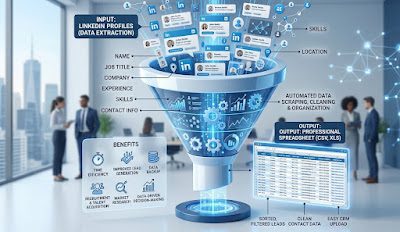
Even in the age of AI, the human element remains irreplaceable in lead generation. High-level executives do not just want raw data — they want accuracy, accountability, and precision. They want someone who understands the difference between a valid contact and a liability, and who takes professional responsibility for the quality of what they deliver. That is something only a dedicated professional can provide.
What Is LinkedIn Lead Generation and Why Is It So Valuable?
LinkedIn lead generation is the process of identifying and collecting verified contact information for potential business clients — specifically decision-makers at companies that are likely to need a particular product or service.
The output is typically a clean, organized spreadsheet containing names, verified business emails, phone numbers, job titles, company information, and LinkedIn profile URLs. This data powers email outreach campaigns, cold calling, and sales prospecting for businesses of all sizes.
According to HubSpot’s marketing research, 61% of B2B marketers say generating high-quality leads is their single biggest challenge. The demand for skilled professionals who can solve this problem is enormous and growing — and in 2026, LinkedIn remains the most powerful platform in the world for B2B prospecting.
Step-by-Step Roadmap to LinkedIn Lead Generation
Step 1: Identify Your Ideal Customer Profile
Before you extract a single contact, you need to understand who your client is trying to reach. This is called the Ideal Customer Profile — or ICP — and getting it right determines whether the data you deliver is valuable or worthless.
Do not chase giants like Google or Microsoft. Their contact information is already everywhere, and decision-makers at these companies are so inundated with outreach that the response rates are negligible. Instead, target mid-sized companies — typically those with 50 to 500 employees — that have real sales needs and real budget but are not yet overwhelmed with enterprise-level outreach.
Look specifically for decision-makers: CEOs, Founders, Sales Directors, Marketing Managers, and Head of Business Development. These are the people with the authority to say yes to a vendor relationship. Contact information for a junior employee at the same company has almost no value by comparison.
![Ideal Customer Profile for LinkedIn lead generation — targeting mid-sized companies and decision makers]](https://datapips.net/wp-content/uploads/2026/06/clean-infographic-youtube-thumbnail-169-for-ideal--1024x576.jpeg)
Step 2: The Power Tool — Apollo.io
Install the Apollo.io Chrome Extension. This is the industry standard tool for extracting verified contact information directly from LinkedIn profiles. It allows you to find business emails and phone numbers with speed and accuracy that manual research cannot match.
Apollo.io’s free tier provides a meaningful number of monthly credits to get started. As your client work grows, the paid tiers unlock higher volumes. The investment pays for itself many times over in billable hours saved.
How to use it effectively: navigate to a LinkedIn profile of a target decision-maker, open the Apollo.io extension, and extract the verified contact information. The tool cross-references multiple data sources to provide accuracy scores for each email — which brings us to the next critical step.
Step 3: Data Extraction and Verification
Extract the data — but never deliver it raw. Raw, unverified data is not a professional deliverable. It is a liability risk for your client.
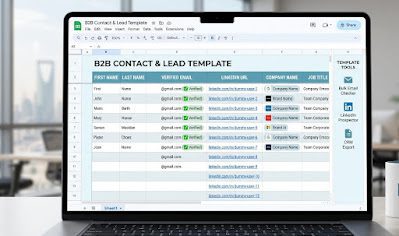
The Golden Rule of Lead Generation: Always verify emails before delivery using dedicated verification tools like ZeroBounce or NeverBounce. A bounced email is a failed delivery — and if your client sends a campaign to a list with a high bounce rate, it damages their domain reputation and can get their email domain blacklisted. That is a catastrophic outcome that will destroy your professional relationship immediately.
Verification services like ZeroBounce assign a validity status to each email address — valid, invalid, catch-all, or unknown. Deliver only the valid contacts. Flag the catch-all contacts separately with a note explaining what they are. Remove the invalids entirely. This level of professional care is what separates a commodity data provider from a trusted lead generation specialist.
Step 4: Creating a Professional Deliverable
Your final deliverable should be a clean, professionally formatted spreadsheet. Every serious client expects consistent column structure that makes their CRM import effortless. At minimum, include:
- First Name and Last Name — separated into individual columns, never combined
- Verified Business Email
- Phone Number — if available and verified
- Company Name and Website URL
- LinkedIn Profile URL — for the contact specifically
- Job Title
- Industry and Company Size — helpful for segmentation
- Email Verification Status — so the client knows what they are working with
Formatting matters as much as accuracy. A clean, consistently structured spreadsheet that imports directly into Salesforce, HubSpot, or any other CRM without manual cleaning is worth significantly more than the same data in a messy, inconsistent format. Professional presentation is part of the deliverable.
The Market Reality in 2026

There are currently over 15,000 active job postings on LinkedIn specifically for “Lead Generation” roles. The demand is not a niche trend — it is a structural feature of the B2B economy. Every company with a sales function needs a pipeline. Pipelines need leads. Leads need to be found, verified, and organized.
The freelancers who are succeeding in this space are not the ones with the most impressive tools — they are the ones with the most consistent quality and the most professional presentation. Apply consistently across platforms. Showcase a high-quality sample of your work in your portfolio. Target dozens of opportunities rather than waiting for the perfect one.
How to Position Yourself as a Lead Generation Specialist
Most people who offer lead generation services on Upwork or Fiverr provide a generic, undifferentiated service. They extract data, dump it in a spreadsheet, and deliver it without verification or professional presentation. The bar for standing out is not as high as the competition volume suggests.
Here is what actually differentiates a specialist from a commodity provider:
- Niche expertise: “I specialize in lead generation for SaaS companies targeting marketing directors in the US and UK” is a far more compelling positioning than “I do lead generation.” Niche specialists charge 2 to 3 times more for the same volume of work.
- Verification as standard: Build ZeroBounce or NeverBounce verification into your standard process and advertise it explicitly. Most clients have been burned by low-quality unverified lists. Being the freelancer who leads with verification quality immediately sets you apart.
- Professional deliverable format: Offer CRM-ready formatting as a default. Name it explicitly in your service description. Clients who use Salesforce, HubSpot, or Pipedrive will immediately recognize the value.
- Turnaround time and communication: Respond quickly. Deliver on time. Update clients proactively on progress. In a field where many freelancers communicate poorly, basic professional communication is a significant competitive advantage.
A Philosophy of Resilience
Building any new skill or business takes time. There will be periods where proposals go unanswered, where clients ask for revisions, where the work feels more difficult than the income justifies.
“Maturity does not come with age; it comes through surviving the hardest phases of life. When a man carries the weight of responsibility on his shoulders and turns his losses into his strength, he becomes truly respected in the eyes of the world.”
True business often starts when your pockets are empty. That is when you have the most time to think, plan, and build. Let the critics talk. Your silence should be your focus. Your success should be your noise. Every closed door is a test to see whether you are serious enough to open the next one.
Frequently Asked Questions
Q: Do I need technical skills to start LinkedIn lead generation?
No. The core tools — LinkedIn, Apollo.io, Google Sheets, and an email verification service — require no coding or technical background. If you can navigate a website and organize a spreadsheet, you have the technical foundation to start. The professional skill is in the quality, verification, and presentation of the data — not in the technology itself.
Q: Is Apollo.io free to use?
Apollo.io offers a free tier with a limited number of monthly credits — sufficient to get started and build your first portfolio samples. Paid tiers unlock higher volumes. Most beginning lead generation freelancers start on the free tier and upgrade as client revenue justifies the cost.
Q: How much can I charge for lead generation services?
Rates vary significantly by quality, niche, and volume. Entry-level lead generation on Fiverr starts at $5 to $10 per 50 to 100 contacts. Professional verified lead generation for B2B niches on LinkedIn and Upwork commands $50 to $200+ per 100 verified, CRM-ready contacts. The premium comes from verification quality, niche expertise, and professional presentation — not from the volume of data extracted.
Q: What is the difference between valid and catch-all emails?
A valid email has been confirmed to exist and accept messages. A catch-all email belongs to a domain that accepts all emails regardless of whether the specific address exists — meaning verification services cannot confirm whether it is genuinely deliverable. Valid emails are safe to include. Catch-all emails should be flagged separately so the client can make an informed decision about using them.
Q: How do I build a portfolio without clients?
Create sample lead lists for fictional or real companies in your target niche — clearly labeled as samples. Demonstrate your full process: ICP definition, LinkedIn sourcing, Apollo.io extraction, verification, and clean spreadsheet formatting. A professional-looking sample of 25 to 50 contacts is sufficient to demonstrate your capability to potential clients.
Q: Is lead generation legal in terms of data privacy?
LinkedIn lead generation using publicly available professional profile information for legitimate B2B outreach is generally acceptable under most jurisdictions. However, data privacy laws including GDPR in Europe impose obligations on how contact data is stored, used, and disclosed. Always advise clients to consult their legal counsel regarding compliance obligations in their specific markets. As a data provider, your responsibility is accuracy and professional presentation — not legal compliance for your client’s outreach campaigns.
1. Install Apollo.io Chrome extension — free tier is sufficient to start.
2. Define your ICP — mid-sized company, specific decision-maker title, specific industry.
3. Create a sample lead list of 25-50 verified contacts — label it clearly as a portfolio sample.
4. Set up a ZeroBounce or NeverBounce account for email verification.
5. Create profiles on Upwork and Fiverr with clear niche positioning and your sample as portfolio proof.
6. Apply consistently — target dozens of opportunities, not one at a time.
Conclusion
Lead generation is more than just selling data. It is connecting businesses to their future clients — and doing it with enough accuracy and professionalism that the client can act on what you deliver with confidence.
Master this skill. Maintain your professional integrity. Specialize rather than generalize. Verify everything. Present professionally. And remember that every closed door in this journey is simply a test of whether you are serious enough to keep going.
The doors of opportunity will open. They always do for people who refuse to stop knocking.
About the Author
Shurah Beel Hamid is a business enthusiast, active trader, and content creator who transformed his life by training his brain from an electrician’s mindset to an entrepreneur’s mindset. His expertise lies in practical brain training for entrepreneurship, trading psychology, compounding strategies, and elite mindset development. He shares his raw, unfiltered journey — from suicidal thoughts to strategic patience, from blowing trading accounts to consistent profitability — to provide actionable insights for those tired of theoretical advice and ready for real change. His writing combines hard-won experience, neuroscience-backed techniques, and relentless optimism.
Disclaimer: This article is for educational purposes only. Lead generation practices must comply with applicable data privacy laws in your jurisdiction.