Freelancing is not just a side hustle anymore — it is a full-scale digital business. However, many beginners jump in without a plan and quit within a month. They get frustrated by slow results, confused by too many options, and discouraged by competition that seems impossible to break into.
If you want to build a sustainable freelancing career, you need more than just a laptop and a Fiverr account. You need a strategy — a clear roadmap that takes you from zero to your first client and beyond.
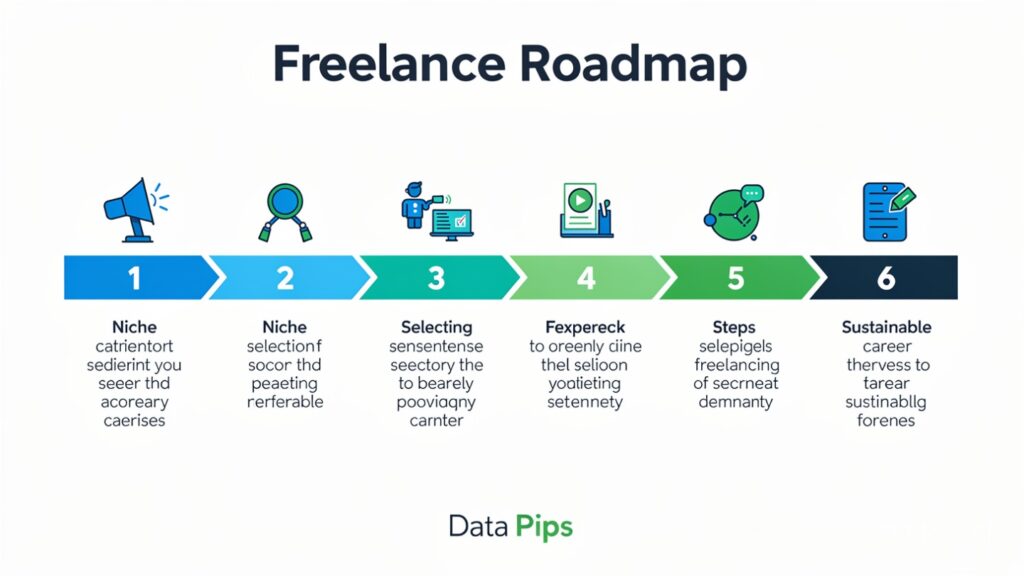
1. The Power of Choice: Selecting Your Niche
Before you sign up for any platform, you must decide what you are going to offer. Freelancing is a broad ocean — and trying to swim everywhere at once means you drown everywhere at once.
Are you an article writer, a video editor, a graphic designer, a social media manager, or an AI tools specialist? Pick one. Then pick a specific type of client within that skill. “Video editor” is a category. “Video editor for YouTube creators in the finance niche” is a niche — and niches get paid significantly more than categories.

Choosing a niche allows you to become an expert rather than a generalist. Experts charge more. Experts get referred. Experts build reputations that compound over time. Generalists compete on price and lose.
According to LinkedIn’s professional research, specialists earn on average 40% more than generalists across every major freelancing category. The market is not saturated for specialists. It is only saturated for people offering undifferentiated, generic services with no clear positioning.
2. Find a Mentor or Coach
The biggest mistake beginners make is trying to learn everything alone through random YouTube videos. YouTube is genuinely useful — but it is unstructured, inconsistent, and cannot answer your specific questions about your specific situation.
A mentor or coach provides something YouTube cannot: a shortcut built on someone else’s real experience.
- Direct Guidance: A mentor tells you specifically what works in your niche and what leads to failure — saving you months of trial and error.
- Specific Q&A: You can ask about your exact struggles rather than hoping a YouTube video happens to cover your precise problem.
- Real-World Scenarios: A good mentor or coach walks you through actual situations you will face — difficult clients, pricing negotiations, scope creep — before you encounter them unprepared.
You do not need to pay for expensive coaching to get this. Many experienced freelancers share knowledge generously on LinkedIn and in niche communities. Engage with their content. Ask thoughtful questions. Build genuine relationships. The mentorship often follows naturally.
3. Mastering Your Skill
Choosing a niche is step one. Developing genuine expertise in that niche is what makes clients choose you and stay with you.

The standard for “good enough to charge” is lower than most beginners think. You do not need to be the best in the world. You need to be better than what the client is currently doing themselves — which is usually nothing, or something very rough.
For Video Editors: Master transitions, sound design, pacing, and color correction. Understand what makes a video retain viewers versus what makes them click away. Study the top creators in your target niche and reverse-engineer what their editing does for engagement.
For Writers: Understand SEO, readability, and audience psychology. Learn how to write a headline that gets clicked, an introduction that keeps people reading, and a conclusion that drives action. These are learnable skills — not talents.
For Designers: Master the principles of visual hierarchy, typography, and brand consistency. Understand why certain designs convert and others do not. Study successful brands in your target niche and learn what their visual identity communicates.
Platforms like Coursera and YouTube provide sufficient learning resources for any of these skills at no cost. The question is never whether the resources are available — it is whether you will use them consistently.
4. Building Your Digital Presence
Do not wait for clients to find you on Fiverr or Upwork alone. Be proactive about building a presence that brings clients to you across multiple channels.
- LinkedIn: Create a professional profile and post consistently. Use client-focused language in your headline — not “I am a video editor” but “I help YouTube creators grow their channels through professional editing that retains viewers.” Post content that demonstrates your expertise once or twice per week.
- Facebook and Social Media: Share your portfolio work and genuine experiences. Document your journey. People follow and hire creators who feel real, not polished corporate entities.
- Networking with Other Freelancers: Connect with established freelancers in your skill area. When a busy editor has more work than they can handle, they refer to people they know and trust. Showing up consistently in the right communities puts you on that referral list.
The goal of your digital presence is simple: when someone who needs your skill encounters your profile or your content, they should immediately think “this person knows what they are doing.” Everything you post is either building that impression or diluting it.
Before you send a single pitch, focus on building a portfolio with zero clients — clients hire pattern recognition, not client logos.
5. The Test Drive: Demos and Trials
When a serious client contacts you, they will often request a demo or test project. This is not an inconvenience — it is your best opportunity to convert interest into a long-term relationship.
If you can complete a demo exactly as the client described — on time, to their specifications, with professional quality — you have secured a client who already knows what you can do. That trust is worth far more than any profile rating.
- Scope the demo clearly: Agree on exactly what the demo will include before starting. Unlimited revisions on a demo trains clients to expect unlimited revisions on paid work.
- Pricing model decision: After a successful demo, decide whether the ongoing relationship works better on a monthly retainer or a per-project basis. Retainers provide income predictability. Per-project work provides flexibility. Both are valid — the choice depends on the client’s needs and your own cash flow situation.
6. The Golden Rule: Consistency and Patience

Freelancing is not a get-rich-quick scheme. You might go one or two months without a single paid order. This is not failure — it is the normal early phase of building any business. The people who succeed are almost always the people who simply did not quit during this phase.
- Stay employed while you build: Do not quit your day job until your freelancing income is stable enough to cover your essential expenses for at least 3 consecutive months. One good month is not stability. Three consecutive good months is the beginning of stability.
- Manage the feast and famine cycle: One week you may have three orders. The next week, none. This is normal. Build a financial buffer of at least 2 to 3 months of expenses so that slow periods do not create panic decisions.
- Track your inputs, not just your outcomes: During slow periods, focus on what you can control — proposals sent, skills practiced, content posted, connections made. The outcomes lag behind the inputs by weeks or months. Keep doing the inputs.
As Bain and Company’s research on service businesses consistently shows, the compounding value of repeat clients and referrals only becomes visible after 6 to 12 months of consistent service delivery. The freelancers who survive to month 12 almost always succeed. Most quit before month 3.
7. Why Human Freelancers Are More Valuable Than Ever in 2026
Despite — and in many ways because of — the rise of AI, skilled human freelancers are commanding higher rates and more demand in 2026 than at any previous point.
- Google’s content quality standards: Google’s helpful content updates have systematically penalized AI-generated content that lacks genuine expertise, experience, and original insight. Human-written content that demonstrates real knowledge ranks better. Clients who depend on SEO increasingly need human writers who can produce content that passes Google’s quality standards.
- YouTube’s engagement algorithm: High-quality, human-edited videos with genuine personality, pacing, and emotional intelligence consistently outperform AI-assembled content on watch time and engagement metrics. Human editors who understand story structure and audience psychology are increasingly valuable to creators.
- Client trust and brand voice: AI can produce output. It cannot understand a brand’s specific voice, a founder’s authentic personality, or the subtle emotional tone that makes content feel genuine rather than generated. Clients who understand this — and most serious clients do — will always pay a premium for humans who can deliver what AI cannot.
The freelancers who thrive in the AI era are not those who ignore AI — they are those who use AI as a productivity tool while applying uniquely human judgment, creativity, and relationship skills that AI cannot replicate.
Frequently Asked Questions
Q: How do I choose between two or three skills I am good at?
Start with the one that has the highest market demand relative to your current skill level — not necessarily the one you enjoy most. Once you have income and momentum, you can develop adjacent skills. The worst choice is trying to offer all three simultaneously from the beginning.
Q: What if there is no mentor in my area?
Geography is not a barrier. LinkedIn, Twitter, and niche online communities have experienced freelancers who share knowledge publicly. Engage consistently with their content. Send thoughtful messages. Many successful freelancers actively want to help beginners — they simply need to know you exist and that you are serious.
Q: How long should I practice a skill before offering it to clients?
Until you can produce work that is better than what the client is currently doing themselves. For most skills, this threshold is reachable in 4 to 8 weeks of focused daily practice. Do not wait for perfection — it will never arrive. Wait for “genuinely useful” and then start.
Q: Should I do free demos for potential clients?
A brief, scoped demo on a specific agreed task is reasonable when building your initial portfolio and reputation. Unlimited free work is not. Define exactly what the demo includes before starting. If a client is not willing to pay anything after a successful demo, they are likely not a serious long-term client worth pursuing.
Q: How do I handle the income inconsistency of freelancing?
Build a financial buffer before making freelancing your primary income. Three months of expenses in savings gives you the psychological freedom to make good decisions during slow periods rather than desperate ones. Freelancers who are financially panicked consistently undercharge, overcommit, and take on difficult clients — all of which make the situation worse.
Q: Is freelancing still worth starting in 2026 with so much AI competition?
Yes — more so than ever for skilled practitioners. AI has lowered the barrier for producing average work. It has raised the premium for genuinely excellent human work. If you develop real expertise and genuine client relationships, AI is not your competition. It is your productivity tool.
Final Thought
Do not listen to the critics who say the market is saturated. The market is saturated with average, undifferentiated, underprepared freelancers who quit after 30 days. It is not saturated with skilled, consistent, strategically positioned professionals who treat their freelancing work like the real business it is.
If you have the skill and the consistency, there is room for you. There has always been room for people who are genuinely good at what they do and reliable about delivering it.
Start today. Find a mentor. Build your legacy.
About the Author
Shurah Beel Hamid is a business enthusiast, active trader, and content creator who transformed his life by training his brain from an electrician’s mindset to an entrepreneur’s mindset. His expertise lies in practical brain training for entrepreneurship, trading psychology, compounding strategies, and elite mindset development. He shares his raw, unfiltered journey — from suicidal thoughts to strategic patience, from blowing trading accounts to consistent profitability — to provide actionable insights for those tired of theoretical advice and ready for real change. His writing combines hard-won experience, neuroscience-backed techniques, and relentless optimism.
Disclaimer: This article is for educational purposes only. Freelancing results depend on individual effort, skill development, and market conditions.