Look, here’s a belief that quietly destroys more entrepreneurs than any recession ever could: the idea that failure is the opposite of success. That you either win or you lose. That a failed business means you’re a failed businessman.
It’s wrong. Dangerously wrong. And until you rewire this single belief, every setback will feel like a verdict instead of a lesson.
The truth is harder and more useful: failure in business is not the opposite of success — it’s part of the path to it. The opposite of success isn’t failure. It’s quitting. It’s never starting. It’s staying so afraid of losing that you never give yourself a real chance to win.
This article is about reframing failure honestly — not with motivational fluff, but with the brutal, practical truth of what failure actually is, what it teaches, and how the people who win treat it completely differently than the people who quit.
- Why failure and success are not opposites — and what the real opposite of success is
- How to extract the actual lesson from a failure instead of just the pain
- The mindset difference between people who recover from failure and those who quit
- The brutal truths about business failure nobody prepares you for
The Belief That Holds Everyone Back
Most people are raised on a simple, broken equation: success is good, failure is bad, and the two are opposites on a line. Win or lose. Pass or fail. Up or down.
This works fine for a school exam. It’s catastrophic for business.
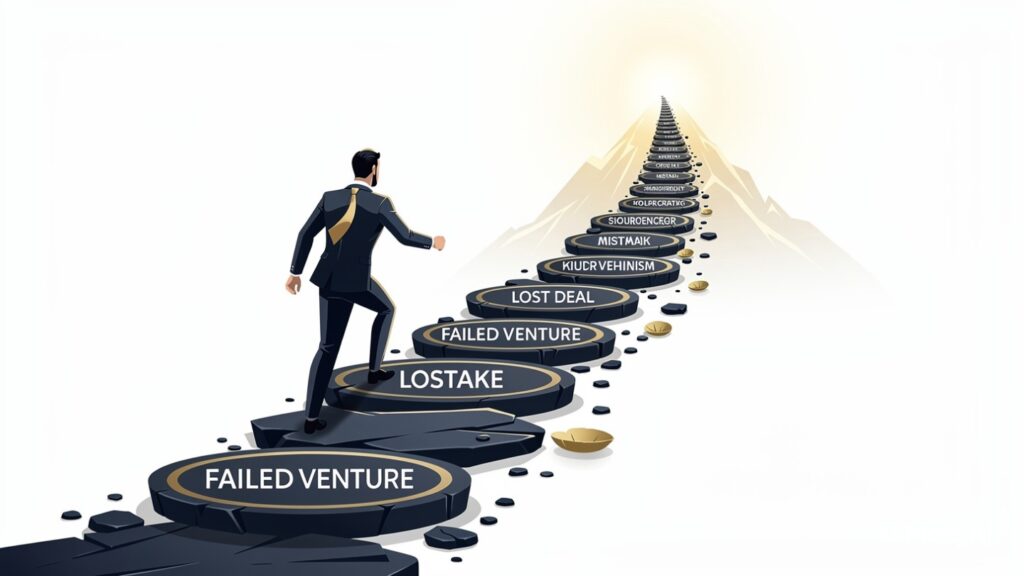
Because in business, the path to any meaningful success runs directly through failure. Not around it. Through it. Every experienced entrepreneur you admire has a graveyard of failed ideas, dead products, lost money, and embarrassing mistakes behind them. You just don’t see it, because the world only shows you the final win, never the pile of failures it was built on.
What the Data Actually Says About Business Failure
Let’s ground this in reality, not motivation. Business failure isn’t rare or shameful — it’s statistically normal.
According to data from the U.S. Bureau of Labor Statistics on business survival, roughly 20% of new businesses fail within their first year, and about half don’t survive past their fifth year. Sit with that. Half. This isn’t a fringe outcome that happens to “bad” entrepreneurs — it’s the baseline reality of building anything.
As Investopedia’s analysis of why startups fail outlines, the most common causes aren’t bad luck — they’re things like running out of cash, building something nobody wants, and poor planning. Which means most failures are learnable. They’re not random punishment from the universe. They’re feedback about what didn’t work.
If half of all businesses fail and yet new successful businesses are created constantly, then the math tells you something important: the successful founders aren’t the ones who never failed. They’re the ones who failed and kept going.
Failure Is Information, Not a Verdict
Here’s the reframe that changes everything. A failure is not a judgment on your worth. It’s data about what doesn’t work.
When a product flops, the market just told you something specific and valuable — this offer, at this price, to these people, in this way, didn’t work. That’s not an insult. That’s a research result you’d have paid a consultant thousands to discover. You got it for the price of trying.
The entrepreneur who treats failure as information asks: “What exactly went wrong, and what does that teach me?” The one who treats it as a verdict asks: “What’s wrong with me?” The first question leads to the next attempt. The second question leads to quitting.
There was a period when our founder was running multiple businesses at the same time — footwear, cosmetics, a family business, and a personal venture, all at once. It felt like ambition. It was actually a slow-motion failure.
The energy split across four directions meant near-zero progress in any of them. Nothing failed dramatically — it failed quietly, by stagnation. The lesson only became clear after the fact: the failure wasn’t bad luck or a bad market. It was a structural mistake — divided focus.
The moment focus narrowed to ONE direction, results started coming. That “failure” of running four businesses taught the single most valuable principle: 80% of energy on the primary thing, 20% on everything else. The failure wasn’t the opposite of the later success — it was the direct cause of it.
The Two Types of Failure — And Only One Is Useful
Not all failure is created equal. This distinction matters enormously, and almost nobody makes it.
| Aspect | Intelligent Failure | Careless Failure |
|---|---|---|
| Cause | A calculated risk that didn’t work out | Ignoring obvious warnings or repeating known mistakes |
| Lesson | Produces genuine new knowledge | Teaches nothing you didn’t already know |
| Value | An investment in future success | A pure, avoidable loss |
| Repeat? | No — you learned something new | Often yes — because no lesson was extracted |
Research featured in Harvard Business Review on learning from failure makes a similar distinction — that the most valuable failures are the “intelligent” ones, where a thoughtful risk in new territory produces knowledge you couldn’t have gained any other way. The goal isn’t to avoid all failure. It’s to make sure your failures are the intelligent kind that teach you something — and to stop repeating the careless kind that just costs you.
How to Take a Calculated Risk Instead of a Reckless One
If failure is part of the path, the skill isn’t avoiding it — it’s making sure your failures don’t destroy you. That’s the entire purpose of calculated risk. You take chances in a way where the downside can’t wipe you out, but the upside can change your life.
Here’s a simple framework for testing any risk before you take it:
- What’s the absolute worst that can happen? Get specific. An exact figure, an exact outcome. Vague fear is paralyzing; a defined worst-case is manageable.
- Can I survive that outcome? If the worst case doesn’t end you — if you’d still have a roof, food, and the ability to try again — the risk is probably worth taking.
- What’s the upside if it works? Weigh the survivable downside against the potential gain.
- How can I reduce the downside without killing the upside? This is where smart entrepreneurs live — shrinking the risk while keeping the reward intact.
This is exactly the kind of thinking we broke down in depth in our guide on how businessmen handle risk through calculated decisions. When your failures are survivable by design, failure stops being terrifying — it becomes just another iteration on the path.
Why Fear of Failure Is More Expensive Than Failure Itself
Here’s something most people never calculate: the cost of not trying.
When you fail at a business, the cost is visible — lost money, lost time, bruised ego. Painful, but countable, and usually recoverable. But the cost of never trying because you’re afraid to fail? That’s invisible, and it’s far larger. It’s every business you never started, every opportunity you watched someone else take, every year you stayed small because you were protecting yourself from a loss that wouldn’t have killed you anyway.
Fear of failure feels like safety. It’s actually the most expensive choice you can make — you just never get the bill in a form you can see. We explored this fear directly in our piece on how to start a business and overcome the fear factor, because this single emotion stops more potential entrepreneurs than any real obstacle ever does.
The Comeback Is the Real Story
Nobody respects the person who never fell. They respect the person who fell, got up, and came back stronger. The comeback is the entire point — and it’s only available to people who failed first.
Every comeback follows a rough pattern: the failure happens, the pain is real, but then the lesson gets extracted, the approach gets adjusted, and the next attempt is smarter than the last. The people who never come back are the ones who skip the middle step — they feel the pain but never extract the lesson, so they either quit entirely or repeat the same failure.
We told a full version of this arc in our business failure comeback story, and the core truth in it applies to everyone: your comeback is built from the exact materials your failure handed you. The failure isn’t the enemy of the comeback. It’s the raw material for it.

What Nobody Tells You About Failure in Business
Now the honest part — the truths that the motivational posters and “fail fast” slogans conveniently leave out.
“Failure is a lesson” only if you actually extract the lesson — otherwise it’s just loss. The cult of failure has gone too far in some circles, romanticizing it as automatically valuable. It’s not. A failure you don’t analyze teaches you nothing and costs you everything. The value isn’t in the failing — it’s in the brutal, honest post-mortem afterward. Sit down and answer specifically: what exactly went wrong, what was in my control, what would I do differently? Skip that, and you didn’t “learn from failure” — you just lost.
Failing the same way twice isn’t a lesson — it’s a pattern, and patterns point at you. The first time you fail at something, it’s the market or the circumstances teaching you. The second time you fail the same way, the common factor is no longer the circumstances — it’s you. There’s no shame in an intelligent first failure. But repeating a known mistake means you didn’t do the honest work of extracting the lesson. Guard ferociously against the failures you’ve already had once.
The emotional damage of failure is usually worse than the financial damage — and it’s the part that makes people quit. Most people can recover the money. What stops them is the hit to identity — the voice that says “maybe I’m just not cut out for this.” That voice is the real danger, far more than any lost capital. Your business failed. You didn’t fail. Separating your self-worth from your business results isn’t soft advice — it’s the specific psychological skill that determines whether you come back or quit. We dug into this exact battle in our piece on the pain of discipline versus the pain of regret.
The people who mock your failure have usually never risked anything. When you fail publicly, the loudest critics are almost always people who never put themselves on the line. It’s easy to mock from the sidelines. Their opinion is worthless precisely because they’ve never been in the arena. The person actually trying and failing is doing something the critic is too afraid to attempt. Never take feedback on courage from someone who has none.
Survivable failure is a competitive advantage your competitors are too scared to use. Here’s the edge nobody talks about: most people are so terrified of failure that they never take the calculated risks that lead to outsized success. If you can train yourself to take intelligent, survivable risks while everyone around you is frozen by fear, you’ll capture opportunities they’re too scared to touch. Your willingness to fail intelligently — when structured so it can’t destroy you — is itself a genuine competitive advantage.
Frequently Asked Questions
Is failure really necessary for success in business?
For most people, yes — not because failure is magical, but because business involves uncertainty that you can only navigate through trial, error, and adjustment. The data shows roughly half of businesses fail within five years, meaning successful founders are typically those who failed and kept iterating, not those who never failed at all. Failure is how you learn what the market actually wants.
What’s the difference between good failure and bad failure?
Intelligent failure comes from a calculated risk in new territory and produces genuine knowledge you couldn’t have gained otherwise. Careless failure comes from ignoring obvious warnings or repeating known mistakes, and teaches you nothing new. The goal isn’t to avoid all failure — it’s to ensure your failures are the intelligent kind, while eliminating the careless, repeatable kind.
How do I recover emotionally from a business failure?
The most important step is separating your self-worth from your business result — your business failed, but you as a person did not. Extract the specific lesson through an honest post-mortem, which turns vague shame into useful knowledge. Then focus forward on the next, smarter attempt. The emotional damage is usually worse than the financial damage, so protecting your identity is critical.
How can I take risks without destroying myself financially?
Use calculated risk: define the absolute worst-case outcome in specific terms, confirm you could survive it, weigh it against the potential upside, and find ways to reduce the downside without killing the upside. When your failures are survivable by design, you can take the chances that lead to growth without the risk of being wiped out.
Why do so many businesses fail in the first few years?
The most common causes are running out of cash, building something the market doesn’t actually want, and poor planning — not bad luck. This is actually encouraging, because it means most failures are learnable and preventable. Understanding the common failure patterns lets you guard against them rather than repeating them.
Should I be afraid of failing in business?
You should respect failure enough to take only survivable risks, but fearing it to the point of inaction is far more costly. The invisible cost of never trying — every opportunity missed because of fear — is usually far greater than the visible cost of a survivable failure. Fear of failure feels safe but is often the most expensive choice you can make.
1. Take your most recent failure and write an honest post-mortem: what exactly went wrong, what was in your control, what you’d do differently.
2. Label each of your past failures as “intelligent” (taught you something new) or “careless” (a repeat or ignored warning) — and commit to never repeating the careless ones.
3. Before your next risk, run the 4 questions: worst case, can I survive it, what’s the upside, how do I shrink the downside.
4. Separate your identity from your results — write down “My business failed; I am not a failure” and mean it.
5. Identify one calculated, survivable risk you’ve been avoiding out of fear — and take the first small step toward it this week.
Final Word
Here’s the truth that ties it all together. Failure was never the opposite of success. It’s the tuition you pay for it — and the only people who never pay it are the ones who never enroll.
Every entrepreneur worth respecting has a trail of failures behind them that you’ll never see, because the world only celebrates the final result. Don’t compare your messy middle to someone else’s polished ending. Their ending was built on a pile of the exact kind of failures you’re afraid of right now.
Fail intelligently. Make your failures survivable. Extract every lesson. And never, ever confuse a failed venture with a failed life. The business can fail a hundred times. You only truly fail the day you decide to stop getting back up.
Disclaimer: This article is for educational and informational purposes only and does not constitute financial, business, or investment advice. Business outcomes depend on many individual factors, and all ventures carry risk. Make decisions based on your own circumstances and consult qualified professionals where appropriate.