Look, here’s a question that haunts more high earners than anyone admits: your income has doubled over the last few years — maybe even tripled — so why is your bank balance basically standing still?
You’re making more than you ever dreamed of back when you started. And yet, somehow, you’re not saving more. The money comes in bigger now, but it leaves just as fast. If this is hitting a nerve, you’re not broken and you’re not bad with money. You’re caught in one of the most predictable financial traps that exists: lifestyle inflation.
This single force has quietly destroyed more wealth-building potential than any market crash, any bad investment, or any recession. And almost nobody talks about it honestly — because the entire economy is built on you never noticing it.
- Why earning more money rarely translates into saving more — and the psychology behind it
- How lifestyle inflation silently consumes every raise before you even feel richer
- The exact difference between the saver, the spender, and the investor mindset
- A practical system to capture your raises instead of losing them to upgraded spending

What Lifestyle Inflation Actually Is
Let’s define it clearly, because the name sounds harmless and the reality is anything but.
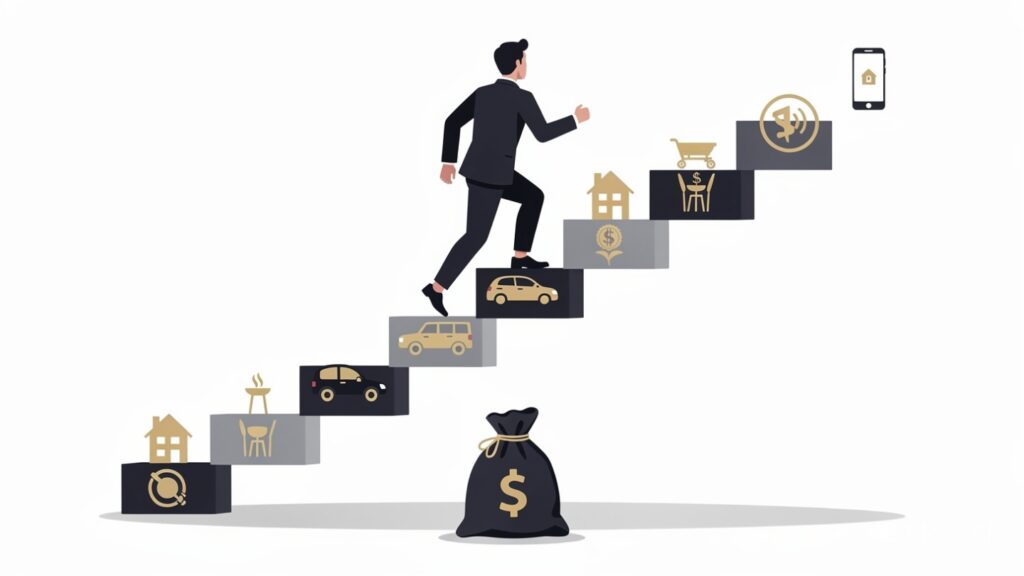
Lifestyle inflation — sometimes called lifestyle creep — is the tendency to increase your spending every time your income increases. You get a raise, and within a few months, your expenses have quietly expanded to match it. The bigger apartment. The newer car. The better phone. The restaurant dinners that used to be a treat and are now just Tuesday.
According to Investopedia’s definition of lifestyle creep, it occurs when former luxuries become perceived necessities as discretionary income rises. The dangerous part is that word: perceived. The new spending doesn’t feel like luxury anymore. It feels like your normal, baseline life — and going back feels like a downgrade, even though you lived perfectly fine without it a year ago.
Here’s the trap in one sentence:
Why Earning More Doesn’t Make You Richer
This is the part that confuses people. They genuinely believe that the path to wealth is simply earning more. Make more money, save more money — it sounds obvious. But the data tells a very different story.
Studies on consumer behavior consistently show that spending rises with income across nearly every bracket. Data from the U.S. Bureau of Labor Statistics Consumer Expenditure Survey shows a clear pattern: as household income increases, total expenditures increase right alongside it. Higher earners don’t just save the difference — they spend a large portion of it, on bigger homes, more expensive vehicles, and elevated discretionary categories.
This is why you see people earning six figures who are living paycheck to paycheck. We covered this exact phenomenon in depth in our breakdown of the cash flow trap that keeps six-figure earners broke — and it’s worth understanding because it destroys the comforting myth that “I’ll save more once I earn more.”
You won’t. Not automatically. Because the same psychology that made you spend your old salary will make you spend your new one. The number changed. The behavior didn’t.
The Real Reason: It’s Psychology, Not Math
Here’s the thing nobody wants to hear — lifestyle inflation isn’t a math problem. It’s a psychology problem. And until you fix the psychology, no amount of income will fix the savings.
Our founder learned this the hard way during the years of building multiple income streams. There was a period running several ventures at once — and a hard lesson emerged that applies directly here. When the money started coming in better than before, the instinct wasn’t to interrogate it. It was to enjoy it. To feel like the struggle had finally paid off and now it was time to live a little.
That instinct feels completely natural. It’s also exactly how wealth gets quietly leaked away.
The shift that changed everything was learning to treat money in three distinct ways — and recognizing which one you default to.
The Poor Spender: Money arrives and vanishes on status items — things that look like wealth but produce nothing. The new phone, the visible upgrade, the thing that impresses people who don’t matter.
The Middle-Class Saver: Money is protected and saved, but never put to work. It sits, safe but stagnant, slowly losing value to inflation. Better than the spender — but still not building anything.
The Wealthy Investor: Every single dollar gets interrogated with one question — “How can you bring more back?” Money isn’t for showing off and it isn’t just for sitting safely. It’s a tool that’s expected to work.
Here’s a concrete example of the investor mindset in action. When our founder’s earlier business generated its first meaningful profit, the instinct wasn’t to spend it on something visible. Out of an initial profit, the large majority was immediately reinvested back into the business. The following month, that reinvested money came back multiplied several times over.
That’s the difference. The spender would have bought something. The saver would have parked it. The investor sent it back out to work — and it returned with reinforcements.
Saver vs. Spender vs. Investor — The Critical Comparison
Let’s lay this out clearly, because understanding which category your raise falls into is the entire game.
| When a Raise Arrives | Spender | Saver | Investor |
|---|---|---|---|
| First instinct | Upgrade lifestyle | Park it in savings | Deploy it to grow |
| After 1 year | Higher expenses, same balance | Bigger balance, no growth | Balance compounding upward |
| After 10 years | Trapped, needs the income | Safe but not free | Building real freedom |
| Relationship with money | Money controls them | Money sits idle | Money works for them |
Look at the spender’s row carefully. After ten years of rising income, they’re trapped — because their expenses have grown so large that they now need the high income just to survive. They’ve built a more expensive prison, not more freedom. This is the cruel irony of lifestyle inflation: the more you earn and spend, the more you become a hostage to your own income.
How Lifestyle Inflation Sneaks In
The reason this trap is so effective is that it never arrives all at once. Nobody wakes up and decides to triple their spending overnight. It happens in small, reasonable-feeling steps — each one easy to justify.
You get a raise. You think, “I’ve earned a slightly nicer apartment.” Reasonable. A few months later, “My car’s getting old, and I can afford better now.” Reasonable. Then, “I work hard, I deserve to eat well.” Reasonable. Each individual decision makes sense. The problem is the cumulative effect — twelve reasonable upgrades later, your entire raise is gone, absorbed into a higher baseline you can never easily reverse.
Behavioral research featured in Harvard Business Review highlights that humans adapt remarkably quickly to improved circumstances — a phenomenon psychologists call hedonic adaptation. The new luxury becomes the new normal within weeks, delivering no lasting increase in satisfaction, while permanently raising your cost of living. You paid more to end up feeling exactly the same.
The 50% Rule — Capturing Raises Instead of Losing Them
So how do you break the cycle? Not with willpower. Willpower fails because lifestyle inflation is gradual and you’re fighting it one small decision at a time. You break it with a system that works automatically.
Here’s the principle that changes everything: every time your income increases, decide in advance where the increase goes — before you ever see it in your account.
A practical version of this is what many disciplined wealth-builders call the 50% raise rule. When you get a raise or your income increases, you allow yourself to enjoy 50% of it — go ahead, upgrade something, you earned it. But the other 50% gets automatically directed toward savings or investment before it touches your spending.
This works for two reasons. First, you never feel deprived — you still get to enjoy half of every raise, so it doesn’t feel like punishment. Second, the saved half never enters your lifestyle, so hedonic adaptation never gets its hands on it. You can’t miss money you never started spending.
The mechanics matter. This has to be automatic. Set up the transfer to happen the day your income lands. If you wait to “see what’s left at the end of the month,” the answer will always be nothing — because spending expands to fill whatever is available. We broke down this exact “pay yourself first” principle in our guide to the rules of money and wealth building, and it remains the single most powerful habit in personal finance.
Why This Connects Directly to Compounding
Here’s where it gets serious. The money you fail to save because of lifestyle inflation isn’t just “money not saved.” It’s compounding you’ll never get back.
Every dollar you capture and invest today doesn’t just sit there — it grows, and then the growth grows, in the exponential process we explain fully in our breakdown of what compounding actually is. A dollar lost to a lifestyle upgrade in your thirties isn’t a one-dollar loss. Over a few decades of compounding, it’s potentially many dollars of future wealth that simply never existed.
This is the brutal math of lifestyle inflation. It doesn’t just cost you the money you spend. It costs you everything that money would have become.
What Nobody Tells You About Lifestyle Inflation
Now let’s get into the things the personal finance gurus on social media won’t tell you — because these truths aren’t comfortable and they don’t sell courses.
The biggest expenses are the ones you can’t easily reverse, and those are the ones to guard hardest. A coffee habit is annoying but reversible — you can quit it in a day. A mortgage on a house bigger than you need, a car loan on a vehicle that signals a status you can’t afford, a private school commitment — these are the spending decisions that lock you in for years. Lifestyle inflation does the most damage not through small daily purchases but through large, sticky commitments that you can’t undo without major life disruption. Guard the big decisions ferociously. The small ones matter far less than the budgeting apps want you to believe.
Your social circle is the single biggest driver of your lifestyle inflation, and nobody warns you. You don’t upgrade your life in a vacuum. You upgrade it to match the people around you. When your income rises and you start spending time with people who spend more, their normal becomes your target. The car you “need,” the neighborhood you “should” live in, the vacations that are “just what people do” — these standards come from your environment, not from your own genuine desires. If you want to control lifestyle inflation, pay very close attention to whose normal you’re unconsciously adopting.
Feeling broke at a high income is more psychologically painful than being broke at a low income. When you earned little and had little, there was a clear external reason — you simply didn’t make enough. But when you earn a great income and still have nothing saved, the problem points directly back at you, and that’s a much harder thing to face. This is why many high earners avoid looking at their finances altogether — the shame of “I make so much, where did it all go?” is genuinely uncomfortable. The way out isn’t more income. It’s facing the behavior honestly, without the self-attack.
The goal was never to deprive yourself — it’s to spend deliberately instead of automatically. This isn’t about living like a monk or never enjoying your money. That’s a miserable strategy nobody sustains. The actual goal is to make your spending conscious rather than automatic. Spend lavishly on the few things you genuinely love and value. Cut ruthlessly on the things you’re only buying out of habit, status, or unconscious comparison. Lifestyle inflation is dangerous specifically because it’s unconscious — fix that, and you can enjoy your money without it enslaving you.
Frequently Asked Questions
Is lifestyle inflation always bad?
No. Some lifestyle improvement is healthy and earned — the point isn’t to live in deprivation forever. The problem is unconscious lifestyle inflation that consumes 100% of every raise automatically, leaving nothing for wealth-building. Deliberate, partial upgrades while still capturing a meaningful share of every income increase is a perfectly healthy approach.
How much of a raise should I save versus spend?
A widely used guideline is the 50% rule — enjoy half of any raise and automatically save or invest the other half before it enters your spending. If you’re behind on savings or carrying debt, directing an even higher percentage of new income toward those goals accelerates your progress significantly.
Why do I feel broke even though I earn more than ever?
Because your expenses have almost certainly risen to match — or exceed — your income growth. This is the core mechanism of lifestyle inflation. The feeling of being broke at a high income is the clearest possible signal that your spending expanded to fill your earnings, leaving no margin behind.
What’s the fastest way to stop lifestyle creep?
Automate the capture of your income before you can spend it. Set up an automatic transfer to savings or investments the day your income lands, so the money never enters your spendable balance. You can’t inflate your lifestyle with money you never see in your checking account.
Does earning more money ever lead to more savings?
Only when paired with a deliberate system to capture the increase. On its own, higher income almost never produces higher savings — the behavior simply scales up to consume it. The income is the fuel; the system is what determines whether that fuel builds wealth or just funds a bigger lifestyle.
How is lifestyle inflation connected to building long-term wealth?
Directly and severely. Every dollar lost to unconscious lifestyle inflation is a dollar that never gets the chance to compound. Over decades, the gap between someone who captures their raises and someone who spends them isn’t small — it’s often the entire difference between financial freedom and being permanently dependent on the next paycheck.
1. Calculate honestly how much your income has grown over the last 3 years, then compare it to how much your savings actually grew. Sit with that gap.
2. Set up one automatic transfer to savings or investment that triggers the day your income arrives — not at month-end.
3. Apply the 50% rule to your next raise: enjoy half, automatically capture half before it touches your spending.
4. Identify your three largest “sticky” expenses (housing, vehicle, recurring commitments) and question whether each genuinely serves you or just signals status.
5. Audit whose “normal” you’ve been unconsciously adopting — and decide your standards deliberately instead of by comparison.
Final Word
Here’s the truth that ties it all together. The path to wealth was never just about earning more. Plenty of people earn enormous incomes and die with nothing. The path is about the gap between what you earn and what you keep — and lifestyle inflation is the silent thief that closes that gap every single time your income rises.
Your income doubling is meaningless if your savings don’t move. The number on your paycheck is not wealth. Wealth is what survives after the spending — and that survival depends entirely on whether you control your lifestyle, or let it control you.
Earn more. But for the love of your future self, don’t let the spending grow in its shadow. Capture the difference. Put it to work. And let it compound into the freedom that the spenders, with all their visible upgrades, will never actually own.
Disclaimer: This article is for educational and informational purposes only and does not constitute financial advice. Personal financial decisions should be based on your individual circumstances and made in consultation with a qualified financial professional where appropriate.