Sinking funds solve a problem almost every budget has and almost no budget admits to. You plan for rent, groceries, transport, the bills that arrive every month like clockwork — and then the car needs tyres, the insurance renewal lands, a wedding invitation arrives, and suddenly the month you’d planned carefully is a month you’re borrowing through.
We call those emergencies. Most of them aren’t. Tyres wear out on a schedule. Insurance renews on the same date every year. Someone in your family gets married roughly as often as they always have. These are predictable costs arriving at unpredictable moments, and there’s a name for the tool that handles them.
A sinking fund is just money you set aside a little at a time for a specific expense you already know is coming. That’s it. It’s an unglamorous idea, it’s centuries old, and it will do more for your financial calm than any app you download this year.
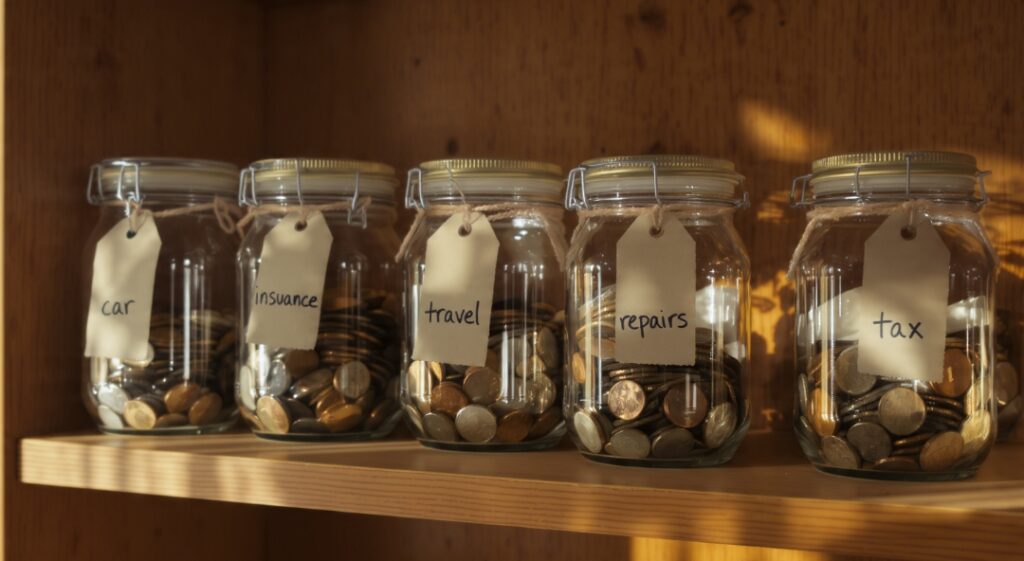
What Sinking Funds Actually Are
The term is borrowed from corporate finance, where a company issuing bonds sets aside money gradually so it can repay the principal at maturity instead of scrambling for a lump sum on the due date. Investopedia’s definition of a sinking fund covers that original usage, and the practice dates back to eighteenth-century government debt. Governments and corporations worked out three hundred years ago that large known costs should be funded in advance. Households mostly still haven’t.
Applied to personal finance, the mechanics are identical and much simpler. You take a cost you know is coming, divide it by the number of months until it arrives, and move that amount aside every month. When the bill lands, the money is already there. You don’t feel it, because you already felt it — in small, painless pieces, across months when nothing was happening.
The shift is subtle but it’s the whole point: you stop paying for things after they happen and start paying for them before.
Sinking Funds vs Emergency Fund — Not the Same Job
This confusion costs people real money, so it’s worth being precise.
An emergency fund exists for the things you cannot see coming: job loss, a medical event, an urgent repair with no warning. It is insurance against the unknown, and once it’s built you leave it alone.
Sinking funds exist for the things you can see coming but that don’t arrive monthly. Annual insurance. School fees. A trip you’ve already decided to take. The phone you know won’t survive another year.
Here’s why mixing them up matters. If you have no sinking funds, every predictable irregular expense hits your emergency fund instead. Your emergency fund never grows, because it’s constantly being drained by things that were never emergencies. Then a real emergency arrives and finds an empty account. I’ve watched people conclude they’re “bad with money” when the actual problem was structural — one bucket doing two jobs.
If you haven’t built the first one yet, start there: the six-step emergency fund process and the emergency fund number most people never calculate both come before this article in sequence. Sinking funds are what protect that fund once it exists.
Why Your Budget Keeps Failing Without Them
Look honestly at the last twelve months. Not the good months — all twelve.
Most people’s budgets work perfectly for about seven or eight months a year. The other four or five are the ones with the annual renewals, the festival season, the birthday cluster, the repair. And because those months are labelled “unusual,” they never get built into the plan. Every year they’re a surprise. Every year they’re described as bad luck.
They’re not bad luck. They’re arithmetic that nobody did.
This is the quiet reason so many budgeting systems collapse in month three — the plan was built for an average month that doesn’t exist. I’ve written about that structural failure in why budgeting fails and what works instead, and percentage-based frameworks run into the same wall. A method like zero-based budgeting only works if every future cost has a line, and irregular ones rarely do. Sinking funds are the missing piece in both: they turn irregular costs into a fixed monthly line, which is the only form a budget can actually absorb.
There’s a psychological effect too, and it’s underrated. Money sitting in a general account has no assigned job, so your brain treats it as available — mental accounting works against you here. The same money labelled “car maintenance” is much harder to spend on something else, even though nothing physical has changed. Naming money is a genuine defence, and it’s free.
What to Actually Set Sinking Funds Up For
Go through your last year of bank statements and pull out every expense above a meaningful threshold that didn’t happen monthly. That list is your starting point. Most people’s falls into these groups:
| Category | Typical examples | Timing |
|---|---|---|
| Fixed date, known amount | Insurance renewals, annual subscriptions, tax, school fees | Easiest — you know both numbers |
| Fixed date, variable amount | Festivals, holidays, birthdays, family events | Set your own ceiling in advance |
| Wear-and-tear replacement | Tyres, laptop, phone, appliances, home repairs | Estimate lifespan, divide the cost |
| Chosen goals | Travel, a course, moving costs, a deposit | You control the deadline |
That third row is the one people skip, and it’s the most valuable. Nothing you own lasts forever. A laptop that costs 1,200 and lasts four years is a 25-a-month expense whether you treat it as one or not. Ignoring that doesn’t make it cheaper — it just means you’ll meet it as a crisis instead of a line item, and often on a credit card. That’s precisely how a predictable cost becomes the bad kind of debt described in good debt versus bad debt.
How to Calculate Each One
Three inputs. Target amount, deadline, months remaining.
Target ÷ months = monthly contribution.
An insurance renewal of 600 due in ten months is 60 a month. A 1,500 trip fourteen months out is roughly 107 a month. A 900 laptop replacement you expect in three years is 25 a month.
Two adjustments worth making. First, if the expense is more than a year out, pad your target — a cost estimated today will be higher when you actually pay it, which is the same erosion covered in how inflation eats savings. Adding around 5% per year of waiting is a reasonable rough adjustment for most economies. Second, if you’re starting mid-cycle with a renewal three months away, be realistic: fund what you can now, and start the full twelve-month cycle the day after you pay it. The first round of any sinking fund is always the hardest, and it’s a one-time problem.
A worked example
Someone lists five sinking funds: insurance 600/year, festival and gifts 480/year, car maintenance 720/year, phone replacement 800 over two years, travel 1,800 over eighteen months.
That’s 50 + 40 + 60 + 33 + 100 = 283 a month.
The number is confronting the first time you see it. Nearly 300 a month, on top of everything else. But that money was already leaving — it just left in painful lumps four or five times a year instead of steadily. Nothing about your actual spending changed. The only thing that changed is that you can now see it, and seeing it is what makes it manageable.
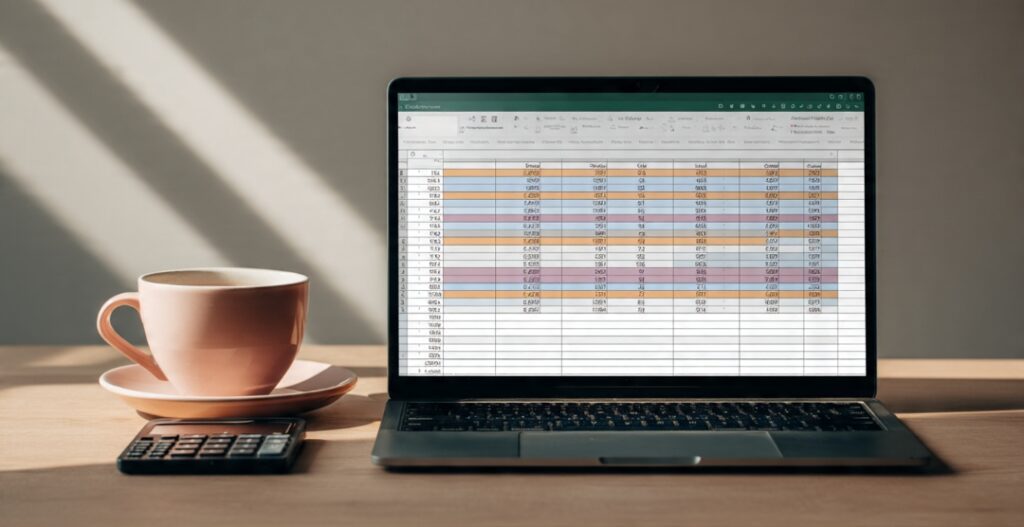
If the total genuinely doesn’t fit your income, that’s not a failure of the method. That’s the method doing its job — telling you, calmly and in advance, that your committed lifestyle costs more than you earn. Better to learn that in a spreadsheet than at a checkout counter.
Where to Keep the Money
Not in your current account. That’s the single most common mistake, and it defeats the whole purpose — money you can see while paying for lunch is money that will eventually pay for lunch.
Match the storage to the timeline:
- Needed within a year — a separate savings account, kept liquid and boring. You are not trying to grow this money; you’re trying to keep it available and out of reach of impulse. Many banks let you open multiple named sub-accounts, which is ideal.
- Needed in one to three years — still low risk. A fixed-term deposit maturing near your target date works well, since the lock-in is a feature rather than a limitation.
- Needed in three years or more — you can consider low-risk invested options, but understand the trade: markets don’t care about your deadline. Never invest money for an expense with a hard date within a couple of years.
One physical trick that works better than it should: keep the accounts in a bank you don’t have a card for, or at least not one in your wallet. Friction is a strategy. Regulators publish plenty of practical guidance on separating savings from spending — the Consumer Financial Protection Bureau is a good neutral starting point if you want the formal version.
Common Mistakes That Break the System
- Starting with twelve funds. Begin with three — the ones that hurt most last year. Add more once the habit holds. A system you abandon in month two protects nothing.
- Keeping it all in one pot. A single “misc savings” account defeats the labelling advantage. If you can’t open multiple accounts, at least track the balances separately on paper.
- Borrowing between funds. Taking from the car fund for the travel fund feels harmless. Do it twice and you no longer have sinking funds — you have a savings account with extra steps.
- Never refilling after spending. The cycle restarts the day you pay. Insurance paid in March means April’s contribution starts next year’s.
- Ignoring the wear-and-tear category. Replacement costs are the least emotional and most forgotten. They’re also the ones most likely to end up on credit.
- Letting the targets drift upward. Every year the festival budget grows a little, the trip gets slightly nicer. That’s Parkinson’s Law of money operating inside your own system. Set the ceiling deliberately, or it will set itself.
Start This Week, Not This Quarter
Pull up last year’s statements. Find the three irregular expenses that did the most damage. Divide each by twelve. Open one separate account and set up three standing transfers for the day after you get paid.
That’s the entire implementation, and it takes about forty minutes.
What you’ll notice within a few months isn’t wealth — the numbers are too small for that. It’s the absence of a particular feeling: the small drop in your stomach when a predictable bill arrives. Sinking funds don’t make you richer directly. They make you steady, and steady is what lets every other financial decision get made from a calm position instead of a cornered one.
Key Takeaways
- Sinking funds are money set aside gradually for known, irregular expenses — not for emergencies.
- Most “financial emergencies” are predictable costs arriving at unpredictable times.
- Without them, every irregular expense drains your emergency fund, so it never grows.
- The formula is simply target amount divided by months until due; pad the target if the deadline is over a year away.
- Keep each fund in a separate, named, liquid account — friction and labelling both do real work.
- Don’t forget wear-and-tear replacement: a 1,200 laptop lasting four years is a 25-a-month cost whether you budget it or not.
- Start with three funds, not twelve, and never borrow between them.
Frequently Asked Questions
What is a sinking fund in personal finance?
It’s money you save gradually for a specific expense you know is coming, so the cost is already covered when it arrives. The term comes from corporate finance, where companies set aside money over time to repay bond principal rather than facing one large payment at maturity.
How are sinking funds different from an emergency fund?
An emergency fund covers unpredictable events like job loss or a sudden medical cost. Sinking funds cover predictable expenses that simply don’t occur monthly, such as insurance renewals, festivals, or replacing a laptop. You need both, and keeping them separate is what stops the emergency fund being constantly drained.
How many sinking funds should I have?
Start with three, covering the irregular expenses that caused the most stress in the past year. Most people eventually settle between five and eight. More than that becomes admin-heavy and the system tends to get abandoned.
Where should I keep sinking fund money?
In a separate savings account, away from your everyday spending account. For money needed within a year, prioritise liquidity over returns. For funds with deadlines beyond three years, low-risk options are reasonable, but avoid investing money tied to a hard near-term date.
Can I use sinking funds if my income is irregular?
Yes, and it matters more when income varies. Instead of a fixed monthly transfer, assign a percentage of each payment you receive. In strong months you get ahead; in weak months you contribute less without breaking the system.
Are sinking funds worth it if I have debt?
Usually yes, at least for the essentials. Without them, the next irregular expense goes straight onto credit and your debt grows while you’re trying to clear it. A small number of funded categories alongside your repayment plan stops that cycle repeating.
What’s the biggest mistake people make with sinking funds?
Borrowing between them. Once one fund starts covering another’s shortfall, the labels stop meaning anything and you’re back to a single undifferentiated pot — which is the exact problem the system was meant to solve.
Disclaimer: This article is for educational purposes only and does not constitute financial, investment, or tax advice. All amounts, timelines and percentages used here are illustrative examples in no particular currency, chosen to demonstrate the calculation method rather than to recommend specific figures. Account types, interest rates, deposit protection and tax treatment vary by country. Always do your own research and consider consulting a licensed financial professional before making financial decisions.