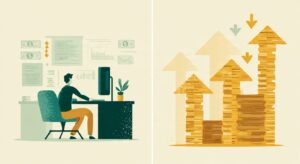
Everyone loves to talk about compounding when it is building wealth, the snowball rolling downhill, the small sums quietly turning into fortunes, the magic of money making money. It is one of the most celebrated ideas in personal finance, and rightly so. But almost nobody mentions that this same force has an evil twin, one that works the night shift, quietly, relentlessly, against anyone carrying debt.
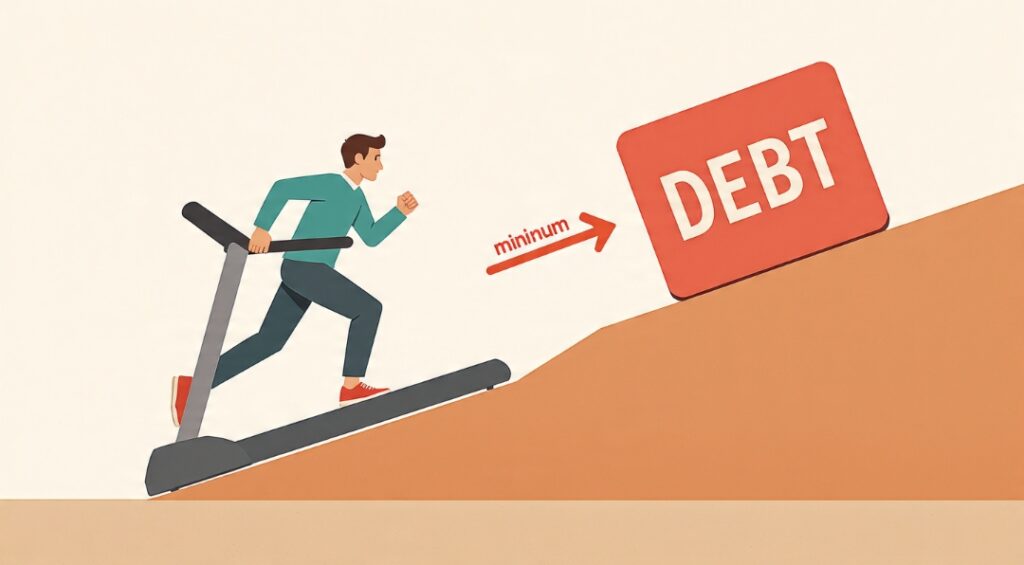
Because here is the uncomfortable symmetry: compound interest does not care which direction it runs. The exact mechanism that grows your investments while you sleep also grows your debts while you sleep. Every night you carry a balance, interest is quietly added, and the next night interest is charged on that larger amount too. You are not standing still. If you are in high-interest debt, you are on a treadmill that speeds up on its own, and understanding this is the difference between escaping it and being slowly buried by it.
The Same Force, Simply Reversed
Compounding, in one sentence, is earning interest on your interest, growth stacking on top of previous growth. When you invest, that is a beautiful thing. When you borrow, the identical process runs against you: you are charged interest, and then charged interest on that interest, so the balance grows faster and faster the longer it sits. The mathematics is described the same way whether it is helping or hurting you, as laid out in this overview of compound interest.
Most people intuitively feel that debt “adds up,” but they picture it adding up in a straight line, a fixed amount each month. It does not. It accelerates, in a curve, exactly the way investment growth does, just pointed downhill. This is the same blind spot that makes people underestimate how quickly savings grow, only now the cost of that blind spot is measured in money leaving your pocket rather than arriving in it. If you have ever been surprised how a balance ballooned despite your payments, this is why, and it is the flip side of why your brain underestimates compounding in the first place.
Why Debt Compounding Hurts More Than Investing Compounding Helps
Here is the part that should genuinely alarm anyone carrying a balance. The compounding working against you as a borrower is usually stronger than the compounding working for you as an investor, for three brutal reasons.
The rates are higher. A diversified investment might realistically return somewhere around the high single digits over the long run. High-interest debt, especially credit cards, frequently charges two or three times that. The annual percentage rate on a card can dwarf any return you could safely earn, which means your debt is compounding at a speed your investments simply cannot match.
It is guaranteed. Investment returns are uncertain, they go up and down, and some years you lose. Debt interest is not uncertain at all. It is contractually guaranteed to be charged, every single period, without fail. You are fighting a certainty with, at best, a probability.
It compounds against you first. Paying down high-interest debt is, in effect, a guaranteed, tax-free return equal to the interest rate you avoid. Clearing a balance charging you a punishing rate is mathematically better than almost any investment you could make with the same money, because you are removing a certain loss rather than chasing an uncertain gain. This is why the sequence of your financial moves matters so much, a theme explored in getting the money sequence right.

How the Balance Grows While You Sleep
The mechanics are worth seeing plainly. Many forms of debt, credit cards in particular, calculate interest daily and add it to your balance. That means every day the amount you owe ticks up slightly, and the next day’s interest is calculated on that new, slightly larger amount. Interest earning interest, in reverse.
This is especially vicious with revolving credit, the kind that lets you carry a balance from month to month. Unlike a fixed loan with a clear end date, revolving debt can roll on indefinitely, compounding the entire time. You can make payments every month and still watch the balance barely move, or even grow, if those payments are not outrunning the interest being added. The debt is working twenty-four hours a day. Your payments show up once a month. That asymmetry is the whole trap.
The Minimum Payment Trap
If compounding debt is the engine, the minimum payment is the seatbelt that quietly keeps you strapped into it. Minimum payments are deliberately set low, often just enough to cover the interest plus a tiny sliver of the principal. Pay only the minimum, and the overwhelming majority of your money goes straight to interest, while the actual debt barely shrinks.
The result is that a balance which feels manageable at the minimum can take years, sometimes decades, to clear, and over that time you can end up paying far more in interest than the original amount you borrowed. The minimum payment feels comfortable precisely because it is designed to, it is the most profitable outcome for the lender and the most expensive one for you. Any strategy for escaping debt starts with a single rule: pay more than the minimum, always, on the debt that is costing you the most. Choosing which debt to attack first is its own decision, and the two main methods are compared in debt snowball versus debt avalanche.
The Rule of 72, Turned Against You
There is a fast way to feel exactly how quickly debt doubles, and it is the same shortcut used to estimate how investments grow. The Rule of 72 says you can divide 72 by an interest rate to estimate how many years it takes for an amount to double. Point it at your debt and the results are sobering.
| Debt Interest Rate (APR) | 72 ÷ Rate | Balance Doubles In |
|---|---|---|
| 12% | 72 ÷ 12 | 6 years |
| 18% | 72 ÷ 18 | 4 years |
| 24% | 72 ÷ 24 | 3 years |
| 36% | 72 ÷ 36 | 2 years |
Read that again. Debt at a 24% rate, left unpaid, roughly doubles what you owe in about three years. That is not a distant, abstract danger; that is the ordinary behaviour of an unpaid credit card balance. The same clean, elegant math that makes compounding a wealth-building marvel makes high-interest debt a genuine emergency.
But Not All Debt Is the Enemy
It would be dishonest to end the discussion at “debt bad.” Compounding runs against you on all debt, but the rate and the purpose change everything, and treating a low-rate, wealth-building loan the same as a punishing credit card balance is its own mistake.
Some debt is taken at low rates to acquire something that grows in value or generates income, an asset that can out-earn the interest cost. Other debt is taken at high rates to buy things that lose value the moment you own them, adding a compounding cost on top of a depreciating purchase. The first can be a tool; the second is almost pure destruction. Learning to tell them apart is one of the most important financial skills there is, and it is exactly the line drawn in good debt versus bad debt. The reverse-compounding danger is most acute, and most urgent, on the high-rate, value-destroying end of that spectrum.
The Psychology That Keeps You Trapped
If the math is this clear, why do so many capable people stay in high-interest debt for years? Because the same psychological wiring that undermines investors works overtime on borrowers.
We heavily discount the future, so the interest piling up “later” feels less real than the comfort of paying only the minimum “now.” The minimum payment feels responsible, you are paying something, after all, which soothes the discomfort without solving the problem. And because the balance grows slowly at first, the danger never feels urgent until it is large. It is the wealth-destroying mirror of the same slow start that makes investors give up too early, the quiet lag phase, except here the lag lulls you into ignoring a problem that is quietly accelerating. Recognising this pattern in yourself is often the thing that finally breaks it.
How to Reverse the Reversal
The good news is that the same force can be switched back to your side. Once high-interest debt is gone, the money that was feeding it can start compounding for you instead. Here is the practical path.
- Stop adding to it. You cannot bail out a boat while the hole is still open. Pause new high-interest borrowing first, or every other effort is undone as fast as you make it.
- Attack the highest rate hardest. Compounding does the most damage at the highest interest rate, so mathematically that is where every extra unit of money should go first. Pay minimums on the rest, and throw everything spare at the most expensive balance.
- Always pay above the minimum. Even a modest amount above the minimum dramatically shortens the timeline and slashes the total interest, because more of it hits the principal instead of feeding the interest.
- Build a small buffer so you stop needing debt. Much high-interest debt is taken on to cover emergencies. A modest cash cushion breaks that cycle, which is precisely why calculating your safety number matters, as covered in the emergency fund number.
- Try to lower the rate. Where possible, reducing the interest rate itself, through consolidation or negotiation, directly slows the compounding working against you. A lower rate means less of your payment is lost to interest. Improving your standing here is helped by understanding how credit works from the ground up.
The mindset that makes all of this stick is simple. Every unit of high-interest debt you eliminate is a guaranteed return you have locked in, and every day you leave it in place, the reverse snowball keeps rolling. Get it off your back, and then let compounding do what it does best, but this time, working for you.
🔑 Key Takeaways
- Compounding runs both ways. The same force that grows your investments grows your debts, accelerating in a curve, not a straight line.
- Debt compounding often beats investment compounding, because debt rates are higher, the interest is guaranteed rather than uncertain, and it works against you first.
- Balances grow daily. Revolving debt compounds around the clock while your payments arrive once a month, an asymmetry that is the core of the trap.
- The minimum payment is the trap, designed so most of your money covers interest, stretching repayment over years and multiplying what you pay.
- Rule of 72 in reverse: debt at 24% roughly doubles in about three years. High-interest debt is a genuine emergency.
- Reverse it: stop borrowing, attack the highest rate, always pay above the minimum, build a buffer, and lower the rate where you can.
Frequently Asked Questions
Does debt really compound like investments do?
Yes, in many cases. Credit cards and other revolving debts typically charge interest on your balance and then charge interest on that accumulated interest, which is compounding in reverse. The balance grows faster the longer it goes unpaid, following the same accelerating curve as compound investment growth, just working against you.
Why is high-interest debt considered worse than the benefit of investing?
Because debt often compounds at a higher rate than investments realistically return, the interest is contractually guaranteed rather than uncertain, and paying it off removes a certain cost. Clearing high-interest debt effectively delivers a guaranteed, tax-free return equal to the rate you avoid, which is hard for any investment to beat.
What is the minimum payment trap?
Minimum payments are set low, often just covering interest plus a small part of the principal. Paying only the minimum means most of your money goes to interest while the balance barely shrinks, so the debt can take years or decades to clear and you end up paying far more in interest than you originally borrowed.
How fast can debt double?
You can estimate it with the Rule of 72: divide 72 by the interest rate. A debt at 24% interest roughly doubles in about three years if left unpaid, and at 36% in around two years. This is why unpaid high-interest balances can escalate so quickly.
Is all debt bad because of compounding?
No. Compounding runs against all debt, but the rate and purpose matter enormously. Low-rate debt used to acquire an income-producing or appreciating asset can be a useful tool, while high-rate debt used to buy depreciating things is the most destructive. The reverse-compounding danger is most severe on high-interest, value-destroying debt.
Should I pay off debt or invest first?
As a general principle, paying off high-interest debt first usually wins, because eliminating a guaranteed high interest cost beats chasing an uncertain, typically lower investment return. Lower-rate debt is more of a judgment call. Circumstances vary, so consider your specific situation and, where needed, professional guidance.
How do I start getting out of compounding debt?
Stop adding new high-interest debt, direct every spare amount at the highest-rate balance while paying minimums on the rest, always pay more than the minimum, and build a small emergency buffer so you stop relying on debt for surprises. Lowering the interest rate itself, where possible, also slows the compounding against you.
⚠️ Disclaimer: This article is for educational and informational purposes only and does not constitute financial, credit, legal or tax advice. Interest rates, how interest is calculated, minimum payment rules, and credit and lending regulations vary by country, lender and product, and the examples here are illustrative and simplified. Investment returns are not guaranteed and carry risk. Before making decisions about debt repayment, consolidation or investing, consider consulting a qualified financial professional in your own jurisdiction.