Look, I used to think entrepreneurs were born, not made. I’d see guys like Elon Musk or Jeff Bezos and think, “They have something I don’t. They’re smarter, luckier, born with a business brain.” I was a 10th-grade dropout working as an electrician, covered in dust and sweat, convinced I’d be stuck in that life forever. My brain was wired for survival, not strategy. For risk avoidance, not opportunity creation.
Then I tried to kill myself three times. The shame of being the “failed” kid, the son of a government teacher, working manual labor while my peers went to college — it crushed me. But that pain also forced me to ask a question I’d been avoiding: What if my brain could be trained? What if “thinking like an entrepreneur” isn’t a gift you’re born with, but a skill you can develop?
Honestly? It took me years of trial, error, blowing trading accounts, failing at side hustles, and almost losing everything to figure out the answer. But now I know: you can train your brain to think like an entrepreneur. And it starts with understanding that your current mindset isn’t fixed — it’s just a habit you can change.
The Electrician Mindset vs. The Entrepreneur Mindset: My Wake-Up Call
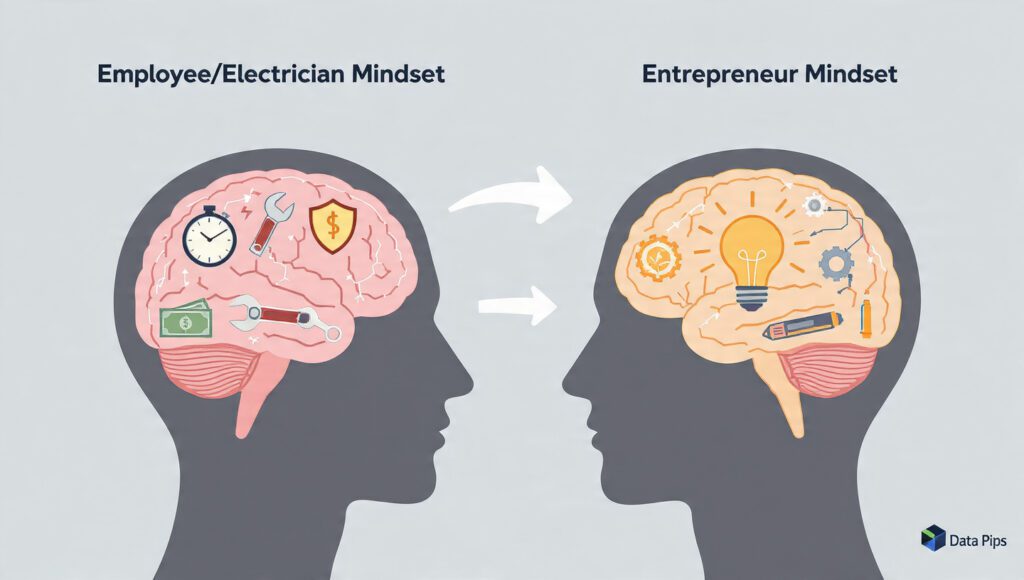
Here’s the thing: your current job shapes your brain. For three years, I was an electrician and plumber. My brain was trained for:
- Reactive problem-solving: “The wire is broken. Fix it.” “The pipe is leaking. Fix it.”
- Linear effort = linear reward: Work 12 hours, get paid for 12 hours. No work, no pay.
- Risk avoidance: Don’t touch live wires. Don’t make mistakes. Follow the code exactly.
- Individual contribution: My work = my pay. No teamwork, no scaling.
That mindset kept me alive, but it kept me poor and miserable. The entrepreneur mindset is completely different. It’s trained for:
- Proactive opportunity creation: “What problem can I solve that people will pay for?”
- Scalable systems: How can I do this once and earn repeatedly? How can I build something that works without me?
- Calculated risk-taking: What’s the worst that can happen? Is the potential reward worth the risk?
- Leverage: How can I use other people’s time, money, or skills to grow?
I didn’t wake up one day with this mindset. I had to train my brain, like a muscle, through deliberate practice. And the first step was realizing that my “electrician brain” was just a set of neural pathways I’d built through repetition. I could build new pathways. It would hurt. It would feel uncomfortable. But it was possible.
As neuroscience research shows, your brain is neuroplastic — it can change at any age. Entrepreneurs aren’t born with a different brain. They’ve trained theirs to see opportunities, manage risk, and think in systems. And you can too.
What “Thinking Like an Entrepreneur” Actually Means (It’s Not What You Think)
Here’s the thing: most people think “thinking like an entrepreneur” means having big, flashy ideas. Or being a risk-taker. Or being super creative. That’s not it.
Thinking like an entrepreneur means training your brain to see the world through a specific lens: the lens of value creation and systems.
It means when you see a problem, your brain doesn’t just think “that’s annoying” — it thinks “that’s a potential business.” When you see a process, your brain doesn’t just think “that’s how it’s done” — it thinks “how could this be 10x more efficient?” When you see money, your brain doesn’t just think “what can I buy” — it thinks “how can I make this work for me?”
This isn’t about being greedy or selfish. It’s about being solution-oriented. It’s about seeing opportunities where others see obstacles. It’s about building systems that create value for others, and capturing a portion of that value for yourself.
My T-shirt business in Saudi Arabia was my first real lesson in this. I saw expats missing home, feeling nostalgic. My electrician brain thought, “That’s too bad.” My entrepreneur brain (once I started training it) thought, “They’d pay for T-shirts with designs from their home country.” That simple shift in perspective — from “problem” to “opportunity” — was the first step.
It’s Not About Being a “Risk-Taker” — It’s About Managing Risk
Another myth: entrepreneurs are reckless risk-takers. False. The best entrepreneurs I know are obsessive risk managers. They don’t jump off cliffs. They calculate the fall.
When I started trading, I blew accounts because I was a gambler, not an entrepreneur. I’d risk 10% on a “sure thing” and lose everything. A real entrepreneur-trader risks 1% on a high-probability setup, and has 20 other setups ready. They manage downside, not just chase upside.
Training your brain to think like an entrepreneur means training it to ask: “What’s the worst-case scenario? Can I survive it? What’s the probability of success? Is the potential reward worth the risk?” It’s cold, calculated, and systematic — not emotional or reckless.
It’s About Systems, Not Heroics
The electrician mindset is heroic: “I’ll work harder, longer, faster.” The entrepreneur mindset is systemic: “How can I build a system that works without me?”
When I had my T-shirt business, I could have just kept selling shirts myself forever. That’s the heroic approach. But the entrepreneurial approach was: “How can I automate this? Can I hire someone? Can I create designs once and print them on demand? Can I build an online store that sells while I sleep?”
That systems-thinking is what separates a small business owner from a true entrepreneur. The small business owner is trapped in the business. The entrepreneur builds a business that can run without them. Training your brain means constantly asking: “Is this scalable? Can this work without me?”

The Neuroscience of Entrepreneurial Thinking: How to Rewire Your Brain
Okay, let’s get nerdy for a minute, because this is important. Your brain has neural pathways — basically, well-worn trails of thought. If you’ve been an electrician for 3 years, your brain has strong pathways for “fix this,” “follow instructions,” “avoid danger.”
Entrepreneurial thinking requires new pathways: “see opportunity,” “connect dots,” “calculate risk,” “think in systems.” The good news? You can build these pathways through repetition, just like you built your current ones.
Here’s how neuroplasticity works for entrepreneur brain training:
- Identify the desired thought pattern: “When I see a problem, I think ‘opportunity.’”
- Practice it deliberately: Every day, find 3 problems and brainstorm business solutions. Force yourself.
- Repeat until it’s automatic: After 30-60 days, that thought pattern becomes easier. The old “this is a problem” pathway weakens; the new “this is an opportunity” pathway strengthens.
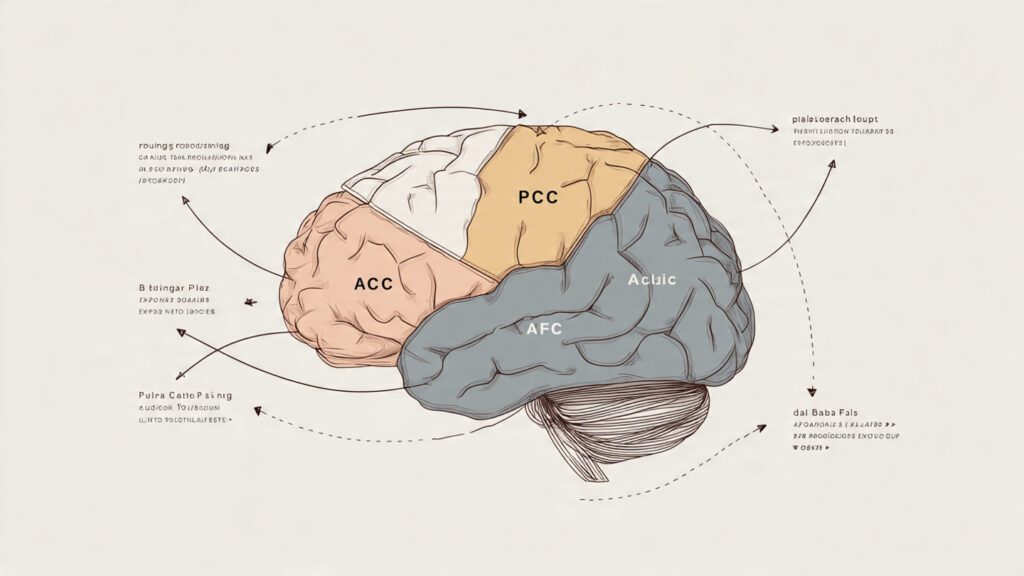
Research from Psychology Today shows that successful entrepreneurs have stronger neural connectivity between the prefrontal cortex (planning, decision-making) and the anterior cingulate cortex (error detection, conflict monitoring). They’re better at spotting opportunities and learning from mistakes. That’s not magic — that’s trained brain circuitry.
So when I say you can train your brain, I mean it literally. Every time you practice entrepreneurial thinking, you’re physically changing your brain structure. It’s like going to the gym for your mind.
The 3 Brain Regions You Need to Train for Entrepreneurial Thinking
1. Prefrontal Cortex (PFC): This is your CEO brain. It handles planning, strategy, and long-term thinking. Most people’s PFC is underused because they’re stuck in reactive mode. Train it by: planning your week every Sunday, setting 3-month goals, thinking in systems.
2. Anterior Cingulate Cortex (ACC): This is your error detector. It notices when things aren’t working. Entrepreneurs have a hyper-active ACC — they’re constantly spotting problems as opportunities. Train it by: journaling business failures and asking “what did this teach me?”, actively looking for inefficiencies in everyday processes.
3. Basal Ganglia: This is your habit brain. It automates repeated behaviors. You want entrepreneurial thinking to become automatic. Train it by: doing daily entrepreneurial exercises (like idea generation) until they’re habit.
When I was an electrician, my PFC was barely used — I just followed instructions. My ACC was only active for safety risks (“this wire might be live”). My basal ganglia was wired for repetitive physical tasks. Training my entrepreneur brain meant deliberately activating these regions in new ways, every day.
5 Mental Shifts I Had to Make to Train My Entrepreneur Brain
You can’t just “think like an entrepreneur” by wishing for it. You have to change specific mental habits. Here are the 5 shifts I had to make, based on my journey from electrician to entrepreneur:
1. From “Time for Money” to “Value for Money”
The electrician mindset: “I work 12 hours, I get paid for 12 hours.” The entrepreneur mindset: “How can I create value that people will pay for, regardless of my time?”
My first shift was creating the T-shirt business. I stopped trading time for money (repairing AC units) and started creating value (designs that evoked nostalgia). That value could be sold over and over without me working 12 hours each time. Training your brain means asking: “Am I selling my time, or am I selling value?”
2. From “Avoid Risk” to “Manage Risk”
Electricians are trained to avoid risk — one mistake can kill someone. Entrepreneurs take calculated risks. The difference is in the word “calculated.”
When I blew my first funded trading account, I was gambling, not calculating. I’d think “this trade feels right” and risk 10%. An entrepreneur-trader thinks: “What’s my edge? What’s my risk per trade? What’s the worst-case scenario? Can I survive 10 losses in a row?”
Training your brain means replacing “what if I lose?” with “what’s the probability, and can I handle the downside?”
3. From “Problems Are Bad” to “Problems Are Opportunities”
My electrician brain saw a broken pipe as a problem to fix, end of story. My entrepreneur brain now sees a broken pipe and thinks: “People need plumbers. Can I build a plumbing business that’s 10x better than competitors? Can I create a product that prevents pipe bursts?”
This is the biggest shift. Every problem you encounter is a potential business. The annoying thing about your phone battery dying? That’s an opportunity. The long lines at the DMV? Opportunity. The difficulty finding good help? Opportunity.
I trained this by carrying a small notebook and writing down every problem I encountered, then forcing myself to write one business idea to solve it. After 30 days, it became automatic.
4. From “I Must Do Everything Myself” to “How Can I Leverage Others?”
Electricians work alone or in small teams, but they’re ultimately responsible for their own work. Entrepreneurs think: “Who else can do this? How can I delegate, automate, or partner?”
When my T-shirt business grew, I could have kept doing everything myself. But I trained my brain to ask: “What tasks don’t require my specific skills?” I hired a friend to help with packing and shipping. I used print-on-demand for some designs. I automated social media posts. This freed me up to think strategically.
5. From “Fixed Ability” to “Growth Ability”
The electrician mindset is often fixed: “I’m good at wiring, bad at business. That’s just how it is.” The entrepreneur mindset is growth: “I can learn anything. Skills are developed, not born.”
I was terrible at sales. My first cold calls were disasters. But I trained my brain to think “I’m not bad at sales — I’m untrained at sales.” That small shift — from “I am” to “I can become” — changed everything. I read books, practiced, failed, adjusted. Now sales is one of my strengths.
This growth mindset is perhaps the most important entrepreneurial brain training of all. Carol Dweck’s research on growth mindset shows that people who believe abilities can be developed outperform those who believe they’re fixed. Entrepreneurs have a growth mindset about everything — skills, business, relationships.
How to Train Your Brain Daily: 7 Practical Exercises That Actually Work
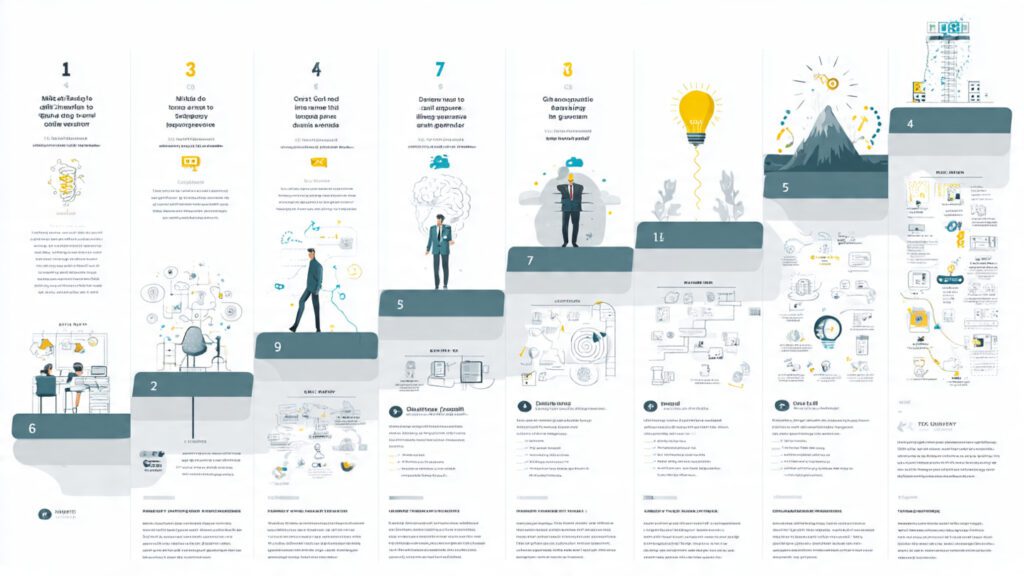
Okay, enough theory. How do you actually train your brain? Here are 7 exercises I used daily to rewire my thinking:
1. The “Problem → Opportunity” Drill (5 minutes/day)
Every morning, write down 3 problems you encountered yesterday (big or small). Then, force yourself to write one business idea to solve each problem. Example:
- Problem: “My phone battery dies by 3pm.”
- Opportunity: “Portable battery pack subscription service — deliver charged batteries to offices.”
- Problem: “Hard to find good plumbers.”
- Opportunity: “Plumber matching service with guaranteed quality and pricing.”
Do this for 30 days. Your brain will start automatically seeing problems as opportunities.
2. The “1% Better System” Audit (10 minutes/week)
Pick one routine in your life (morning routine, work process, shopping habit). Audit it: “How could this be 1% more efficient? Could it be systematized? Could it be delegated?”
I applied this to my trading journal. Instead of scribbling notes, I created a simple spreadsheet with dropdown menus. Saved 2 minutes per trade. Not much, but it trained my brain to look for systems.
3. The “Leverage Question” (Ask it constantly)
Every task you do, ask: “Could someone else do this? Could this be automated? Could I partner with someone who already does this?”
When I was writing blog posts, I asked this. Could I record them as videos too? (Yes — repurposing). Could I hire an editor? (Yes — freed up writing time). Could I create templates? (Yes — faster production). This question forces entrepreneurial leverage thinking.
4. The “Worst-Case Scenario” Exercise (When facing a decision)
Before taking any risk (investing, launching, quitting a job), write down:
- Best-case scenario
- Most likely scenario
- Worst-case scenario
- Can I survive the worst-case? If yes, proceed. If no, adjust.
This trains your brain to move from emotional fear (“what if I lose everything?”) to rational risk assessment.
5. The “Business Model Canvas” for Daily Life (Weekly)
Take an ordinary thing (your commute, your grocery shopping, your gym) and fill out a mini business model canvas:
- Value proposition: What value does this provide?
- Customers: Who is the customer?
- Revenue streams: How does it make money?
- Key activities: What are the core activities?
- Key resources: What resources are needed?
This trains systems thinking. You start seeing everything as a business.
6. The “Failure Reframe” Journal (Daily)
Every night, write down one failure or mistake from the day. Then reframe it: “What did this teach me? How will this make me better?”
When I blew a trading account, my old brain said “I’m a failure.” My trained entrepreneur brain says “What risk management rules did I break? What will I do differently next time?” This turns failure from identity to data.
7. The “Surround Yourself with Entrepreneurial Inputs” Rule
Your brain is shaped by what you consume. If you consume TikTok drama and employee-focused media, you’ll think like an employee. If you consume business books, case studies, and entrepreneur stories, you’ll think like an entrepreneur.
I replaced 30 minutes of YouTube entertainment with 30 minutes of business podcasts or biographies. I followed entrepreneurs on LinkedIn, not just friends. I read one business book a month. This constant input slowly rewired my thinking.

The Brutal Truths About Training Your Entrepreneur Brain (No One Tells You This)
Let’s be real: this brain training isn’t all sunshine and rainbows. Here are the hard truths no one talks about:
1. It Feels Awful at First
Your brain will resist. It’s used to old pathways. When you try to think “opportunity” instead of “problem,” it will feel forced, awkward, even fake. That’s normal. It’s like learning to write with your non-dominant hand. It feels wrong at first. But with practice, new pathways form.
I remember the first time I tried to brainstorm business ideas from daily problems — my brain kept saying “that’s stupid, that’ll never work.” I had to push through that resistance every day for weeks before it got easier.
2. You’ll See Opportunities Everyone Else Misses (And They’ll Think You’re Crazy)
Once your brain starts training, you’ll notice business ideas everywhere. That empty storefront? That’s an opportunity. That inefficient process at your job? That’s an opportunity. People will think you’re overthinking or being negative. You’re not. You’re just seeing what they can’t see yet.
When I told my family I was starting a T-shirt business, they laughed. “Who’s going to buy those?” They couldn’t see the opportunity because their brains weren’t trained for it. That’s okay. Your job isn’t to convince them. Your job is to train your brain and act on the opportunities you see.
3. It Requires Consistent Practice (No Days Off)
You can’t train your brain once a week. Neural pathways strengthen through repetition. If you do the exercises sporadically, you’ll never build new habits. I did my “problem → opportunity” drill every single day for 60 days before it started feeling natural. No exceptions.
Think of it like physical exercise. One gym session a month won’t build muscle. Daily practice builds neural muscle.
4. Your Old Brain Will Fight Back (Especially Under Stress)
When you’re stressed, tired, or scared, your brain defaults to old, comfortable pathways. That’s why under pressure, you might revert to employee thinking: “Just play it safe,” “Don’t take the risk,” “Follow the rules.”
I felt this every time I blew a trading account. My old brain said “go back to plumbing, it’s safe.” My trained entrepreneur brain said “what did I learn? How do I adjust?” The stress made the old pathway stronger. That’s why you have to train the new pathway so strongly that it becomes your default, even under stress.
5. It Changes Your Relationships (Some Won’t Last)
When you start thinking like an entrepreneur, you’ll see your friends and family differently. Some will embrace your new mindset. Some will feel threatened or think you’re “different now.” Some relationships will fade.
I lost friends when I stopped going to gatherings because I was too busy building my business. Some relatives still think I’m “too ambitious” or “not grounded.” That’s the price of brain training. You’re changing your identity, and not everyone will come with you.

Pro Tips to Make the Shift Permanent
Here are my top tips to make entrepreneurial thinking your permanent default:
- Start with identity, not actions: Don’t just “do entrepreneurial exercises.” Start saying “I am an entrepreneur” or “I am a business builder.” Identity drives behavior. I started introducing myself as “an entrepreneur and trader” even when I was still working as an electrician. It felt fake at first, but it rewired my self-concept.
- Use “entrepreneurial language”: Change your self-talk. Instead of “I have to go to work,” say “I get to build my business.” Instead of “That’s not my job,” say “How can I add value here?” Language shapes thought.
- Find an entrepreneur mentor (even if virtual): I didn’t have any entrepreneur friends in Saudi Arabia. So I consumed their content — podcasts, books, interviews. I studied how they thought, what questions they asked, how they framed problems. This gave my brain models to emulate.
- Track your entrepreneurial thoughts: Keep a log of times you caught yourself thinking entrepreneurially. “Saw a problem, thought of business idea.” “Noticed inefficiency, thought of system.” This reinforces the new pathways.
- Embrace “entrepreneurial failure” as data: When an idea fails, don’t say “I’m not cut out for this.” Say “That experiment gave me data. What did I learn?” This keeps your growth mindset intact.
- Create environmental triggers: Put up posters or quotes that prompt entrepreneurial thinking. Change your phone wallpaper to something that reminds you of your business goals. Design your environment to cue the new mindset.
- Celebrate the shift, not just the outcome: When you catch yourself thinking like an entrepreneur (even if the idea doesn’t work), celebrate it. “Yes! I saw an opportunity instead of a problem!” This reinforces the behavior itself, not just the results.

Conclusion: Your Brain Is Already Trainable — Start Today
“Whether you think you can or you think you can’t, you’re right.” — Henry Ford
Look, I’ve been at the absolute bottom. I’ve felt the shame of being the “failed” kid. I’ve worked 12-hour days in 40-degree heat, covered in dust, thinking I’d never escape. I’ve blown trading accounts, failed at businesses, and tried to end my life because I thought my brain was broken.
But I was wrong. My brain wasn’t broken — it was just trained for the wrong things. It was trained for survival, not creation. For risk avoidance, not opportunity recognition. For linear effort, not scalable systems.
And if I could retrain my brain from electrician to entrepreneur, anyone can.
Your brain is not fixed. It’s a muscle. And you can train it.
The entrepreneur mindset isn’t a gift from the gods. It’s a set of neural pathways you can build through deliberate, daily practice. Start small. Pick one exercise from this article. Do it today. Do it tomorrow. Do it for 30 days straight.
In 6 months, you’ll look back and won’t recognize your old thinking. You’ll see opportunities everywhere. You’ll think in systems. You’ll manage risk instead of fearing it. You’ll create value instead of just trading time.
Start today:
- Pick one exercise from the 7 listed above.
- Do it for 30 days straight, no exceptions.
- Track your shifts in thinking, not just outcomes.
The life you want is on the other side of a trained brain. And training starts now.

Key Takeaways / Quick Action Steps
- ✅ Entrepreneurial thinking is a trainable skill, not an innate gift. Your brain can rewire through deliberate practice.
- ✅ Start with identity shift: Start saying “I am an entrepreneur” or “I am a business builder,” even if you’re employed.
- ✅ Do the “Problem → Opportunity” drill daily: 3 problems → 3 business ideas. This trains opportunity recognition.
- ✅ Ask the “Leverage Question” constantly: “Can this be automated, delegated, or systematized?”
- ✅ Reframe failure as data, not identity. “What did I learn?” not “I am a failure.”
- ✅ Track your entrepreneurial thoughts to reinforce new neural pathways.
- ✅ Consistency beats intensity: 5 minutes daily is better than 2 hours once a week.
Author Bio
Shurah Beel Hamid is a business enthusiast, active trader, and content creator who transformed his life by training his brain from an electrician’s mindset to an entrepreneur’s mindset. His expertise lies in practical brain training for entrepreneurship, trading psychology, compounding strategies, and elite mindset development. He shares his raw, unfiltered journey — from suicidal thoughts to strategic patience, from blowing trading accounts to consistent profitability — to provide actionable insights for those tired of theoretical advice and ready for real change. His writing combines hard-won experience, neuroscience-backed techniques, and relentless optimism.
Disclaimer
The content on this website is for educational and informational purposes only and does not constitute mental health, business, or financial advice. Brain training and mindset shifts require consistent effort and may not yield specific results. Trading and business involve significant risk of loss; never risk more than you can afford to lose. If you are struggling with mental health issues including suicidal thoughts, please seek help from a qualified professional immediately. The author’s personal experiences are not a guarantee of results for any individual.