Look, I’m not a Harvard MBA. I didn’t grow up in a boardroom. I grew up in a world where “business strategy” meant figuring out how to make the next rupee last until payday. But through sheer trial, error, and a few near-disasters, I discovered one truth that changed everything: the most powerful business strategy isn’t a complex plan—it’s a mindset. The compounding mindset.
Honestly? I used to think business was about big, dramatic moves. Launch this! Expand that! Outsmart the competition! I blew trading accounts, failed at side hustles, and watched my early T-shirt business in Saudi Arabia sputter because I was obsessed with quick wins. Then I met an American investor in his 70s who said something that rewired my brain: “Kid, the best business strategy is boring. It’s about doing the same simple things, day after day, and letting time multiply your efforts.”
This isn’t just theory. This is the exact framework I used to go from an electrician with suicidal thoughts to a trader and entrepreneur building actual wealth. And today, I’ll show you how to apply the compounding mindset to your business—whether you’re a freelancer, a small shop owner, or building a startup. This is about systems over goals, consistency over hype, and long-term physics over short-term luck.

Why “Business Strategy” Is a Misleading Term (And What to Focus On Instead)
Here’s the thing: most people hear “business strategy” and think of a 50-page PowerPoint deck. They think of Porter’s Five Forces, SWOT analyses, and complex market entry plans. That’s all fine for big corporations. But for you—the solopreneur, the small business owner, the freelancer—the real strategy is one thing: creating a self-reinforcing loop of consistent actions that compound over time.
I learned this from Steve Jobs, ironically. As I noted earlier: “So this guy Jobs never invented the first computer; Microsoft already existed.” Exactly. Jobs didn’t invent the personal computer. He saw Xerox’s GUI, saw the potential, and said, “How can we make this intuitive and beautiful?” He didn’t create a new category; he compounded existing ideas with relentless focus on user experience and design. That’s a business strategy: find a proven model, then compound it with your unique twist.
My T-shirt business in Saudi Arabia was the same. I didn’t invent printing. I saw expats nostalgic for home. I copied a successful design from a popular Pakistani brand, improved the fabric quality, and sold it directly at markets. My “strategy” was: 1) Identify a proven niche, 2) Copy the core product, 3) Out-execute on quality and customer service, 4) Reinvest 100% of profits into more inventory. That’s it. No fancy plan. Just a compounding loop.
The Middle-Class Business Trap
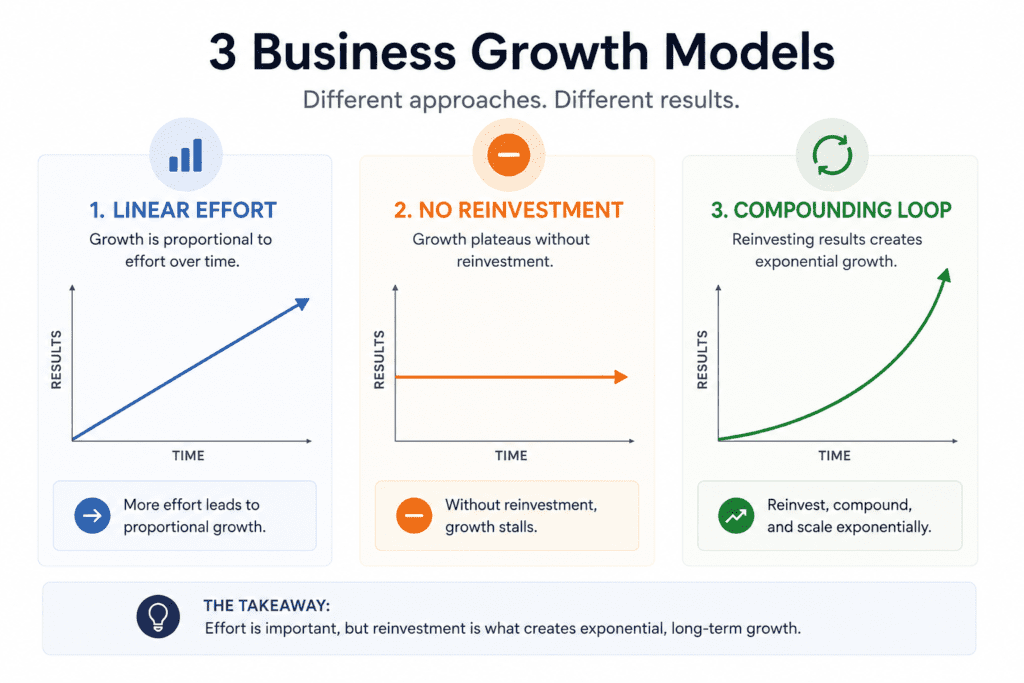
Most small businesses operate linearly: work → earn → spend → repeat. They might save a little, but they rarely reinvest systematically. They’re stuck in the linear effort trap: more hours = more money, but only linearly.
The compounding business operates differently:
- Revenue comes in from sales.
- A fixed, high percentage (e.g., 50%) is automatically reinvested into growth levers: marketing, product development, skill upgrades, or new customer acquisition.
- That reinvestment generates more revenue.
- The cycle repeats, but each cycle is larger than the last.
This is how Amazon operated for years: no profits, all reinvestment. This is how my T-shirt business grew from 50 shirts to a small inventory of 500 within 6 months. The growth wasn’t explosive—it was steady, predictable, and exponential because I was reinvesting the profits, not spending them.
The 3 Core Pillars of a Compounding Business Strategy
To build this, you need a framework. Here’s mine, tested in my own journey from electrician to entrepreneur:
1. The Pillar of Micro-Consistency (The Atomic Business Habit)
Forget massive quarterly goals. Focus on impossible-to-fail daily actions that directly feed your growth loop.
- Sales: Reach out to 1 potential customer or partner daily.
- Marketing: Create 1 piece of valuable content (post, video, article) daily.
- Product: Improve one small aspect of your product/service weekly.
- Learning: Study your market/competitors for 20 minutes daily.
My story: When I sold T-shirts, my daily non-negotiable was: talk to 5 people about my shirts. Some days I sold zero. But the habit of showing up, listening, and refining my pitch compounded into a deep understanding of my market. The sales came not from a “big campaign,” but from the aggregate of thousands of small conversations.
2. The Pillar of Radical Reinvestment (The 50% Rule)
This is the financial engine. Most business owners pay themselves first, then reinvest the “leftover.” Wrong. The compounding business reinvests first, pays themselves second.
- The Rule: Reinvest at least 50% of all profits back into growth channels. Live on the rest.
- Why 50%? It’s aggressive enough to fuel exponential growth, but sustainable enough to keep you motivated.
- Where to reinvest: Paid ads, inventory, skill courses, hiring help, better tools. Anything that can generate more than 1 rupee of revenue per rupee invested.
I lived on 50% of my T-shirt business income for over a year. It meant no fancy meals, no new phone. But that 50% reinvestment bought more inventory, which led to more sales, which led to a larger reinvestment base. The business started funding its own growth.
3. The Pillar of Systematic Tracking (You Can’t Improve What You Don’t Measure)
You need a public or private scoreboard. This is your compass.
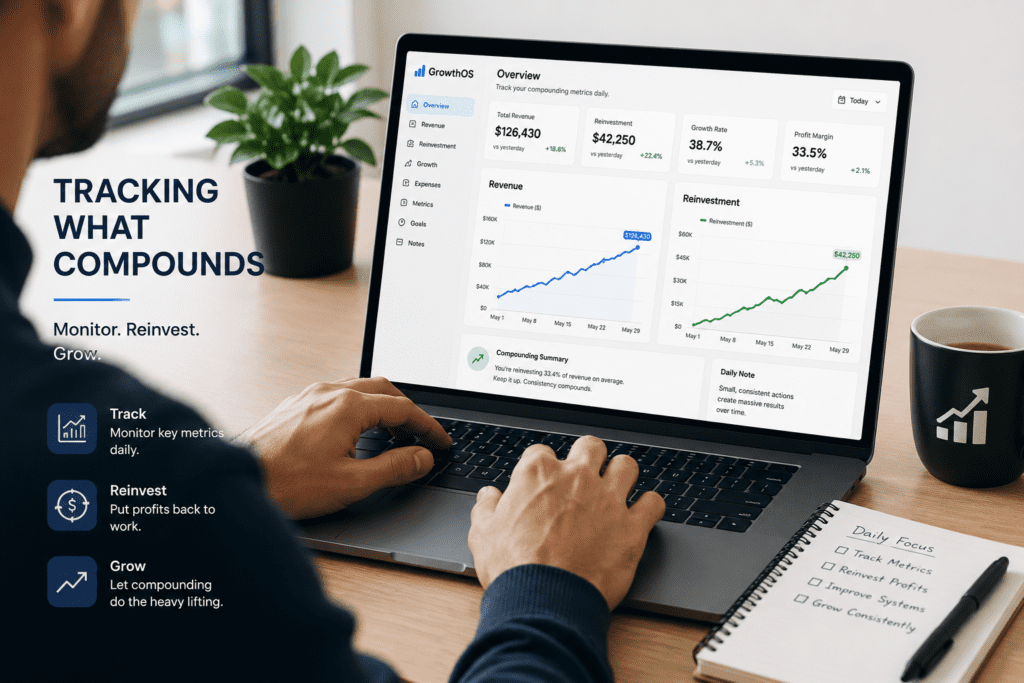
- Tool: A simple Google Sheet or Notion dashboard.
- Metrics to track daily/weekly:
- Revenue
- Reinvestment amount (must be ≥50% of profit)
- Customer acquisition cost (CAC)
- Customer lifetime value (LTV)
- Key activity numbers (calls made, content published, products improved)
- My Trading Journal Applied to Business: I tracked every “trade” (sale, ad campaign, product change). After 100 data points, patterns emerged. I saw which marketing channel had the best LTV:CAC ratio. I saw which product tweaks increased repeat purchases. The act of tracking itself forced better decisions.
How to Apply the Compounding Mindset to Any Business Model
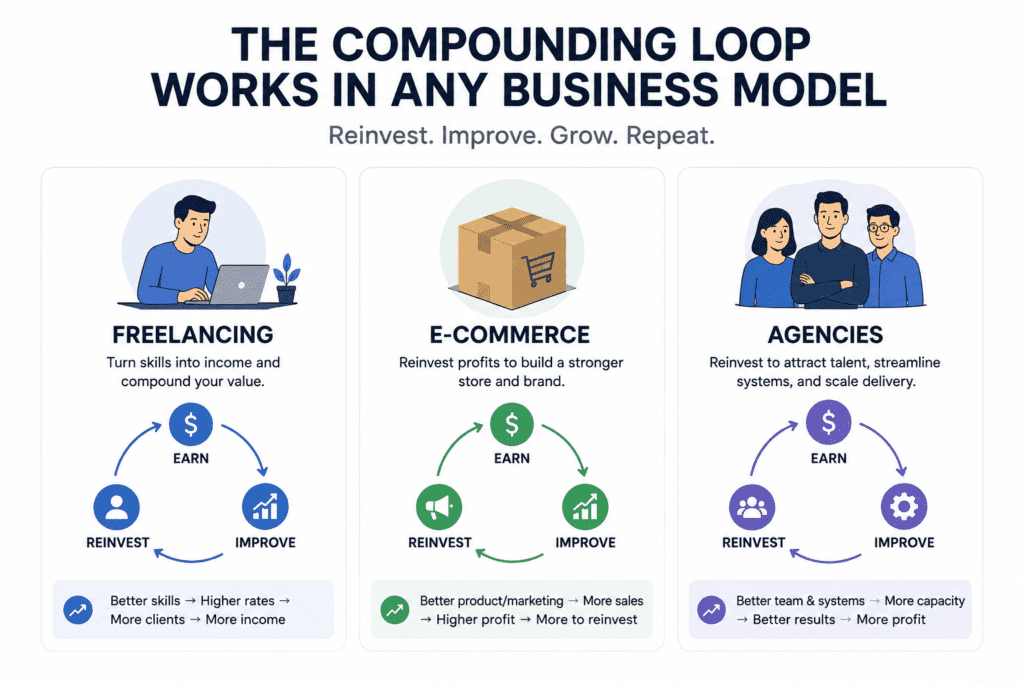
This framework is universal. Here’s how it looks in different business models:
For Freelancers & Solopreneurs
Linear Trap: Trade time for money. More hours = more money, but you hit a ceiling.
Compounding Strategy:
- Productize Your Service: Turn your freelance skill (e.g., copywriting) into a fixed-price package or digital product (e.g., “5-email sequence template”). This creates an asset that sells while you sleep.
- Reinvest 50% of profits into learning (courses, certifications) and marketing (building an email list, content).
- Systematize delivery: Create templates, processes, SOPs. This reduces your time per client, allowing you to take on more without burning out.
Result: Your time becomes more valuable (through products), your marketing compounds (list grows), and your efficiency compounds (SOPs). Income becomes less linear.
For E-commerce & Physical Products
Linear Trap: Buy inventory, sell it, repeat. Profit is taken as income, so next cycle starts at the same size.
Compounding Strategy:
- Reinvest 100% of initial profits into more inventory for the best-selling product.
- Use profit to fund marketing (Facebook/Google ads) that targets lookalike audiences. This compounds your customer base.
- Reinvest in customer experience: Better packaging, follow-up emails, loyalty programs. This increases lifetime value (LTV), which means you can spend more to acquire a customer (CAC), fueling further growth.
Result: Each cycle: more inventory → more sales → more data → better ads → higher LTV → more profit to reinvest. The loop accelerates.
For Service-Based Businesses (Agencies, Consultants)
Linear Trap: More clients = more revenue, but also more hours. You become a prisoner of your own success.
Compounding Strategy:
- Reinvest profits into hiring junior talent or subcontractors. You move from “doer” to “manager” to “owner.”
- Reinvest into systems: CRM, project management tools, automated proposals. This reduces operational friction.
- Reinvest into authority content: Blog, YouTube, podcast. This builds a brand that attracts clients without you having to hunt. This asset compounds for years.
Result: You build a team (scales capacity), systems (scales efficiency), and a brand (scales lead flow). The business grows even if you work less.
The Brutal Truths About Business Compounding (That No One Talks About)
It’s not all sunshine. Here are the hard realities:
1. The First 12-18 Months Feel Like Nothing Is Happening
This is the valley of disappointment. You’re reinvesting, but the growth is slow. Your friends are buying new cars on loans, and you’re driving a beat-up car because you’re reinvesting 50%. It feels unfair. This is where 95% quit. You must trust the math. The curve is flat, but it’s building potential energy. Then, suddenly, it bends upward.
2. Compounding Exposes Your Weaknesses
If your product is mediocre, compounding will just amplify the mediocrity. If your customer service is poor, compounding will spread negative word-of-mouth faster. Compounding is an amplifier, not a fix. You must have a fundamentally sound business—a good product, decent margins, real demand—before compounding can work its magic.
3. It Requires Extreme Patience and Delayed Gratification
You will see competitors take shortcuts, use shady tactics, and get “quick” success. You’ll be tempted to abandon your slow, steady path. Don’t. Most “overnight successes” are 10-year overnight successes that you didn’t see. Their compounding was invisible until it wasn’t.
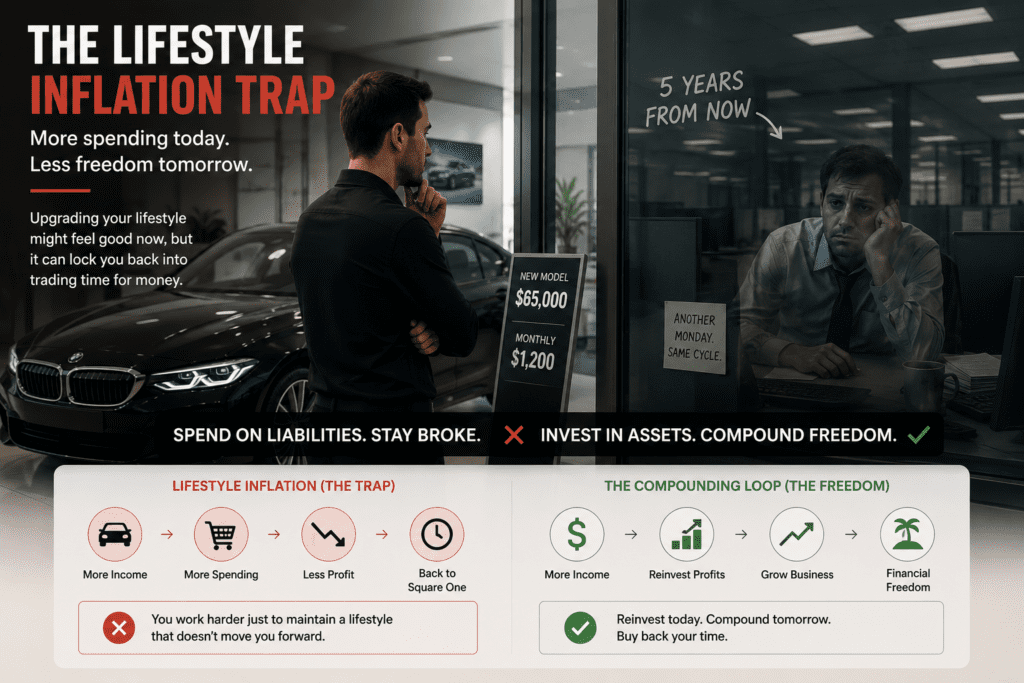
4. Lifestyle Inflation Is Your #1 Enemy
As your business income grows, your lifestyle will scream for an upgrade. New car, bigger house, fancy vacations. If you let lifestyle inflation outpace your reinvestment rate, the compounding engine stalls. I’ve been there. I got a small profit boost and upgraded my phone. That 30,000 PKR could have bought inventory that would have returned 60,000 PKR. I chose a depreciating asset over an appreciating one. I lost the compounding momentum.
Technology & AI: The Ultimate Compounding Accelerator (2026)
We’re in 2026. You don’t have to do everything manually. Technology is a force multiplier for your compounding loop.
- Automated Reinvestment: Set up rules in your accounting software (like QuickBooks) to automatically move 50% of every profit into a separate “Reinvestment Account.” Out of sight, out of mind.
- AI-Powered Marketing: Use tools like Jasper or Copy.ai to turn one blog post into 10 social media captions, 5 email newsletters, and 2 video scripts. One piece of content compounds across 10 platforms.
- AI Customer Service: Chatbots handle FAQs 24/7, freeing you to focus on high-value tasks. The bot’s efficiency compounds as it learns.
- Data Analytics: Tools like Google Analytics 4 + AI insights show you exactly which marketing channels have the best LTV:CAC ratio. You can double down on what works, compounding your marketing ROI.
- Automated Inventory Management: For e-commerce, AI tools predict demand and auto-order stock, ensuring you never miss a sale due to stockouts.
The Warning: Technology is a tool. If your underlying business fundamentals (product, customer service) are weak, AI will just help you fail faster. Build the human-powered compounding loop first, then use tech to automate and accelerate it.
Case Study: How I Applied This to My Trading (It’s the Same Physics)
My forex trading is a direct application of business compounding.
- Micro-Consistency: I risk only 1% per trade. I must take 100 trades to see real data. The daily habit is: analyze charts for 30 mins, execute 1-2 high-probability trades, journal the outcome.
- Radical Reinvestment: I don’t increase my risk size after a win. I keep risk at 1% until my account has grown by 50%. Then I increase risk by 0.1%. Slow, steady, unemotional.
- Systematic Tracking: Every trade is logged: reason, emotion, outcome, lesson. After 100 trades, I review. My win rate improved from 40% to 58% not by magic, but by seeing my own patterns and eliminating emotional decisions.
The result? My account grew 15% in 6 months through consistency, not home runs. That’s business compounding applied to trading: small, repeatable edges, compounded over time.
Pro-Tips: Actionable Steps to Start This Week
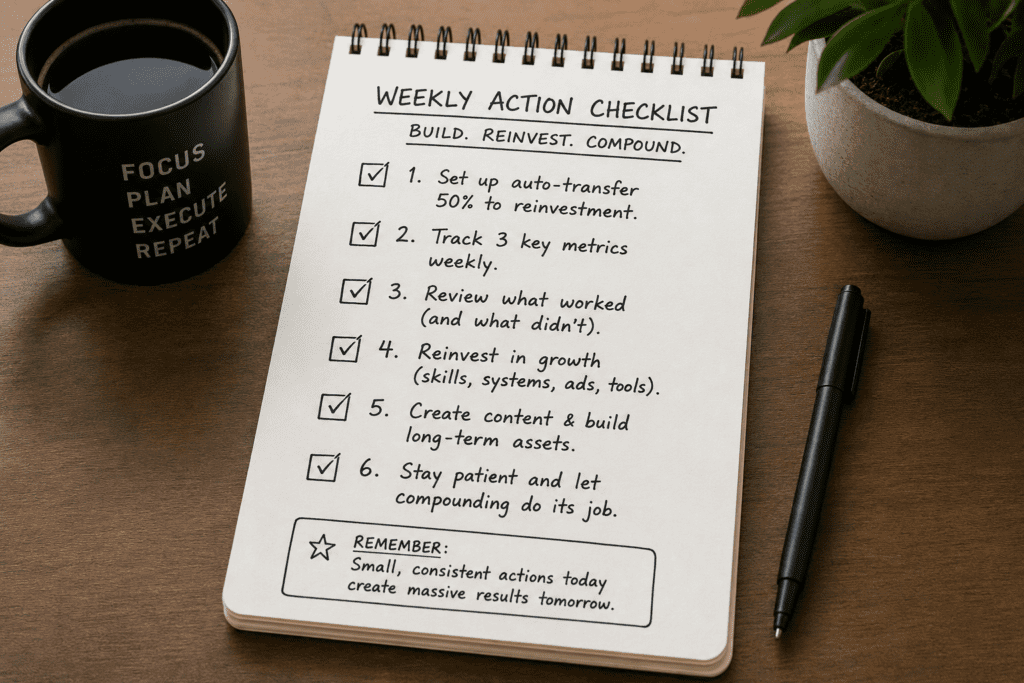
- The 50% Audit: Look at your last 3 months of business income. How much did you reinvest? If less than 30%, commit to 50% starting this month. Set up an automatic transfer to a separate “Reinvestment Account.”
- Identify One Leverage Point: What’s one activity that, if improved by 1% daily, would compound massively? (e.g., sales calls, content creation, product quality). Focus all your energy there.
- Build Your Scoreboard: Create a simple dashboard with 3-5 key metrics (Revenue, Reinvestment %, Customer Satisfaction Score, Lead Count). Update it every Friday. Watch the lines move.
- Copy a Proven System: Find one successful business in your niche (not a giant, but a peer who’s 2-3 years ahead). Study their public moves. Reverse-engineer their core loop. Copy it. Adapt it. Make it yours.
- Protect Your Foundation: Your health and mental clarity are your ultimate assets. Schedule 30 mins of exercise, 10 mins of meditation. Non-negotiable. A burned-out founder destroys compounding.
Conclusion: Your Business Is Already Compounding—Choose the Direction
“The best time to plant a tree was 20 years ago. The second best time is now.” – Chinese Proverb
Look, I’ve been at the bottom. I’ve felt the shame of being the “failed” kid, the desperation of manual labor, the sting of blowing accounts. I know what it’s like to think you’ll never build something that lasts.
But I also know the quiet power of showing up every single day and reinvesting in your future self through your business.
Your business is already compounding. Every decision you make—to spend or reinvest, to chase shortcuts or build systems, to neglect or track metrics—is a vote for either exponential growth or stagnation.
Start today.
- Commit to the 50% Rule. Set up that automatic transfer.
- Pick one metric to track weekly (revenue, customer count, etc.).
- Find one proven business model in your niche and copy its core loop.
- Never stop.
The rich aren’t magic. They’re just consistent. And now, you have the map. The question is: will you start walking?

Key Takeaways / Quick Action Steps
- ✅ Adopt the 50% Reinvestment Rule: Automatically reinvest half of all business profits into growth channels.
- ✅ Build a Daily Scoreboard: Track 3-5 key metrics every week without fail.
- ✅ Copy, Don’t Invent: Find a proven business model in your niche and compound it with your twist.
- ✅ Protect Your Foundation: Never sacrifice health or relationships for business—they’re your ultimate assets.
- ✅ Use Tech to Automate: Automate savings, content repurposing, and data tracking to free up mental energy.
Author Bio
Shurah Beel Hamid is a business enthusiast, active trader, and content creator who turned a life of manual labor and mental health struggles into a mission of building unshakable financial independence. His expertise lies in cutting through the noise of get-rich-quick schemes to focus on the timeless principles of compounding, trading psychology, and elite mindset. He shares his real, unfiltered journey—from electrician to entrepreneur—to provide practical, actionable insights for those building their own path. His writing is a blend of hard-won experience, strategic analysis, and relentless optimism.
Disclaimer
Trading and investing involve significant risk of loss and are not suitable for everyone. Past performance is not indicative of future results. The content on this website is for educational and informational purposes only and does not constitute financial or business advice. You are solely responsible for your own business and investment decisions. Please consult with a qualified financial or business advisor before making any commitments. The author’s personal experiences are not a guarantee of results for any individual.