Key Takeaways
- A fair value gap (FVG) is a gap left on the chart when price moves so fast that a section gets skipped — creating an imbalance between buyers and sellers.
- The theory is that price tends to return to “fill” this gap before continuing, because the market wants to rebalance the skipped area.
- An FVG is a simple three-candle pattern — once you see it, you cannot unsee it.
- FVGs are most powerful when combined with other concepts like order blocks and trend direction, not used alone.
- Like every trading concept, knowing what an FVG is and trading it profitably are two different skills separated by real experience.
You have seen it happen. Price rockets up so fast it leaves a visible gap on the chart — and then, like it has unfinished business, it comes back down to that exact area before continuing higher. It felt almost magnetic, like price was pulled back to fill something. That something has a name: a fair value gap.
Fair value gaps — or FVGs — are one of the most useful ICT concepts for beginners, partly because they are genuinely simple to spot once you know what you are looking for. But like every concept in this space, they are wrapped in enough jargon that beginners feel intimidated before they even understand the basic idea, which is actually quite intuitive.
This guide cuts through all of that. The Data Pips Team will explain what a fair value gap actually is, why price seems to return to it, how to spot one in seconds, and how to use it in your trading — in plain language, with no assumption that you already speak fluent ICT. Let us get into it.
What Is a Fair Value Gap — In Plain English?
Let us define it simply.
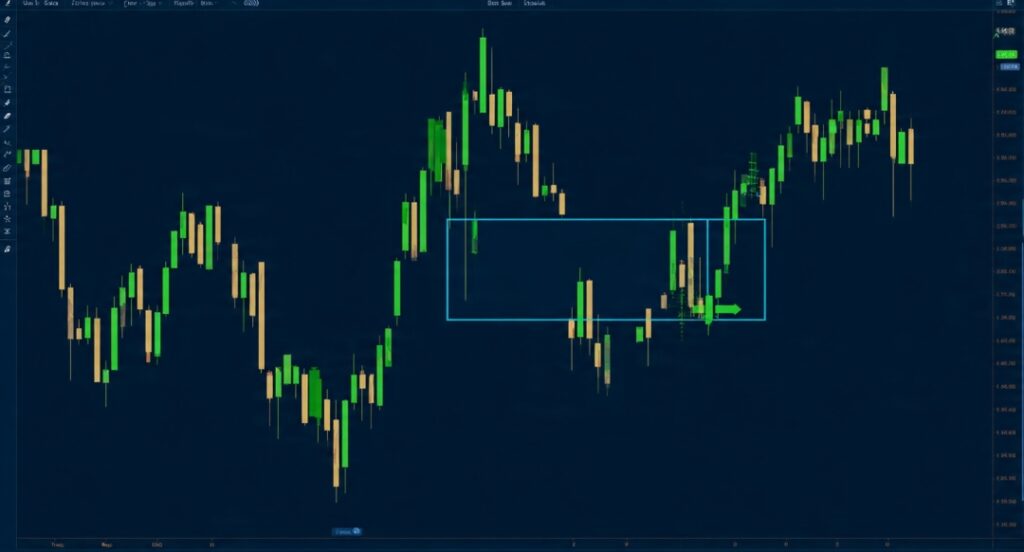
A fair value gap is an area on the chart that price skipped over because it moved too fast — leaving a gap where very little trading actually happened.
Think about it this way. Normally, as price moves up or down, it trades through every level relatively smoothly — buyers and sellers exchanging at each price along the way. But sometimes, price moves so explosively fast — usually driven by a sudden burst of institutional buying or selling — that it leaps past a section, leaving a “gap” where almost no trading occurred. Buyers and sellers never properly met in that zone. That untraded area is the fair value gap.
The word “imbalance” is often used for this, and it captures the idea well. In a normal market, buying and selling are roughly balanced at each price level. In a fair value gap, there was a sharp imbalance — one side completely overwhelmed the other so fast that the price zone got skipped. The market left behind an area that was never fairly traded.
This is related to the general concept of a gap in trading, which Investopedia describes as an area on a chart where price moves sharply with little or no trading in between. The fair value gap is a specific, candle-based version of this idea used heavily in ICT and smart money trading.
If you understand candlesticks — and if you do not, Investopedia explains them clearly — then you are ready to spot fair value gaps, because they are defined by a simple three-candle pattern that we will cover next.
— Data Pips Team
How to Spot a Fair Value Gap (The Three-Candle Pattern)
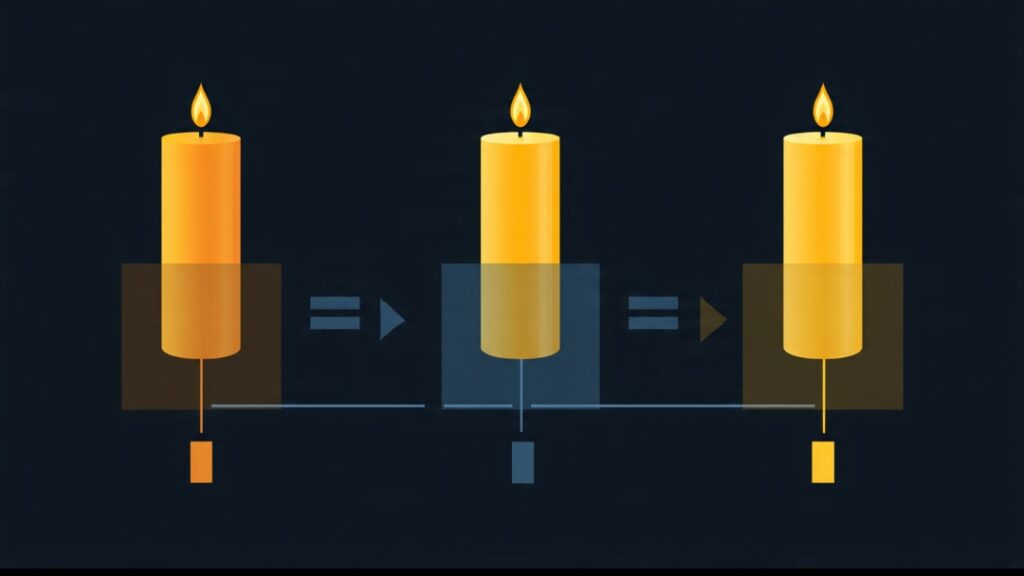
Here is the genuinely simple part. A fair value gap is identified using three consecutive candles. Once you learn this pattern, you will spot FVGs instantly on any chart.
Look at any three candles in a row where the middle candle is a strong, large candle (a big move). Then check this: is there a gap between the wick of the first candle and the wick of the third candle?
Let us break it down for a bullish (upward) fair value gap:
- The first candle has a high (the top of its upper wick).
- The middle candle is a big, strong upward candle.
- The third candle has a low (the bottom of its lower wick).
- If the low of the third candle is ABOVE the high of the first candle, there is a gap between them — that empty space is the bullish fair value gap.
For a bearish (downward) fair value gap, it is the mirror image:
- The first candle has a low.
- The middle candle is a big, strong downward candle.
- The third candle has a high.
- If the high of the third candle is BELOW the low of the first candle, the empty space between them is the bearish fair value gap.
In simple terms: you are looking for a strong middle candle that created a clean gap between the candle before it and the candle after it. That gap is the FVG. It represents the price zone the market skipped over during the fast move.
Once you train your eyes on this three-candle pattern, you will see fair value gaps everywhere — and the challenge, as always, shifts from spotting them to knowing which ones actually matter.
Why Does Price Return to Fill the Gap?
Okay, so you can spot an FVG. But why does price come back to it? Why does the gap seem to act like a magnet? Here is the logic.
Remember that a fair value gap represents an imbalance — an area where one side (buyers or sellers) completely overwhelmed the other, so fast that the zone was never fairly traded. The theory holds that markets naturally seek balance. An area that was never properly traded represents “unfinished business” — and price tends to return to that zone to allow proper trading to occur, rebalancing the imbalance before continuing.
There is also an institutional angle. Large players — the smart money — often were not able to fill all their orders during the fast move that created the gap. When price returns to the FVG zone, those remaining orders can be filled, which provides a logical reason for the market to revisit the area. The institutions essentially get a “second chance” to enter at better prices within the gap.
So when traders see a fair value gap, they watch for price to return to it — expecting that the gap will act as a zone where price reacts. A bullish FVG below current price becomes a potential support zone where buyers may step in when price returns. A bearish FVG above current price becomes a potential resistance zone where sellers may step in.
Is this guaranteed? No. Not every fair value gap gets filled, and not every fill produces a clean reaction. But it happens often enough that FVGs have become one of the most widely used tools for identifying potential entry zones and targets. For the broader framework behind why institutions move price in these patterns, read our beginner guide on what ICT concepts are in forex trading.
How Beginners Actually Use Fair Value Gaps
Fair value gaps have two main practical uses for traders. Understanding both helps you see where they fit in your trading.
1. As Entry Zones
The most common use. When you identify a quality fair value gap, you wait for price to return to it, and you look to enter in the direction of the original strong move when price reaches the gap. A bullish FVG becomes a zone to look for buy entries when price pulls back into it. A bearish FVG becomes a zone to look for sell entries. The gap gives you a specific, logical area to watch rather than guessing where to enter.
2. As Targets
The second use is as a target or magnet. If there is an unfilled fair value gap sitting above or below current price, it can act as a target — a level price may be drawn toward to fill the imbalance. Traders use unfilled FVGs to anticipate where price might head next, treating the gap as a likely destination.
The Basic Entry Approach
Here is the simple beginner method for trading an FVG as an entry: First, identify a quality fair value gap aligned with the trend direction. Second, wait patiently for price to return to the gap — do not chase. Third, look for some confirmation that the gap is reacting (a rejection, a shift) rather than entering blindly. Fourth, place your stop loss beyond the gap, where it is protected by structure rather than at the obvious level. Fifth, target a logical level — the next liquidity zone, a recent high or low, or a favorable risk-reward ratio.
Notice how similar this is to trading order blocks — wait for return, look for confirmation, protect your stop, target logically. That is because these concepts are part of the same framework and work best together. Our guide on order blocks explained for beginners covers the complementary concept in detail.
Real Pattern: The Gap That Got Filled vs. The One That Didn’t
Consider a trader watching Gold. Price makes a strong upward move, leaving a clear bullish fair value gap behind. The higher timeframe trend is bullish, so this gap aligns with the bigger direction — a quality setup.
The trader waits. Price pulls back, returns to the fair value gap, shows a rejection candle (buyers stepping in), and the trader enters long with a stop just below the gap. Price bounces from the gap and continues upward in the direction of the trend. The gap acted exactly as theorized — a zone where the move resumed.
But the same week, the trader spots another FVG — this one formed during a choppy, sideways market, against the higher timeframe trend, in the middle of directionless noise. They are tempted to trade it the same way. This time, price slices straight through the gap without reacting, because the gap had no real significance — it formed in noise, not in a meaningful move.
Lesson: The concept did not fail. The quality of the gap determined the outcome. A fair value gap aligned with the trend, formed during a strong move, is high probability. One formed in noise, against the trend, is just an empty box on the chart. Learn to tell the difference.
How to Spot a GOOD Fair Value Gap (Not Just Any Gap)
Just like order blocks, the basic FVG pattern appears constantly — and most of them are meaningless. Here is how to filter for the ones that actually matter:
1. It Formed During a Strong, Decisive Move
The best FVGs come from powerful, impulsive moves — the kind driven by real institutional momentum. A gap left by a weak, hesitant move is far less significant than one left by an explosive, decisive move. The stronger the move that created the gap, the more meaningful the gap.
2. It Aligns With the Higher Timeframe Trend
A fair value gap that points in the same direction as the bigger trend is far more reliable. A bullish FVG in a bullish market is high probability. A bullish FVG in a strongly bearish market is fighting the bigger move — and usually loses. Always check the trend direction first.
3. It Is Still Unfilled (Fresh)
A fair value gap that price has not yet returned to is “fresh” and more likely to react. Once price has already passed through and filled the gap, that zone often loses its significance. The first return to a fresh, quality FVG is usually the highest-probability moment.
4. It Lines Up With Other Concepts
The most powerful fair value gaps do not stand alone — they line up with other signals. An FVG that sits right at a quality order block, or near a liquidity zone, or that forms right after a liquidity sweep, carries far more weight than an isolated gap. This stacking of signals is called confluence, and it is what separates high-probability setups from random ones. Our guide on liquidity sweeps covers a concept that combines especially powerfully with fair value gaps.
Where Beginners Go Wrong With Fair Value Gaps
They Trade Every Gap They See
Because the three-candle pattern is so easy to spot, beginners find FVGs everywhere and try to trade all of them. Most are meaningless — formed in noise, against the trend, or already filled. Quality over quantity. Trade only the gaps that pass the filters: strong move, trend alignment, fresh, and ideally with confluence. If you are marking ten FVGs on a single chart, you are seeing noise, not setups.
They Enter Blindly When Price Reaches the Gap
Beginners often enter the instant price touches the fair value gap, without waiting for any confirmation. Many gaps get sliced straight through. Waiting for a sign that the gap is actually reacting — a rejection, a shift in momentum — dramatically improves results. The gap is a zone to watch, not an automatic entry trigger.
They Trade FVGs Against the Trend
A fair value gap fighting the dominant trend is low probability. Beginners spot a bullish FVG in a bearish market, buy it, and get run over as the downtrend continues. The trend is the context that determines whether a gap is likely to hold. Always trade FVGs in the direction of the bigger move, not against it.
They Think the Concept Alone Makes Them Profitable
The familiar deepest trap. Understanding fair value gaps feels like progress — and it is, at the level of knowledge. But knowing what an FVG is and trading it profitably under real market pressure are completely different skills. The Data Pips Team has seen this endlessly: traders who can identify perfect FVGs in hindsight and explain the theory flawlessly, yet still lose money, because real-time execution with real emotions and real money is a separate skill that only experience builds. Our guide on why traders confuse being right with being profitable explains this gap in depth.
— Data Pips Team
The Truth About Fair Value Gaps Nobody Tells Beginners
1. Not Every Gap Gets Filled
The theory says price returns to fill fair value gaps — and it often does. But not always. Some gaps never get filled, especially in very strong trends where price keeps running without looking back. Beginners who assume every gap MUST be filled get into trouble waiting for fills that never come, or placing targets at gaps that price ignores. Treat gap fills as a tendency, not a certainty. Probability, not prophecy.
2. They Look Obvious in Hindsight, Harder in Real Time
Scrolling back through charts, you can clearly see which fair value gaps got filled and reacted beautifully. In real time, you do not know whether a fresh gap will be respected or ignored until after the fact. This gap between hindsight clarity and real-time uncertainty is why FVGs feel easy to understand but harder to trade. Respect the difference, and never assume live trading is as clean as the backtested chart looks.
3. Smaller Gaps on Lower Timeframes Are Mostly Noise
On very low timeframes, tiny fair value gaps form constantly, and most of them are meaningless market noise. The meaningful, tradeable FVGs tend to form on higher timeframes during significant moves. Beginners who trade tiny low-timeframe gaps drown in noise and false signals. Focus on quality gaps on higher timeframes, where the concept is far more reliable and the psychological pressure is more manageable.
4. Confluence Is Everything
A fair value gap by itself is a useful but modest signal. A fair value gap that lines up with an order block, sits at a key level, and forms after a liquidity sweep, all aligned with the trend — that is a high-probability setup. The traders who use FVGs well rarely trade them in isolation. They wait for multiple signals to stack up. Learn to combine FVGs with order blocks, liquidity sweeps, and trend direction, and the concept becomes far more powerful.
5. The Concept Will Not Fix a Discipline Problem
The familiar hard truth. Learning fair value gaps will not make you profitable if your real problem is a lack of discipline. If you overtrade, oversize positions, revenge trade, or abandon your plan under pressure, FVGs change nothing — you will just lose money with a more sophisticated-sounding reason. The concept is a tool. Discipline is what makes any tool work. Most traders need to fix their psychology far more than they need to learn one more concept. Our guide on mechanical discipline covers exactly this.
Your Fair Value Gap Practice Plan
Now It’s Your Move
- Learn to spot the three-candle pattern. Strong middle candle, gap between the first and third candle wicks. Practice until you can spot FVGs instantly on any chart.
- Apply the quality filter. Strong move + trend alignment + fresh + confluence. Only mark FVGs that pass these filters. Ignore the noise.
- Practice in hindsight before risking money. Open historical charts. Find quality FVGs. See which got filled and reacted, and which got ignored. Train your eye.
- Wait for confirmation at the gap. Do not enter the instant price touches the FVG. Wait for a reaction — a rejection, a shift — before entering.
- Combine FVGs with other concepts. An FVG at an order block, after a liquidity sweep, aligned with the trend, is far stronger than a gap alone. Look for confluence.
- Protect your stops with structure. Place stops beyond the gap where they are protected, not at the obvious levels the market hunts.
- Treat gap fills as probability, not certainty. Not every gap gets filled. Manage your risk so that the gaps that work outweigh the ones that fail over many trades.
Frequently Asked Questions
A fair value gap is an area on the chart that price skipped over because it moved too fast, leaving a zone where very little trading actually happened. It represents an imbalance — one side (buyers or sellers) overwhelmed the other so quickly that a price zone was never fairly traded. FVGs are identified using a simple three-candle pattern: a strong middle candle that creates a gap between the wick of the candle before it and the wick of the candle after it. The theory is that price tends to return to fill this gap before continuing, because the market seeks to rebalance the skipped area.
Look at three consecutive candles where the middle candle is a strong, large move. For a bullish FVG, check if the low of the third candle is above the high of the first candle — the empty space between them is the gap. For a bearish FVG, check if the high of the third candle is below the low of the first candle. In simple terms, you are looking for a strong middle candle that created a clean gap between the candle before it and the candle after it. That gap represents the price zone the market skipped during the fast move. Once you learn this three-candle pattern, you will spot FVGs instantly.
The theory is that markets naturally seek balance, and a fair value gap represents an imbalanced area that was never fairly traded — essentially “unfinished business.” Price tends to return to this zone to allow proper trading to occur. There is also an institutional explanation: large players often could not fill all their orders during the fast move that created the gap, so when price returns to the FVG, those remaining orders can be filled, giving the market a logical reason to revisit the area. However, not every gap gets filled — it is a strong tendency, not a guarantee.
The basic approach: First, identify a quality FVG aligned with the trend direction. Second, wait patiently for price to return to the gap rather than chasing. Third, look for confirmation that the gap is reacting — a rejection or momentum shift — instead of entering blindly. Fourth, place your stop loss beyond the gap where it is protected by structure, not at the obvious level. Fifth, target a logical level like the next liquidity zone or a favorable risk-reward ratio. FVGs work best when combined with other concepts like order blocks and trend alignment rather than traded in isolation.
No. While price often returns to fill fair value gaps, it does not always happen — especially in very strong trends where price keeps running without pulling back. Beginners who assume every gap must be filled get into trouble waiting for fills that never come or setting targets at gaps that price ignores. Treat gap fills as a tendency or probability, not a certainty. The skill is identifying high-quality gaps — those formed during strong moves, aligned with the trend, still fresh, and with confluence — which have a much higher likelihood of being respected than random gaps formed in market noise.
Both are ICT concepts used to find entry zones, but they identify different things. An order block is the last candle before a strong move in the opposite direction, marking where institutions placed orders. A fair value gap is the imbalance or gap left behind when price moved so fast it skipped a zone — identified by a three-candle pattern. They often appear near each other and work powerfully together: a fair value gap that sits right at a quality order block creates a high-probability confluence zone. Many traders use both concepts together rather than choosing one over the other.
Yes, fair value gaps are one of the more beginner-friendly ICT concepts because the three-candle pattern is genuinely simple to identify. However, the ease of spotting them is also a trap — beginners tend to trade every gap they see, most of which are meaningless noise. The real skill is filtering for quality gaps that formed during strong moves, align with the trend, remain fresh, and have confluence with other signals. Beginners should also understand that knowing what an FVG is and trading it profitably are two different skills separated by real experience, discipline, and screen time.

Now It’s Your Move
That magnetic pull you noticed — price racing up, leaving a gap, then returning to it before continuing — was never magic. It was a fair value gap: an imbalanced zone the market skipped over too fast, and then returned to rebalance. Once you see the three-candle pattern, you cannot unsee it. FVGs are everywhere, and now you understand what they actually are.
But understanding the pattern is the easy part. The real skill is filtering — trading only the gaps that formed during strong moves, align with the trend, remain fresh, and stack with other signals like order blocks and liquidity sweeps. Most gaps are noise. The few that matter are the ones worth trading, and learning to tell them apart is what separates beginners who lose from traders who profit.
And remember the deeper truth that applies to every concept in this space: knowing what a fair value gap is will not make you profitable on its own. It is a tool. Whether the tool works depends on your discipline, your patience, your risk management, and the real-time judgment that only experience builds. The trader who masters a few concepts deeply and executes them with discipline beats the one who collects every concept and trades them with confusion.
Learn the pattern. Apply the filter. Practice in hindsight. Wait for confirmation. Combine with confluence. Protect your stops. And give yourself the years it takes to convert this knowledge into genuine skill.
You now understand fair value gaps better than most beginners ever will. What you do with that understanding over the coming months is what turns it into something real.
For your next steps, read our guides on order blocks for beginners and liquidity sweeps — the two concepts that combine most powerfully with fair value gaps. Then tie it all together with our complete ICT trading strategy guide.