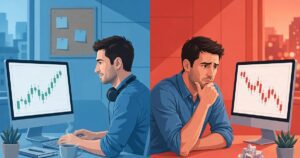
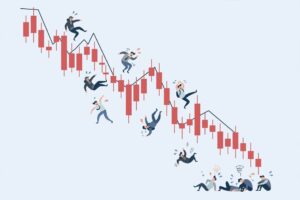
A FOMO trade rarely feels like a mistake at the moment it’s entered. It feels like finally acting on something that’s clearly already working — price is moving, the setup looks obvious in hindsight, and staying out feels like the riskier choice. That inversion, where entering late feels safer than waiting, is the specific psychological signature of FOMO, and it’s been studied closely enough to name the exact mechanism behind it.
- A peer-reviewed study of retail investors found that FOMO actively mediates the relationship between loss aversion, herd behavior, and investment decisions — meaning it’s a measurable link in the chain, not just a vague feeling.
- The specific driver behind FOMO is regret aversion — research shows the anticipated pain of missing a move often outweighs the actual financial risk of chasing it.
- By the time a move is visible enough to trigger FOMO, most of the statistically favorable part of it has typically already happened.
- The clearest sign of a FOMO trade isn’t the outcome — it’s the absence of a predefined entry criterion at the moment the trade was taken.
What the Research Actually Shows
A study published in the International Journal of Emerging Markets surveyed 323 retail stock market investors and used structural equation modeling to test how loss aversion and herd behavior influence investment decisions. The findings showed that FOMO doesn’t just sit alongside those two biases — it actively mediates between them, meaning the fear of missing out is part of the mechanism through which loss aversion and herding actually translate into trading decisions, not a separate, independent factor. The presence of FOMO measurably strengthened the influence of both biases on the eventual decision.
This matters because it means FOMO isn’t a standalone emotional weakness to simply “manage better” — it’s the channel through which two other well-established biases (the fear of losing, and the pull to match what others are doing) actually express themselves in a trade being taken. Addressing FOMO directly interrupts more than one bias at once.
Why Missing Out Feels Worse Than Losing Money
The specific mechanism behind FOMO is what behavioral economists call regret aversion — a well-established finding that the anticipated regret of not acting on an opportunity frequently outweighs the actual financial risk of acting on it. This produces a strange but consistent pattern: a trader who would never knowingly risk a fixed amount on an unplanned, rules-free trade will readily chase an already-extended move, because in that moment the prospect of watching it continue without them feels worse than the prospect of losing money entering it.
This asymmetry is what makes FOMO trades identifiable by a specific tell: they almost never come with a predefined stop loss, position size, or exit plan, because the trade wasn’t entered against a plan in the first place — it was entered to relieve the discomfort of not having acted yet.
Why the Trade Is Usually Already Too Late
FOMO functions, structurally, as a lagging indicator. By the time a move is visible enough — trending, discussed, obviously working — to trigger the fear of missing it, the earlier and statistically more favorable part of that move has typically already occurred. The people positioned before the visibility threshold were, by definition, acting on something other than the crowd’s attention; anyone entering once the crowd has noticed is buying into whatever’s left of the move, at a worse risk-to-reward ratio than existed earlier, often right as the move is exhausting itself.
This connects directly to the overtrading mechanism covered in Overtrading: How It Empties Trading Accounts — both patterns share the same underlying reward-seeking loop, but FOMO specifically channels that loop toward chasing price rather than simply trading more often.
Distinguishing FOMO From a Legitimate Late Entry
Not every entry taken after a move has started is a FOMO trade — the distinction isn’t timing, it’s process:
- A FOMO entry has no predefined criteria that existed before the move caught attention, is driven by urgency rather than analysis, and sizes the position based on how much of the move already feels “missed” rather than on a standard risk formula.
- A legitimate reactive entry meets the trader’s existing, pre-written rules, has a clearly defined risk before entry, uses standard position sizing, and comes with a risk-to-reward case that can actually be articulated — not just a feeling that the move is continuing.
The single most reliable test: if a clear entry thesis can’t be written down before the trade is placed, that’s the signal to reduce size or skip the trade entirely — not a reason to enter smaller “just in case.”
Interrupting the Pattern
- Define entry criteria during low-emotion periods, in writing, before the market session. Rules set in advance are far more resistant to override in the moment than rules recalled from memory while the urge is active.
- Treat an extended, already-visible move as evidence against entry, not for it. The more attention a move has attracted, the more of its favorable risk-to-reward has typically already been spent.
- Keep a specific FOMO log — every urge to chase, written down instead of acted on, along with the price and the outcome a week later. Reviewing this over time makes the lagging-indicator pattern concrete rather than theoretical.
- Build a mandatory pause before any unplanned entry — even sixty seconds of deliberately checking the trade against written criteria interrupts the urgency that regret aversion depends on to bypass analysis.
This pairs directly with the discipline covered in Why Profitable Traders Still Blow Accounts — a FOMO entry sized without a plan is exactly the kind of position that turns a survivable strategy into a blown account, regardless of how sound the trader’s actual edge is on properly planned trades.
Why This Compounds With Other Trading Signals
FOMO gets particularly dangerous when combined with external signals — a tip, a trending chart, someone else’s public trade — because the social-proof element of herding adds a second bias on top of regret aversion. See Trading Signals vs. Financial Suicide: A Reality Check for the specific risks that show up when an entry decision outsources its criteria to someone else’s visible activity rather than a trader’s own written rules.
It’s also worth recognizing that FOMO and its opposite — freezing rather than acting — often trace back to the same underlying discomfort with uncertainty, just expressed in different directions. See Why Traders Freeze Before Big Moves.
This article is for general educational purposes and summarizes published behavioral finance research. It is not personalized trading or investment advice. Trading carries a high risk of loss — consult a qualified financial advisor before making trading decisions.
FAQs
Can FOMO trades ever be profitable?
Individual FOMO trades can win, purely by chance, since the market doesn’t know a trade was entered without a plan. The research concern isn’t any single outcome — it’s that the entry method itself is negative-expectancy on average, because it systematically enters after the favorable part of a move and without a defined risk.
Does experience reduce FOMO over time?
Awareness helps, but the underlying mechanism — regret aversion — is a well-established, persistent bias rather than something that fades with time in the market. Structural safeguards (written criteria, mandatory pauses) tend to be more reliable than expecting the urge itself to weaken with experience alone.
Next step: for the broader risk-management framework that makes both FOMO entries and oversized positions less likely to happen in the first place, see Risk Management in Trading Psychology: Beyond the Basics.
About the Author
Shurah writes and maintains DataPips independently, drawing on hands-on experience in trading and entrepreneurship. Articles are shaped by personal research, real trading lessons, and the process of building this publication from scratch — not by a formal financial credential.