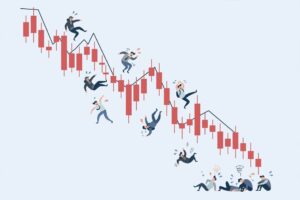
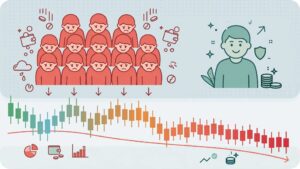
It is 11:40 on a Wednesday night. A trader I know was up for the week — three clean wins, plan followed, journal updated. Then one setup failed, then another, and by midnight he had given the whole week back plus a chunk of the account, trading twice his normal size on setups he would have laughed at that morning. The strategy did not change between 9 AM and midnight. The person running it did.
That is the whole of trading psychology in one evening: the plan was fine, the execution collapsed, and the collapse followed a pattern. The good news is that patterns can be trained. Not read about. Trained.
Short answer
You build trading psychology the way you build any skill: small daily reps with feedback, not motivation. Write the plan before the session, size every loss so it feels boring, stop trading at a pre-set daily loss limit, journal each trade in five minutes, and review the week for process — not profit. Expect two to three months before the new responses feel automatic.
Key takeaways — where I stand
- Your brain treats a loss as roughly twice as painful as an equal gain is pleasant. That is not a character flaw; it is documented human wiring, and every trading plan has to be built around it.
- Reading about discipline has never made anyone disciplined. Only repeated, reviewed execution does. Treat psychology as a training schedule, not a personality trait.
- The single highest-leverage rep is deciding everything before the session starts. A decision made at midnight, mid-drawdown, is not a decision — it is a mood with a mouse.
- Position size is a psychology tool, not just a math tool. If a single loss can ruin your evening, the size is wrong regardless of what the math says.
- Measure adherence to your plan, not your profit, in the weekly review. A profitable week of broken rules is a failure wearing a disguise.
The two studies that explain your worst trading days
Before the training plan, it helps to know what you are training against. Two pieces of research, nearly fifty years apart in origin, describe the exact mistakes from that Wednesday night.
In 1979, Daniel Kahneman and Amos Tversky published prospect theory, showing that people judge outcomes as gains or losses against a reference point — usually their entry price — rather than as changes in total wealth, and that losses sting roughly twice as much as equivalent gains please. That finding is not a dusty curiosity: a 2020 global replication study with 4,098 respondents across multiple countries reproduced the core effects at about a 90% rate. The wiring is real, it is current, and it is in you.
Then in 1985, Hersh Shefrin and Meir Statman named the disposition effect: investors sell their winners too early and ride their losers too long. They traced it to four ingredients — loss aversion, mental accounting, regret avoidance, and self-control. Read that list again and you have the Wednesday-night script: the trader could not accept the sure small loss (loss aversion), tracked each trade against its entry instead of the account (mental accounting), dreaded the feeling of being wrong (regret avoidance), and had no mechanism to stop himself (self-control). As one secondary explainer puts it, winning £100 carries roughly the emotional weight of losing £50 — which is why a trader fights ten times harder to avoid a small loss than to protect a big gain.
Why does this matter for a “how to build” article? Because it reframes the job. You are not trying to become a fearless person. You are trying to build procedures that work despite a brain that, left alone, will reliably do the wrong thing at the worst moment. That is a training problem, and training problems have training solutions.
Why reading about psychology has never fixed anyone’s psychology
Here is the uncomfortable part. Most trading psychology content — including, frankly, plenty of articles like the ones on this site — describes the biases and stops there. You nod along, recognise yourself in the fear-and-greed paragraph, and trade exactly the same way on Monday. Recognition is not training.
Think about how any other high-pressure skill is built. Nobody learns to stay calm in an emergency by reading about calmness. They drill the response until the drilled response fires before the panic does. Trading is the same: the goal is not to eliminate emotion — the research on habit formation suggests new behaviours take around 66 days on average to become automatic (Phillippa Lally’s 2010 UCL study of 96 people, with a range of 18 to 254 days) — the goal is to install a small set of responses so well-rehearsed that they trigger before the emotion finishes its sentence.
Two practical consequences follow. First, the early reps matter most: habit research shows the biggest gains in automaticity come from the first repetitions, then the curve flattens. So the first month of doing the routine below counts double. Second, missing a day does not reset anything — in Lally’s study, a single missed day had no meaningful effect on the outcome. Consistency over months beats intensity over a weekend. Judge the program at the two-to-three-month mark, not at day nine.
The five-rep training plan
Five reps. Small enough to do every day, specific enough to score. Run them in order for at least sixty trading days before you change anything.
Rep 1 — Decide everything before the session
The most important decision in trading psychology is when decisions get made. Write these four lines before the market opens, on paper or in a note you cannot edit mid-session:
- My valid setup today is…
- A trade idea is proven wrong when…
- I am risking X per trade, and I stop trading today after Y in losses or Z losing trades.
- Conditions under which I do not trade at all (tired, rushed, already emotional).
The logic is simple and it is the backbone of the whole plan: a calm morning version of you makes better rules than a midnight version of you who is down money. During the session you execute; you do not renegotiate. New information that genuinely changes the thesis can be noted for tomorrow’s plan — it does not get to rewrite today’s.
This is also where the core pillars of trading psychology get their daily workout: a plan turns abstract principles like patience and discipline into checkable behaviour.
Rep 2 — Accept the loss before you take the trade
Before every entry, say the sentence out loud or type it in your journal: “I am fine losing this trade.” If some part of you flinches, the position is too big — cut the size until the loss feels boring. A boring loss is a tradeable loss; an exciting loss is a future revenge trade wearing a costume.
I learned the underlying sequence the hard way, long before I had words for it: calm first, then assess, then decide. Breathe, pause, look at the actual options on the screen rather than the story in your head, and only then act. When the calm step is skipped, the assessment step never really happens — you just react, and reaction in a drawdown is almost always the disposition effect talking. Traders who confuse being right with being profitable usually skipped exactly this pause: they needed the trade to validate them, so no loss felt acceptable.
Rep 3 — Install a circuit breaker
Decide your daily stop in advance — a loss amount, a number of losing trades, or both, whichever hits first — and treat it like a fuse, not a suggestion. When it blows, the screens go off. No “one more to get back to even.” Getting back to even is the market’s favourite lie; it is loss aversion dressed up as a plan.
Start conservative: many traders use 2–3% of the account or three consecutive losses as the tripwire. The exact number matters less than the absoluteness of it. Overtrading empties accounts precisely because there is no breaker — one bad afternoon compounds into a bad month. The breaker converts “I will try to be disciplined” into “the day ends here,” which is the only version of discipline that survives contact with a red screen.
Rep 4 — The five-minute journal
After each trade, or at minimum at the end of the session, answer three questions:
- Did I follow the plan? (Score 1–5.)
- What was the dominant emotion during the trade?
- One line: what did I learn?
Five minutes. The score is the point — it turns vague self-improvement into a number you can track. Over weeks, patterns surface that no amount of introspection reveals: maybe your adherence collapses specifically on the third trade of the day, or after news events, or when you trade outside your planned hours. Those patterns are the curriculum. This is also where recency bias gets caught: the journal shows you that last week’s disaster was one data point, not your identity.
Rep 5 — The weekly review (process, not profit)
Once a week, thirty minutes, three numbers:
- Adherence rate: what share of trades followed the plan?
- Revenge rate: how many trades were taken within an hour of a loss?
- Break rate: how often did you exceed the risk cap or the daily stop?
Look at these next to your profit-and-loss, but keep them separate. A green week with a 60% adherence rate is a warning, not a victory — the market paid you for behaviour that will eventually bill you. A red week with 95% adherence is a strategy question, not a psychology problem, and it deserves a strategy review instead of self-blame.
One lesson I picked up from watching patient traders, and it took me years to actually believe: the market rewards patience, not urgency. The traders who last are not the ones who react fastest — they are the ones who can sit through a whole session, take nothing, and call it a good day because the setups never came. Urgency feels like edge. It is usually just emotion with a work ethic.
If the weekly review shows the same broken rule three weeks running, the fix is structural, not motivational: shrink size further, add a hard trade-count cap, or tighten the risk framework until the rule becomes easy to keep. Willpower is a bad plan; design is a good one.
Size the loss your psychology can actually take
Here is where psychology meets arithmetic. Your circuit breaker from Rep 3 should not be a round number you picked because it sounded tough — it should be a number your account can survive while your brain stays functional. The tool below connects the two: tell it your account size, the maximum drawdown you can stomach without losing your judgement, and your risk per trade, and it shows how many consecutive full losses that budget survives.
Risk-budget calculator
Read the output as a psychology diagnostic, not just a math result. If your current risk per trade means four bad days end your month — and you know four bad days make you trade worse, not better — then the math is telling you your size is a psychology problem wearing a strategy costume. Fix the number and half the “psychology issues” disappear, because they were never psychology issues. They were arithmetic issues with emotional symptoms.
When the inner critic gets loud during a losing streak, negative visualization helps more than positive thinking: you already rehearsed this exact streak before it happened, so it arrives as an expected event rather than a personal attack. And when the mind starts looping on a past mistake, the ABC method for overthinking gives the spiral somewhere concrete to go.
Who this training will not save
Honesty requires the other side of the page. No training plan fixes these, and pretending otherwise would be cruel:
- If you are trading money you cannot afford to lose — rent money, emergency savings, borrowed funds — no journal will make that okay. The fear is rational. Fund a separate, small, losable account or do not trade.
- If trading feels like gambling to you — chasing the rush, hiding losses from family, unable to stop — that is not a discipline deficit, it is a compulsion, and the right professional is a counsellor, not a trading coach.
- If you have no edge and no plan to develop one — psychology multiplies whatever the strategy produces. Perfect discipline applied to a losing system just loses money efficiently. Paper-trade and study first.
Everyone else — funded, edged, and willing to do boring reps for a couple of months — can build this. It is not talent. It is installation.
Frequently asked questions
How long does it take to build trading psychology?
Plan on two to three months of deliberate daily reps before the new responses start feeling automatic. That timeline comes from habit-formation research — a UCL study found new behaviours took about 66 days on average to become automatic, with wide variation — and it matches what traders report: the first month is conscious effort, the second is easier, the third starts to feel like “just how I trade.”
Can trading psychology really be trained, or is discipline something you are born with?
It can be trained, because what we call “discipline” in trading is mostly a set of procedures: pre-written plans, position sizing, circuit breakers, journals. None of those require a special personality — they require repetition. The traders who improve are the ones who treat psychology as a trainable skill with measurable reps, not a fixed trait.
What is the 1% rule in trading?
It is the guideline that you risk no more than 1% of your account on a single trade. The psychology behind it matters more than the number: at 1%, a loss is an accounting entry, not an emotional event, which keeps the thinking brain in charge. Use the calculator above with your own drawdown tolerance to find the number that keeps you functional — for some traders that is 0.5%, for others 2%.
How do I stop revenge trading after a loss?
Move the decision out of the moment: a written rule that says “after two consecutive losses I step away for X minutes” or “my daily stop is Y and then screens go off.” Revenge trading is loss aversion plus urgency; a pre-committed breaker removes the decision from the emotional window entirely. Journaling the urge each time it appears also weakens it — named patterns lose power.
Should I use a demo account to build trading psychology?
Demo is useful for the first phase — learning the mechanics of your plan and proving you can follow rules for dozens of trades. But demo cannot fully train psychology, because the emotions only switch on when real money is at stake. The bridge that works: go live with the smallest size your broker allows, so the feelings are real but the tuition is cheap, and scale size only as your adherence scores stay high. That’s the demo-to-live gap: simulated fills, resettable records, and cost-free losses make demo a different game from live trading — and closing it takes a staged transition, not more simulator hours.
A quick note: this article is for education, not financial advice. Trading can lose money, sometimes quickly. Nothing here is a recommendation to trade, and if you are unsure, talk to a licensed financial professional before putting capital at risk.
About the author — Shurah writes and maintains DataPips on his own, working from hands-on time in the markets and the slow process of building this publication one article at a time. His pieces come out of personal research, real trading mistakes, and the discipline of showing up daily — not from formal financial credentials.