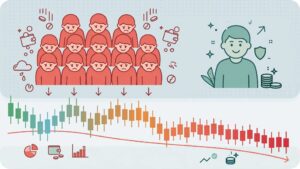
Most day traders lose money for two compounded reasons: trading costs eat returns faster than most people budget for, and specific, well-documented psychological patterns push traders to hold losing positions too long and cut winning ones too early. The “90%” figure gets thrown around loosely online, but the most rigorous long-term academic tracking found the real number is closer to 97% of people who stick with day trading for any real length of time.
- The 90% figure actually undersells it — the most rigorous long-term study found 97% of persistent day traders lost money, with no measurable improvement over time.
- Trading costs and overtrading explain a large share of the gap between average traders and the market, independent of psychology.
- The core psychological trap isn’t stupidity — it’s a well-documented tendency to hold losers too long and sell winners too early.
- The rare traders who make it treat individual losses as expected data points, not emotional events. A strong reaction to one trade is usually the tell that someone has no real edge.
Where the “90%” Number Actually Comes From
The most cited hard data on this comes from a 2020 study that tracked every single individual who started day trading Brazilian equity futures between 2013 and 2015 — not a sample, the whole population, sourced from national securities regulator records. Of the traders who persisted for at least 300 trading days, 97% lost money net of fees, and only 1.1% earned more than local minimum wage. The researchers found no evidence that traders improved with experience — profitability didn’t rise the longer someone stuck with it.
For the documented regulatory evidence behind the headline — the mandatory EU broker disclosures and what they actually prove — read the real numbers behind the 90% myth before quoting the statistic again.
It’s Not Just One Country’s Market
This isn’t a Brazil-specific quirk. An earlier, widely cited study of over 66,000 US brokerage households found that the most active traders earned an annual return of roughly 11.4%, versus 17.9% for the broader market over the same period — a gap the researchers attributed largely to overconfidence driving excessive trading. Different country, different market, same basic pattern: the more actively people traded, the worse they tended to do relative to simply holding.
The Real Reason Isn’t Bad Luck. It’s Cost Plus Behavior.
Every trade carries a cost, spread, commission, or slippage, and those costs compound the same way returns do, just working against you instead of for you. Overtrading multiplies that drag, turning a strategy that might be marginally profitable in theory into a losing one in practice once real-world costs get factored in. Day trading itself is defined by opening and closing positions within the same session, which means the cost of every single trade gets paid repeatedly, day after day, whether the trade wins or loses.
The Psychological Trap: Selling Winners, Holding Losers
Behavioral finance has a name for the single most studied trading bias: the disposition effect — the tendency to sell winning positions too early and hold losing ones far too long, hoping they’ll recover before admitting the loss. It’s directly connected to loss aversion, the deeper wiring that makes a loss feel worse than an equivalent gain feels good. Put those two together and you get traders who consistently lock in small wins while letting losses run, which is close to the exact opposite of what a profitable trading approach actually requires.
Overconfidence Makes It Worse
The Barber and Odean research above pointed to overconfidence as the main driver of excessive trading, and it shows up constantly in retail trading specifically: a trader who’s had a few good weeks starts sizing up, skipping their own rules, and treating a short winning streak as proof of skill rather than normal variance. We cover this directly in overconfidence after a winning streak, and it pairs closely with recency bias — weighting the last few trades far more heavily than the actual long-run statistics of a strategy justify.
Trading Is a Probability Game, Not a Certainty Game
Even a properly backtested strategy with a real, verified win rate, say 70%, never guarantees the order the wins and losses show up in. Four or five losses can cluster together in a row and still be completely normal variance inside a winning system. A trader who actually understands their edge treats each loss as an expected part of the sequence and moves to the next trade without much reaction at all. The reliable tell that someone doesn’t actually have an edge, and is really just gambling on a lucky guess, is a visible emotional reaction to a single trade, panic, anger, or a sudden urge to “win it back” right now. Professionals don’t skip that reaction because they’re unusually calm people. They skip it because they already know, statistically, that one trade means almost nothing.
What the Surviving Minority Actually Does Differently
The traders who don’t end up in the losing majority tend to share a few habits: they treat risk management as the actual job, not an afterthought bolted onto a strategy; they don’t chase a bad trade with a worse one, which is the exact mechanism behind revenge trading; and they’ve usually already internalized why even genuinely profitable traders can still blow an account if the underlying behavior around risk doesn’t change.
The Real Answer
Day traders lose overwhelmingly because trading costs compound against them exactly the way returns compound for a patient investor, and because a specific, well-studied set of psychological patterns pushes most people toward exactly the wrong behavior at exactly the wrong moments. Neither of those is a character flaw. Both are measurable, documented, and, to some real degree, correctable, which is the entire reason the losing percentage isn’t 100%.
Frequently Asked Questions
Is the 90% statistic real, or is it exaggerated?
If anything it’s understated. The most rigorous long-term academic tracking found 97% of people who persisted in day trading lost money, with no evidence that experience alone improved outcomes.
Do professional or institutional traders lose money at the same rate?
No. The studies behind this figure track retail, individual traders specifically. Institutional traders operate with different capital, cost structures, information access, and risk controls, which changes the picture substantially.
About the Author
Shurah trades ICT and Smart Money Concepts himself and writes about trading psychology from real screen time, wins and losses both, rather than a licensed advisory background.