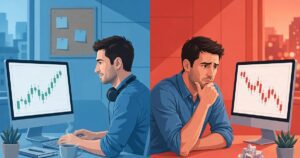
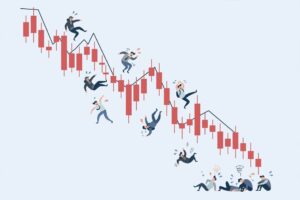
Overtrading doesn’t usually feel like a mistake while it’s happening. It feels like staying engaged with the market, catching opportunities, staying sharp. The account balance is what eventually reveals the difference between activity and edge — and by the time it does, the damage has usually been accumulating for a while through small, individually reasonable-looking trades rather than one obvious blunder.
- A study using real trading records, tax filings, and psychological profiles found that sensation-seeking and overconfident individuals trade measurably more often — independent of their actual investment skill.
- The average investor in a landmark U.S. study turned over 75% of their portfolio annually, and the most active traders in that dataset earned notably less than the market itself.
- Trading produces the same variable, unpredictable reward pattern that neuroscience research has identified as the most powerful driver of repeated-seeking behavior in the brain’s dopamine system.
- The fix isn’t willpower in the moment — it’s removing the ability to act on the impulse before it happens.
Overtrading Is a Documented Trait, Not Just a Bad Habit
A National Bureau of Economic Research study by Mark Grinblatt and Matti Keloharju combined real equity trading data with information from investors’ tax filings, driving records, and psychological profiles to isolate what actually predicts trading frequency. Controlling for wealth, income, age, and occupation, the study found that two specific traits — sensation seeking and overconfidence — independently predicted how often someone traded. This wasn’t a self-reported survey about feelings toward risk; it connected documented psychological tendencies to actual, verified trading behavior.
The finding matters because it reframes overtrading as something closer to a predictable trait expressing itself through a specific channel, rather than a simple failure of self-control that any trader could fix by trying harder in the moment. Someone with a stronger sensation-seeking tendency will find trading pulling at that tendency regardless of how sound their actual strategy is.
The Cost, Measured
Brad Barber and Terrance Odean’s well-known study of over 66,000 U.S. brokerage households found the average household turned over 75% of its portfolio annually — and the households in the top fifth of trading activity, turning over more than 20% of their portfolio per month, earned an annualized return of 11.4% during a period when the overall market returned 17.9%. The infrequent traders in the same dataset came far closer to matching the market. The mechanism the researchers pointed to wasn’t worse stock selection — it was the sheer volume of activity itself, driven by overconfidence, generating costs and errors that ate directly into returns.
That gap — roughly 6.5 percentage points annually between the most and least active traders — compounds dramatically over years. It’s the clearest available evidence that trading activity itself, independent of strategy quality, is a cost center that has to be
Costs and overtrading explain a large share of the gap between average traders and the market — the two compounded reasons day traders lose are independent of psychology and hit before psychology even gets a say.
actively managed rather than assumed to be harmless as long as the underlying analysis is sound.
Why the Impulse Feels So Strong in the Moment
Trading produces a specific reward pattern that neuroscience research has identified as unusually powerful at driving repeated behavior. Wolfram Schultz’s research on dopamine — recognized with the Brain Prize in 2017 — established that dopamine neurons fire based on reward prediction error: the gap between an expected outcome and the actual one, not the reward itself. An unexpected win produces a large dopamine signal; an expected win produces almost none. This is the same underlying mechanism behind variable-ratio reinforcement schedules — the pattern used in slot machines and, more relevantly here, produced naturally by markets, where the size, timing, and outcome of the next trade are inherently unpredictable.
The practical consequence: a losing trade doesn’t reliably discourage the next one, because the uncertainty itself, not the specific outcome, is what sustains the seeking behavior. This is part of why “just be more disciplined” instructions fail so often in the moment — the mechanism being fought isn’t primarily about willpower, it’s about the same reward-prediction system that drives repeated behavior across many other domains, from gambling to social media engagement.
How This Actually Empties an Account
- Transaction costs compound with frequency. Every additional trade adds spread, commission, or slippage cost that a lower-frequency approach never incurs — a cost that scales directly with activity regardless of whether any individual trade is a good idea. Demo traders never feel this drag — live execution costs quietly confiscate a slice of every trade, which is one more reason demo profitability doesn’t transfer.
- More trades means more exposure to the same sizing mistakes. A position-sizing error that would be a minor, recoverable event once a week becomes a serious cumulative risk when repeated daily. See Why Profitable Traders Still Blow Accounts for the sizing mechanics this compounds with.
- Losses trigger more trading, not less. Because the drop in dopamine after a loss registers as discomfort the brain seeks to resolve, the natural response is another trade rather than a pause — the opposite of what a losing streak usually calls for strategically.
- Marginal trades get justified after the fact. A trader looking for reasons to act finds them; the market always offers some plausible-looking setup, which means the impulse to trade rarely lacks a story to attach itself to.
Interrupting the Pattern Without Relying on Willpower
Because the mechanism is structural rather than purely a matter of intention, the most effective interventions remove the ability to act rather than relying on resisting the urge in real time: For a full daily routine built on exactly that principle, see how to build trading psychology — five trainable reps, from pre-session planning to a weekly process review.
- Set a hard cap on trades per day or week, enforced mechanically — a trading platform setting, a broker-side limit, or simply logging out once the cap is reached — rather than a mental note to “trade less.”
- Require a written, pre-defined reason for every trade before entering it, checked against a fixed checklist. This adds friction specifically at the moment the impulse is strongest, which is exactly when friction is most valuable.
- Separate screen time from trading time. Constant chart-watching manufactures more opportunities to notice “setups” than a fixed, scheduled review window does — reducing exposure time reduces the raw number of triggering moments.
- Review trade frequency, not just trade outcomes, in the trading journal. A journal that only records wins and losses misses the variable — activity level — that the research above identifies as the actual driver of underperformance.
This connects to the broader discipline covered in How to Stop Revenge Trading — overtrading and revenge trading share the same underlying mechanism, triggered by the discomfort of a loss rather than by any new information the market has actually provided.
Why This Isn’t a Character Flaw
Losing a trade is a natural cost of running any real strategy — the honest reframe worth holding onto is that a single loss is not the same thing as a mistake, provided the trade followed the plan. The actual mistake, when there is one, usually isn’t the loss itself; it’s the extra trade taken afterward to resolve the discomfort of having lost, disconnected from the original strategy entirely. Separating the two — a loss that’s simply variance from a trade that was never justified in the first place — is what keeps a losing streak from becoming a pattern of overtrading layered on top of it.
This article is for general educational purposes and summarizes published academic research on trading behavior and neuroscience. It is not personalized trading or investment advice. Trading carries a high risk of loss — consult a qualified financial advisor and consider professional support if trading activity feels compulsive or difficult to control.
FAQs
Is overtrading the same thing as being an active trader?
Not necessarily — a strategy that genuinely requires frequent trades, executed according to a fixed plan, is different from trading driven by impulse or discomfort. The distinguishing factor is whether each trade has a pre-defined reason tied to the strategy, not the raw number of trades taken.
Does experience reduce the tendency to overtrade?
The research on sensation seeking and overconfidence suggests these are relatively stable traits rather than something that fades automatically with experience. Structural safeguards — trade limits, checklists, scheduled review windows — tend to be more reliable than expecting the underlying tendency to diminish on its own over time.
Next step: for the specific position-sizing failures that overtrading tends to compound alongside, see Risk Management in Trading Psychology: Beyond the Basics.
About the Author
Shurah writes and maintains DataPips independently, drawing on hands-on experience in trading and entrepreneurship. Articles are shaped by personal research, real trading lessons, and the process of building this publication from scratch — not by a formal financial credential.