A researcher hooked people up to blood pressure monitors and asked them to vividly imagine achieving their biggest goal — the business taking off, the career move landing, the thing they’d wanted for years.
Their blood pressure dropped. Immediately.
Their bodies relaxed, as though the work were already done. And over the following weeks and months, those people achieved measurably less than the people who hadn’t done the exercise at all.
That result is roughly the opposite of what every vision board, morning affirmation routine, and “see it to believe it” business book teaches — and it’s held up across decades of studies in careers, academic performance, health behavior, and relationships.
What Visualization Is Supposed to Do
Visualization is the practice of mentally rehearsing a desired outcome in vivid sensory detail — picturing the result as though it has already happened, on the theory that a clear mental image directs behavior toward it. That’s the concept, in full.
Now the part the concept gets wrong.
The Mechanism That Makes It Backfire
NYU psychologist Gabriele Oettingen spent decades on this question, and her core finding was counterintuitive enough that it required replication across multiple studies before publication: people who engaged in pure positive visualization showed decreased goal-relevant effort and lower attainment than control groups who didn’t visualize at all.
Not “less than optimal.” Less than doing nothing.
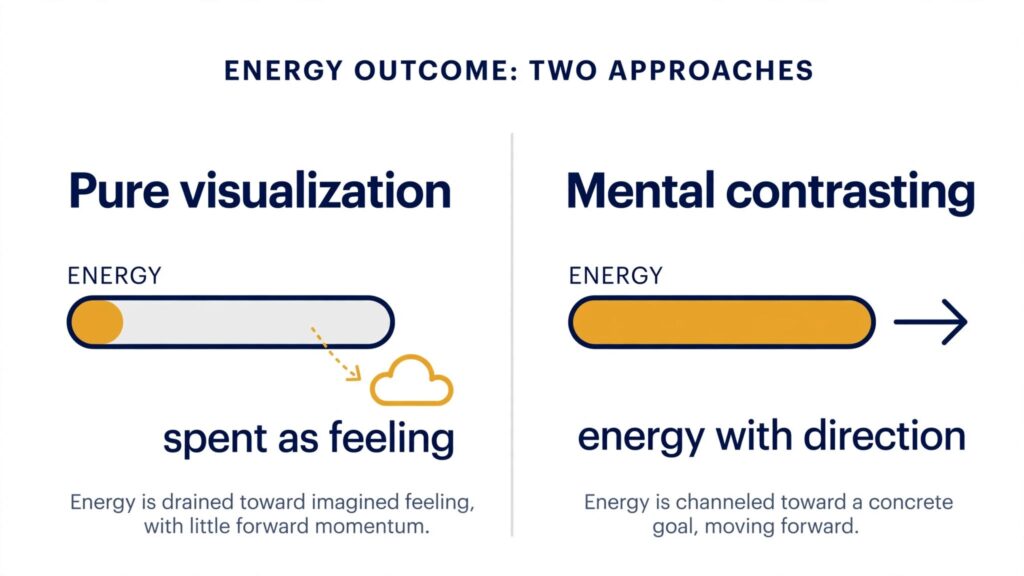
The mechanism she identified is worth understanding precisely, because it explains why this isn’t a matter of doing visualization wrong. The brain runs substantially on emotional signal, and it does not cleanly distinguish a vividly imagined success from an actual one. So the imagery gets partially registered as evidence the goal is already achieved. The energy that should have funded action instead gets spent as the subjective experience of having succeeded. Blood pressure falls. Reported energy decreases.
You feel good, and you do less. That’s the whole failure, and it’s structural rather than a technique problem.
There’s a second finding attached that’s darker and gets even less airtime. In follow-up measurement, the more positive students’ fantasies had been, the more depressed they became weeks later — even though the fantasizing itself corresponded to feeling better at the time. The relief is real. It’s just borrowed from later.
The Distinction That Rescues the Whole Idea
Oettingen’s early work separated two things that get used interchangeably and behave completely differently:
Positive expectations — a judgment, based on your track record, that you probably can do this. This increases success.
Positive fantasy — a sensory experience of the outcome, detached from any assessment of whether it’s likely. This decreases success.
They feel similar from the inside. They’re opposite in effect. Expectation is grounded in evidence about yourself; fantasy is grounded in nothing and therefore has to generate its satisfaction from the imagery itself.
This distinction is the reason “believe in yourself” advice sometimes helps and sometimes hollows people out. Belief built from a record of small completed things is expectation. Belief built from a vision board is fantasy. Same vocabulary, different machinery — which is also why confidence built on evidence holds under pressure while confidence built on imagery collapses the first time reality pushes back.
The Advice That’s Actively Wrong
I’ll name it directly: “focus only on the outcome, never on the obstacles, because thinking about obstacles is negative energy” is the single most damaging idea in popular goal-setting content.
The research inverts it. Obstacle-thinking isn’t a leak in your motivation — it’s what converts the vision into something your brain can actually route toward. Oettingen’s alternative, mental contrasting, requires the positive image AND an unflinching look at what’s genuinely in the way, held together in sequence.
What’s notable is that it beat every comparison condition tested — including pure realism, and including reverse contrasting, where people dwelt on obstacles first and then fantasized. The order matters. Future first, then obstacle. Reversing it doesn’t work.
That detail is the part I’d flag hardest for anyone building a planning routine, because it means this isn’t just “be realistic.” Realism alone performed worse too. It’s a specific sequence with a specific effect, not a general attitude adjustment.
The Protocol, and What Most People Get Wrong Inside It
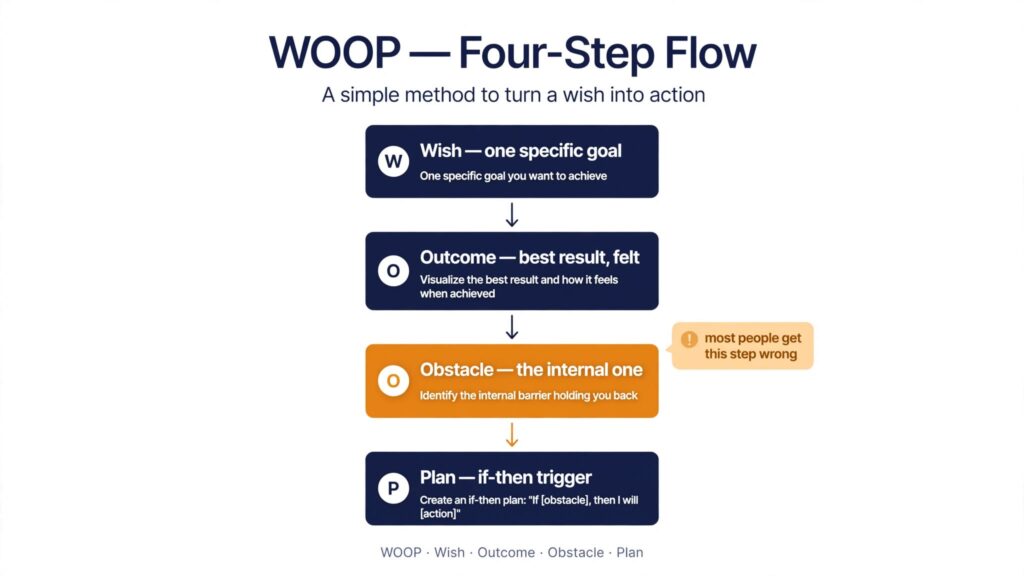
The structured version is WOOP: Wish, Outcome, Obstacle, Plan. It takes five to ten minutes, works best written rather than mentally, and has been tested in randomized controlled trials across health, academic, and professional domains.
Wish. One specific, meaningful goal — and specific means “finish the pricing page this week,” not “grow the business.” The vagueness of most stated goals is where this fails before it starts.
Outcome. The best result of achieving it, genuinely felt. Thirty to sixty seconds. This is conventional visualization, and it’s necessary — it just isn’t sufficient, which is the whole point.
Obstacle. Here’s the step almost everyone performs incorrectly. The obstacle you’re looking for is internal. Not the market, not the competition, not the economy. What is the thing inside you that actually stops you — the avoidance, the perfectionism, the checking your phone, the fear of the specific conversation? External obstacles feel more legitimate to name, which is exactly why people default to them and why the exercise then does nothing.
Plan. An if-then implementation intention aimed at that specific internal obstacle. “If I open the laptop and start reorganizing files instead of writing, then I close every tab and write one paragraph before anything else.” Not a goal restated as a plan — a trigger and a response.
The reason the Plan step works is that it pre-decides the behavior at the moment of friction, so the decision isn’t being made by the version of you who is tired and avoiding. That’s a different kind of tool entirely from motivation.
Where Visualization Genuinely Earns Its Place
I don’t think the honest conclusion is “visualization is useless.” It’s narrower than that.
Visualizing a process — mentally rehearsing the difficult conversation, the pitch, the specific sequence of actions — is a different activity from visualizing an outcome. Process rehearsal is preparation. Outcome fantasy is consumption. The popular version collapses these into one word, which is a large part of why the advice is such a mess.
There’s also a genuine conditional worth stating, since I’ve taken a strong position above: the effect is documented most clearly for difficult goals, where effort actually determines the result. For something trivially easy, draining a bit of motivational energy costs you nothing, because you’d have completed it anyway. So the warning scales with how much the goal genuinely demands of you — which unfortunately means it’s most dangerous exactly where it matters most.
Why This Matters More in Business Than Anywhere Else
Business goals have unusually long feedback delays. Months can pass between the work and any visible result, and during that stretch there’s nothing external confirming you’re on track. That’s precisely the gap where fantasy substitutes for progress most easily — you can spend a year genuinely feeling like a founder without shipping anything, because the imagery keeps supplying the emotional payoff that shipping was supposed to provide.
It compounds with a related trap. That flat stretch where nothing seems to be working is real and unavoidable in most compounding efforts — I’ve written about it as the lag phase. The difference between someone who survives it and someone who quits is usually whether their motivation was resting on evidence of small completed actions or on an image of the finished result. The image can’t survive a year without confirmation. The evidence can.
And there’s a present-bias interaction worth naming: your brain already discounts the future heavily. Fantasy delivers a present-moment reward for a future-tense goal, which is precisely the trade your brain is most eager to accept and least equipped to evaluate honestly.
What I’d Do Instead
Replace the vision board with a written WOOP once a week — same five minutes, opposite effect. Keep the future imagery, but always immediately followed by the internal obstacle, in that order, never reversed.
Track completed actions rather than imagined outcomes, because completed actions build the positive expectation that actually predicts success, while imagined outcomes build the fantasy that predicts the opposite. This is the same reason daily thinking patterns outperform annual vision exercises: they generate evidence rather than imagery.
Be suspicious of any planning activity that leaves you feeling accomplished. That feeling is the warning sign — it’s the energy that was supposed to fund the work being spent on the plan instead. A useful planning session should leave you slightly uncomfortable, because you just looked directly at the thing that’s been stopping you.
Related reading if you’re rebuilding how you set goals: building the underlying mindset, the rules that raise your actual value, and the phrases that kill an ambition before it starts — that last one pairs directly with this, since the language you use about a goal shapes whether it stays a fantasy or becomes a plan.
Key Takeaways
- Pure positive visualization measurably reduces goal attainment — performing worse than not visualizing at all, across multiple domains and decades of studies.
- The mechanism is that the brain partially registers vivid imagery as achievement, spending the energy that should have funded action.
- Positive expectation (grounded in your track record) increases success; positive fantasy (detached from likelihood) decreases it — they feel identical and behave oppositely.
- “Never think about obstacles” is the most damaging idea in popular goal-setting; obstacle-thinking is what converts a vision into something actionable.
- Order matters — future imagery first, then obstacle. Reversing the sequence, or doing pure realism, both perform worse.
- The obstacle step must identify an internal barrier, not an external one; naming external obstacles is the most common way this exercise gets neutered.
- Any planning session that leaves you feeling accomplished has probably already spent the energy it was meant to generate.
Questions Worth Asking
Does this mean vision boards are actively harmful, or just ineffective?
Based on the research, closer to actively harmful for demanding goals — the comparison groups who did nothing outperformed the pure-fantasy groups. The effect scales with difficulty, so a vision board around something genuinely hard is where the drain matters most.
How is mental contrasting different from just being realistic?
Pure realism was also tested and also performed worse than mental contrasting. The effect comes from holding both the desired future and the obstacle together in a specific order, not from lowering your expectations. Dwelling on obstacles alone produces hopelessness rather than direction.
What if my real obstacle genuinely is external — funding, market conditions, timing?
Then the useful question is what internal response to that external condition is within your control. “The market is slow” isn’t actionable; “I stop reaching out to prospects when responses dry up” is. The exercise needs a barrier you can build an if-then plan around.
Should I stop visualizing before a pitch or a difficult conversation?
No — that’s process rehearsal, not outcome fantasy, and it’s a genuinely different activity. Mentally walking through the steps you’ll take is preparation. Picturing the deal already closed is the version that drains effort.
How often should mental contrasting be done to be useful?
Frequently enough that the obstacle you identify stays current, since internal obstacles shift as circumstances change. A weekly written pass tends to work better than an annual goal-setting ritual, partly because the specificity required simply isn’t available at a yearly horizon.