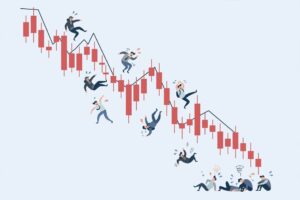
A trader can have a genuinely profitable strategy — one that would make money over a large enough sample of trades — and still blow the account before that edge ever gets the chance to play out. This isn’t a contradiction. It’s what happens when position sizing, not strategy quality, is the thing actually deciding whether an account survives long enough to realize its edge.
- Regulatory disclosures across major UK and EU brokers show 68% to over 80% of retail CFD accounts lose money — a figure that’s held roughly steady for years and doesn’t move much even between well-regulated, reputable brokers.
- A landmark academic study found that investors who traded the most earned 11.4% annually while the market returned 17.9% — the cost wasn’t bad picks, it was excessive activity itself.
- A profitable strategy and a survivable position size are two separate requirements; having one without the other still ends in a blown account, just on a longer timeline.
- The account usually doesn’t blow up on the trade that broke the strategy — it blows up on the trade sized wrong for a strategy that was actually working.
The Numbers Behind the Myth of “Just Find a Good Strategy”
Regulatory risk warnings on CFD and forex brokers — mandatory in the UK and EU — disclose the percentage of retail client accounts that lost money over the preceding 12 months. As of 2026, that figure has run from roughly 68% at some of the more conservative, established brokers up to over 80% at others, with the UK’s FCA itself citing an approximate 80% loss rate across the industry. These numbers hold across brokers of very different reputations and regulatory standing, which is itself informative: the loss rate isn’t primarily a broker-quality problem or even, in most cases, a pure strategy problem. It’s remarkably consistent regardless of which platform a trader chose.
Separately, a landmark study by Brad Barber and Terrance Odean examined the trading records of over 66,000 U.S. discount brokerage households across 1991–1996. The households that traded the most earned an annualized net return of 11.4%, while the overall market returned 17.9% over the same period — a gap the researchers attributed specifically to overconfidence-driven overtrading, not to picking worse assets. The infrequent traders in the same dataset earned closer to 18.5%, nearly matching the market. The strategy quality of individual picks mattered far less than how often the account acted on them.
Why “Profitable Over Time” Doesn’t Mean “Survives to Get There”
A strategy with a genuine statistical edge — a positive expectancy across a large enough sample — is only profitable if the account survives long enough for that sample to actually play out. Between any two points in that sequence sits variance: a string of losses that a positive-expectancy strategy will produce sometimes, purely by chance, even when nothing about the strategy has changed.
The risk isn’t the losing streak itself — a sound strategy is built expecting one. The risk is sizing each position as if the current trade were the only one that mattered, rather than as one draw from a longer sequence that includes an unlucky run somewhere inside it. A position sized to survive five consecutive losses comfortably behaves completely differently under stress than one sized to survive two. The strategy can be identical in both cases; only the survival math changes.
This is the same mechanism explored from the winning-streak side in Overconfidence After a Winning Streak: The Silent Account Killer — a run of wins tends to make the next position size creep upward exactly when the underlying variance hasn’t gone anywhere. The account that survives a losing streak with disciplined sizing often gets undone instead by the sizing creep that followed the streak before it.
The Specific Way a Working Edge Still Blows Up
- Risking too much per trade relative to account size. A strategy that wins 55% of the time with a favorable payoff ratio can still produce a losing streak of six, eight, or more trades within a normal sample. Risking a large fraction of the account per trade turns an expected, survivable drawdown into a terminal one.
- Increasing size after a win rather than by rule. Position size that grows because a trade just worked, rather than because a pre-set formula says it should, reintroduces exactly the overconfidence dynamic the Barber and Odean data measured — more activity and more exposure, triggered by recent success rather than by an actual edge recalculation.
- Correlated positions counted as diversified ones. Multiple trades that are all effectively the same directional bet (several gold-related pairs moving together, for instance) can combine into a single oversized position without ever registering as one on a trade-by-trade basis.
- No hard stop on the variance itself. A strategy without a defined maximum drawdown at which trading pauses for reassessment allows a losing streak — even a statistically normal one — to run until the account is gone, rather than until the pre-agreed limit is reached.
Every one of these failure points is a sizing and risk-management failure, not a strategy failure — which is precisely why a genuinely profitable approach can still end in a blown account. See Risk Management in Trading Psychology: Beyond the Basics for the deeper mechanics of building position sizing that survives a real losing streak.
Why This Gets Missed Even by Experienced Traders
Most trading education focuses heavily on entries — where to get in, what pattern to look for, what confirmation to wait on. Far less attention goes to position sizing, partly because it’s less visually interesting to teach and partly because it doesn’t feel like the “skill” part of trading. But the retail loss-rate data above spans traders of wildly varying strategy sophistication and still lands in the same 68–85% range across brokers — a strong signal that the entry-selection skill isn’t the primary differentiator between the accounts that survive and the ones that don’t.
This connects to a pattern covered in Why Traders Freeze Before Big Moves — the discomfort traders feel around position sizing decisions often gets avoided entirely by defaulting to a fixed dollar or lot amount that was never actually calculated against account size or realistic drawdown, simply because sizing math is less immediately rewarding to think through than the next setup.
What Actually Protects a Working Strategy
- Risk a fixed, small percentage of the account per trade — commonly 1–2% — calculated fresh each time from the current account balance, not the balance from before the last winning streak.
- Define a maximum consecutive-loss or drawdown threshold in advance, at which trading pauses for review rather than continuing on the same sizing that produced the drawdown.
- Track correlated exposure across open positions as one combined risk figure, not as separate, independently-sized trades.
- Review sizing decisions with the same scrutiny as entry decisions — a trading journal that records why a trade was entered but not why it was sized the way it was is missing the variable that actually determines survival.
This ties directly into the broader discipline covered in Psychology of Money: Respecting Trading Capital — treating trading capital as something to be preserved through variance, not just deployed toward the next good setup, is what separates traders whose edge gets the chance to compound from traders whose edge never survives long enough to matter.
This article is for general educational purposes and reflects publicly available regulatory disclosures and academic research on trading behavior. It is not personalized trading or investment advice. Trading CFDs and leveraged products carries a high risk of loss — consult a qualified financial advisor and understand the specific risks of any product before trading.
FAQs
Does a higher win rate protect against this problem?
Not by itself. A high win rate with oversized positions can still produce a terminal drawdown during the losses it does have — win rate and position sizing are separate variables, and a strategy needs both addressed to actually survive.
Is reducing position size after a loss the right response?
Reducing size reactively, after a loss, can be just as arbitrary as increasing it after a win if it isn’t tied to a pre-set rule. The goal is a fixed sizing formula that doesn’t change based on the emotional weight of the most recent trade in either direction.
Next step: for the specific behavior pattern that tends to follow a blown or badly drawn-down account, see How to Stop Revenge Trading.
About the Author
Shurah writes and maintains DataPips independently, drawing on hands-on experience in trading and entrepreneurship. Articles are shaped by personal research, real trading lessons, and the process of building this publication from scratch — not by a formal financial credential.