Let me be very honest with you.
There comes a point in almost every trader’s journey where everything feels broken. Back-to-back losses. Disturbed psychology. Zero confidence. And a constant voice in your head saying “trading is not for me.” I have been there. And I know now that this single phase decides whether you become a successful trader or quit forever.
If you are reading this right now and feeling exactly like this, do not close the tab. This article might be the reason you do not give up. Let me show you exactly what this phase is, what I went through, and how to come out the other side.
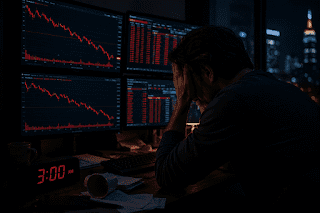
What Is the Dark Phase in Trading Psychology?
The dark phase is that period when nothing seems to work. You follow your rules — and still lose. You study hard — and the results do not come. Your mind fills with self-doubt and frustration until trading stops feeling like a skill you are building and starts feeling like a verdict on who you are.
Most traders hit this point within the first 6 to 18 months. And here is the critical thing to understand: this is not primarily a strategy problem. It is a psychology problem. How you handle this specific phase decides your entire future as a trader far more than any indicator or system ever will.
Why This Phase Determines Your Success or Failure
Every serious trader faces this phase. That is not an exaggeration — it is close to universal. The difference between the traders who eventually succeed and the ones who quit comes down to something simple and brutal: the successful ones pushed through this exact period, and the others gave up in the middle of it.
If you quit here, you will never find out how close you actually were. Many traders are a relatively short distance from genuine, consistent improvement when they decide to stop — they just cannot see it from inside the pain. This phase is painful, but it is also the single greatest filter in trading. It does not filter by intelligence. It filters by who refuses to quit.
My Real Experience: The Time I Almost Quit Trading
I started with binary options after watching a video online. I made $20 profit on my first $10 deposit and got extremely excited — the kind of excitement that, looking back, was a warning sign rather than a good omen. I even told a friend that I would soon support my entire family and have my father retire. Within a few days, I lost everything.
So I moved to forex. I studied indicators, bought expensive tools, deposited money again. For a few days I made small profits — and then I lost control of my emotions and blew the account. I bought funded accounts and blew those too.
At one point I was completely broken. Back-to-back losses, zero confidence, psychology in pieces. I seriously considered quitting trading forever. But something refused to let me. I kept thinking about my family, about the responsibility I carried, about the future I actually wanted. That is when I decided to change my entire approach — not my strategy, my approach.
Today, I look back and I am grateful I did not quit during that period. The trader I became was built specifically in those months when everything felt hopeless.
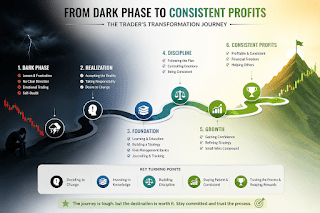
Signs You Are Currently in This Dark Phase
Here are the common signs that you are in this difficult period right now:
- Back-to-back losing trades even when you are following your rules
- Feeling like “trading is not for me” almost every day
- Loss of confidence in both your strategy and yourself
- Disturbed sleep and constant background stress about the market
- Recurring thoughts about quitting trading completely
- Blaming the market, the brokers, or your luck for everything
If most of these describe you, you are in the dark phase. And recognizing that you are in it — naming it — is the first real step out of it.
How I Survived and Came Out Stronger
After blowing multiple accounts, I did the thing that felt counterintuitive: I stopped depositing money entirely for a while. I removed the financial bleeding so I could think clearly. I focused only on learning and practicing on demo. I worked on my psychology every single day, deliberately, the way you would train any other weak skill.
I accepted — really accepted, not just intellectually agreed — that losses are part of trading, and I stopped fighting the market like it was a personal enemy.
The biggest single change came when I stopped hunting for quick profits and started focusing on long-term consistency. I told myself: even if I lose for one full year but genuinely learn and grow, I am still ahead — because I am becoming a better trader, and the money follows the trader, not the other way around. That reframe is what carried me through the worst of it.
The Compound Knowledge Method That Changed Everything
One approach changed my trajectory more than any other: pick one thing and become genuinely excellent at it, instead of being mediocre at everything.
I decided to go deep into trading psychology and risk management specifically. And I gave myself a concrete, escalating target. First, become the most knowledgeable person on this topic among my few close friends. Then aim to be the best among 40 people I knew of. Then 400. Then 4,000. Each level forced a deeper understanding than the last.
Instead of scattering my attention across every indicator and every new strategy, I went deep into one narrow area until I genuinely owned it. This single shift — depth over breadth — made more difference to my results than years of collecting surface-level knowledge had.
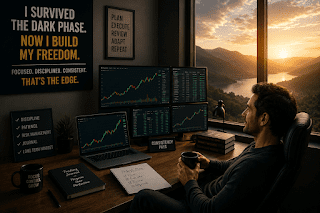
Practical Ways to Handle This Phase
- Take a short break from live trading. Switch to demo or paper trading for a defined period. Stop the financial bleeding so your mind can recover enough to think clearly.
- Focus on learning instead of earning. Deliberately shift your goal from “make money this week” to “understand this one thing deeply.” The earning follows the learning, not the reverse.
- Journal your emotions daily. Write how you feel before, during, and after every trade — not just the profit and loss, the emotional state. Patterns you cannot see in the moment become obvious on paper.
- Reduce position size drastically. Trade so small that a loss is almost irrelevant, until your confidence rebuilds. Small risk produces calm decisions; calm decisions rebuild confidence.
- Remind yourself of your “why.” When the daily grind feels pointless, reconnecting with the actual reason you started provides fuel that pure discipline cannot.
- Accept that this phase is normal. Almost every trader who eventually succeeded went through exactly this. You are not uniquely broken. You are in the standard, predictable, survivable hard part.
The traders who survive this phase are not the smartest ones. They are the ones who refuse to make a permanent decision during a temporary low.
What Nobody Tells You About the Dark Phase
Every trading course sells you the strategy. Almost none of them prepare you honestly for the psychological collapse that comes before consistency — so here is what nobody tells you.
The dark phase is not a sign you are failing — it is a sign you have stayed long enough to face the real test. The people who never reach this phase are usually the ones who quit in the first month, before it could even arrive. Reaching the dark phase means you have already outlasted most people who ever opened an account. It feels like the end. It is actually a checkpoint that most people never even get to.
The most dangerous decisions are made during the lowest emotional points, and those decisions feel the most justified at the time. When you are deep in losses and despair, quitting feels rational, wise, mature even. Revenge trading to “fix” it feels urgent and necessary. Both feelings are the dark phase talking, not your judgment. The single most important rule of this phase: do not make permanent decisions during temporary pain. Wait until the emotion passes, then decide.
Trading losses can affect far more than your account — and pretending otherwise makes it worse. When the money at risk matters to your real life, the stress of this phase does not stay inside the trading app. It affects sleep, relationships, self-worth, and mental health. This is exactly why the financial rules — small position sizes, never trading money you cannot afford to lose, taking breaks — are not just about protecting your account. They are about protecting you. If trading stress is genuinely affecting your wellbeing, that is a signal to step back and, if needed, talk to someone — not a weakness, a basic act of self-protection.
“Just be disciplined” is useless advice during the dark phase. When your emotions have taken over, willpower alone is not enough — this is well established in behavioral psychology. What actually works is removing the decision from the heated moment: pre-set rules, drastically reduced size, scheduled breaks, a written plan you follow mechanically. You do not out-discipline an emotional hijack. You build systems so the hijack has less to grab onto.
Frequently Asked Questions
Q: Is it normal to feel like quitting during this phase?
Yes — completely normal, and close to universal. Almost every trader reaches this point. The key is to recognize the feeling for what it is and not make a permanent decision during temporary pain. The urge to quit is a symptom of the phase, not reliable evidence about your future.
Q: How long does this dark phase usually last?
It varies significantly. For some traders it is a few weeks; for others it stretches to 6 to 12 months. The duration matters less than how you handle it — a trader who handles a long dark phase well comes out stronger than one who rushes through a short one without learning anything.
Q: Should I stop trading completely during this phase?
Not necessarily completely — but you should drastically reduce your risk or move to demo trading while you rebuild your psychology and knowledge. The goal is to stop the financial and emotional bleeding without stopping the learning. Continuing to trade large size while in this state usually deepens the hole.
Q: Can I become successful if I am currently in this phase?
Yes. Many traders who became consistent were in exactly the situation you are in right now. The presence of the dark phase is not evidence you will fail — if anything, it is evidence you have stayed in the game long enough to face the test that most people never reach.
Q: What is the fastest way to come out of this phase?
Counterintuitively, by slowing down. Shift your focus from making money to learning and psychology. Reduce your risk so losses stop triggering emotional spirals. Journal your emotions to see your patterns. Stay consistent with study. Trying to rush out of the dark phase by trading harder is the single most common way to make it worse.
Q: How do I know if I am actually improving during this phase?
Improvement during the dark phase usually shows up in your decisions before it shows up in your account. Are you following your rules more consistently? Recovering from losses faster emotionally? Recognizing your own patterns? These process improvements come first; the financial results lag behind them, sometimes by months. Track the process, not just the profit.
1. Write down exactly how you are feeling about trading right now — get it out of your head and onto paper.
2. Commit to a 7-day break from live trading — study and demo only.
3. Choose one area (psychology, risk management, or strategy) and go deep into it instead of spreading thin.
4. Start a simple trading journal today — record emotions, not just results.
5. Tell yourself daily: I am not quitting. I am in the learning phase.
Final Thoughts
Trading psychology is not taught seriously in most courses, but it is the most important skill you will ever develop. The dark phase you may be going through right now is not the end — it is the test that separates the people who genuinely want this from the people who only liked the idea of it.
I almost quit multiple times. I am grateful I did not — because the trader I am today was built specifically during those difficult months when everything felt hopeless.
If you are in this phase right now, understand one thing clearly: you are not a failure, and you are not alone. You are in the process of becoming a better trader, in the exact part of the process that feels the worst and matters the most.
Do not quit. Keep learning. Keep showing up. The version of you a year from now is built by what you decide to do today.
Disclaimer: Trading forex, stocks, and precious metals involves substantial risk of loss and is not suitable for every investor. Past performance is not indicative of future results. Always do your own research. If trading-related stress is affecting your mental wellbeing, please consider speaking with a qualified professional.