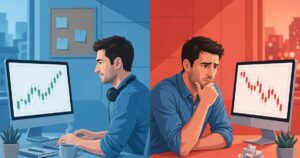
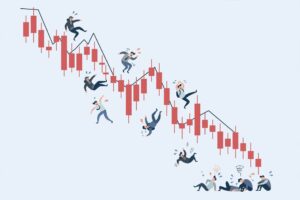
In today’s digital age, trading knowledge is everywhere. From ICT and SMC to advanced price action, everyone seems to have a “strategy.” But if strategies were all it took, why do roughly 90% of traders still fail? The hard truth is that while everyone learns how to read a chart, very few learn how to read their own minds or manage their risk — and that gap is where almost everyone gets destroyed.
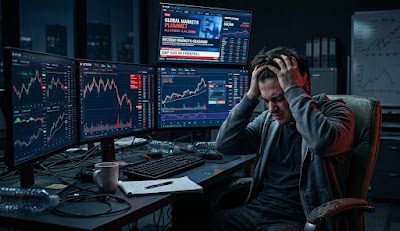
1. The Illusion of the Money-Printing Machine
Many beginners treat a trading strategy like a machine that produces cash on demand. Think about this: every country has a currency printing press, but even that press has limits. If a government prints beyond what the economy can support, the currency collapses and the country defaults.
Trading works the same way. Your account does not blow up because the strategy failed in some abstract sense. It blows up the moment you ignore your limits — risking more than your account, or your mind, can actually absorb. The strategy was never the printing press. Your risk management was.
2. When Trading Becomes More Than Money — My Story
2021 and 2022 were the hardest years of my life. Heavy market losses combined with the weight of family expectations pushed me to a breaking point I am not proud of and do not enjoy revisiting — but I think it matters to say honestly: I reached a place of genuine mental health crisis during that period, including thoughts and attempts that I survived.

I felt like a failure who only knew how to lose money. But in those moments, I thought about my family — people who had already endured real hardship, who had built a life through genuine struggle. I could not add the weight of losing a son to everything they had already carried. That realization did not fix anything immediately. But it gave me a reason to keep going long enough to actually change something.
If anything in this section resonates with you — if you are carrying something similar right now — please know this is a sign worth taking seriously, and reaching out to a mental health professional or a crisis line in your country is a real and worthwhile step, not a weakness.
3. The Family Photo: Your Real Stop Loss
Here is something practical that came directly out of that period. If you find yourself gambling instead of trading — oversized positions, no plan, revenge trades after a loss — try this: set a photo of your family as your phone and laptop wallpaper.
Before you take that revenge trade, before you enter without confirmation, look at those faces. Ask yourself honestly: is this money mine to gamble away, or does it belong to their future too?
If the honest answer is that you are gambling with their stability — close the laptop. Walk away. Go outside, move your body, let the urge pass. The trade will still be there tomorrow if it was genuinely valid. The version of you trading from desperation right now will make a worse decision than the version of you that returns tomorrow with a clear head.
This is not about guilt. It is about using something real and immediate to interrupt a pattern that purely mental willpower often cannot interrupt in the moment.
4. Mentor vs. Coach — Know the Difference
Stop spending money on “mentors” who lecture five hundred students at once, where you are one face in a crowd they will never personally know. What you actually need is a coach.
- The Mentor: Delivers content to a large audience. Cannot answer your specific questions. Does not know your specific flaws, your specific account size, or your specific emotional triggers. Valuable for general education — not for personal transformation.
- The Coach: Works with you directly. Reviews your actual trades, identifies your actual patterns, and tells you specifically where your emotions are overriding your logic — because they can see it in your data, not just hear about it in theory.

In my own life, my father was my greatest coach — not because he understood charts, but because he understood me, and because he had lived through versions of the mistakes I was about to make. He used to tell me: “If you follow my advice, you will be 25 years ahead of your peers — because I have already lived through the mistakes you are about to make, so you do not have to.”
A real coach does not need to be a trading expert. A real coach is someone who knows you well enough to tell you the truth, and who has lived enough to recognize a pattern before it destroys you. Sometimes that is a paid professional. Sometimes it is someone in your own life who has earned the right to be heard.
According to the National Institute of Mental Health, having a trusted person to talk to during periods of significant stress is one of the most protective factors for mental health outcomes — and this applies directly to the kind of chronic financial stress that trading can produce when risk is mismanaged.
What Nobody Tells You About Trading and Mental Health
Every trading course talks about discipline and risk management as financial concepts. Almost none of them talk about what happens when financial stress becomes a mental health crisis — and how closely the two are connected.
Trading losses do not stay contained to your account. When the amounts at risk are large relative to what you can actually afford to lose, the stress does not stay in the trading app. It follows you into your relationships, your sleep, your physical health, and your sense of your own worth. The risk management rules that traders treat as purely financial — never risk more than 1-2% per trade, never use money you cannot afford to lose — are also mental health protections. They exist to keep a bad trading day from becoming a bad month, a bad relationship, or worse.
Shame keeps people in the cycle longer than the losses do. The hardest part of a financial crisis caused by trading is often not the loss itself — it is the shame of having to explain it, or the fear of what people will think. This shame keeps people trading in secret, hiding losses, and making increasingly desperate decisions to avoid having to admit what happened. Breaking that cycle usually requires being honest with at least one person — which is uncomfortable, and also often the turning point.
Recovery is not linear, and that is normal. If you are working through a difficult period right now — financially or otherwise — expect it to not be a straight line. Good days and bad days both happen during recovery. The presence of a bad day does not mean the recovery failed. It means recovery is happening the way it actually happens for most people.
Conclusion: The Loss Is the Only Thing You Control
In trading, the market decides your profit. You decide your loss. Every time you open a position, the question worth asking is not “what could I gain here” — it is “what am I willing to lose, and can I genuinely afford that, financially and otherwise.”
When you master your stop loss — both in the market and in how you carry the weight of this work in your own mind — you start the actual journey toward becoming a professional. Not before.
Disclaimer: This article reflects personal experience and is for educational purposes only. Trading involves substantial risk of loss. If you are experiencing financial hardship that is affecting your wellbeing, please seek support from a qualified professional.