

- You exit trades too early not because your strategy is wrong, but because your nervous system treats unrealized profit as a threat.
- The fear of losing what you already “have” on screen is stronger than the desire for what you could still gain.
- Most early exits are not decisions — they are reflexes disguised as decisions, made in under three seconds.
- Fixing this requires structural rules, not willpower. Willpower fails exactly when you need it most.
If you exit trades too early, you already know the pattern. The trade is green. It is moving in your direction. And somewhere around the halfway point to your actual target, a feeling rises up from nowhere and tells you to close it now, lock in what you have, do not be greedy. You close it. Ten minutes later, the trade hits your original target — without you in it.
This is not a one-time mistake. For most traders, it is the single most repeated, most expensive habit in their entire trading career. Not the big loss. Not the blown account. The thousand small early exits that quietly erased what could have been a completely different equity curve.
This article exists because the Data Pips Team has lived through this exact pattern in gold and forex markets, studied it, and rebuilt a trading process specifically designed to fight it. No sugarcoating. No “just trust your gut” advice. Just the real psychological mechanism behind why you exit trades too early, and the exact discipline structure that fixes it.
Table of Contents
Why You Exit Trades Too Early — The Real Mechanism
Here is what nobody explains clearly: when you exit trades too early, you are not making a calculated decision. You are responding to a threat signal. Your brain is treating unrealized profit the exact same way it treats a wild animal jumping out of the bushes — as something that needs to be neutralized immediately.
This sounds dramatic until you understand the psychology behind it. The moment a trade moves into profit, your brain stops seeing “potential gain” and starts seeing “something I could lose.” That single shift in perception is the root of almost every premature exit you have ever made.
Psychology Today’s research on loss aversion confirms that the pain of losing something already in your possession is felt roughly twice as intensely as the pleasure of gaining the same amount. Once a trade is green, your brain mentally reclassifies that floating profit as already yours — and now it will fight hard to protect it, even at the cost of a much larger gain still waiting ahead.
This is why disciplined traders are not people who feel less fear. They are people who built a system that does not let that fear make the decision.
The Three Triggers That Make You Exit Trades Too Early
Premature exits are not random. They follow three specific psychological triggers, every single time.
Trigger 1: Floating Profit Anxiety
The moment your trade shows green, a part of your brain starts calculating “what if this turns red again.” This anxiety grows the longer the trade stays open and the bigger the floating profit becomes. Eventually the anxiety becomes louder than your original plan, and you close the trade just to make the discomfort stop — not because your analysis changed.
Trigger 2: Recency Bias From a Past Loss
If your last few trades reversed against you after looking profitable, your brain builds a pattern: “profitable trades reverse.” Even if this pattern is statistically false over a larger sample size, your brain treats your most recent experiences as the most reliable predictor of the future. This is why a string of reversals makes you exit the very next winning trade far too early — you are trading your last experience, not your actual strategy.
Trigger 3: Need for Certainty
An open trade is uncertain. A closed trade is certain. Humans have a strong psychological preference for certainty, even a smaller certain outcome, over a larger uncertain one. This is documented extensively in behavioral finance research. Closing a winning trade early converts an uncertain larger gain into a certain smaller one — and that conversion feels like relief, even though it is mathematically a worse decision over time.
“You are not closing the trade because your analysis says exit. You are closing it because your nervous system cannot tolerate the uncertainty of letting it run.”
— Data Pips Team
Why This Habit Is So Expensive Over Time
One early exit does not ruin a trading account. The damage comes from how this pattern compounds over hundreds of trades.
Most profitable trading strategies rely on a small number of large winning trades to offset a larger number of small losing trades. This is the core of positive expectancy. If you consistently exit your winners early while still taking your full losses, you destroy the exact math that made your strategy profitable in the first place.
| Scenario | Average Win | Average Loss | Result Over 100 Trades |
|---|---|---|---|
| Full target reached | $300 | $150 | Strong positive expectancy |
| Exits trades too early (50% of target) | $150 | $150 | Breakeven or losing, same win rate |
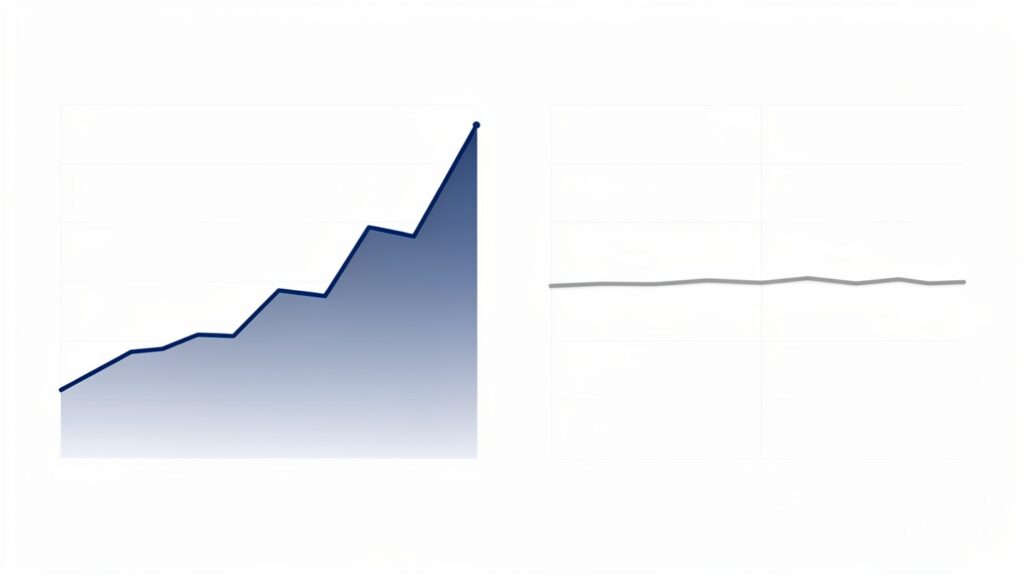
Notice something critical here: the win rate did not change in this example. The strategy did not change. The only variable that changed was the exit discipline — and it was enough to turn a profitable system into a breakeven or losing one. This is exactly why fixing this single habit often produces a bigger improvement in results than switching strategies entirely.
The Founder’s Real Lesson From Gold Trading
The Data Pips Team has gone through years of trading XAUUSD and forex markets, and the most expensive lesson did not come from a single bad trade. It came from a long stretch of consistently profitable setups that were closed early, over and over, because of the discomfort of watching floating profit and the fear of giving it back.
The strategy was never the problem. The entries were sound, the risk management was disciplined, and the win rate was solid. What was missing was a structural system that prevented emotional override of the original plan once a trade moved into profit. Building that system — not finding a better strategy — was the actual turning point.
This matches a core trading psychology principle the Data Pips Team teaches consistently: slow, controlled, rule-based growth beats fast, emotional, reactive growth over any meaningful timeframe. Our guide on fear and greed in trading expands further on how these two emotions specifically distort trade management decisions.
During a stretch of trading gold (XAUUSD), a recurring pattern emerged: trades reaching 60–70% of their planned target before being closed manually out of fear the move would reverse. After tracking this pattern across dozens of trades, the data showed something uncomfortable — the trades that were allowed to run to full target hit it more often than they reversed. The fear was statistically unjustified. Once a strict rule was introduced — no manual closes before the predetermined target or stop — the equity curve improved significantly without changing a single entry criterion.
How to Stop Exiting Trades Too Early
This is not solved by trying harder to be patient. Patience is not a personality trait you summon on demand under pressure — it is a structural outcome of rules that remove the decision from you in the heat of the moment.
Set your target and stop before you enter — and do not touch them. The moment you are in the trade, your judgment is compromised by the emotional triggers explained earlier. Your pre-trade self, calm and objective, made a better decision than your in-trade self ever will.
Use a partial close strategy if full discipline feels impossible at first. Closing 50% of the position at a set level and letting the remainder run to full target with a breakeven stop satisfies the brain’s need for certainty while still capturing the larger move. This is a legitimate bridge strategy while you build full discipline.
Remove your eyes from the live floating profit number. Many trading platforms let you hide the unrealized P&L display during an open trade. Removing the constant visual reminder of “how much you could lose” significantly reduces the anxiety trigger that causes early exits.
Track every early exit in a journal with the outcome if you had stayed in. After 20–30 trades, you will have hard data on exactly how much premature exits are costing you. This data is far more convincing to your emotional brain than any amount of advice, because it is your own proof.
Build a rule that requires a reason beyond “I feel nervous.” Before closing any trade early, require yourself to write one objective, technical reason. If the only reason you can write is a feeling, the rule itself should block the exit. This single habit eliminates the majority of impulsive early closes.
According to Investopedia’s research on trading psychology, traders who use mechanical, pre-defined exit rules consistently outperform those who manage exits subjectively in real time, primarily because mechanical rules remove the emotional decision-making bottleneck entirely.
What Nobody Tells You About Exiting Trades Too Early
1. It is not a confidence problem — it is a nervous system problem. Most trading advice tells you to “be more confident” or “trust your analysis.” This misses the point entirely. Your analysis was already correct — that is why the trade was profitable. The exit happened despite your confidence, driven by a biological threat response that confidence alone cannot override.
2. Backtesting your strategy does not fix this. You can have a strategy that backtests beautifully and still exit trades too early in live conditions, because backtesting removes the emotional component entirely. The strategy was never broken in testing — the execution breaks under real psychological pressure that a backtest cannot simulate.
3. The fear gets worse, not better, after a winning streak. Many traders assume confidence builds with consecutive wins, making it easier to let trades run. In reality, the fear of “breaking the streak” often makes traders exit even earlier during winning periods, because there is now more perceived to lose.
4. Most traders never actually measure the cost of this habit. They feel the frustration of watching a closed trade keep running without them, but they rarely sit down and calculate the actual dollar cost across months of trading. That number is almost always far larger than they expect — and seeing it is often the only thing powerful enough to force real behavioral change.
5. External stress makes this dramatically worse. Research from the National Institute of Mental Health confirms that chronic stress impairs the brain regions responsible for patience and long-term decision-making. A trader under significant financial or personal stress will exit trades early far more frequently than the same trader in a stable, low-pressure period — regardless of strategy quality.

How This Connects to Capital Preservation and Long-Term Compounding
Exiting trades too early is, at its core, a compounding problem disguised as a trading problem. Every premature exit reduces the size of your winning trades relative to your losing trades, which directly slows the exponential growth your trading account is capable of over time. Our article on emotional interference and compound growth covers this exact mechanism in more depth — the same psychological pattern that destroys investment compounding destroys trading account compounding.
Protecting your account from this habit is not separate from protecting your long-term capital. Our capital preservation guide outlines the broader framework this single habit fits into.
The traders who consistently grow their accounts over years are not the ones with the most exciting strategies. They are the ones whose execution matches their plan, trade after trade, without emotional override. That consistency is what compounding actually requires.
Quick Action Steps: Stop Exiting Trades Too Early Starting This Week
Step 1: Set your target and stop loss before entering every trade this week, and write a personal rule: no manual closes before either level is hit.
Step 2: Hide your live floating P&L display if your platform allows it, especially during the first 30 minutes after entry.
Step 3: Start a simple early-exit journal. Log every trade you close before target, and track what it would have done if left alone.
Step 4: Review your journal after 20 trades and calculate the real dollar cost of premature exits over that sample.
Step 5: If full discipline feels impossible immediately, use a partial close rule — close half at a set level, let the rest run to full target with a breakeven stop.
For a deeper foundation on why traders fail in their first years, read our guide on why traders fail the first time, and for the bigger picture on why even profitable traders blow accounts, see our breakdown here.
Frequently Asked Questions
Why do I always exit trades too early even when my analysis is correct?
This happens because your brain treats floating profit as something already yours, and the fear of losing it triggers a stronger emotional response than the potential reward of letting the trade run further. This is a documented psychological bias called loss aversion, not a flaw in your trading analysis.
Is exiting trades early always a bad decision?
Not always. If new technical information genuinely invalidates your original trade thesis, exiting early is a valid, rule-based decision. The problem specifically described here is exiting purely due to emotional discomfort with floating profit, without any technical justification, while your original setup remains valid.
Will a partial close strategy fix the problem completely?
A partial close is a useful bridge strategy that satisfies your brain’s need for certainty while still allowing a portion of the trade to capture the full move. It is not a complete fix on its own, but it significantly reduces the pressure to fully close early while you build stronger discipline over time.
How long does it take to break the habit of exiting trades too early?
Most traders who consistently apply structural rules — fixed targets, hidden P&L displays, and journaling — see measurable improvement within 30 to 50 trades. The timeline depends on consistency in applying the rules, not on willpower or motivation alone.
Does this problem get worse during high-stress periods in life?
Yes. Research confirms that chronic stress impairs the brain functions responsible for patience and long-term decision-making, which directly increases the frequency of premature exits. Traders under significant personal or financial stress should consider reducing position sizes or trading frequency during those periods rather than fighting the increased emotional pressure head-on.
Should I trade without seeing my floating profit and loss at all?
Many experienced traders intentionally hide the live P&L number during open trades and only check price action relative to their predetermined levels. This removes the constant emotional trigger of watching unrealized profit fluctuate and helps traders stick to their original plan with significantly less psychological friction.
Disclaimer: This article is for educational and informational purposes only and does not constitute financial or trading advice. Trading forex, gold, and other leveraged instruments carries substantial risk of loss and is not suitable for all investors. Past performance and behavioral patterns described in this article do not guarantee future results. The Data Pips Team makes no guarantees regarding trading outcomes from applying the strategies described in this article. Always trade with capital you can afford to lose and consult a licensed financial professional before making trading decisions.