I once watched my own mother walk out of a store over a single sentence. Same product she wanted, same price, same shelf. What sent her out the door wasn’t the item — it was a bored employee who decided she was asking too many questions and told her so. Twenty minutes later, a different shop three doors down sold her the same category of thing, at a similar price, because someone there treated her like a person worth twenty minutes of attention. This is why respect drives business growth in ways that pricing, marketing and product specs never fully explain on their own.
Most owners hunt for growth in the wrong place. They test prices, tune ad copy, redesign the shopfront. Meanwhile the actual leak is standing at the counter, and it’s usually a mirror of how that person is treated by the business itself.
The store visit that made the mechanism obvious
Here’s exactly what happened. I took my mother shopping for something she’d been wanting for a while. First shop: no greeting at the door, nobody offered her a seat or water — it was a hot day and she’s older, and that detail matters more than it sounds. When she asked to see a few more options, the employee sighed and said, more or less, “Madam, I think your demands are too high.” She put down what she was holding and we left.
Second shop, same street, same category of product, similar price range. She was greeted the moment she walked in. Someone asked if she wanted something to drink. They asked what she actually liked rather than jumping straight to what she could afford. They showed her eight or nine options, one after another, without once making her feel like she was wasting anyone’s time. She bought.
The product in both shops was functionally the same. The price difference was negligible. The only variable that moved was how a human being was made to feel for the fifteen minutes she was standing there. She didn’t walk out of shop one because of the item. She walked out because she refused to hand her money to someone who’d made her feel small.
Why this isn’t a “soft skills” story
It’s tempting to file this under customer service and move on. That undersells what actually happened. What she experienced in shop one wasn’t a training gap — it was a leadership signal, transmitted through an employee who almost certainly didn’t invent that attitude on their own.
Employees rarely treat customers better than they themselves are treated. An employee who is rushed, undervalued, underpaid relative to the demands on them, or spoken to sharply by a manager carries that exact posture to the counter. They don’t clock out of it between the back room and the shop floor. As the employer is, so are the employees — and a customer standing at that counter is reading the whole internal culture in about ninety seconds, whether the owner intended them to or not.
That’s the part most cost-cutting misses. You can train a script. You cannot script warmth into someone who’s being treated like a cost centre themselves.
Respect is a distribution channel, not a value statement
Put “respect” on a mission statement and it does nothing. Build it into how people are actually treated — staff and customers both — and it starts moving in a specific, traceable way: word of mouth.
A customer who was made to feel understood tells two or three people, unprompted, with no incentive attached. That referral converts at a rate paid advertising can only envy, because it arrives pre-loaded with trust the business didn’t have to build from zero. A customer who was made to feel small doesn’t just leave quietly — they tell the same two or three people the opposite story, and that version travels faster.
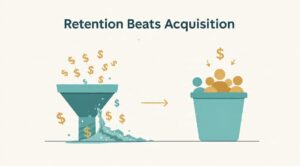
This is why retention beats acquisition as the cheapest growth lever a business has. Acquisition costs money on every single customer. A respected customer costs nothing to keep, and actively recruits more customers on your behalf without being asked.
Where respect actually shows up — and where owners look instead
Owners chasing growth tend to reach for the same four levers, roughly in this order of instinct: pricing, product quality, staff, location, marketing. Respect doesn’t sit cleanly in any one of those boxes, which is exactly why it gets skipped. It’s not a line item. It’s the operating condition all of the other levers run inside.
| Where owners look first | What respect changes underneath it |
|---|---|
| Pricing | A respected customer is far less price-sensitive; a disrespected one leaves even at a discount. |
| Marketing spend | Word of mouth from respected customers replaces a meaningful share of paid acquisition. |
| Staff turnover | Respected employees stay, and tenure is directly visible to customers as competence and care. |
| Product quality | Identical quality reads as better or worse depending entirely on how it was delivered. |
Notice that none of these are marketing tactics. They’re downstream effects of a single upstream decision about how people get treated inside the business.
The compounding version of disrespect
A single rude interaction rarely shows up on a report. It looks like nothing — one customer, one visit, no measurable dent. The damage is that it never appears alone. It’s a pattern that repeats across every employee who absorbed the same treatment from above, across every customer who happens to walk in on a bad day for that employee.
Run that pattern for a year and you get a business quietly bleeding customers it never technically lost — they just stopped coming back, for reasons that never made it into any feedback form. Owners then look at flat growth and blame the market, the competition, the algorithm. The actual cause was standing at the till the whole time.
Admitting a mistake early is a genuine superpower in business for the same underlying reason — both are forms of respecting the person on the other side of the counter enough to be straight with them instead of managing them.
How to actually build this in, not just say it
This isn’t about smiling harder. It’s about a handful of concrete decisions an owner controls directly.
- Treat employees the way you want customers treated. This is the entire mechanism in one sentence. Everything else on this list is downstream of it.
- Train for the actual need, not the visible budget. The employee in shop two never asked what my mother could afford. She asked what she actually wanted, and let the fit decide the rest.
- Never let “too many questions” become an acceptable internal complaint. A customer asking questions is doing free due diligence before handing you money. Treat it as engagement, not friction.
- Give staff room to spend a few extra minutes. Shop two showed eight or nine options without rushing. That’s a staffing and incentive decision the owner made, not a personality trait the employee happened to have.
- Watch how leadership talks about customers when customers aren’t in the room. That tone is the one that eventually reaches the counter.
None of this requires a bigger budget. It requires deciding that how people are treated is a growth lever, not a soft add-on to be handled once the “real” strategy is sorted.
Respect scales; charm doesn’t
A single charismatic salesperson can carry a small shop. They cannot carry a business with fifty employees across multiple locations — nobody can be everywhere at once. What scales is a standard: this is how we treat people here, full stop, regardless of who’s on shift.
Build the standard into hiring, onboarding and how managers are themselves treated, and it survives the founder walking out the door. Build it around one likeable person instead, and growth caps at whatever that one person can personally cover. This is a large part of why how successful business owners actually think day to day tends to focus so heavily on systems and culture rather than individual heroics — heroics don’t scale, standards do.
The two shops my mother visited that day were selling the same thing at close to the same price. Only one of them understood that the sale wasn’t the product. It was ever having been in the room in the first place.
Key Takeaways
- How an owner treats employees is how those employees treat customers — the counter is a mirror of the culture behind it.
- A respected customer is less price-sensitive and refers others for free; a disrespected one leaves even at a discount.
- Disrespect rarely shows up on a report because it looks like one small incident — the damage is that it’s never actually isolated.
- Respect isn’t a values statement. It’s built through concrete decisions: staffing, training focus, and how much room employees are given.
- A single charismatic employee can’t scale a business alone. A treatment standard can.
Frequently Asked Questions
Isn’t this just customer service under a different name?
Not quite. Customer service is a function inside a business. Respect is the operating condition that determines how well every function — service, sales, retention, referrals — actually performs. You can have a customer service department and still run a disrespectful business; the two aren’t the same thing.
How do I know if my business has a respect problem?
Watch for customers who leave mid-conversation without an obvious reason, staff turnover that outpaces the industry, and repeat customers who quietly stop returning without ever complaining. None of these show up clearly on a standard sales report, which is exactly why they get missed.
Does this apply to online businesses without face-to-face interaction?
Yes — it just moves channel. Response tone in support tickets, how refund requests are handled, and whether a customer’s question is answered like it matters all carry the same signal a shop-floor interaction does. The counter is now a chat window, but the mechanism is identical.
Can a business fix this without spending more money?
In most cases yes. This is a decision about tone, pace and how staff are treated internally, not a budget line. The main cost is usually time — giving employees room to handle a customer properly instead of rushing them to the next one.
What if my prices are already the lowest in the market?
Low prices attract a customer once. Respect is what decides whether they come back a second time without a discount pulling them in again. A business built purely on being cheapest is exposed the moment a competitor undercuts it — a respected relationship isn’t exposed the same way.
How do I train employees to be more respectful without it feeling forced?
Start with how you treat them, not with a script for how they should treat customers. Genuine tone is very hard to fake convincingly for an eight-hour shift; it’s far easier to sustain when it isn’t being performed on top of feeling undervalued.
Does this matter more for small businesses or large ones?
It matters at both, but it’s easier to lose sight of at scale, because the founder is no longer present for most interactions. Building it into a repeatable standard — rather than relying on individual personalities — is what keeps it intact as a business grows past the size the owner can personally oversee.