Key Takeaways
- Break of Structure (BOS) signals trend continuation — price breaks in the same direction the trend is already moving.
- Change of Character (CHoCH) signals a potential reversal — price breaks against the current trend for the first time, hinting the trend may be ending.
- The simplest way to remember: BOS = trend continues, CHoCH = trend may be changing.
- Reading these correctly tells you whether to trade with the existing trend or prepare for a reversal — the foundation of all structure-based trading.
- Like every concept, spotting BOS and CHoCH in hindsight is easy; reading them correctly in real time takes genuine experience.
Two acronyms confuse more beginners than almost anything else in modern trading: BOS and CHoCH. They sound technical, they look intimidating, and most explanations make them more confusing than they need to be. But here is the truth — the difference between them is genuinely simple, and once it clicks, you will read charts in a completely different way.
These two concepts are the foundation of market structure trading. They tell you the single most important thing you can know about a chart: is the trend continuing, or is it about to reverse? Get this right, and you trade with the market’s momentum instead of against it. Get it wrong, and you find yourself buying right as the market turns down, or selling right as it turns up — confused about why your good setups keep failing.
This guide explains Break of Structure (BOS) and Change of Character (CHoCH) in the simplest possible terms, with clear examples, for someone who has been staring at these acronyms wondering what the difference actually is. Plain language. No assumptions. By the end, you will tell them apart instantly. Let us get into it.
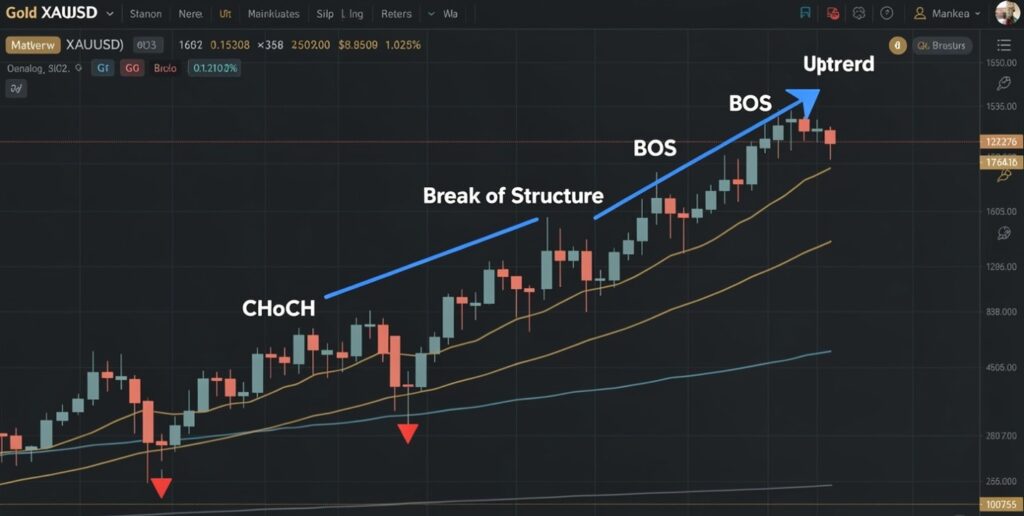
First — You Need to Understand Market Structure
Before BOS and CHoCH make any sense, you need to understand the thing they describe: market structure. Do not worry — it is simple.
Market structure is just the pattern of highs and lows that price makes as it moves. By looking at how these highs and lows form, you can tell what the market is doing — trending up, trending down, or moving sideways.
Here is the foundation. Price moves in waves, creating swing highs and swing lows — the peaks and valleys on the chart. The relationship between these peaks and valleys tells you the trend:
- Uptrend: Price makes higher highs and higher lows. Each peak is higher than the last, and each valley is higher than the last. The market is climbing a staircase upward.
- Downtrend: Price makes lower highs and lower lows. Each peak is lower than the last, and each valley is lower than the last. The market is descending a staircase downward.
- Range: Price moves sideways without clear higher highs or lower lows — stuck between a ceiling and a floor.
This is the entire foundation. An uptrend is higher highs and higher lows. A downtrend is lower highs and lower lows. Once you can see this on a chart, you are ready to understand BOS and CHoCH — because they are simply specific events that happen within this structure. For the broader framework of how structure fits into ICT trading, read our beginner guide on what ICT concepts are in forex trading.
— Data Pips Team
What Is a Break of Structure (BOS)?
Now to the first concept. Let us define it simply.
A Break of Structure (BOS) is when price breaks a previous high or low in the SAME direction as the current trend — confirming the trend is continuing.
Let us make this concrete with an uptrend example:
- The market is in an uptrend, making higher highs and higher lows.
- Price pulls back a little, then pushes up again and breaks ABOVE the most recent high.
- That break above the previous high, continuing the upward direction, is a bullish Break of Structure.
- It confirms: the uptrend is still alive and continuing.
And in a downtrend, it is the mirror image:
- The market is in a downtrend, making lower highs and lower lows.
- Price bounces a little, then pushes down again and breaks BELOW the most recent low.
- That break below the previous low, continuing the downward direction, is a bearish Break of Structure.
- It confirms: the downtrend is still alive and continuing.
So the key idea of BOS is simple: BOS = the trend continues. Price broke a level in the same direction the trend was already going, confirming that the momentum is intact and the trend should keep moving. When you see a BOS, it is a signal to look for trades in the direction of the existing trend.
What Is a Change of Character (CHoCH)?
Now the second concept — and this is the one that signals something more dramatic.
A Change of Character (CHoCH) is when price breaks a previous high or low AGAINST the current trend for the first time — signaling the trend may be reversing.
Let us make this concrete. Imagine an uptrend:
- The market has been making higher highs and higher lows for a while — a healthy uptrend.
- Then, price fails to make a new higher high, pulls back, and breaks BELOW a recent higher low — something it has not done during the uptrend.
- That break below, AGAINST the uptrend direction, is a Change of Character.
- It signals: the uptrend may be ending, and a reversal to the downside could be starting.
The same works for a downtrend reversing up:
- The market has been making lower highs and lower lows — a downtrend.
- Then price breaks ABOVE a recent lower high — something it has not done during the downtrend.
- That break above, against the downtrend direction, is a Change of Character.
- It signals: the downtrend may be ending, and a reversal to the upside could be starting.
So the key idea of CHoCH is: CHoCH = the trend may be changing. It is the first sign that the existing trend is losing control and the market might be reversing. The “change of character” name captures it perfectly — the market’s behavior has changed from what it was doing during the trend.
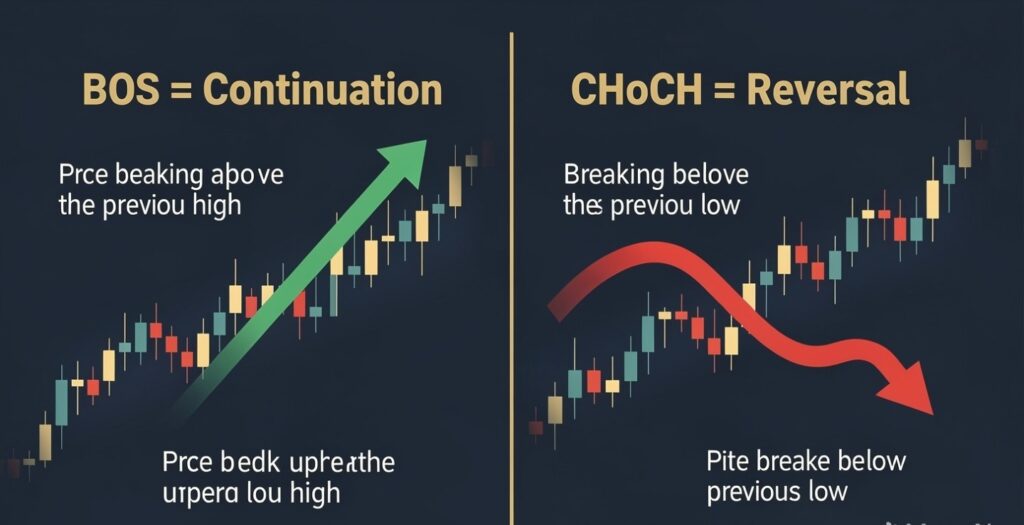
The Simplest Way to Remember the Difference
If all the explanation above still feels like a lot, here is the dead-simple version you can hold in your head forever:
BOS = trend CONTINUES (break in the same direction as the trend).
CHoCH = trend may be CHANGING (break against the trend for the first time).
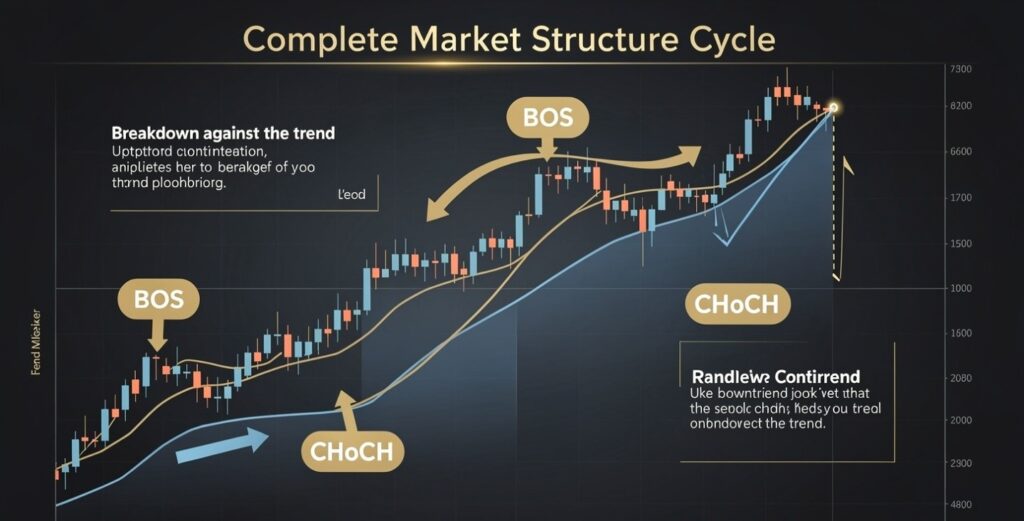
One more memory trick: a CHoCH usually comes FIRST, then BOS confirms the new trend. Here is how that sequence works in practice:
- The market is in an uptrend (higher highs, higher lows).
- A CHoCH happens — price breaks below a higher low for the first time, signaling the uptrend might be ending.
- Now the market starts forming lower highs and lower lows — a new downtrend begins.
- A BOS happens — price breaks below another low, confirming the new downtrend is now in control.
So the typical lifecycle is: trend → CHoCH (warning of reversal) → new trend forms → BOS (confirmation of new trend) → BOS → BOS (trend continues) → eventually another CHoCH (warning again). Understanding this cycle is how you read the flow of any market. The CHoCH warns you the trend is turning; the BOS confirms the new trend is established and gives you confidence to trade in that new direction.
Real Pattern: Reading the Turn on Gold
Consider a trader watching Gold in a clear uptrend — higher highs and higher lows, climbing steadily. They are looking for buy opportunities in line with the trend, and each Break of Structure (price breaking above the previous high) confirms the uptrend is healthy and gives them confidence to keep buying the pullbacks.
Then something changes. Price reaches a high but fails to push convincingly higher. It pulls back — and this time, it breaks below the most recent higher low, something it had not done during the entire uptrend. That is a Change of Character. The trader does not immediately flip to selling, but they recognize the warning: the uptrend may be ending. They stop looking for new buys.
Sure enough, the market then forms a lower high and breaks down again — a bearish Break of Structure confirming a new downtrend. Now the trader shifts to looking for sell opportunities in line with the new trend. By reading the CHoCH as a warning and the BOS as confirmation, they avoided buying into a reversal and positioned correctly for the new direction.
Lesson: The CHoCH warned of the turn. The BOS confirmed the new trend. Reading both correctly kept the trader on the right side of the market through the reversal — exactly what structure analysis is for.
How Traders Actually Use BOS and CHoCH
Understanding the definitions is one thing. Here is how these concepts actually shape trading decisions:
BOS Tells You to Trade With the Trend
When you see a Break of Structure confirming a trend, it tells you the trend is healthy and you should look for entries in the direction of that trend. In an uptrend confirmed by bullish BOS, you look for buy setups on pullbacks. In a downtrend confirmed by bearish BOS, you look for sell setups on bounces. BOS keeps you aligned with the dominant momentum, which is where the highest-probability trades live.
CHoCH Tells You to Be Cautious or Prepare to Switch
When you see a Change of Character, it is a warning. It tells you the current trend may be ending, so you should stop taking trades in the old trend direction and prepare for a possible reversal. A CHoCH is not always an immediate signal to flip your bias — but it is a signal to be cautious, tighten up, and watch closely. If a BOS then confirms the new direction, you can shift to trading the new trend with more confidence.
Combining Them With Other Concepts
BOS and CHoCH become far more powerful when combined with the other concepts in your toolkit. A CHoCH that happens right after a liquidity sweep, near a quality order block, or aligned with a fair value gap, is a high-probability reversal signal. Structure gives you the direction; the other concepts give you the precise entry. Used together, they form a complete reading of the market — which is exactly how the concepts are meant to work, not in isolation.
Use Higher Timeframes for the Real Trend
BOS and CHoCH on higher timeframes carry far more weight than on lower timeframes, where noise creates constant false signals. A CHoCH on a low timeframe might just be noise within a larger trend. A CHoCH on a higher timeframe is a genuine warning of a major shift. Always read your overall structure from the higher timeframes, then use lower timeframes only for refining entries. This connects to proper timing — our guide on ICT kill zones and best trading times covers when these structural breaks are most reliable.
Where Beginners Go Wrong With BOS and CHoCH
They Confuse the Two
The most basic mistake: mixing up which is which. They see a break and cannot tell whether it confirms the trend (BOS) or warns of a reversal (CHoCH). The fix is to always know the current trend direction first. If the break is in the SAME direction as the trend, it is a BOS. If it is AGAINST the trend for the first time, it is a CHoCH. Always establish the trend before labeling the break.
They Trade Every Small Break as Significant
On lower timeframes, price breaks tiny highs and lows constantly, and beginners label every minor wiggle as a BOS or CHoCH. Most of these are meaningless noise. The significant structural breaks happen at meaningful swing points on higher timeframes. Focus on the clear, obvious highs and lows that matter, not every tiny fluctuation. If you are marking ten CHoCHs on a single screen, you are reading noise.
They Treat CHoCH as an Immediate Reversal Signal
A common error is flipping bias the instant a CHoCH appears, assuming the trend has fully reversed. A CHoCH is a WARNING, not a confirmation. The trend might reverse — or the CHoCH might be a false signal and the original trend resumes. Wait for further confirmation, like a follow-up BOS in the new direction, before fully committing to a reversal. CHoCH says “be cautious,” not “flip everything immediately.”
They Think Knowing These Concepts Makes Them Profitable
The familiar deepest trap. Understanding BOS and CHoCH feels like a breakthrough — and it is, at the level of knowledge. But knowing what they are and reading them correctly in real time, with money on the line, are completely different skills. The Data Pips Team has seen countless traders who can identify BOS and CHoCH perfectly in hindsight, yet still lose money, because real-time structure reading under pressure is a separate ability that only experience builds. The concept gives you a framework. Discipline and screen time turn it into skill. Our guide on mechanical discipline covers the work that actually matters.
— Data Pips Team
The Truth About BOS and CHoCH Nobody Tells Beginners
1. Defining the Swing Points Is Subjective
Here is something rarely admitted: deciding which highs and lows “count” as significant swing points involves judgment, and different traders will mark them slightly differently. This means BOS and CHoCH are not perfectly objective — two skilled traders might label the same chart slightly differently. This is normal. The goal is consistency in how YOU define your swing points, not finding the one “correct” way. Develop a consistent method and stick with it.
2. They Look Obvious in Hindsight, Hard in Real Time
Scrolling back through charts, every BOS and CHoCH looks clear and obvious. In real time, on the right edge of the chart, you do not yet know whether a break is a genuine structural shift or a false move that will reverse. This gap between hindsight clarity and real-time uncertainty is why structure reading feels easy to learn but hard to trade. Respect this — never assume live trading is as clean as the historical chart looks.
3. False Breaks Are Common
Price often breaks a level slightly and then reverses, creating a false BOS or false CHoCH. These false breaks trap beginners who act on every break immediately. This is closely related to liquidity sweeps — sometimes a “break” is actually just a liquidity grab before reversing. Waiting for a candle to actually close beyond the level, rather than just wicking past it, filters out many false breaks. Patience for confirmation protects you.
4. The Higher Timeframe Always Wins
When a lower timeframe shows one thing and a higher timeframe shows another, the higher timeframe is more reliable. A CHoCH on a 5-minute chart means very little if the daily chart is in a powerful uptrend — it is just noise within the bigger trend. Always anchor your analysis to the higher timeframe structure, and treat lower timeframe breaks as refinement, not as the main signal. Beginners who trade lower timeframe structure without higher timeframe context get whipsawed constantly.
5. This Knowledge Will Not Fix a Discipline Problem
The familiar hard truth. Understanding BOS and CHoCH perfectly will not make you profitable if you overtrade, oversize positions, revenge trade, or abandon your plan under pressure. Structure reading is a powerful tool, but a tool in undisciplined hands still produces losses. Most traders need to fix their psychology far more than they need another technical concept. The structure tells you the direction; your discipline determines whether you can actually trade it without sabotaging yourself.
Your BOS and CHoCH Practice Plan
Now It’s Your Move
- Master market structure first. Practice identifying higher highs/higher lows (uptrend) and lower highs/lower lows (downtrend) until it is automatic. Everything builds on this.
- Memorize the simple rule. BOS = trend continues (break with the trend). CHoCH = trend may change (break against the trend for the first time). Burn this into your memory.
- Practice spotting both in hindsight. Open historical charts. Find BOS and CHoCH events. Trace the full cycle: trend, CHoCH, new trend, BOS. Train your eye before risking money.
- Always establish the trend before labeling a break. You cannot tell BOS from CHoCH without first knowing the current trend direction. Trend first, then label the break.
- Treat CHoCH as a warning, not a verdict. Do not flip your bias the instant a CHoCH appears. Wait for confirmation like a follow-up BOS before fully committing to a reversal.
- Anchor to higher timeframes. Read your real structure from higher timeframes. Use lower timeframes only for refining entries. The higher timeframe always wins.
- Wait for candle closes to filter false breaks. A wick past a level is not a confirmed break. Wait for a candle to close beyond the level to reduce false signals.
Frequently Asked Questions
A Break of Structure (BOS) is when price breaks a previous high or low in the SAME direction as the current trend, confirming the trend is continuing. A Change of Character (CHoCH) is when price breaks against the current trend for the FIRST time, signaling the trend may be reversing. The simplest way to remember it: BOS means the trend continues, while CHoCH means the trend may be changing. A CHoCH typically comes first as a warning of reversal, and then a BOS in the new direction confirms the new trend has taken control.
A Break of Structure is when price breaks a recent high or low in the same direction the trend is already moving. For example, in an uptrend (making higher highs and higher lows), when price breaks above the most recent high, that is a bullish BOS — it confirms the uptrend is still healthy and continuing. In a downtrend, when price breaks below the most recent low, that is a bearish BOS confirming the downtrend continues. BOS is essentially the market telling you the current trend is intact and you should look for trades in that same direction.
A Change of Character is the first time price breaks against the current trend, signaling the trend may be ending. For example, in an uptrend, when price breaks below a recent higher low — something it had not done while trending up — that is a CHoCH, warning the uptrend may be reversing into a downtrend. The name captures it perfectly: the market’s behavior has “changed character” from what it was doing during the trend. A CHoCH is a caution signal, not necessarily an immediate reversal — it tells you to stop trading the old trend and watch closely for confirmation of a new one.
In a trend reversal, CHoCH comes first, then BOS confirms the new trend. The typical sequence is: the market is in a trend, then a CHoCH happens (price breaks against the trend for the first time, warning of reversal), then the market starts forming a new trend in the opposite direction, and then a BOS in that new direction confirms the new trend is established. So CHoCH is the early warning of a turn, and BOS is the confirmation that the new trend has taken control. After that, repeated BOS events confirm the new trend continues until the next CHoCH warns of another turn.
No — a CHoCH is a warning, not a confirmed reversal signal. Flipping your bias the instant a CHoCH appears is a common beginner mistake, because the CHoCH might be a false signal and the original trend could resume. Instead, treat a CHoCH as a signal to be cautious: stop taking trades in the old trend direction and watch closely. Wait for further confirmation — such as a follow-up BOS in the new direction — before fully committing to trading the reversal. Patience for confirmation protects you from the many false reversals that trap impatient traders.
The most common reasons are: trading them on lower timeframes where noise creates constant false signals, acting on wicks past a level rather than waiting for a candle to actually close beyond it, ignoring the higher timeframe context (a lower timeframe CHoCH means little if the higher timeframe trend is strong), and confusing genuine structural breaks with liquidity sweeps that break a level and immediately reverse. The fixes are to anchor your analysis to higher timeframes, wait for candle closes to confirm breaks, and combine structure with other concepts like liquidity for confirmation rather than trading every break in isolation.
Both. BOS and CHoCH are core market structure concepts used in both ICT (Inner Circle Trader) and SMC (Smart Money Concepts), which share most of their fundamental ideas. These concepts describe how price action reveals trend continuation and reversal through breaks of structure, and they form the foundation of structure-based trading in either framework. Whether you study ICT or SMC, you will encounter BOS and CHoCH as essential tools for reading whether a trend is continuing or potentially reversing. They are part of the shared toolkit that both frameworks rely on.

Now It’s Your Move
Two acronyms that confused you at the start now make complete sense. BOS — Break of Structure — means the trend is continuing, price breaking in the same direction the market is already moving. CHoCH — Change of Character — means the trend may be reversing, price breaking against the trend for the first time. BOS continues. CHoCH changes. That is the entire core of it.
And once this clicks, you read charts differently. You see the staircase of higher highs and higher lows, you recognize when a BOS confirms it is still climbing, and you spot the CHoCH that warns the market just stepped onto a different staircase heading the other way. You stop buying into reversals and selling into continuations. You start trading with the market’s actual direction instead of against it.
But remember the deeper truth that applies to every concept in this space: knowing BOS and CHoCH will not make you profitable on its own. Spotting them in hindsight is easy; reading them correctly in real time, filtering out false breaks, anchoring to the right timeframe, and waiting for confirmation — that takes genuine experience and discipline. The concept gives you the map. Your psychology determines whether you can actually follow it.
Master market structure first. Memorize the simple rule. Practice in hindsight. Always establish the trend before labeling the break. Treat CHoCH as a warning, not a verdict. Anchor to higher timeframes. And give yourself the screen time it takes to turn this knowledge into real skill.
You now understand BOS and CHoCH better than most traders who have been staring at these acronyms for months. The chart just became a lot more readable.
For your next steps, combine structure with the concepts that confirm your entries: order blocks, liquidity sweeps, and fair value gaps. Then tie it all together with our complete ICT trading strategy guide.