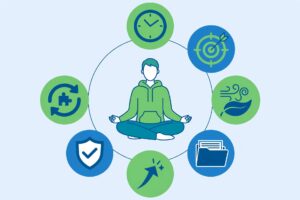
Overthinking rarely announces itself as a decision to keep thinking. It feels more like getting stuck — the same three or four thoughts circling on repeat, each pass promising clarity that never actually arrives. “Should I take this job or not.” “Should I learn this skill or not.” The loop doesn’t resolve anything; it just burns time and leaves you more tired than when it started. A trainer once described breaking this loop down into three concrete steps, small enough to actually use in the moment it happens, rather than a vague instruction to “just stop worrying.” It’s simple enough to remember under pressure: A for Awareness, B for Breathing, C for Commitment.
Why Overthinking Isn’t a Willpower Problem
The instinct most people have when they notice they’re overthinking is to try to think their way out of it — to reason harder, weigh the pros and cons one more time, hoping the extra pass will finally settle it. This almost never works, because overthinking isn’t usually a reasoning problem. It’s closer to a stuck loop, psychologically similar to what researchers call rumination — repetitive, passive dwelling on a problem without actually moving toward resolution. Trying to reason your way out of a loop using the same mental machinery that’s stuck in the loop rarely breaks it. What actually breaks it is interrupting the loop itself, which is exactly what each step of this method is built to do.
Step One: Awareness
The first step sounds almost too simple to matter, and that’s precisely why it gets skipped. Before anything else can happen, you have to actually notice, in the moment, that you’re overthinking — not five minutes later when you’re already exhausted from it, but while it’s happening. This single act of naming what’s occurring (“I’m overthinking this”) is a form of what psychologists call metacognition — thinking about your own thinking rather than being fully absorbed inside it. That small shift in vantage point is what makes the next two steps possible at all. Without it, you stay inside the loop without realizing there’s a loop to step out of. This connects to the same mechanism behind breaking cycles of compulsive attention — the moment you can label a pattern from slightly outside it, the pattern loses some of its automatic grip.
Step Two: Breathing
Once you’ve noticed the loop, the next step is physiological, not mental: a slow inhale through the nose for about four seconds, followed by a longer exhale through the mouth for around six seconds. This isn’t a relaxation cliché — there’s a real mechanism behind it. Breathing with a longer exhale than inhale activates the vagus nerve, which triggers the parasympathetic nervous system — the body’s “rest and digest” mode — and measurably slows heart rate. The American Heart Association has highlighted this same mechanism: deliberately making the exhale longer than the inhale helps stimulate the vagus nerve and shift the body out of a stressed state. Research on this technique specifically finds that even brief practice — as little as two minutes of longer-exhale breathing — is enough to noticeably calm the nervous system. The practical effect matters more than the physiology: an overactive, “foggy” mind genuinely can’t reason clearly, and this step isn’t about willpower — it’s about physically shifting the nervous system state that’s making clear thought difficult in the first place, so the third step actually has a chance to land.
Step Three: Commitment
With the mind in a calmer, more neutral state, the final step is deciding something concrete and acting on it — not eventually, immediately. This doesn’t need to be the perfect, fully-reasoned decision. It needs to be a specific, time-bound commitment: “I’ll spend one month learning this skill, daily, before I revisit whether it’s right.” The commitment’s job isn’t to guarantee the correct long-term choice. It’s to end the loop by giving the mind something concrete to act on instead of something abstract to keep circling. This is the same principle behind identity-based change — a vague intention keeps getting re-litigated indefinitely, while a specific, bounded commitment gives you something to actually evaluate later, based on real evidence from having tried it rather than more hypothetical reasoning about whether you should.
Why the Sequence Matters
Each step depends on the one before it actually working. Skipping straight to commitment without awareness means you’re still reasoning from inside the fog, more likely to make a reactive decision than a genuinely clearer one. Skipping breathing and going straight from noticing you’re stuck to trying to decide means you’re still working with an activated, stressed nervous system that isn’t primed for calm decision-making in the first place. The order isn’t arbitrary — each step clears the way for the next one to actually function. This mirrors the broader idea behind deep, focused work: the conditions around a task determine how well the task itself gets done, and trying to force good output from bad conditions — a scattered mind, an activated nervous system — rarely works as well as fixing the conditions first.
When This Method Actually Applies
The ABC method is built for a specific kind of overthinking: repetitive, low-stakes-relative-to-time-spent deliberation — should I learn this skill, should I send this message, should I take this smaller decision. It’s not a substitute for genuinely difficult decisions that deserve real, extended thought, and it’s not a mental health treatment for clinical anxiety or persistent rumination that interferes with daily functioning; those situations are worth discussing with a qualified professional rather than managed with a three-step technique alone. Where it does apply, it’s most useful as a repeatable habit rather than a one-time fix. The method gets faster and more automatic with practice — noticing the loop becomes quicker, the breath becomes a more reliable reset, and the commitment step gets easier to trust once you’ve seen it work a few times.
Building It Into a Habit
The method works best when it’s practiced on genuinely small decisions first — what to eat, whether to send a low-stakes message, whether to start a small task now or later — before relying on it for something bigger. This builds the pattern recognition needed to catch the loop early, the same way breaking any limiting pattern tends to start small and compound, rather than working the first time it’s tried on the hardest possible case. A useful test for whether the loop has genuinely broken, rather than just been temporarily quieted: notice whether the same thought resurfaces an hour later demanding the same deliberation again. If a real commitment was made, it usually doesn’t — there’s nothing left to decide until the committed timeframe actually plays out. If it does resurface immediately, that’s often a sign the commitment step wasn’t specific or bounded enough to actually close the loop.
The Underlying Shift
What makes this method work isn’t any single step in isolation — it’s that it treats overthinking as a state to interrupt rather than a problem to out-think. This connects to what real mental toughness actually looks like — not the absence of doubt or overthinking, but a reliable, practiced way of moving through it quickly instead of getting stuck in it for hours. And it ties into building genuine self-confidence too: confidence grows less from having perfectly reasoned every decision in advance, and more from a track record of committing, acting, and adjusting — which is exactly the loop this method is designed to protect.
Key Takeaways
- Overthinking is a stuck loop, not a reasoning gap — trying to think your way out with more analysis rarely works.
- The ABC method: Awareness (notice the loop), Breathing (4-second inhale, 6-second exhale to calm the nervous system), Commitment (a specific, time-bound decision).
- Longer exhales than inhales activate the vagus nerve and shift the body into a calmer state — this is measurable, not just a relaxation cliché.
- The commitment step doesn’t need to be the “perfect” decision — it needs to be specific and bounded enough to actually end the loop.
- This method works best as a repeated habit on small decisions, not as a one-time fix for major life choices or clinical anxiety.
About the Author
Shurah writes and maintains DataPips independently, drawing on hands-on experience in trading and entrepreneurship. Articles are shaped by personal research, real trading lessons, and the process of building this publication from scratch — not by a formal financial credential.