Key Takeaways
- Everyone consumes something every day — the real question is what percentage of your time goes toward producing instead.
- Consuming feels productive in the moment because it engages attention, even though it leaves nothing behind afterward.
- The same hours spent scrolling could be spent building a skill, creating content, or producing something of value.
- Producers compound their time; consumers spend it. One accumulates, the other simply passes.
- This isn’t about eliminating rest or entertainment entirely — it’s about noticing which category is quietly winning most of your day.
- The gap between a producer and a consumer rarely shows up in a single day — it shows up clearly after a few years.
Everyone wants a good, peaceful life. Almost nobody, when asked directly, says they want to stay behind or watch others get ahead of them. And yet an enormous amount of daily time gets handed over to consuming — buying, scrolling, watching — while producing anything of lasting value gets pushed to “later,” “when I have more energy,” or “this weekend.”
This isn’t a lecture about deleting every app or never resting. It’s a simple, uncomfortable question worth actually answering honestly: on a typical day, how much of your time goes toward producing something, and how much goes toward consuming what someone else already produced?
Why Consuming Feels Like Progress When It Isn’t
Scrolling, watching, and buying all activate real attention and even real emotion — which is exactly why they feel like they’re accomplishing something, even when nothing is actually being built. This is closely tied to the attention economy — an entire industry is specifically engineered to hold your focus for as long as possible, because attention itself is the product being sold, regardless of whether you walk away with anything of your own to show for the time spent.
None of this is really your fault in the way it can feel. These systems are built by extremely well-resourced teams whose entire job is making consumption feel satisfying enough that you keep returning. Recognizing that the pull is engineered, rather than a personal failing, is often the first honest step toward changing the ratio.
“Consuming fills the hour. Producing fills the years that come after it.”
The Same Hours, Redirected
Take a specific, concrete example: eight hours spent across a week on entertainment platforms is eight hours that could have gone toward writing, learning a skill, building something small, or studying a topic that compounds into future opportunity. The hours aren’t the issue — everyone has roughly the same amount in a day. The issue is which category absorbs most of them by default, without ever being consciously chosen.
This connects to deliberate practice as a concept — meaningful skill development requires focused, intentional effort over time, which is a fundamentally different activity than passive consumption, even when both occupy the exact same number of hours on a calendar. Redirecting even a portion of consumption time toward this kind of intentional output is where the real compounding difference begins.

Comparison: Producer Habits vs Consumer Habits
| Element | Consumer Habit | Producer Habit |
|---|---|---|
| Time Spent | Watching, scrolling, buying | Writing, building, studying, creating |
| Feeling In the Moment | Satisfying, effortless, easy to sustain | Often requires initial resistance to start |
| What Remains Afterward | Nothing tangible carries forward | A skill, asset, or body of work accumulates |
| Effect Over One Day | Barely noticeable difference | Barely noticeable difference |
| Effect Over Several Years | Time has passed with little to show for it | Meaningful compounding output or skill exists |
What Nobody Tells You
Here’s the part that gets left out of most productivity content: this isn’t about eliminating consumption entirely, and trying to do so usually backfires. Rest, entertainment, and genuine downtime matter and have real value. The actual issue is when consumption becomes the overwhelming default — when producing anything requires a special mood or a rare burst of motivation, while consuming requires none at all.
This connects to why discomfort is often the actual path to growth — producing typically requires pushing through an initial resistance that consuming never demands, which is exactly why consumption wins the default battle for most people’s time unless a deliberate choice interrupts it.
Why the Difference Doesn’t Show Up for Years
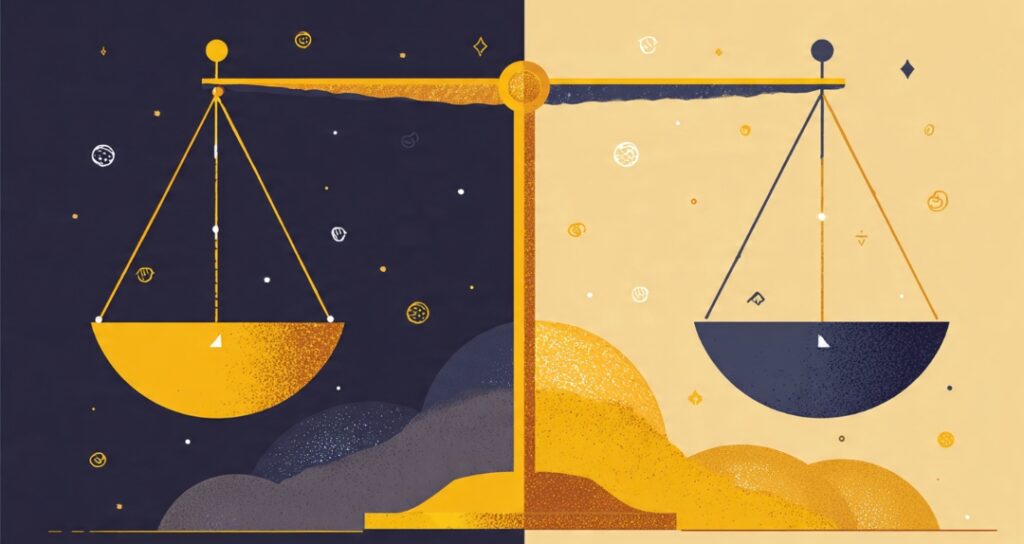
The producer-versus-consumer gap is nearly invisible day to day, which is exactly what makes it so easy to ignore. Nobody feels the cost of a single evening of scrolling instead of building. The cost only becomes visible in aggregate, after enough days have quietly gone the same direction, at which point the gap between someone who consistently produced and someone who consistently consumed becomes obvious and much harder to close.
This mirrors the daily compounding habits that actually build meaningful change — the producer-consumer divide compounds in exactly the same silent way, just applied to time and attention rather than money or skill directly.
“You won’t feel today’s scrolling cost you anything. You’ll feel three years of it all at once.”
The Role of Dopamine in Making Consumption So Sticky
Part of why consuming wins the default battle so consistently is genuinely biological. Short-form content, notifications, and quick purchases are specifically designed to trigger frequent, small hits of dopamine, creating a reward loop that’s far more immediate and reliable than the slower, delayed satisfaction that comes from producing something meaningful. Producing rarely offers that same instant reward, which is precisely why it needs to be chosen deliberately rather than left to compete on the same terms as consumption.
Understanding this makes the imbalance feel less like a personal willpower failure and more like an environment stacked in one direction — which is also why small, structural changes, like specifically scheduling production time before opening any consumption apps, tend to work better than relying purely on willpower in the moment.
How This Shapes Long-Term Outcomes
Over enough time, the producer-consumer ratio quietly determines who builds skills, assets, and opportunities, and who simply accumulates hours of consumed content with nothing carried forward from most of it. This connects to rewiring a mindset from zero — the shift rarely requires eliminating consumption entirely, just consistently choosing to produce during a portion of the time that would otherwise default to consuming without a second thought.
This same discipline underlies genuine mental resilience and why discipline functions as a survival mechanism rather than a personality trait some people are simply born with — both require choosing the harder, less immediately rewarding option repeatedly, the exact same choice this producer-versus-consumer divide demands every single day.
Now It’s Your Move
- Track your actual screen time for one week honestly, without judgment, just to see the real number.
- Identify one hour of typical consumption time and redirect it toward a small, specific act of production.
- Schedule production time before opening consumption apps, rather than relying on willpower after the scrolling has already started.
- Don’t aim to eliminate consumption entirely — aim to shift the ratio meaningfully over time.
- Notice which moments trigger consumption by default — boredom, waiting, stress — and interrupt at least one of them deliberately this week.
- Pick one skill or project and commit a specific, recurring block of time to producing it, even if the block is small.
- Revisit this ratio in three months and notice whether anything has genuinely accumulated from the time redirected toward producing.