Albert Einstein — the man who gave us the theory of relativity and reshaped our understanding of the universe — was once asked what he considered the most powerful force in the world.
His answer was not gravity. It was not nuclear energy.
He called compounding the eighth wonder of the world — and then added something even more profound:
“He who understands it, earns it. He who doesn’t, pays it.”
Two sentences. But if you truly absorb them, they will change the way you look at every single decision you make — not just with money, but with your time, your habits, your relationships, and your growth.

What Is Compounding?
Let us strip away all the complexity and get to the core idea.
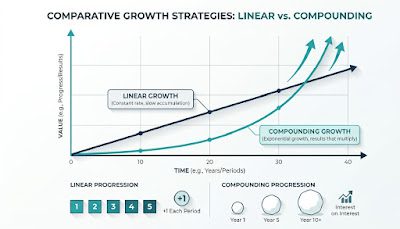
Compounding means that the results of your efforts do not just add up — they multiply.
Here is a simple way to think about it. Imagine you fold a piece of paper in half once — it doubles in thickness. Fold it again — it doubles again. Fold it 42 times, and that piece of paper would theoretically reach the Moon.
That is compounding. Small, repeated actions building on top of each other — not linearly, but exponentially. Each cycle does not just add to what came before — it multiplies it.
Beyond Money: Compounding Is a Life Principle
Here is where most people get it wrong. When they hear “compounding,” they immediately think of bank interest or investment portfolios. And yes — compounding is incredibly powerful in Finance. But limiting this concept to money alone is like owning a Ferrari and only using it to go to the corner shop.
Compounding is not just a financial concept. It is a universal principle of growth.
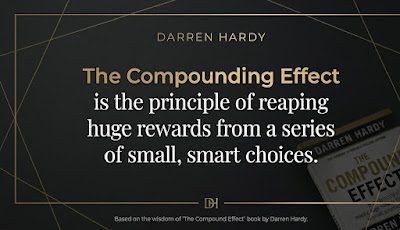
Author and success coach Darren Hardy captured this perfectly in his book The Compound Effect:
“The Compounding Effect is the principle of reaping huge rewards from a series of small, smart choices.”
— Darren Hardy
Read that again. Small, smart choices. Not giant leaps. Not overnight transformations. Just consistent, intelligent effort — repeated over time. This single idea has the power to transform every area of your life.
Compounding in Real Life: It Is Everywhere
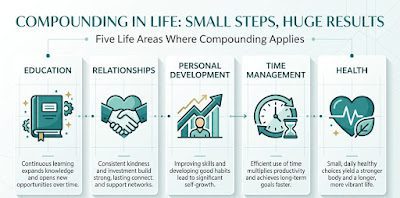
1. Compounding in Education
Every time you learn something new, you are not starting from zero. You are building on everything you already know. A student who reads for just 20 minutes a day will have read over 7,000 minutes — roughly 116 hours — by the end of a year.
That is the compound effect of learning. Each new idea connects to the last, deepening understanding, strengthening memory, and making future learning faster and easier. The students who seem to “suddenly” excel did not become brilliant overnight. They compounded small efforts, day after day, until their knowledge reached a tipping point.
2. Compounding in Relationships
Every kind word, every moment of genuine attention, every promise kept — these are deposits into the relationship. Small on their own, but compounded over months and years, they build something extraordinary: deep trust, unshakeable bonds, and relationships that become the foundation of a meaningful life.
Conversely, small neglects also compound. A habit of checking your phone during conversations, consistently running late, forgetting small commitments — alone, they seem harmless. Together, over time, they erode even the strongest relationships.
3. Compounding in Personal Development
James Clear, author of Atomic Habits, famously illustrated this: if you improve by just 1% every day, you will be 37 times better by the end of the year. That is not a metaphor — that is mathematics.
Personal development is perhaps the most powerful application of compounding. A daily habit of reflection, exercise, reading, or skill-building may feel almost invisible in the short term. But give it time — and the transformation becomes undeniable.
4. Compounding in Time Management
How you spend your time compounds too. One hour of deep, focused work each morning — before distractions arrive — compounds into hundreds of hours of high-quality output over a year. That is the difference between people who accomplish remarkable things and those who feel perpetually busy but never truly productive.
Time, unlike money, cannot be recovered once spent. But it can be invested — and compounded.
5. Compounding in Health and Fitness
A 30-minute walk today does not transform your health. But 30 minutes, every day, for a year? That compounds into improved cardiovascular health, better sleep, sharper mental clarity, and a body that functions with more energy and resilience.
The same is true in reverse. A single late night, a single unhealthy meal — harmless. But consistently poor sleep and poor nutrition compound into chronic health problems that take years to develop and years to reverse.
Why Compounding Feels Invisible at First
Here is the most important — and most misunderstood — truth about compounding:
In the beginning, it does not look like it is working.
When you first start exercising, you do not feel fit. When you first start saving, the numbers feel meaningless. When you first start learning a skill, you feel incompetent. When you first start improving your relationships, nothing seems to change.
This early phase is what makes most people quit. They do not see results, so they assume their efforts are not working. They switch strategies, start over, or give up entirely.
But this is exactly the phase where compounding is doing its most important work — silently, beneath the surface, building the foundation for a transformation that is not yet visible.
Scientists call this the “Plateau of Latent Potential.” Progress is happening. You just cannot see it yet. The people who understand compounding do not quit during this phase. They trust the process. And then, when the results finally arrive, they arrive with extraordinary force.

The Dark Side of Compounding: It Works Both Ways
This is the part that most articles leave out. Compounding does not distinguish between good habits and bad ones. It amplifies whatever you consistently do.
- Small daily overspending compounds into serious, suffocating debt.
- Consistent negative self-talk compounds into deeply embedded limiting beliefs.
- Gradual neglect of health compounds into chronic illness that takes years to reverse.
- Repeated procrastination compounds into lost years and unrealized potential.
Einstein’s warning — “He who doesn’t understand it, pays it” — applies here directly. If you are not consciously using compounding in your favor, it may very well be working against you without your awareness.
The question is not whether compounding is affecting your life. It is. The only question is: in which direction?
How to Start Using Compounding Intentionally
You do not need to make dramatic changes. You need to make small, smart, consistent choices — exactly as Darren Hardy described.
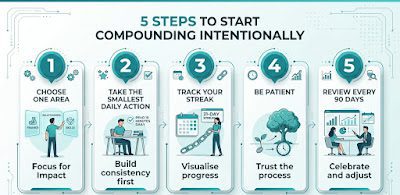
Here is a simple framework to begin:
1. Identify one area of your life you want to transform. Not five. One. Focus is the multiplier of compounding. Spreading attention across too many areas dilutes the effect.
2. Choose the smallest possible action you can commit to daily. Not the most impressive action — the most sustainable one. A five-minute daily habit beats a two-hour weekly effort because consistency is what activates compounding, not intensity.
3. Track your streak. The visual evidence of consistency is a powerful motivator. When you can see 30 consecutive days on a calendar, the desire to protect that streak becomes a force in itself.
4. Be patient with the invisible phase. Remind yourself that the absence of visible results does not mean the absence of progress. The foundation is being built. Trust the mathematics.
5. Review quarterly, not daily. Compounding works over time. Measuring progress every day is like watching grass grow — you will see nothing. Review every 90 days and the transformation will become visible and motivating.
A DataPips Perspective
Across trading psychology, personal finance, AI, and personal development — every single domain tells the same story:
The greatest results always belong to those who compound consistently — not those who act dramatically once.
In trading, the investor who compounds small, disciplined gains year after year outperforms the speculator chasing massive returns. In technology, the developer who codes for an hour every day builds more than the one who works in frantic weekend bursts. In personal finance, the person who saves a small percentage of every paycheck compounds their way to financial freedom while those waiting for a “big moment” remain stuck.
Understanding compounding is not just an intellectual exercise. It is the foundational principle behind every success story you have ever admired — and every one you are yet to write.
Conclusion: The Wonder That Rewards the Patient
Albert Einstein called compounding the eighth wonder of the world. Not because it is complicated — but because it is quietly, relentlessly, extraordinarily powerful.
The magic is not in dramatic gestures. It is in the daily choice to show up, do the small thing, and trust that over time — with patience, consistency, and intention — small actions will produce results that once seemed impossible.
He who understands it, earns it.
Now you understand it.
Explore more on DataPips — your source for insights on AI, technology, personal finance, compounding, and trading psychology.
This article is for educational and informational purposes only.