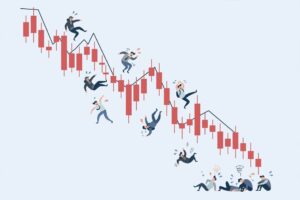
A trader with a genuinely strong, properly tested strategy loses money regularly, sometimes several times in a row, and that isn’t a sign anything is broken. It’s the actual, expected shape of a probability-based edge playing out over time. The traders who don’t understand this distinction are the ones who abandon good strategies after a bad week, and the ones who react emotionally to a single loss — which, as one trading educator put it, is the single clearest tell that someone doesn’t actually have an edge at all. They’re gambling and calling it trading.
Why Even a Great Strategy Loses Repeatedly
The process a serious trader is supposed to follow before ever risking real capital is specific: build a strategy, backtest it against historical data, then forward test it in real market conditions without real money, before finally committing capital. What comes out of that process is a statistic — a win rate. A strategy might come out of backtesting with a 70% win rate, meaning roughly 70 out of every 100 trades win and 30 lose. What that win rate does not tell you is the order those wins and losses will arrive in. This is where most traders’ intuition badly misleads them. A losing streak of four, five, even six trades in a row is entirely consistent with a strategy that wins 70% of the time overall — it’s basic probability, the same math that explains why flipping a fair coin ten times doesn’t reliably alternate heads and tails. Industry data on this is specific: even a 55% win-rate strategy can produce a run of eight consecutive losses within 100 trades from completely normal variance, and a strategy with a 50% win rate has a 96% probability of hitting at least one five-loss streak over the same sample. A 70% win-rate strategy can still, eventually, run into ten losses in a row. None of that means the edge stopped working. It means the sequence, not the average, is what feels painful in real time.
The Professional Response: No Emotion, Just the Next Trade
Once a trader actually knows their strategy’s tested statistics, the correct response to any individual outcome is close to indifferent. A win: good, move to the next trade. A loss: expected, move to the next trade. The strategy’s edge lives in the long-run average across many trades, not in any single one of them, so reacting strongly to one result treats a single data point as if it were the whole picture. This is precisely the discipline covered in risk management as a psychological practice, not just a position-sizing spreadsheet. The math can be perfect on paper and still fail completely in practice if the person executing it can’t tolerate the emotional weight of the variance the math actually predicts.
The Gambler Tell
Here’s the practical diagnostic: watch how a trader reacts to a single trade. Someone yelling, panicking, or emotionally unraveling over one loss — or getting euphoric over one win — is showing you they don’t actually have a tested statistical edge to fall back on. If they did, that one outcome would just be an expected data point inside a known distribution, not an event worth an emotional reaction. The emotional intensity is the tell. A trader with a real, backtested edge treats a loss the way a casino treats a losing hand at blackjack — an expected cost of running a profitable system over volume, not a crisis. This distinction connects directly to the gambler’s fallacy — the mistaken belief that past outcomes influence independent future ones (“I’ve lost four times, I’m due for a win”). A trader without a tested edge is especially vulnerable to this thinking, because without real statistics to anchor to, every outcome gets interpreted emotionally instead of probabilistically.
Why This Matters More Than Strategy Selection
A huge amount of retail trading education focuses on finding the “right” strategy, as if the core problem is picking better setups. The evidence points elsewhere: traders with genuinely profitable strategies blow their accounts regularly, and the failure almost never traces back to the strategy’s actual math. It traces back to abandoning the strategy at exactly the wrong moment — usually during a losing streak that was well within normal variance — or increasing risk after a losing streak to “make it back,” which is revenge trading by another name. This is also where overtrading quietly starts. A trader inside a losing streak, not understanding it as expected variance, starts taking extra, lower-quality setups outside their tested criteria specifically to end the uncomfortable feeling of losing — which statistically just adds more low-edge trades into the mix and makes the actual drawdown worse, not better.
The Sample-Size Problem
A related trap compounds all of this: judging a strategy’s validity from too small a sample. Ten trades tell you almost nothing — you could flip a fair coin ten times and get eight heads purely by chance, and it wouldn’t mean the coin was biased. A reasonable working sample for evaluating a strategy sits closer to 100 trades at minimum, with 200 or more considered more statistically defensible, specifically because variance dominates at small sample sizes and only settles down as the sample grows. This has a direct, painful consequence for a trader who doesn’t know it: quitting a genuinely good strategy after 15 or 20 trades because a chunk of them lost is a decision made on almost no statistical information — and it’s exactly the mistake recency bias pushes traders toward, weighting the last handful of outcomes far more heavily than the actual accumulated evidence.
How This Plays Out in the Demo-to-Live Transition
This probability-based mindset is especially hard to hold onto right after moving from demo to live trading, where the emotional stakes of every single trade suddenly feel much higher. The demo-to-live gap is largely this exact problem in a different form — a trader who intellectually understood variance on a demo account often can’t actually apply that understanding once real money is on the line, and starts reacting to individual live trades the way a gambler reacts to a hand at the table, rather than the way a professional treats a known statistical process.
What Actually Separates the Two
The practical difference between a trader and a gambler isn’t intelligence, effort, or even strategy quality — plenty of gamblers are highly disciplined about following their system right up until a losing streak breaks their composure. The difference is whether a real, tested statistical foundation exists underneath the emotional response. A trader who’s genuinely done the backtesting and forward-testing work has something concrete to point to during a bad stretch: “this is within my strategy’s known variance.” A trader without that foundation has nothing to anchor to except the feeling of the moment, which is exactly the condition risk-of-ruin calculations are built to warn against — not the risk that a strategy loses sometimes, but the risk that undisciplined reactions to normal losses eventually compound into an account that can’t recover. None of this means variance is comfortable to sit through. It means the discomfort is expected, quantifiable, and survivable for a trader who actually did the preparation work — and unpredictable, unbounded, and eventually fatal for one who’s really just gambling with extra steps.
Key Takeaways
- Even a strategy with a 70% win rate will hit losing streaks of 4–6+ trades in a row — that’s normal variance, not a broken edge.
- A backtested, forward-tested strategy gives a trader real statistics to fall back on during a losing stretch; without that, every outcome gets processed emotionally instead of probabilistically.
- Strong visible emotional reaction to a single trade is the clearest sign someone lacks a real tested edge — a professional treats each outcome as an expected data point.
- Judging a strategy from a small sample (10–20 trades) is a statistical mistake — 100+ trades is a more reasonable minimum before drawing conclusions.
- Most account blowups trace back to abandoning a valid strategy during normal variance or overtrading to recover a loss, not to the strategy’s actual math.
Disclaimer: This article is for educational purposes only and is not financial advice. Trading carries a high risk of loss; consult a licensed financial advisor before making trading decisions.
About the Author
Shurah writes and maintains DataPips independently, drawing on hands-on experience in trading and entrepreneurship. Articles are shaped by personal research, real trading lessons, and the process of building this publication from scratch — not by a formal financial credential.