I’ve met hundreds of people who talk about starting a business. They have ideas, they have dreams, and they even have plans. But when it comes to actually taking the first step, almost everyone freezes.
I used to be the same. For years I kept thinking about starting something of my own while trading and freelancing. The fear was real. What if I lose money? What if I fail? What if people laugh at me?
Here is the thing — fear is the single biggest reason most people never start a business. Not lack of money. Not lack of ideas. Fear. Let me share exactly what I learned from my own journey.

What Is the Fear Factor in Business?
The fear factor is that invisible wall that keeps talented, intelligent, and ambitious people stuck in their comfort zone. It shows up as fear of failure, fear of losing money, fear of judgment from others, and — perhaps most surprisingly — fear of success itself.
Most people do not realize how powerful this fear is until they actually try to move past it. They experience it as procrastination, as endless research without action, as waiting for the “right time” that never arrives. The mechanism is always the same: the brain generates a plausible-sounding reason to delay, and the person accepts that reason rather than examining it honestly.
I have seen this fear destroy more genuine potential than any economic recession ever could. The market did not stop these people. They stopped themselves — before the market ever had a chance to respond to what they had to offer.
My Personal Story: Almost Giving Up Before I Started
When I was thinking about starting my own thing, I had almost no money. I was trading forex and doing freelance work, but the idea of building a real business felt overwhelming. I kept telling myself: “I’ll start when I have more capital.” Months turned into years.
The fear of losing what little I had kept me frozen. Every time I got close to taking a step, my mind produced a new reason to wait — a better time was coming, the market was uncertain, I needed more experience first. These were not real obstacles. They were fear wearing the costume of rational analysis.
Then one realization changed everything: starting does not require a lot of money. Scaling does. If you have a genuine offer and the ability to sell it, money follows. That single distinction — between the capital needed to start and the capital needed to scale — collapsed the justification for waiting.
The Real Reasons Most People Never Start
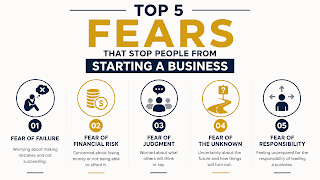
After going through my own struggles and observing dozens of others in the same position, the real reasons become clear. They are not the ones people admit to openly — they are the ones operating quietly underneath the surface.
- Fear of losing money: They believe they need significant capital to begin — and that losing it would be catastrophic. This fear is often disproportionate to the actual amount at risk, especially for service-based starting points.
- Fear of failure: They imagine the worst possible outcome — public humiliation, financial ruin, permanent damage to their reputation — and that imagined outcome stops them before any real outcome has had a chance to materialize.
- Fear of judgment: “What will people say if I fail?” This fear is particularly powerful in communities where entrepreneurship is not normalized and failure is treated as a character flaw rather than a learning experience.
- Waiting for the perfect time: The perfect time is a moving target that always stays just ahead of the present moment. There will always be a reason the timing is not ideal. The people who start are those who eventually recognize this pattern and act anyway.
- Lack of genuine self-belief: Underneath the specific fears is often a more fundamental one — the belief that success is for other people, not for them specifically. This belief is almost never examined directly because it is too uncomfortable to look at honestly.
These fears are not signs of weakness. They are normal human responses to uncertainty. The people who succeed are not fearless — they are the ones who move forward despite the fear being present.
Money Is Not the Real Barrier
Here is what I learned the hard way: you do not need significant money to start. You need money when you want to scale — to hire people, to carry inventory, to fund marketing at volume. The starting point requires something different.
The real skill that matters at the beginning is the ability to sell. There are thousands of business owners sitting on inventory and products who are struggling to move them. If you can sell, you can approach those people and offer to sell their products for a commission or profit share. You start using their capital and your selling skills. You take no financial risk and gain real business experience simultaneously.
This model works. Many of the people I know who built solid businesses started exactly this way — selling someone else’s products first, learning the business mechanics without personal financial risk, and building their own product or brand once they had cash flow and confidence.
According to SCORE’s research on business startups, the majority of successful small businesses were started with less than $10,000 — and many were started with significantly less. The constraint is almost never capital at the starting stage. It is the willingness to begin with what is available.
How I Started With Almost Zero Money
When I decided to actually start rather than continuing to plan, I had very little capital. Instead of waiting to accumulate more, I focused on services first. Freelance work. Helping other businesses with sales and content. Building cash flow through skills before building through assets.
The biggest lesson from that period: service first, business later. Earn money through your current skills, then use that money and the experience you gain to build something of your own. Trying to build a product business with zero money and zero business experience is genuinely difficult. Most “zero to hero” stories that circulate online either had some starting capital or significant previous professional experience that is not mentioned in the headline version of the story.
Starting with services does not mean staying in services. It means buying yourself the time and cash flow to build something more scalable while learning the fundamentals of running a business — client management, cash flow, pricing, quality control — without catastrophic financial risk.
The Simple Shift That Changed Everything
The moment I stopped waiting for perfect conditions and started asking what I could do with what I already had, the paralysis ended. The mental shift was from “I need money to start” to “I need to start to make money.” These are not the same thing and they produce completely different behaviors.
The first statement is passive — it puts the prerequisite for action outside your control and gives fear a permanent reason to delay. The second is active — it acknowledges that the starting point is the action itself, and that the resources follow from the action rather than preceding it.
This shift does not eliminate the fear. It changes your relationship with it. The fear is still there. But it no longer has veto power over your next step.
Practical Ways to Overcome the Fear Factor

- Start extremely small. Do not try to build a complete business on day one. Start with one small offer, one service, one product. Prove the concept at the smallest scale possible before expanding. Small starts produce real feedback, real experience, and real confidence — none of which planning produces.
- Focus on learning to sell. Selling skill removes the need for large capital at the beginning. If you can identify someone with a problem and communicate how you can solve it, you can generate revenue without significant upfront investment. Selling is the most valuable business skill and the one most people avoid developing because it involves direct rejection.
- Build a small financial cushion first. Before quitting employment or committing significant savings, use part-time freelance or side work to build 2 to 3 months of expenses in reserve. This safety cushion changes the psychology of starting from desperate to deliberate.
- Surround yourself with people who take action. Fear grows in environments where everyone talks and nobody starts. Action grows in environments where people are actually building things and the expectation is participation rather than observation.
- Accept failure as part of the process. The fear of failure becomes dramatically smaller once you have genuinely internalized that failure is not the end — it is data. Every business that eventually succeeded went through multiple failures that produced the knowledge that made the eventual success possible.
Practical exercise: Write down your biggest fear about starting on paper. Then write down specifically what the worst realistic outcome actually is — not the imagined catastrophic version, the realistic one. Most people find the realistic worst case is manageable. It is the imagined version that is paralyzing.
What Nobody Tells You About Overcoming Business Fear
Every motivational article tells you to “face your fears.” Nobody tells you what that actually feels like in practice and why the advice rarely works on its own.
Action reduces fear more reliably than thinking does. Most people try to think their way out of fear — analyzing it, understanding its origins, reasoning with it. This rarely works because fear is not primarily a cognitive experience. It is a physiological one. The most effective way to reduce fear is to take a small action in the feared direction and survive it. The survival experience updates the brain’s threat assessment more effectively than any amount of reasoning. The first cold outreach message sent, the first product listed, the first client approached — these actions reduce fear more than months of preparation.
The people around you are often the biggest source of fear, not the market. Family members who mean well but consistently highlight risks. Friends who have never started anything offering opinions about why your idea will not work. The social environment you are embedded in may have strong unspoken norms around security and conformity that make entrepreneurship feel like a betrayal. Recognizing this dynamic — and deliberately managing who you discuss your plans with — is one of the most underrated practical steps in overcoming business fear.
Most of the scenarios you fear will never happen. The specific catastrophe your brain is generating — the public humiliation, the financial ruin, the permanent judgment — has a much lower probability of occurring than your fear suggests. The actual outcomes of starting a business and struggling are almost always much more manageable than the imagined ones. You learn, you adjust, you continue or you stop and apply what you learned somewhere else. The dramatic worst-case scenario almost never materializes.
Waiting does not reduce fear — it increases it. Every month you spend not starting, the idea in your head grows larger and more intimidating in proportion to the gap between where you are and where you imagine it should be. The business you have been thinking about for three years feels more impossible to start than the same business would have felt on day one. Taking action earlier — even imperfect action — is almost always better than waiting for the fear to subside on its own.
Frequently Asked Questions
Q: Is lack of money really not the main barrier?
For the vast majority of service-based and skills-based businesses, no. Money matters significantly for product businesses that require inventory or manufacturing. But the first step for most people — offering a skill or service to someone who needs it — requires almost no capital. The barrier is the first sales conversation, not the bank balance.
Q: Can I realistically start a business with almost no money?
Yes — but with an important condition. Start with a service or skill first to generate cash flow and experience. Then build a product-based business once you have both capital and practical knowledge. Trying to build a product business from absolute zero with no sales experience and no cash is genuinely difficult. The service-first path is more reliable.
Q: How do I overcome the fear of failure specifically?
Start small enough that the cost of failure is genuinely manageable. When the downside is small, the fear is proportionally smaller. Take the first action before the fear is resolved — resolution comes after action, not before. And redefine failure: a business attempt that does not work but produces real learning is not failure. It is the tuition for the knowledge that makes the next attempt more likely to succeed.
Q: What is the best starting point if I have no capital at all?
Identify one skill you have that someone else needs. Identify one person or business that needs it. Offer to solve their specific problem. That is the beginning of a business. No capital required for the first conversation, the first agreement, or the first delivery.
Q: Is it too late to start in your 30s or 40s?
Harvard Business Review’s research on startup founders found the average age of a successful founder is 45. Life experience, professional networks, and developed judgment are genuine advantages that younger founders often lack. Starting later is not a disadvantage — it is a different set of starting conditions, with different advantages and different challenges.
Q: How long before I see results?
Small results from consistent effort typically appear in 3 to 6 months. Building something meaningful — a business that provides stable income and operates somewhat independently of your daily labor — typically takes 1 to 3 years. The timeline varies enormously based on the business model, the market, the starting skill level, and the consistency of execution. Most people overestimate what they will achieve in 6 months and underestimate what they can build in 3 years.
1. Write down the one business idea you have been thinking about the longest.
2. Write down the specific worst realistic outcome — not the imagined catastrophe, the actual realistic one.
3. Identify one small offer or service you could start this week — not eventually, this week.
4. List three people or businesses you could approach in the next 7 days.
5. Tell one trusted person who takes action themselves about your plan — accountability changes behavior.
Final Thoughts
The fear factor is real. But it does not have to control the outcome. Most people never start a business not because they lack ideas, skills, or even money — but because they let fear have the final word.
The people who succeed are not the ones who felt no fear. They are the ones who decided their vision was more important than their fear — and took one small step anyway. Then another. Then another.
If you have been waiting for the perfect time, the right amount of capital, or the fear to disappear on its own — I want you to know directly: the perfect time does not exist. The fear will not disappear before you start. The capital will not accumulate to the point where the risk feels zero.
The best time was a year ago. The second best time is today.
Disclaimer: Starting a business involves risk. Results depend on individual effort, market conditions, and consistency. This article shares personal experiences and general guidance only.