We tracked a freelancer last year who spent eight months learning graphic design. He watched 200+ YouTube tutorials, bought three Udemy courses, and practiced daily. Then he hit Upwork. His first month? $47. Total. Eight months of effort for less than a decent dinner.
The problem wasn’t his talent. The problem was his skill selection. He picked a dying commodity skill in a market flooded with 12 million competitors willing to work for $3/hour. No amount of grinding can fix a fundamentally broken choice.
At Data Pips, we’ve analyzed freelance market data, tracked earning patterns across platforms, and tested multiple skill paths ourselves. What we’ve found is uncomfortably clear: the freelancing skills in demand for 2026 look nothing like what dominated even two years ago. The market has shifted violently — and most people haven’t noticed yet.
In this article, we’re giving you the definitive list of 10 freelancing skills that will command premium rates in 2026. Not trending hashtags. Not “maybe someday” predictions. Skills with proven demand, growing budgets, and real clients paying real money right now. If you’re serious about starting your freelancing career, this is where your decision begins.

Why Skill Selection Is More Important Than Skill Level
Before we get into the list, we need to kill a dangerous myth: “Just get really good at something and clients will come.” That’s the career equivalent of believing hard work alone makes you rich. It doesn’t. Strategic hard work does.
The freelancing market follows a brutal supply-demand curve. If 5 million people offer basic graphic design and only 500,000 clients need it, prices crash to the floor regardless of how talented you are. But if 50,000 people offer AI automation consulting and 2 million businesses desperately need it, even a moderately skilled freelancer commands $100+/hour.
Skill selection determines your earning ceiling before you write a single proposal.
According to Upwork’s latest skills report, the fastest-growing freelance categories aren’t the traditional ones. They’re at the intersection of technology, strategy, and specialized knowledge. The World Economic Forum’s Future of Jobs Report confirms this shift — analytical thinking, AI literacy, and creative problem-solving are displacing routine execution skills across every industry.
We covered this exact principle in our guide to choosing your freelancing niche. If you haven’t read it, bookmark it. It’ll save you from spending months mastering a skill that the market doesn’t reward.
1. AI Automation and Agent Building
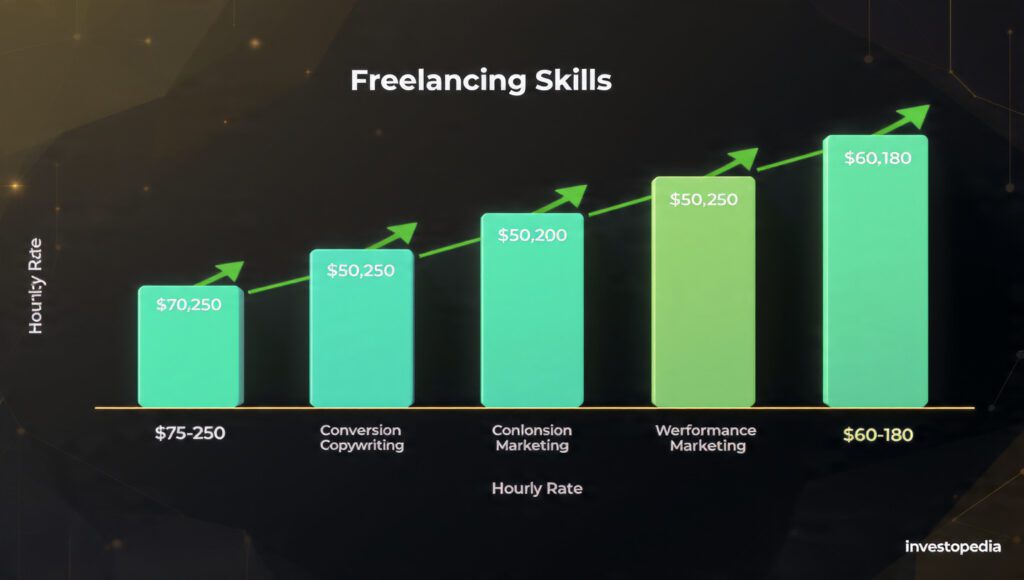
Average Rate: $75 – $250/hour
Demand Trajectory: Exploding — and we’re not even close to the peak
This isn’t just the #1 skill on our list. It’s the #1 skill on the planet right now. Businesses are drowning in repetitive workflows — customer support, data processing, content scheduling, lead qualification — and they’re desperate for someone who can build AI agents to handle it.
We’re not talking about using ChatGPT. We’re talking about building autonomous systems using frameworks like LangChain, CrewAI, AutoGen, and Phidata that can execute multi-step workflows independently. The freelancers who can do this are charging enterprise-level rates because the supply is still microscopic compared to demand.
What you need to learn:
- Python fundamentals (not advanced — functional is enough)
- One AI agent framework deeply (we recommend LangChain or CrewAI to start)
- API integration — connecting AI to real business tools
- Prompt engineering at an advanced level
- Basic understanding of vector databases and RAG systems
Where to find clients: Upwork, LinkedIn outreach, SaaS company directories, startup communities. Businesses with 10-200 employees are the sweet spot — big enough to need automation, small enough that they can’t afford full-time AI engineers.
Our take: If you learn one skill from this entire list, make it this one. Everything else on this list will eventually be augmented by AI agents. The person building the agents sits at the top of the food chain.
2. Conversion-Focused Copywriting
Average Rate: $50 – $200/hour
Demand Trajectory: Strong and steady — AI writes content, but humans still sell
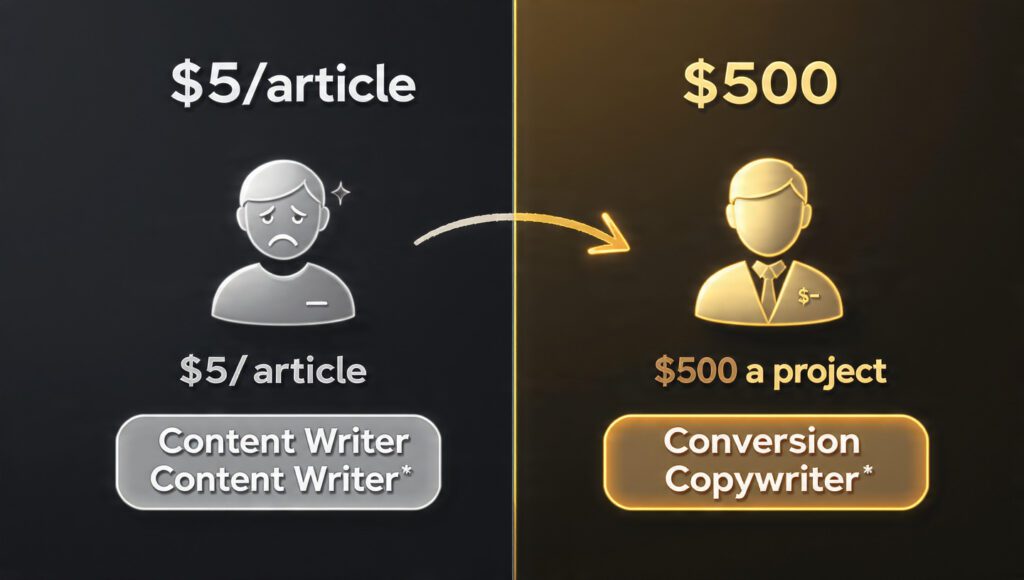
AI can write blog posts. AI can generate product descriptions. But AI still struggles with one specific thing: making someone pull out their credit card. That’s where conversion copywriting lives — and it’s the reason experienced copywriters are earning more than ever while basic content writers are watching their rates collapse.
Conversion copywriting isn’t about beautiful sentences. It’s about understanding human psychology, identifying buyer resistance, and crafting messages that move people from “maybe” to “yes.” Landing pages. Sales emails. Ad copy. Webinar scripts. Product launch sequences. Every business needs this. Most can’t do it themselves.
What you need to learn:
- Direct response copywriting fundamentals (AIDA, PAS frameworks)
- Customer research — understanding pain points deeper than surface level
- A/B testing and data-driven optimization
- Email sequence architecture
- Landing page psychology and structure
We’ve seen firsthand how the right words multiply revenue. When our team restructured a client’s email sequence using psychological triggers we’ve studied — scarcity, social proof, and decision reversal — their conversion rate jumped 34% in three weeks. No design changes. No new traffic. Just better words.
3. Short-Form Video Production and Editing
Average Rate: $40 – $150/hour
Demand Trajectory: Massive — every brand needs video content yesterday
TikTok changed the game. Instagram Reels doubled down. YouTube Shorts followed. Now every business, personal brand, and creator on the planet needs short-form video content — and most of them have zero idea how to produce it well.
This isn’t about Hollywood-level cinematography. It’s about understanding hooks, pacing, text overlays, trending formats, and platform-specific optimization. A 30-second video that stops the scroll is worth more to a brand than a 30-page PDF nobody reads.
What you need to learn:
- Editing tools: CapCut (free and dominant), Premiere Pro, or DaVinci Resolve
- Hook writing — the first 1-3 seconds determine everything
- Platform-specific formatting (aspect ratios, caption placement, CTA timing)
- Sound design and trending audio integration
- Basic motion graphics and text animation
Where to find clients: DM brands directly on Instagram with a “before/after” reel showing your editing style. That single outreach method has generated more video editing clients than any platform proposal ever written.
4. Performance Marketing (Paid Ads Management)
Average Rate: $50 – $200/hour (plus percentage of ad spend in some models)
Demand Trajectory: Consistently high — businesses always need customers
Every business needs traffic. Organic takes months. Paid ads deliver tomorrow. But most business owners are burning money on Meta Ads and Google Ads because they don’t understand targeting, creative testing, or conversion tracking. That’s where performance marketing freelancers come in — and they’re some of the highest-paid freelancers in the market.
What you need to learn:
- Meta Ads Manager (Facebook + Instagram advertising)
- Google Ads (Search + Shopping campaigns)
- Audience segmentation and retargeting strategies
- Creative testing frameworks (hook variations, visual testing)
- Analytics — reading data and making decisions, not just running reports
- Basic funnel architecture
We recently covered how LinkedIn lead generation is becoming a massive opportunity for B2B freelancers. Combine LinkedIn ads expertise with Meta Ads, and you’ve got a skill stack that very few freelancers possess but nearly every business needs.
Pro tip from our team: Don’t just learn to run ads. Learn to audit them. When you can walk into a client’s ad account, identify what’s bleeding money, and fix it within 48 hours — that’s when you start commanding premium retainers instead of hourly rates.
5. Web Development (Full-Stack with a Specialty)
Average Rate: $60 – $180/hour
Demand Trajectory: Permanent demand — but the bar is rising
Web development has been on “top skills” lists for a decade. So why is it still here? Because every business still needs a website, a web app, or a platform — and AI hasn’t replaced developers. It’s made good developers faster and exposed bad ones.
The key shift for 2026: generalist “I build WordPress sites” developers are being commoditized. Specialists — developers who focus on one stack, one framework, or one industry vertical — are seeing their rates climb.
What you need to learn:
- Pick ONE stack and go deep: React/Next.js, or Python/Django, or Shopify/Liquid
- Database management and API development
- Version control with Git (non-negotiable)
- Performance optimization and security basics
- AI integration — adding chatbots, automation, and intelligent features to websites
The developer who can build a website AND integrate AI agents into it is charging 3x what a plain web developer charges. Stack skills compound.
6. UI/UX Design (Product-Focused, Not Just Pretty)
Average Rate: $50 – $175/hour
Demand Trajectory: Growing — especially for designers who understand business
The days of UI/UX designers who just make things “look nice” are numbered. In 2026, the designers who thrive are the ones who understand why a button should be green instead of blue — and can prove it with data. Product-focused design means understanding user behavior, conversion funnels, and the business impact of every design decision.
What you need to learn:
- Figma — it’s the industry standard, period
- User research methods — interviews, surveys, heatmap analysis
- Wireframing and prototyping with interaction design
- Design systems and component libraries
- Basic understanding of front-end development (HTML/CSS) — so you can communicate with developers
- Data-driven design decisions — using analytics to validate choices
The premium niche: SaaS product design. Companies building software products pay premium rates for designers who understand user onboarding, feature adoption, and churn reduction through design. This niche alone can sustain a six-figure freelancing career.
7. Data Analytics and Visualization
Average Rate: $45 – $160/hour
Demand Trajectory: Accelerating — every company is drowning in data they can’t interpret
Every business collects data. Almost none of them know what to do with it. They’ve got spreadsheets, dashboards, CRM exports, and Google Analytics reports — and they can’t turn any of it into a decision. That gap is your opportunity.
Data analytics freelancers who can take raw business data, extract patterns, and present actionable insights in clear visualizations are in extreme demand. This isn’t data science (which requires a deeper technical background). This is business analytics — translating numbers into decisions.
What you need to learn:
- SQL — for pulling data from databases
- Excel/Google Sheets at an advanced level (pivot tables, VLOOKUP, array formulas)
- One visualization tool: Tableau, Power BI, or Looker Studio
- Python basics for data manipulation (Pandas library)
- Storytelling with data — presenting findings that drive action, not just reports that get filed
According to LinkedIn’s skills report, data analysis has been in the top 5 most in-demand skills for three consecutive years — and the gap between demand and supply keeps widening.
8. SEO Strategy and Content Architecture
Average Rate: $50 – $175/hour
Demand Trajectory: Evolving — traditional SEO is dying, strategic SEO is thriving
Let’s be clear: basic SEO — keyword stuffing, meta tag optimization, link building schemes — is dying. AI can handle that now. But strategic SEO — content architecture, topical authority building, search intent mapping, and E-E-A-T optimization — is more valuable than ever because Google’s algorithms have become sophisticated enough to reward genuine expertise and punish surface-level tactics.
What you need to learn:
- Search intent analysis — understanding WHY someone searches, not just WHAT they search
- Content clustering and topical authority architecture
- Technical SEO fundamentals (site speed, crawlability, schema markup)
- Google Search Console and GA4 at an advanced level
- AI-assisted content strategy (using AI for research while maintaining human expertise)
- Competitor gap analysis and content differentiation
This is exactly the skillset we use at Data Pips to build our own content strategy. We don’t chase keywords randomly. We build content ecosystems where each article strengthens every other article. That architectural thinking is what separates $50/article writers from $5,000/month SEO consultants.
9. Cybersecurity Consulting
Average Rate: $80 – $300/hour
Demand Trajectory: Surging — every data breach creates 100 new clients
Every time a company gets hacked — and it’s happening daily — every other company in that industry suddenly realizes they need security help. Cybersecurity freelancers operate in a permanent seller’s market because the consequences of NOT hiring them are catastrophic, public, and career-ending for executives.
You don’t need to be an ethical hacker to enter this space. Many cybersecurity freelancers focus on compliance consulting, security audits, policy development, and employee training — areas that require knowledge but not necessarily deep technical hacking skills.
What you need to learn:
- Security frameworks: ISO 27001, SOC 2, NIST basics
- Risk assessment methodologies
- Cloud security fundamentals (AWS/Azure security configurations)
- Security audit procedures and reporting
- Compliance requirements for specific industries (healthcare, finance, e-commerce)
- Certifications that matter: CompTIA Security+, CISSP, or CEH
Our observation: This is the skill with the highest entry barrier on this list — but also the highest rates and the least competition. If you’re willing to invest 6-12 months in serious learning, cybersecurity consulting can generate $150K+ annually as a freelancer.
10. Business Process Automation (No-Code/Low-Code)
Average Rate: $40 – $150/hour
Demand Trajectory: Rapidly growing — the bridge between AI and everyday business
Not every business needs a custom AI agent. But almost every business has workflows that could be automated using existing tools. No-code and low-code automation — connecting apps, automating repetitive tasks, building workflows without traditional programming — is the entry point for millions of businesses into the automation era.
What you need to learn:
- Zapier and Make (Integromat) — the two dominant automation platforms
- Airtable — the no-code database that powers thousands of businesses
- CRM automation (HubSpot, GoHighLevel, or Salesforce basics)
- Workflow design — mapping business processes before automating them
- Basic API understanding — knowing how apps talk to each other
- Integration with AI tools — connecting ChatGPT or Claude to business workflows
This skill is particularly powerful when combined with Skill #1 (AI Agent Building). Start with no-code automation to land clients, then upsell them to custom AI agents as their needs grow. That progression is a career path, not just a gig.
As we discussed in our article on starting freelancing step by step, the best approach is picking one skill and going deep for six months minimum before adding a second. Skill stacking is powerful — but only after mastery, not as a substitute for it.
The Skills That Are Dying (Stop Learning These)
We’d be doing you a disservice if we didn’t also tell you what to avoid. These skills are either being commoditized by AI or flooded with supply beyond recovery:
- Basic content writing — AI writes generic blog posts faster and cheaper. Unless you specialize in conversion copy or technical writing, this market is collapsing.
- Simple graphic design — Canva and AI image generators have made basic design a commodity. Only specialized design (UI/UX, brand identity systems) commands premium rates.
- Manual data entry — If your skill can be described as “copying data from one place to another,” it’s already being automated.
- Basic social media posting — Scheduling posts is no longer a skill. Strategy, content creation, and community management are. If you just post content someone else creates, you’re replaceable by a $20/month tool.
- Generic virtual assistance — Calendar management and email sorting are being automated rapidly. Unless you specialize in a specific domain (executive VA, technical VA, real estate VA), general VA work is a race to the bottom.
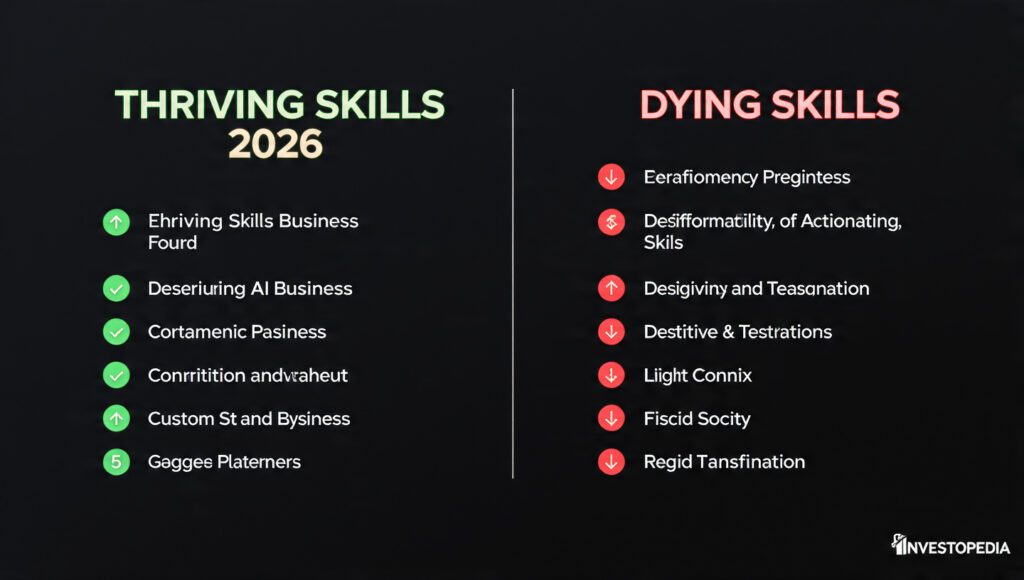
The pattern is clear: anything “basic” or “general” is dying. Anything specialized, strategic, or at the intersection of technology and human judgment is thriving. Position yourself accordingly.
How to Choose Your Skill (The Data Pips Decision Framework)
Don’t try to learn all ten. That’s how you end up knowing nothing well enough to get hired. Use this framework to narrow down to ONE primary skill:
A list of in-demand skills tells you what’s hot, not what’s right for you — run your options through a value-first framework for choosing a skill before committing years of your life.
- Market demand check: Search the skill on Upwork. Are there 500+ jobs posted monthly? If yes, demand is real.
- Rate ceiling check: Are the top freelancers in this skill charging $75+/hour? If yes, there’s room to grow.
- AI resistance check: Can AI do 80%+ of this skill today? If yes, avoid it. If AI handles maybe 20-30%, the skill is augmented, not replaced — that’s the sweet spot.
- Learning curve reality check: Can you reach a hireable level in 3-6 months of focused daily effort? If it requires 2+ years of education before you can earn, reconsider unless you have the runway.
- Personal tolerance check: Could you do this work for 6-8 hours daily without hating your life? Passion is optional. Tolerance is mandatory.
We covered this decision process in detail in our freelancing niche selection guide. That article gives you the full framework. This list gives you the options. Together, they’re your career GPS.
“The freelancer who masters one in-demand skill deeply will always out-earn the one who dabbles in five trending skills lightly. Markets reward depth, not width.” – Data Pips Team
⚡ Quick Action Steps: Pick and Start Your Skill This Week
- Today: Review all 10 skills above. Eliminate any that fail the tolerance check — you need to be able to do this daily without burning out.
- Tomorrow: Search your top 3 choices on Upwork and Fiverr. Count the number of jobs posted in the last 7 days. Check what top freelancers are charging. Let the data decide, not your emotions.
- Day 3: Pick ONE skill. Write it down. Tell someone. Make it real. The decision doesn’t need to be perfect — it needs to be made.
- Day 4-7: Find the best free resource for that skill (official documentation, YouTube course, or free tier of a learning platform) and complete the “Getting Started” module. Don’t buy courses yet — test your interest with free content first.
- Week 2-4: Build one practice project. Not a tutorial project — a real project that solves a real problem. This becomes your portfolio piece #1.
- Month 2: Start landing your first client using manual outreach. Don’t wait until you feel “ready.” You’ll never feel ready. Ship imperfect work and improve with paid feedback.
Frequently Asked Questions
1. Which single freelancing skill will be most in demand in 2026?
AI automation and agent building. It sits at the top because it affects every other industry. Businesses across every sector — e-commerce, healthcare, finance, education, marketing — need automation. The supply of competent AI automation freelancers is still tiny compared to demand, which means premium rates and growing opportunity. If we had to bet our entire freelancing future on one skill, this would be it.
2. I have no technical background. Which skill should I start with?
Start with conversion copywriting or short-form video production. Both have lower technical barriers, can be learned from free resources within 2-3 months, and have proven demand across platforms. Copywriting requires strong language skills and psychology understanding. Video production requires creativity and editing tool proficiency. Neither requires coding or technical degrees. Pick the one that matches your natural strengths — writing or visual thinking.
3. Is it too late to start freelancing in 2026?
No — but it’s too late to start with a commodity skill and expect premium results. The freelancing market in 2026 has over 1.5 billion participants globally. If you enter with a generic skill, you’re competing with millions. If you enter with a specialized, in-demand skill from this list, you’re competing with thousands while millions of businesses need you. The timing is fine. The skill selection is what determines everything.
4. How long does it take to start earning with a new skill?
For most skills on this list, with focused daily practice: 2-3 months to reach a hireable level, 4-6 months to land consistent clients, and 8-12 months to build a sustainable income stream. These aren’t motivational estimates — they’re based on patterns we’ve observed across hundreds of freelancer journeys. The variable isn’t time. It’s consistency. Six months of daily focused practice beats two years of sporadic dabbling every single time.
5. Should I learn multiple skills or focus on one?
One skill first. Deep. For at least six months. We’ve seen this mistake destroy more freelancing careers than anything else — people splitting their energy across four different directions and mastering none of them. Once you’re earning consistently from your primary skill (let’s say $3K+/month), then consider adding a complementary skill. Skill stacking is powerful after mastery, not as a substitute for it.
6. Will AI replace freelancers entirely?
No. AI will replace freelancers who do work that AI can already do — basic writing, simple design, routine data processing. AI will amplify freelancers who use it as a tool — copywriters who use AI for research but bring human persuasion, developers who use AI for code generation but bring architectural thinking, marketers who use AI for data analysis but bring strategic judgment. The freelancers who survive and thrive will be the ones who work with AI, not against it and not below it.
7. What’s the fastest path from zero to $5,000/month in freelancing?
Pick a high-demand skill (from this list). Learn it intensely for 90 days. Build 3 portfolio pieces. Create a specialized profile on Upwork or LinkedIn. Send 10 targeted proposals daily for 30 days. That’s the formula. It’s not complicated. It’s not easy either. But anyone with internet access and 3-4 hours of daily focused effort can follow it. The people who fail aren’t the ones who lack talent — they’re the ones who quit at day 22 when no client has responded yet. Day 23 is usually when things start to move.
Conclusion: The Market Doesn’t Care About Your Excuses
We’ve just given you the complete map of freelancing skills in demand for 2026. Ten skills with verified demand, real rate data, clear learning paths, and honest assessments of where each one is heading. No fluff. No hype. Just what the market is actually paying for.
Now here’s the part that separates the people who build freelancing careers from the people who just read articles about them: execution. This article becomes worthless the moment you close this tab without taking action. Another bookmark. Another “I’ll start Monday.” Another year in the same position wondering why nothing has changed.
At Data Pips, we don’t believe in “someday.” We believe in systems, skills, and relentless action. The freelancing world is rewarding specialists with premium rates while generalists fight over scraps. Which side do you want to be on?
Pick one skill from this list today. Start learning it tomorrow. Send your first proposal within 90 days. That’s the entire game plan. Which skill are you choosing? Tell us in the comments — our team will give you an honest assessment of whether it fits your situation.
Disclaimer: This article is for educational and informational purposes only. Freelancing income varies significantly based on skill level, market conditions, location, effort, and individual circumstances. The rate ranges mentioned are based on market research and platform data — they are not guarantees of income. Always conduct your own research before making career decisions. Data Pips is not affiliated with any platforms, tools, or courses mentioned in this article.