My Journey and Your Success
“With over 7 years of experience in the trading world, I have seen the highs and lows of the market firsthand. In this article, my goal is to share the deep-rooted knowledge and psychological insights I’ve gained over the years—knowledge that I believe will be truly transformative for your trading journey.”
In the world of financial markets, there is a famous saying: “Cut your losses short and let your profits run.” While this sounds simple in theory, almost every trader struggles with its execution. We often find ourselves exiting winning trades too early out of fear, while holding onto losing positions for far too long in hope.
Becoming a profitable trader isn’t just about having a technical strategy; it’s about mastering the psychological triggers that cause us to sabotage our own success. Here is an in-depth look at why traders fail to hold winners and how to fix it permanently.
The Four Pillars of Trading Failure
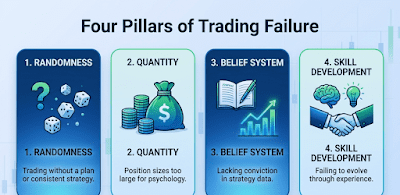
To solve the problem of premature exits, we must first identify the root causes. There are four major psychological pillars that disrupt a trader’s mindset:
1. Eliminating Randomness
The biggest enemy of consistency is randomness. Many traders enter the market without a predefined plan, a fixed strategy, or clear exit rules. When you trade randomly—switching from options to spot, or jumping between different setups—you never develop a deep understanding of how a specific model behaves.
The Fix: Stick to one or two setups. Over time, you will learn to recognize signs of a high-probability “expansion phase” versus a choppy, “sideways market,” giving you the confidence to stay in the trade.
2. Managing Quantity and Greed
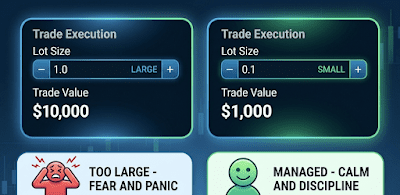
Often, traders fail to hold winners because they are trading with inappropriate position sizes (over-leveraging). If your mind is conditioned to be satisfied with a specific dollar amount—say $100—you will instinctively close your trade as soon as you see that number, regardless of the market’s actual target potential.
The Fix: Focus on the process and the percentage or R:R (Risk to Reward) captured rather than the daily monetary profit. Reduce your position size to a level where minor price fluctuations do not trigger emotional panic.
3. Building a Robust Belief System
Belief doesn’t come from motivational quotes; it comes from hard data. If you don’t objectively know that your strategy can deliver a major move, your brain will always force you to exit at the first sign of a minor retracement.
The Fix: Maintain a rigorous trading journal. Even if you exit early, record what the price did afterward. When your journal proves multiple times in a row that holding would have resulted in a massive profit, your brain will naturally develop the conviction to stay execution-focused next time.
4. Developing Skill Through Conviction
True skill is the culmination of the first three points. Conviction in a live market trade only comes when you have achieved similar results multiple times in the past. It is an evolutionary process where you transition from a market gambler to a disciplined, skilled professional.
Practical Steps for Long-Term Improvement
If you find yourself stuck in a frustrating cycle of taking small profits and large losses, implement these actionable steps immediately:
- Stop the Mixed Strategy Approach: Don’t blend unrelated setups. Isolate your variables so you can measure exactly what is working in current market conditions.
- Reframe Your Losses: Understand that a loss is simply a standard business expense, provided it was executed within your predefined risk parameters.
- The Power of Active Observation: Watch the market even after you have closed your position. Learn the specific “personality” of your chosen trading pairs to understand their true expansion phases.
Conclusion

Holding winning trades is 10% technical strategy and 90% psychology. By removing randomness, optimizing your position sizing, and backing your execution with a data-driven journal, you can successfully rewire your brain to stay calm during major market swings. Remember, the market doesn’t pay you simply for being right—it pays you for your patience and discipline.
“Which of these four pillars do you struggle with the most? Share your experience in the comments below, and let’s discuss how to overcome it together!”