How Multi-Agent Systems Are Redefining Enterprise Automation
A logistics company we studied last quarter had 47 employees handling customer inquiries, order tracking, inventory management, and supplier coordination. Forty-seven people. Doing work that followed predictable patterns, used the same tools, and produced the same outputs day after day. Then they deployed a multi-agent system — four AI agents working collaboratively, each specializing in one domain. Within 90 days, 31 of those roles were absorbed by the system. Not eliminated out of cruelty. Absorbed because four AI agents working together outperformed 31 humans in speed, accuracy, and cost.
That’s not a prediction about 2030. That happened in 2024. And it’s happening across industries right now — quietly, systematically, and far faster than most business leaders realize.
At Data Pips, we’ve been tracking the rise of multi-agent systems in enterprise automation since the first frameworks emerged. What started as experimental research projects has evolved into production-grade technology that’s reshaping how businesses operate at every level. And if your company — or your career — depends on workflows that follow rules, you need to understand what’s coming.
We covered the individual frameworks in our AutoGen vs CrewAI vs LangGraph comparison. This article goes bigger — examining how multi-agent systems are fundamentally redefining what enterprise automation looks like, why traditional automation can’t compete, and what smart businesses are doing right now to stay ahead.

What Are Multi-Agent Systems and Why Should Enterprises Care?
Let’s cut through the jargon. A multi-agent system is exactly what it sounds like: multiple AI agents working together, each with a specialized role, collaborating to accomplish tasks that no single agent — or single human — could handle as efficiently alone.
Think of it this way. A single AI chatbot is like hiring one intern. They can answer questions, draft emails, maybe do some research. Useful, but limited. A multi-agent system is like deploying an entire department — researcher, analyst, writer, quality checker, coordinator — where each member has a defined role, specific expertise, and the ability to hand work off to the next agent in the chain.
According to Gartner’s analysis, by 2028, at least 15% of day-to-day work decisions will be made autonomously through agentic AI — up from virtually zero in 2023. That’s not a small shift. That’s a fundamental restructuring of how organizations operate.
As we explained in our guide to agentic AI, single agents are powerful. But multi-agent systems are where the real enterprise transformation happens — because business problems aren’t single-threaded. They’re multi-dimensional, cross-departmental, and interconnected.
Why Traditional Automation Hits a Wall
Before multi-agent systems, enterprise automation meant one thing: rule-based workflows. If X happens, do Y. If customer sends email, auto-reply with template. If inventory drops below threshold, send purchase order. Rigid. Predictable. Brittle.
Traditional automation tools — Zapier, UiPath, traditional RPA (Robotic Process Automation) — changed business operations dramatically. But they share three fundamental limitations that multi-agent systems obliterate:
Limitation 1: No Reasoning Capability
Traditional automation follows rules. It cannot reason about exceptions, nuances, or situations that weren’t explicitly programmed. When a customer sends a complaint that doesn’t match any template, the system fails. When an inventory discrepancy has an unusual cause, the system flags it but can’t investigate. Traditional automation handles the predictable. Multi-agent systems handle the unpredictable.
Limitation 2: Single-Task Architecture
RPA bots do one thing well. Extracting data from invoices. Moving files between systems. Generating reports. But they can’t chain tasks across domains. They can’t take an insight from a financial report and use it to adjust a marketing campaign. Each bot operates in isolation — no collaboration, no knowledge sharing, no collective intelligence.
Limitation 3: Zero Adaptability
When business processes change — new CRM system, updated compliance requirements, restructured workflows — traditional automation breaks. Every rule needs manual updating. Every integration needs reconfiguring. Multi-agent systems, built on large language models, can adapt to changed contexts without reprogramming — because they understand intent, not just instructions.
McKinsey’s State of AI report estimates that generative AI could automate activities that absorb 60-70% of employee time — but only if the automation can handle reasoning, cross-functional tasks, and adaptive scenarios. That’s precisely the gap multi-agent systems fill.

The Architecture: How Multi-Agent Enterprise Systems Actually Work
Understanding the architecture isn’t just for developers. If you’re a business leader deciding whether to invest in multi-agent automation, you need to understand what’s under the hood — at least at a conceptual level.
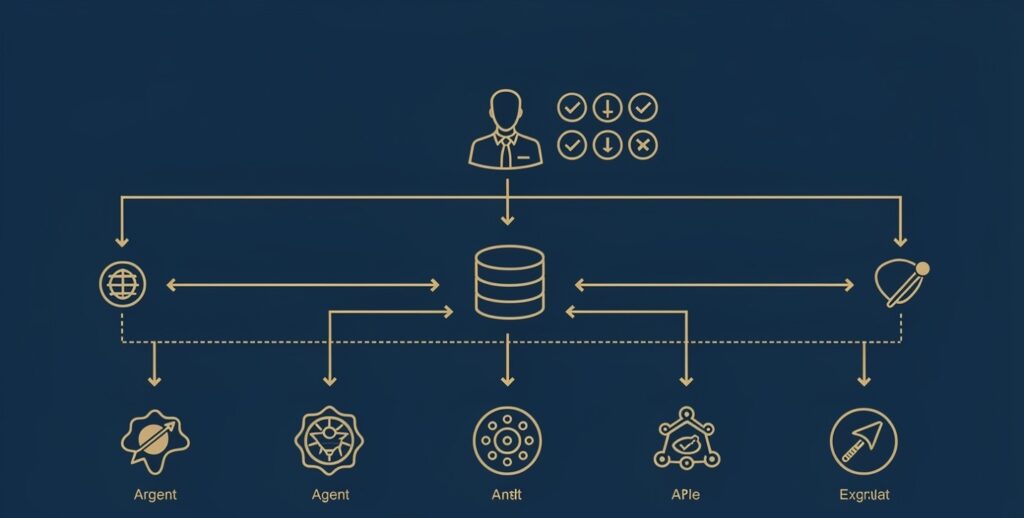
Component 1: Specialized Agent Roles
Each agent in the system has a defined specialty — like employees in a company. A customer service agent handles inquiries. A data analysis agent processes reports. A compliance agent checks regulatory requirements. A coordination agent manages workflow between them. No single agent does everything. Each does one thing excellently.
This mirrors how the best companies operate. As we discussed in our operator-to-owner scaling guide, businesses that depend on one person doing everything don’t scale. Multi-agent systems apply the same principle to AI — specialization enables scale.
Component 2: Inter-Agent Communication Protocol
Agents need to talk to each other. In Microsoft’s AutoGen framework, agents communicate through structured conversations — debating, refining, and improving each other’s outputs. In CrewAI, agents pass work sequentially or through hierarchical delegation. In LangGraph, communication follows graph-based edges with conditional routing.
The communication protocol determines how agents collaborate — and as we explored in our AI agent frameworks guide, choosing the right protocol depends entirely on your use case.
Component 3: Shared Memory and Context
Unlike traditional bots that start fresh with each task, multi-agent systems maintain persistent memory. The customer service agent remembers that Client X complained about delivery delays last month. The sales agent knows that Client X is in renewal discussions. The coordination agent connects these dots: “Client X is unhappy AND deciding whether to renew. Escalate to human account manager immediately.”
No single agent figured this out. The system — through shared context — made a connection that would have taken a human team hours of cross-referencing.
Component 4: Human Oversight Layer
This is critical and non-negotiable for enterprise deployment. Multi-agent systems don’t operate in the dark. They include checkpoints where human managers review, approve, or redirect agent actions. High-stakes decisions — firing a vendor, offering a major discount, changing a compliance procedure — always require human approval. The agents handle the 80% of work that’s routine. Humans handle the 20% that requires judgment.
Real-World Enterprise Use Cases Already in Production
This isn’t theoretical. Multi-agent systems are running in production environments across industries right now. Here are five documented use cases that demonstrate the transformation:
Use Case 1: Customer Service Operations
The old way: Tier 1 agents handle basic queries. Complex issues get escalated to Tier 2. Tier 2 investigates by checking multiple systems manually. Resolution takes 24-72 hours.
The multi-agent way: Agent 1 (Classifier) categorizes the incoming query. Agent 2 (Investigator) checks order history, payment records, and shipping data simultaneously. Agent 3 (Resolver) drafts a personalized response with a solution. Agent 4 (Quality Checker) reviews the response for accuracy and tone. If the issue is complex or high-value, Agent 5 (Escalation Manager) routes it to a human with a complete context package. Resolution time: under 3 minutes for 78% of queries.
Klarna — the European fintech giant — publicly reported that their AI system now handles the equivalent of 700 full-time customer service agents’ workload. Not supporting 700 agents. Replacing them.
Use Case 2: Financial Report Analysis
The old way: Analysts spend 6-8 hours reading quarterly earnings reports, extracting key metrics, comparing against benchmarks, and writing summary briefs.
The multi-agent way: Agent 1 (Extractor) parses the earnings report and pulls key financial metrics. Agent 2 (Comparator) checks these metrics against historical data and industry benchmarks. Agent 3 (Analyst) identifies anomalies, trends, and risks. Agent 4 (Writer) produces a structured executive brief. Agent 5 (Fact Checker) cross-references claims against source data. Entire process: 12 minutes. Accuracy rate: 94%.
Use Case 3: Supply Chain Coordination
The old way: Procurement managers manually check inventory levels, contact suppliers via email, negotiate terms, and coordinate delivery schedules across multiple time zones.
The multi-agent way: Agent 1 (Monitor) continuously tracks inventory levels across all warehouses. Agent 2 (Predictor) forecasts demand based on historical patterns and current trends. Agent 3 (Sourcer) identifies optimal suppliers based on price, reliability, and lead time. Agent 4 (Negotiator) drafts purchase orders within pre-approved parameters. Agent 5 (Coordinator) manages delivery logistics and alerts humans only when exceptions occur. Supply chain response time reduced from days to hours.
Use Case 4: Content Marketing Pipeline
This one is particularly relevant because it’s exactly what we’ve tested at Data Pips. Our multi-agent content pipeline uses four agents working together:
- Research Agent: Analyzes trending topics, competitor content gaps, and audience search behavior
- Strategy Agent: Determines content angle, target keywords, and structural approach
- Writing Agent: Produces the initial draft following brand voice and SEO requirements
- Review Agent: Checks factual accuracy, readability, and optimization score
The system doesn’t replace our editorial judgment. But it reduces the time from “idea” to “publishable draft” from approximately 6 hours to under 45 minutes. We remain the strategic directors. The agents handle the execution heavy-lifting.
Use Case 5: HR and Recruitment
The old way: Recruiters manually screen 200+ resumes per role, conduct phone screens, schedule interviews, and manage candidate communication. Each hire takes 30-45 days.
The multi-agent way: Agent 1 (Screener) evaluates resumes against role requirements and company culture signals. Agent 2 (Communicator) manages candidate correspondence — scheduling, updates, and follow-ups. Agent 3 (Assessor) conducts initial text-based skill assessments. Agent 4 (Coordinator) builds shortlists with detailed candidate profiles and hands them to human interviewers. Time-to-shortlist reduced from 2 weeks to 48 hours.
According to Deloitte’s enterprise AI adoption survey, organizations deploying multi-agent systems report an average 35-40% reduction in operational costs within the first year — with some departments seeing 60%+ cost reduction.
The Competitive Moat: Why Early Adopters Will Dominate
Here’s where this gets serious for business leaders. Multi-agent enterprise automation isn’t just an efficiency tool. It’s a competitive moat.
Consider two competing companies in the same industry. Company A deploys multi-agent systems in 2025 and spends 18 months refining them. Company B waits until 2028 “to see how things develop.” By 2028:
- Company A has 3 years of operational data training its agents to be smarter
- Company A’s agents have learned the company’s specific patterns, exceptions, and edge cases
- Company A operates at 40-60% lower cost for the same output
- Company A can respond to market changes in hours, not weeks
- Company A’s human employees focus on strategy and innovation, not routine execution
Company B starts deploying in 2028 with zero accumulated intelligence, zero operational refinement, and a 3-year knowledge gap. That gap is nearly impossible to close because multi-agent systems improve through use — the longer they run, the better they get.
This is the same principle we teach about AI agents replacing traditional workflows: the window for information advantage is open now. It closes gradually as adoption becomes universal.
The Honest Risks and Challenges Nobody Wants to Discuss
At Data Pips, we refuse to write one-sided hype pieces. Multi-agent enterprise systems are powerful — but they come with real risks that every organization must address:
Risk 1: Cascading Failures
When one agent in the system makes a mistake, that error can propagate through the entire chain. A data extraction agent misreads a number → the analysis agent draws wrong conclusions → the recommendation agent suggests harmful actions → the execution agent implements them. One mistake becomes four mistakes before a human notices.
Mitigation: Build validation checkpoints between agents. Critical decisions require human approval. Implement “circuit breakers” that halt the chain when confidence scores drop below thresholds.
Risk 2: Security and Data Exposure
Multi-agent systems need access to multiple enterprise systems — CRM, ERP, financial databases, email, communication platforms. Each access point is a potential security vulnerability. A compromised agent with broad system access can cause catastrophic data breaches.
Mitigation: Apply the principle of least privilege. Each agent gets access only to the systems it needs — nothing more. Implement comprehensive audit logging. Use encrypted communication between agents.
Risk 3: Over-Automation of Judgment
Not every decision should be automated — even if it technically can be. Firing an underperforming vendor, resolving a customer complaint from a VIP client, or adjusting pricing during a crisis all require human judgment, empathy, and contextual understanding that agents don’t possess.
Mitigation: Create explicit “human-only” decision categories. No agent should be authorized to make decisions that involve ethics, significant financial commitment, or reputational risk without human approval.
Risk 4: Employee Displacement Without Transition
The logistics company that replaced 31 roles with four agents didn’t do it maliciously — but the human impact is real. Organizations that deploy multi-agent systems without reskilling plans, transition support, and honest communication will face legal challenges, morale collapse, and reputational damage.
Mitigation: Budget for transition from day one. Retrain displaced employees for agent oversight, system management, and exception handling roles. The most successful deployments we’ve studied redeploy workers rather than eliminate them.
As Harvard Business Review noted, the organizations that navigate AI transformation most successfully are those that treat it as a human transformation first and a technology deployment second.

The Implementation Roadmap: From Pilot to Production
If your organization is considering multi-agent automation — or if you’re a freelancer/consultant advising companies on this — here’s the phased approach our team recommends:
Phase 1: Identify and Map (Weeks 1-4)
- Document your top 10 most repetitive, rule-based business processes
- Estimate hours spent on each process monthly
- Classify each as “fully automatable,” “partially automatable,” or “requires human judgment”
- Select ONE process from the “fully automatable” category for your pilot
Phase 2: Build the Pilot (Weeks 5-10)
- Design the multi-agent workflow for your selected process
- Define agent roles, communication protocols, and human checkpoints
- Build using an appropriate framework — CrewAI for speed, LangGraph for reliability, AutoGen for complex reasoning
- Test extensively in a sandboxed environment before any production data touches the system
Phase 3: Controlled Deployment (Weeks 11-18)
- Run the multi-agent system in parallel with existing human processes
- Compare outputs: accuracy, speed, cost, and quality
- Collect edge cases the system doesn’t handle well — these become training data
- Gradually shift workload from human-primary to agent-primary with human oversight
Phase 4: Scale and Expand (Month 5+)
- Once the pilot proves ROI, identify the next 3-5 processes for agent deployment
- Build connections between agent systems — customer service agents sharing context with sales agents, for example
- Implement cross-departmental multi-agent workflows
- Establish ongoing monitoring, optimization, and human governance structures
“The companies that win in the age of multi-agent AI won’t be the ones with the best technology. They’ll be the ones who redesigned their operations around what technology makes possible — while keeping humans in the decisions that matter most.” – Data Pips Team
⚡ Quick Action Steps: Prepare Your Organization for Multi-Agent Automation
- This week: List your organization’s top 10 most repetitive processes. Beside each one, estimate the monthly human hours consumed. Highlight any process taking 100+ hours/month — that’s your pilot candidate.
- This month: Research one multi-agent framework. We recommend starting with our comprehensive frameworks guide to understand the landscape before choosing.
- Next month: Build a proof-of-concept for one internal workflow. Use a sandboxed environment. Don’t touch production data yet. The goal is learning, not deployment.
- Quarter 2: Present pilot results to leadership with a clear ROI calculation: hours saved × hourly cost = monthly savings potential. Business leaders respond to math, not technology descriptions.
- Ongoing: Track the competitive landscape. Which of your competitors are deploying multi-agent systems? If the answer is “none” — you have first-mover advantage. If the answer is “several” — you’re already behind.
Frequently Asked Questions
1. What exactly is a multi-agent system in the context of enterprise automation?
A multi-agent system consists of multiple specialized AI agents working collaboratively to accomplish business tasks that are too complex for a single AI agent or traditional automation tool. Each agent has a defined role (customer service, data analysis, quality checking, etc.), and they communicate with each other through structured protocols — sharing context, handing off tasks, and collectively producing outputs that exceed what any individual agent could achieve alone. Think of it as an AI-powered team rather than an AI-powered tool.
2. How are multi-agent systems different from traditional RPA (Robotic Process Automation)?
Traditional RPA follows rigid, pre-programmed rules — it can’t handle exceptions, reason about context, or adapt to changes without manual reprogramming. Multi-agent systems are built on large language models that can understand intent, reason about exceptions, collaborate across domains, and adapt to changing processes without explicit reprogramming. RPA automates tasks. Multi-agent systems automate decisions and workflows. It’s the difference between a calculator and a team of analysts.
3. Which industries benefit most from multi-agent enterprise automation?
Industries with high-volume, cross-functional workflows benefit most immediately: financial services (report analysis, compliance checking, customer service), logistics (supply chain coordination, inventory management), healthcare (patient communication, claims processing, appointment coordination), e-commerce (customer support, inventory, marketing), and professional services (research, document review, project coordination). However, virtually any organization with repetitive cross-departmental processes can benefit.
4. Will multi-agent systems replace all human workers?
No — but they will fundamentally change what humans do. Multi-agent systems excel at routine, rule-based, data-intensive tasks. Humans remain essential for strategic thinking, ethical judgment, creative direction, relationship management, and exception handling. The most successful deployments we’ve studied don’t eliminate humans — they elevate humans from execution roles to oversight and strategy roles. The total workforce may decrease, but the remaining roles become more valuable and more intellectually demanding.
5. How much does it cost to implement a multi-agent system?
Costs vary enormously based on scope. A small pilot using open-source frameworks (CrewAI, LangGraph, AutoGen) can be built for $5,000-$20,000 in development time plus API costs. A full enterprise deployment across multiple departments can range from $100,000-$500,000+ including development, integration, testing, and change management. However, ROI typically materializes within 6-12 months — organizations routinely report 35-60% cost reductions in automated departments. The question isn’t whether you can afford to deploy. It’s whether you can afford not to.
6. What’s the biggest risk of deploying multi-agent systems in an enterprise?
Cascading failures without adequate oversight. When agents are chained together, one agent’s error can propagate through the entire system before humans notice. A misclassified email becomes a wrong response becomes a lost customer. The mitigation is mandatory: build validation checkpoints between agents, implement confidence-score thresholds that trigger human review, maintain comprehensive audit logs, and never deploy without a human oversight layer for high-stakes decisions.
7. How should we start if we have zero experience with AI agents?
Start with education, not deployment. First: Read our agentic AI fundamentals guide. Second: Explore the top AI agent frameworks to understand the landscape. Third: Identify one internal process that’s repetitive and well-documented. Fourth: Build a small proof-of-concept using CrewAI (lowest barrier to entry). Fifth: Measure results against human performance. Don’t try to automate your entire organization in month one. Start with one process, prove the value, and expand from evidence — not enthusiasm.
Conclusion: The Enterprise of 2028 Runs on Agent Teams, Not Just Human Teams
We’ve shown you exactly how multi-agent systems are redefining enterprise automation — from the architecture that makes them work, to the real-world use cases already in production, to the risks that demand careful management. This isn’t speculative futurism. It’s happening now, and the pace is accelerating every quarter.
The organizations that thrive in this transition will share three traits: they started early, they deployed carefully, and they treated multi-agent automation as a human transformation — not just a technology purchase. The organizations that struggle will be the ones that waited too long, deployed recklessly, or forgot that AI agents are tools that amplify human capability, not replacements for human judgment.
At Data Pips, we’re tracking this transformation closely because we believe it represents the most significant shift in how business operates since the internet itself. The question for your organization isn’t whether multi-agent systems will affect your industry. It’s whether you’ll be the one deploying them — or the one being disrupted by someone who did.
What’s the one process in your organization that a multi-agent system could transform? Tell us in the comments — our team will give you an honest assessment of whether it’s a viable pilot candidate.

Disclaimer: This article is for educational and informational purposes only. It does not constitute business, technology, or investment advice. The implementation of AI systems involves significant technical, legal, ethical, and organizational considerations. Case studies and statistics referenced are illustrative and based on publicly available information — individual results will vary. Always consult qualified technology, legal, and business professionals before making significant automation decisions. Data Pips is not affiliated with any AI framework, platform, or vendor mentioned in this article.