The Patience Paradox: Why Compounding Rewards Those Who Do Nothing
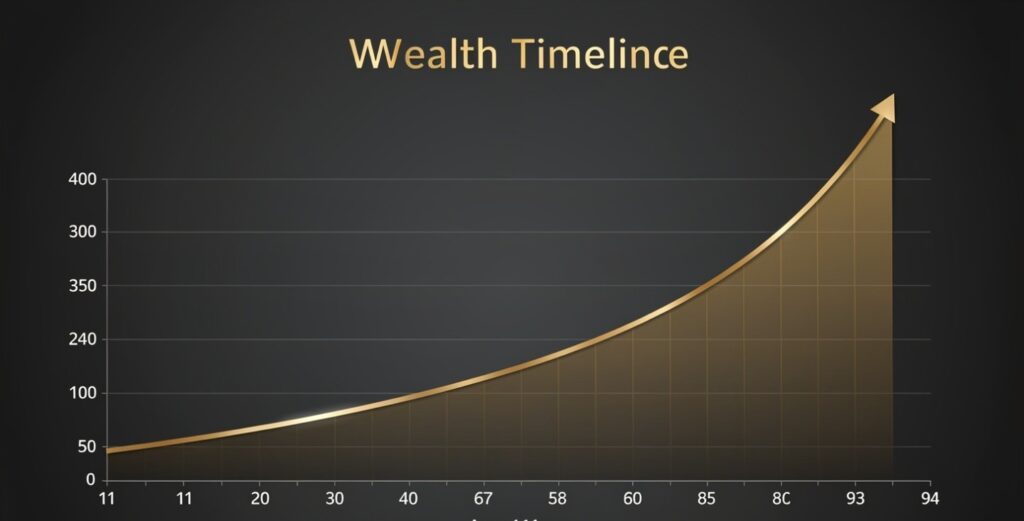
Warren Buffett has been investing for 82 years. He’s currently worth over $130 billion. Here’s the fact that should rewire your entire financial brain: over 99% of that wealth was earned after his 50th birthday. And over 96% was earned after his 65th.
Let that sink in. The greatest investor in human history — a man who started buying stocks at age 11 — didn’t accumulate meaningful wealth until most people are planning retirement. Not because he suddenly got smarter. Not because he found a secret strategy. Because compounding rewards patience on a timeline that the human brain physically cannot comprehend.
This is the patience paradox. The single most powerful wealth-building force in existence demands the one thing that modern humans are least capable of providing: the discipline to do absolutely nothing for an uncomfortably long time.
At Data Pips, we’ve studied this paradox obsessively — in our own portfolios, in the data we analyze, and in the behavioral patterns of the investors we track. What we’ve found is that the difference between people who build generational wealth and people who stay perpetually broke isn’t intelligence, income, or information. It’s the ability to sit still while the math works silently in the background.
We explored the destructive side of this in our previous article on why investors sabotage their own compounding. This article goes deeper into the paradox itself — why doing nothing is so hard, why it’s so profitable, and how to build a system that forces you into profitable inaction.
What the Patience Paradox Actually Means
Here’s the paradox stated plainly: the most profitable action in investing is inaction. But inaction is the hardest action a human can take.
Your brain is wired for activity. For problem-solving. For responding to threats. When your portfolio drops 20%, every neuron fires the same signal: DO SOMETHING. Sell. Switch. Hedge. Run. Your survival circuitry — perfectly designed for escaping predators — is catastrophically designed for building wealth.
The paradox gets worse. In every other area of life, effort correlates with results. Work harder at your job, get promoted. Train harder at the gym, get stronger. Study harder, get better grades. Your entire life has trained you to believe that more effort = more results.
Compounding inverts this rule. More effort — more trading, more switching, more “optimizing” — almost always produces worse results. The Dalbar research institute has tracked this for over 30 years: the average equity fund investor earned 3.6% annually over the past 20 years while the S&P 500 returned 7.5%. The market didn’t underperform. The investors did — by being too active.
That 3.9% annual gap doesn’t sound dramatic. Over 30 years on a $50,000 investment, it’s the difference between $288,337 (at 7.5%) and $144,058 (at 3.6%). Being “active” cost the average investor $144,279. Doing nothing would have literally doubled their wealth.
Why “Doing Nothing” Is the Hardest Financial Skill
If the math is so clear, why doesn’t everyone just sit still? Because three powerful psychological forces conspire against you every single day:
Force 1: Action Bias
Human beings have a deep, evolutionarily programmed bias toward action. When faced with uncertainty, doing something — anything — feels better than doing nothing, even when the data proves that inaction is the optimal choice.
A famous study of soccer goalkeepers found that during penalty kicks, goalkeepers who stayed in the center of the goal saved more penalties than those who dove left or right. But goalkeepers almost always dive — because standing still while a ball rockets toward you feels psychologically unbearable, even when it’s statistically superior.
Your portfolio is the penalty kick. Market volatility is the ball. Standing still — doing nothing — is the mathematically correct decision in most situations. But it feels like irresponsible negligence.
Force 2: Recency Bias
Whatever happened last week feels more important than what happened last decade. If the market dropped 5% this week, your brain treats it as the beginning of a permanent collapse — not a normal fluctuation in a system that trends upward over decades.
J.P. Morgan’s market data shows that the S&P 500 has been positive in approximately 75% of all calendar years since 1926. But in any given week, the probability of a positive return drops to about 56%. The shorter your time horizon, the more chaotic markets appear. The longer your horizon, the more inevitable the upward trend becomes.
Compounding lives in the long horizon. Recency bias traps you in the short one.
Force 3: Social Comparison
Your cousin made 200% on a crypto trade. Your colleague is day-trading options. Your social media feed is full of 22-year-olds claiming six-figure trading profits. Meanwhile, your boring index fund grew 8% last year. You feel like a fool for being patient.
What you don’t see: your cousin lost 80% the following month. Your colleague has blown three accounts. Those social media traders are selling courses, not trading profits. The flashy returns are survivorship bias. The boring returns are where real wealth lives.
As Morgan Housel wrote in The Psychology of Money: “The highest form of wealth is the ability to wake up every morning and say, ‘I can do whatever I want today.’ That’s freedom. And freedom is the highest dividend money pays.” That freedom comes from compounding. And compounding comes from patience.

The Math of Patience: Numbers That Demand Your Attention
We’re going to show you five calculations that will permanently change how you think about time and money. Not opinions. Not motivational fluff. Math. Cold, inarguable, compounding math.
Calculation 1: The 10-Year vs 30-Year Divide
$10,000 invested at 10% annual return:
- After 10 years: $25,937 (you gained $15,937)
- After 20 years: $67,275 (you gained $57,275)
- After 30 years: $174,494 (you gained $164,494)
The last 10 years generated more than the first 20 combined. If you quit at year 10 because “it’s not growing fast enough,” you forfeited 85% of your total potential wealth. The patience paradox in its purest form.
Calculation 2: The Cost of One Year’s Impatience
An investor who starts at age 25 and invests $5,000/year at 10% until age 65 accumulates $2,212,963. The same investor starting at age 26 — just one year later — accumulates $2,002,603. One year of delay cost $210,360. One year of “I’ll start next year” erased two hundred thousand dollars from existence.
Calculation 3: The Active vs Passive Gap
Vanguard’s research consistently shows that over 15-year periods, approximately 85-90% of actively managed funds underperform their benchmark index. The professional money managers — with Harvard MBAs, Bloomberg terminals, and billion-dollar research budgets — lose to a simple index fund that requires zero decision-making. Patience beats expertise in 9 out of 10 cases.
Calculation 4: The Interruption Tax
We ran this simulation ourselves. Portfolio A earns 10% for 20 years without interruption: final value $67,275 from $10,000. Portfolio B earns 10% but the investor panic-sells once (pulling out for 6 months during a crash): final value approximately $48,000-$52,000 depending on timing. One six-month interruption cost between $15,000 and $19,000. One moment of impatience. One interruption. Nearly 30% of total wealth — gone.
We covered the mechanics of this in our compounding mistakes article. Every interruption isn’t just a temporary pause — it’s a permanent amputation of future wealth.
Calculation 5: The Boring 7% vs the Exciting 20%
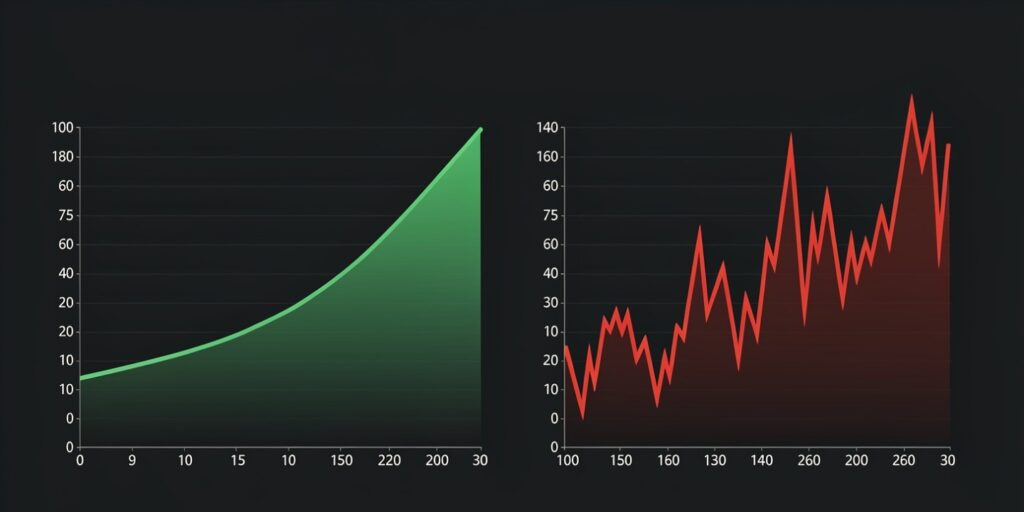
Investor A earns a boring, consistent 7% annually for 30 years. Investor B earns an exciting 20% for the first 5 years, then loses 15% in year 6 (crash), recovers with 12% for 3 years, loses 25% in year 10, and continues this roller coaster pattern averaging about 8% with high volatility.
After 30 years, Investor A has $76,123 from a $10,000 start. Investor B has approximately $52,000-$58,000 despite having higher “peak” returns. Consistency beats brilliance. Boring beats exciting. Patience beats cleverness.
What the World’s Best Investors Actually Do All Day
If the optimal compounding strategy is “do nothing,” what do the most successful investors actually do with their time? The answer is surprisingly boring — and devastatingly effective.
Warren Buffett: Reading
Buffett has famously said he spends 80% of his working day reading. Not analyzing charts. Not executing trades. Not attending meetings. Reading. Annual reports. Industry analysis. Newspapers. Books. He’s building knowledge — not making moves. His annual shareholder letters are masterclasses in patient thinking.
His partner Charlie Munger put it even more bluntly: “The big money is not in the buying and selling, but in the waiting.”
Jack Bogle: Building Systems
The founder of Vanguard — who created the index fund — didn’t spend his career picking stocks. He built a system that automated patience. Buy the entire market. Hold it forever. Don’t try to be clever. The system removes the human temptation to “do something.” Bogle didn’t outperform the market. He removed the human behaviors that cause underperformance.
The Anonymous Millionaires Next Door
Research consistently shows that the average millionaire in America isn’t a tech entrepreneur or a hedge fund manager. They’re a boring saver who invested consistently in index funds for 25-30 years, lived below their means, and never tried to time the market. They built wealth not through brilliance but through the sheer refusal to interrupt the compounding process.
As we outlined in our compounding real story article, the most powerful compounding experiences aren’t dramatic. They’re boring. They’re quiet. They happen in the background while you focus on living your life.
The “Do Nothing” Strategy: A Practical Framework
Telling someone to “do nothing” isn’t actionable advice. It’s like telling an anxious person to “just relax.” Patience isn’t a personality trait. It’s a system you build.
Here’s the exact framework our team at Data Pips uses to enforce productive inaction:
System 1: The Automated Investment Pipeline
Remove yourself from the investment decision entirely. Set up automatic monthly transfers to your investment account on the same date every month. The money moves without your input, your emotion, or your opinion about market conditions.
This is called dollar-cost averaging, and its power isn’t in the math (lump-sum investing actually outperforms DCA about 66% of the time). Its power is in the behavioral protection. You can’t panic-sell if you never had to make the buy decision in the first place.
System 2: The Observation Blackout
Check your long-term portfolio once per month. Not once per day. Not once per week. Once per month, on a scheduled date, for 15 minutes. Then close it.
Why? Because observation changes behavior. Every time you look at your portfolio, you create an opportunity for your brain to panic, celebrate, or overthink. The less you observe, the less you interfere. The less you interfere, the more compounding can do its work.
We detailed this specific system in our compounding sabotage article — over-monitoring is one of the seven silent killers of compounding returns.
System 3: The Crisis Protocol
Write a letter to yourself — while you’re calm and rational — explaining exactly why you should NOT sell during a market crash. Include:
- The historical fact that every major crash has been followed by recovery and new highs
- The specific cost of selling at the bottom (use the J.P. Morgan “missed best days” data)
- A reminder of your long-term goal and how many years remain until you need this money
- A specific instruction: “Do NOT make any changes. Close this screen. Go for a walk.”
Seal the letter. When the next crash comes — and it will — open it before you open your brokerage account. Your calm, rational past self is a far better advisor than your panicked present self.
System 4: The Accountability Lock
Tell one trusted person — a spouse, a friend, a mentor — about your “do nothing” strategy. Give them permission to stop you if you ever call them saying “I think I should sell everything.” Having to explain your panic out loud to another human being is often enough to break the emotional spiral.

The Patience Timeline: What Actually Happens Year by Year
One of the cruelest aspects of the patience paradox is that the early years actively discourage you. The returns are small. The growth is invisible. Your effort-to-result ratio feels insulting. Here’s what actually happens when you invest $500/month at 10% annual return — and why most people quit at exactly the wrong time:
Years 1-3: The Desert Phase
Total invested: $18,000. Portfolio value: approximately $20,655. Gain: $2,655.
This is where most people lose faith. Three years of consistent investing and you’ve gained less than $3,000 in returns. Your brain screams: “At this rate, it’ll take forever.” It won’t. But it feels like it will. And feelings drive quitting.
Years 4-7: The Fog Phase
Total invested: $42,000. Portfolio value: approximately $57,180. Gain: $15,180.
Growth is becoming visible but still unexciting. You’ve earned $15K on top of your $42K investment. Better, but not life-changing. This is the phase where social comparison is most dangerous — your friend’s crypto gains look a lot sexier than your steady index fund.
Years 8-15: The Momentum Phase
Total invested: $90,000. Portfolio value: approximately $191,174. Gain: $101,174.
Now something fascinating happens. Your compounding gains exceed your total contributions for the first time. Your money is literally making more money than you are. This is the inflection point where believers are rewarded and quitters realize what they left on the table.
Years 16-25: The Explosion Phase
Total invested: $150,000. Portfolio value: approximately $590,008. Gain: $440,008.
The exponential curve kicks in violently. Your portfolio is generating more returns in a single year than you contribute in five years. This is where “boring” becomes “beautiful.” But you only see this phase if you survived the desert, the fog, and the momentum phases without quitting.
Years 26-30: The Legacy Phase
Total invested: $180,000. Portfolio value: approximately $986,964. Gain: $806,964.
From $180,000 in total contributions, you’re approaching $1 million. 78% of your wealth was generated by compounding — not by your deposits. The money you put in was the seed. Patience was the soil. Time was the sun. And the harvest only comes to those who refused to dig up the seed to check if it was growing.
As we described in our consistent compounding returns guide, the math doesn’t care about your feelings. It rewards only one behavior: uninterrupted consistency.
The Deadly Myths That Kill Patience
The patience paradox is made worse by three persistent myths that the financial media, social media influencers, and your own ego constantly reinforce:
Myth 1: “Smart Investors Are Active Investors”
Reality: The smartest investors in history are famously inactive. Buffett holds stocks for decades. Bogle created a fund designed to never be traded. The Yale Endowment — one of the most successful institutional investors — makes major allocation changes approximately once per decade.
Activity in investing correlates negatively with returns. More trades = more fees, more taxes, more emotional decisions, and more interruptions to compounding. The data from Dalbar’s 30+ years of investor behavior analysis is unambiguous: the average investor dramatically underperforms the market because they trade too much.
Myth 2: “You Need to Time the Market”
Reality: Market timing requires you to be right twice — when to get out AND when to get back in. Miss either decision, and you underperform someone who simply stayed invested. Over a 20-year period, missing just the 10 best market days — 10 days out of approximately 5,000 — cuts your total return by more than half.
The best trading days cluster around the worst days. If you sell during a crash, you almost certainly miss the recovery. Time IN the market beats timing OF the market. Every study. Every time period. Every market.
Myth 3: “Compounding Is Too Slow for My Goals”
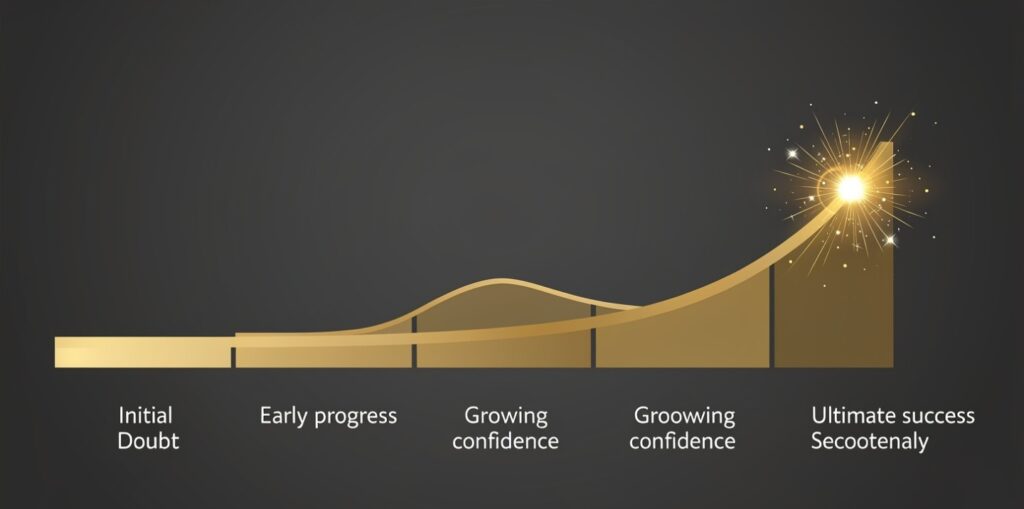
Reality: Compounding only seems slow because you’re looking at the wrong part of the curve. The first five years are unimpressive. The last five years are miraculous. But you only get the miraculous part if you endured the unimpressive part. Calling compounding “slow” is like calling a bamboo tree slow because it spends four years growing roots before exploding 90 feet in six weeks. The invisible growth IS the growth. You just can’t see it yet.
We addressed this directly in our foundational compounding article. If you’re still unclear on why compound growth feels slow early and explosive late, read that first.
Patience as a Competitive Advantage
Here’s the part that should genuinely excite you: because patience is so psychologically difficult, it’s rare. And rare advantages compound themselves.
In a market where 90% of participants can’t sit still for more than 18 months, the 10% who can are essentially playing a different game. They’re not competing with the frantic majority — they’re harvesting the returns that the impatient leave behind.
Every time a panicked investor sells at the bottom, a patient investor buys at a discount. Every time a bored investor switches strategies, a consistent investor extends their compounding streak. Every time an emotional trader revenge-trades their way to ruin — as we detailed in our patience and risk management guide — a disciplined investor sits quietly and lets the math accumulate.
Patience isn’t just a virtue in investing. It’s a structural advantage that becomes more powerful the fewer people practice it.
“Compound interest is the eighth wonder of the world. He who understands it, earns it. He who doesn’t, pays it.” — Albert Einstein (attributed)
“The stock market is a device for transferring money from the impatient to the patient.” — Warren Buffett
⚡ Quick Action Steps: Build Your Patience Infrastructure Today
- Today (15 minutes): Set up automatic monthly investment transfers. Pick a date. Pick an amount — even $50/month. Automate it. Remove your emotions from the equation permanently.
- This evening (20 minutes): Write your crisis letter. Include the math: missing the 10 best market days cuts returns by 50%+. Seal it. Keep it where you’ll find it during the next crash.
- This week: Delete portfolio-tracking apps from your phone. Move to monthly desktop-only check-ins. Observation frequency is directly correlated with emotional interference.
- This weekend: Calculate your “compounding runway” — how many years you have until you need this money. If the answer is 10+ years, write it on a sticky note and put it on your computer: “I don’t need this money for [X] years. The math is working. Leave it alone.”
- Tell one person: Share your “do nothing” commitment with one trusted person. Give them explicit permission to talk you off the ledge when markets panic. External accountability defeats internal panic every time.
Frequently Asked Questions
1. What exactly is the patience paradox in compounding?
The patience paradox is the counterintuitive reality that the most profitable action in long-term investing is deliberate inaction — doing nothing while your investments compound undisturbed. The paradox exists because every other area of life rewards effort and activity, but in investing, more activity almost always leads to worse returns. The investors who earn the most are the ones who interfere the least.
2. How long do I actually need to be patient for compounding to work?
Minimum 10 years for meaningful results. Ideal: 20-30+ years for transformative wealth. The compounding curve is designed to disappoint you in the early years and astonish you in the later ones. Roughly 80% of compounding gains occur in the final third of the investment timeline. If you need the money within 5 years, compounding isn’t your tool. If you have 15+ years, patience is your most powerful weapon.
3. What should I do during a market crash if “doing nothing” feels impossible?
Open your crisis letter — the one you wrote while calm. Read it completely. Then follow these steps: close your portfolio screen, go for a 30-minute walk, and call your accountability partner. If after all three of those actions you still want to sell, wait 72 hours. If you still want to sell after 72 hours of a closed screen, then — and only then — consider making a change. In our experience, 95%+ of panic-sell impulses dissolve within 72 hours of screen blackout.
4. Is the “do nothing” strategy the same as being lazy with finances?
Absolutely not. The “do nothing” strategy requires more discipline than active trading. You must set up automated systems, resist constant temptation to interfere, maintain emotional control during crashes, and hold your position when everyone around you is panicking. Active inaction is one of the hardest psychological disciplines in finance. Lazy investors don’t automate, don’t plan, and don’t maintain systems. Patient investors build infrastructure specifically designed to enforce productive inaction.
5. Doesn’t “doing nothing” mean missing opportunities?
You’re not missing opportunities — you’re avoiding the illusion of opportunities. Research consistently shows that attempting to capture short-term opportunities (market timing, hot stock picks, trend chasing) costs the average investor 3-4% annually compared to simply holding a diversified index. The “opportunities” you’re missing are statistically more likely to be traps than genuine advantages. The real opportunity is the 20-30 year compounding curve that rewards consistency above all else.
6. What if I’ve already been impatient and interrupted my compounding?
Then today is the best day to start a new uninterrupted streak. You can’t recover lost compounding time — that’s gone permanently. But you can prevent further interruptions starting right now. Build the four systems we described (Automated Pipeline, Observation Blackout, Crisis Protocol, Accountability Lock) and commit to the longest unbroken compounding streak of your life, starting today. Five years from now, this moment will be either the beginning of your patience — or another regret.
7. How does this apply to trading, not just investing?
In trading, the patience paradox manifests as: the most profitable traders take the fewest trades. They wait for A+ setups, ignore mediocre opportunities, and refuse to trade out of boredom or revenge. As we covered in our trading patience guide, quality over quantity applies to both investing and trading — the only difference is the timeframe. In investing, patience means decades. In trading, patience means waiting hours or days for the right setup instead of forcing trades every 30 minutes.
In trading, inaction is a skill — patience in trading: three skills of discipline shows what the pros are actually waiting for.
Conclusion: The Hardest Easy Thing You’ll Ever Do
We’ve just shown you the patience paradox in full: compounding rewards those who do nothing — and punishes those who can’t resist the urge to act. The math is inarguable. The history is unanimous. The research is overwhelming. Every data point leads to the same conclusion: sit still, stay invested, and let time do the heavy lifting.
And yet, tomorrow morning, millions of investors will check their portfolios. Thousands will panic at a red number. Hundreds will sell at exactly the wrong moment. And the compounding curve will quietly continue rewarding the few who did nothing — the same way it has for every decade, every century, since mathematics began.
At Data Pips, we don’t sell the illusion that wealth comes from brilliant moves. We sell the uncomfortable truth that wealth comes from consistent, boring, patient behavior sustained across years and decades. Not weeks. Not months. Years.
Build the systems. Automate the process. Write the crisis letter. Delete the apps. And every time your brain screams “DO SOMETHING” — remember that the most profitable response in the history of investing has always been the same six words:
“I’m going to do nothing today.”
How long is your current uninterrupted compounding streak? If you don’t have one, today is Day 1. Tell us in the comments — our team tracks these commitments because accountability is the difference between intention and wealth.

Disclaimer: This article is for educational and informational purposes only. It does not constitute financial advice, investment advice, or any other type of professional advice. All investments carry risk, including the potential loss of principal. Past performance does not guarantee future results. The calculations, examples, and historical data referenced are illustrative and may not reflect actual market conditions or individual outcomes. The “do nothing” strategy described applies to long-term, diversified investing — not to all financial situations. Always consult a licensed financial advisor before making investment decisions. Data Pips is not a registered investment advisor and does not manage client funds.