Look, here’s something most people using AI every single day have no idea about. Every time you open ChatGPT, ask Claude a question, or use Google’s AI search — you are touching the exact same kind of technology underneath. It has a name, and almost nobody outside AI research can explain what it actually is.
It’s called a foundation model.
And here’s why you should care, whether you’re a trader, a business owner, a freelancer, or just someone trying to understand where the world is heading: foundation models are not one small part of modern AI. They are the engine behind nearly every AI product built in the last few years. Understanding them is understanding why AI suddenly got so powerful — and where it’s going next.
This isn’t a technical lecture. No maths degree needed, no coding background required. We’re going to break this down the way one person explains something important to another. Let’s get into it.
- What a foundation model actually is — in plain language, no jargon
- How these models are built and why “train once, adapt everywhere” changed everything
- Why foundation models matter for every industry, not just tech companies
- The real limitations and risks nobody markets to you — and how to think about them
What Is a Foundation Model? The Simple Definition
Let’s start with the cleanest possible definition, then unpack it.
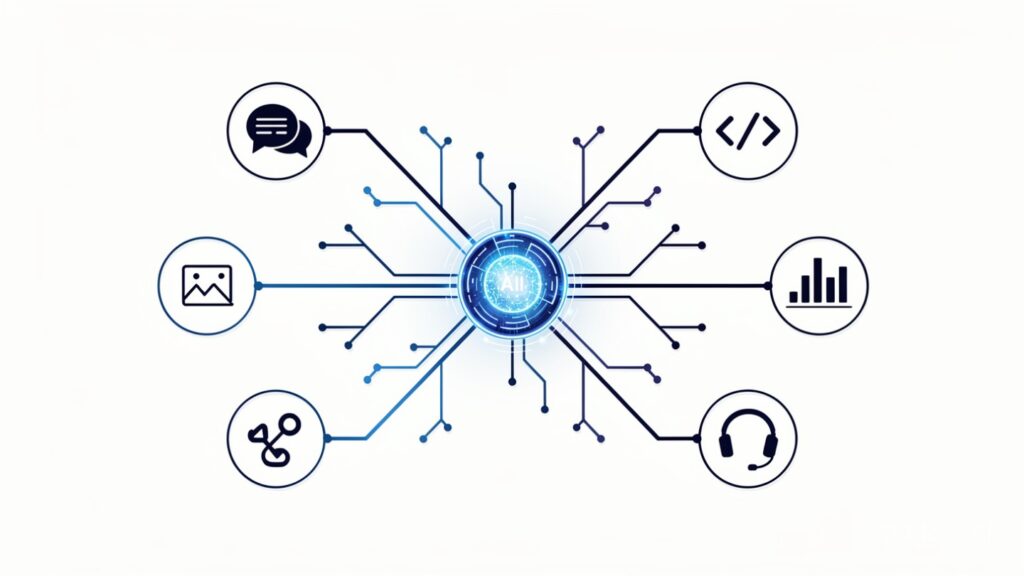
A foundation model is a large AI model trained on a huge, broad set of data — and then adapted to perform many different specific tasks. That’s the whole idea in one sentence. According to IBM’s explanation of the technology, a foundation model is pretrained on vast amounts of data and can then be fine-tuned or prompted for a wide range of downstream applications.
Here’s the part that makes it revolutionary. Before foundation models, AI worked completely differently. If you wanted an AI to translate languages, you built and trained a model specifically for translation. If you wanted one to recognize faces, you built a separate model trained only on faces. Every single task meant a new model, trained from scratch, on task-specific data. It was slow, expensive, and narrow.
Foundation models flipped this entirely. Instead of building a narrow tool for each job, you train one massive, general model on an enormous variety of data — and then that single model can be adapted to do translation, writing, coding, analysis, image generation, and hundreds of other tasks. You train once. You reuse everywhere.
Where the Term Actually Came From
This matters, because knowing the origin helps you understand the concept honestly — and because a lot of websites get this wrong.
The term “foundation model” is newer than most people assume. It was coined in August 2021 by Stanford University’s Center for Research on Foundation Models (CRFM), part of the Stanford Institute for Human-Centered AI. As documented in Stanford HAI’s own explainer, the researchers defined it as any model trained on broad data at scale that can be adapted to a wide range of downstream tasks.
Here’s a detail most people miss: the technology itself wasn’t new in 2021. Models like BERT (from Google, 2018) and GPT-3 (from OpenAI, 2020) already existed and already worked this way. What Stanford did was give the paradigm a name. The researchers explained their reasoning clearly — “large language model” was too narrow because the approach isn’t only about language, “pretrained model” undersold the significance, so they chose “foundation” to capture the idea that these models serve as the common base on which many specific applications are built.
So when someone tells you foundation models are a brand-new invention, they’re half right. The name is recent. The underlying approach had been building momentum since 2018.
How Foundation Models Actually Work
You don’t need the deep technical version, but understanding the basic mechanics will make you smarter than 95% of people talking about AI. Here’s the honest, simplified breakdown.
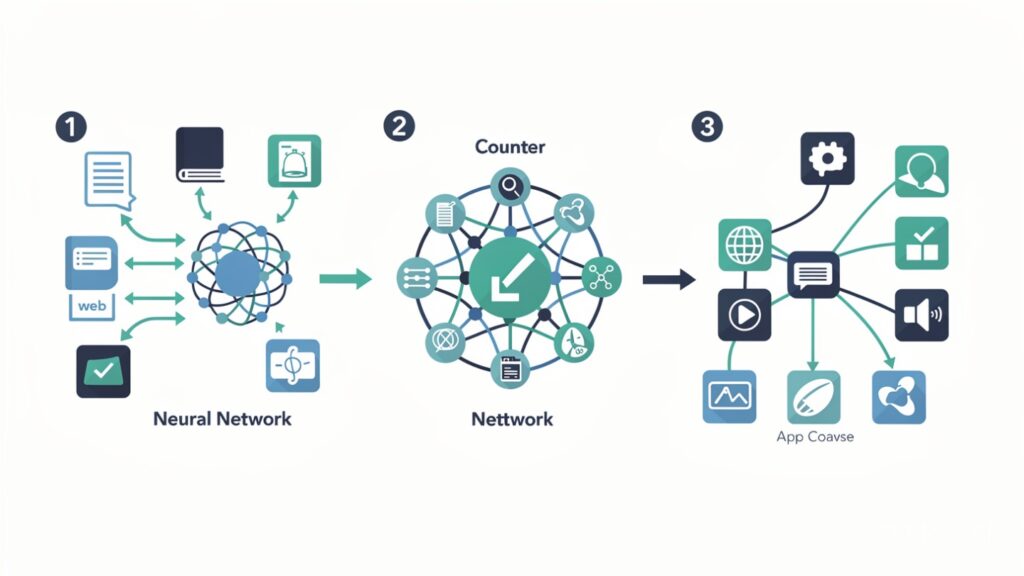
Step 1: Massive Pretraining
The model is fed an enormous amount of data — text from books, websites, articles, code, and more. It isn’t told “this is the right answer” for each piece. Instead, it learns by predicting patterns — for a language model, that means predicting what word comes next, over and over, across staggering amounts of text. This is called self-supervised learning, and it’s how the model absorbs grammar, facts, reasoning patterns, and the structure of language without a human labeling every example.
Step 2: Scale Creates Capability
Here’s where it gets wild. As these models grew larger — more data, more parameters (the internal values the model adjusts as it learns) — they started showing abilities nobody specifically programmed. GPT-3, for example, had 175 billion parameters compared to GPT-2’s 1.5 billion, and that scale jump produced an ability called in-context learning: the model could handle a brand-new task just from a description in the prompt, without being specifically trained for it.
The compute required for this has grown at a breathtaking pace. According to AWS’s breakdown of foundation models, the computational power used for foundation modeling has doubled roughly every 3.4 months since 2012. That’s not a typo — every few months, not every few years.
Step 3: Adaptation
Once the base model is trained, it gets adapted to specific uses. This happens through fine-tuning (training it a little more on specialized data) or simply through prompting (giving it clear instructions). This adaptation layer is where the foundation model becomes a customer service bot, a coding assistant, a trading analysis tool, or whatever the application needs.
The Old Way vs. The Foundation Model Way
Let’s make this concrete with a direct comparison, because the difference is the entire story.
| Aspect | Old Task-Specific AI | Foundation Models |
|---|---|---|
| Training | New model trained per task | Trained once, reused everywhere |
| Data needed | Task-specific labeled data | Broad, general data |
| Flexibility | One model, one job | One model, hundreds of jobs |
| Cost to add a task | Build from scratch | Fine-tune or just prompt |
| Speed to deploy | Slow | Fast |
Look at that last row. Speed to deploy is why your business can now add an AI feature in days instead of years. That’s not a small improvement — it’s the difference that’s letting tiny startups compete with giant corporations on AI capability.
Why Foundation Models Matter for Every Industry
Here’s the part that connects directly to you, whatever field you’re in. Foundation models aren’t a tech-company toy. They’re becoming infrastructure — the same way electricity or the internet became infrastructure that every industry runs on.
Consider how fast adoption is moving. According to Deloitte’s 2026 State of AI in the Enterprise findings, worker access to AI rose 50% in 2025, and the share of companies with 40% or more of their AI projects in production is set to double within six months. This isn’t a future trend. It’s happening right now.
Let’s walk through what this means across different fields.
Finance and Trading
Foundation models can analyze enormous volumes of market news, reports, and sentiment data in seconds — work that would take a human analyst days. They power risk analysis, document processing, and increasingly, autonomous agents that monitor and act on information. We explored this shift in depth in our analysis of AI in trading and business in 2026, and the pace is only accelerating.
Business Operations
Customer support, content creation, data analysis, internal documentation — all of these are being transformed by a single underlying technology adapted to each use. A business no longer needs separate vendors and separate systems for each. One foundation model, adapted multiple ways, can touch every department.
Software Development
This is one of the most dramatic shifts. Foundation models now write, review, and debug code. They’re moving software development from “humans write every line” to “humans direct, AI executes.” This connects directly to a bigger transformation we broke down in our piece on how AI agents are replacing traditional software workflows.
Healthcare, Law, Education, and Beyond
Medical imaging analysis, legal document review, personalized tutoring — the same underlying paradigm adapts to each. This is the genuine meaning of the word “foundation.” It’s the common base that countless specialized applications are built on top of.
Our founder has spent considerable time experimenting directly with how these models are deployed in practice — testing AI agent frameworks and building AI-assisted workflows for trading analysis and content creation.
The single biggest lesson from that hands-on work? The foundation model is never the whole system. The amateurs treat the model as a magic box that does everything. The people getting real results treat it as one powerful component inside a larger structure — with memory, controls, and verification built around it. The model is the engine. It is not the entire car.
Foundation Models vs. Agentic AI — Clearing Up the Confusion
A lot of people mix these up, so let’s settle it clearly.
A foundation model is the underlying brain — the trained intelligence. Agentic AI is what happens when you give that brain the ability to take actions, use tools, and pursue goals over multiple steps. The foundation model is the engine; the agent is the engine put inside a system that can actually drive somewhere.
If you want to understand that next layer — where the industry is genuinely heading — we covered it thoroughly in our guide to what agentic AI is and the evolution beyond chatbots, and the developer-focused side in our overview of the top AI agent frameworks every developer should know. Foundation models are the base. Agents are what you build on top.
What Nobody Tells You About Foundation Models
Now the honest part — the things the marketing won’t tell you, because they don’t help sell AI products.
Foundation models don’t actually “reason” the way you think they do. They are extraordinarily good at recognizing patterns in data and continuing those patterns in ways that look like reasoning. But they don’t follow logical rules the way a formal system does. This means they can make confident mistakes that no careful human would make — and they’ll state those mistakes with total confidence. Treat the output as a brilliant, fast first draft from an assistant who is sometimes wrong, not as gospel. The people who get burned are the ones who forget this.
They hallucinate, and this isn’t a bug they’ll simply patch away. Sometimes a foundation model generates information that is completely false but sounds entirely plausible. There is no internal alarm that goes off when it’s making something up. This is a structural consequence of how the technology works — not a temporary glitch. For any serious use, especially in finance, law, or health, verification isn’t optional. It’s mandatory.
Their knowledge goes stale. A foundation model’s training has a cutoff date. Anything that happened after that date is invisible to the model unless it’s connected to real-time search or fed fresh information. People constantly forget this and ask models about recent events, then get confused by outdated or invented answers. Know the cutoff. Respect the cutoff.
“Build vs. buy” is a real decision, and most who build should have bought. Training a foundation model from scratch costs astronomical sums — far beyond what almost any normal business can justify. The honest reality for 99% of businesses is that you don’t build a foundation model. You build on top of an existing one through prompting and fine-tuning. Anyone telling a small or mid-sized business to “build their own AI model” is usually selling something. The smart money adapts what already exists.
Most foundation model project failures are not the model’s fault. Industry analysis consistently shows that when AI deployments fail in organizations, it’s usually not because the model was weak — it’s because the organization deployed before its data, infrastructure, or governance was ready. The model was fine. The readiness wasn’t. If you’re considering using this technology in your work, fix your data and process foundations first. The fanciest model can’t save a broken process.
Frequently Asked Questions
What is a foundation model in simple terms?
A foundation model is a large AI model trained on a huge variety of data that can then be adapted to perform many different specific tasks. Instead of building a separate AI for each job, you train one general model and reuse it everywhere — for writing, coding, analysis, image generation, and more. It’s the “train once, use everywhere” approach that powers tools like ChatGPT and Claude.
Are foundation models and large language models the same thing?
Not exactly. A large language model (LLM) is a type of foundation model that works with text. But foundation models are a broader category that also includes models for images, audio, and multiple data types at once. All LLMs are foundation models, but not all foundation models are LLMs. The term “foundation model” was actually chosen because “large language model” was considered too narrow.
Who invented foundation models?
The term was coined by Stanford University’s Center for Research on Foundation Models in August 2021. However, the technology itself predates the name — models like Google’s BERT (2018) and OpenAI’s GPT-3 (2020) already worked on the same principle. Stanford gave the existing paradigm a unifying name rather than inventing the approach from nothing.
Why are foundation models important for businesses?
Because they dramatically lower the cost and time of adding AI capability. A business can now adapt an existing foundation model in days through prompting or fine-tuning, instead of spending years and fortunes building custom AI from scratch. This lets even small businesses access powerful AI that was previously available only to tech giants.
Can foundation models be trusted for important decisions?
They should be treated as powerful assistants, not infallible authorities. Foundation models can hallucinate — generate false information that sounds plausible — and their knowledge has a cutoff date. For important decisions in finance, law, or health, their output must be verified by a human or a reliable source. They’re excellent at accelerating work, not at being the final word on it.
Do I need to build my own foundation model to use AI in my business?
Almost certainly not. Building a foundation model from scratch costs enormous sums and requires resources beyond what nearly any normal business can justify. The practical path for the vast majority of businesses is to build on top of an existing foundation model through prompting and fine-tuning — getting the power without the astronomical cost of creating one.
1. Pick one foundation-model-powered tool (a chatbot, a writing assistant, a code helper) and use it deliberately for one real task this week — get hands-on rather than theoretical.
2. Before trusting any AI output for something important, verify it against a reliable source — make verification a permanent habit, not an afterthought.
3. Identify one repetitive task in your work or business that a foundation model could accelerate, and test whether adapting an existing tool beats doing it manually.
4. Learn the knowledge cutoff date of whatever AI tool you use, so you never get caught trusting stale information on recent events.
5. Resist any pitch to “build your own AI model” — focus on smartly adapting what already exists instead.
Final Word
Here’s the truth that ties it all together. Foundation models are the quiet infrastructure underneath the loud AI revolution everyone’s talking about. They’re the reason a technology that was narrow and clumsy a decade ago is now writing, analyzing, coding, and creating across every industry on earth.
You don’t need to build one. You don’t need to understand the deep maths. But you absolutely need to understand what they are, what they can do, and — just as important — where they fail. Because the people who understand both the power and the limits will use this technology to get ahead. The people who treat it as magic will get burned by its confident mistakes.
The foundation is laid. The question now isn’t whether this technology will reshape your industry. It’s whether you’ll understand it well enough to be one of the people building on top of it — or one of the people left wondering what happened.
Disclaimer: This article is for educational and informational purposes only. The AI field evolves rapidly, and specific tools, capabilities, and statistics may change over time. Always verify current information from primary sources before making technology or business decisions.