Key Takeaways
- The “average” freelancer income figure is misleading — it averages micro-gig earners with senior specialists. Your skill and positioning matter far more than any average.
- In 2026, skilled freelancers in the U.S. realistically earn between $50,000 and $128,000 per year, with top specialists exceeding $275,000.
- Region changes the number more than experience does — the same skill can pay 4x more in North America than in South Asia.
- Specialists earn 2–4x more than generalists. Niching down is the single biggest lever on freelance income.
- AI-enabled freelancers earn roughly 40% more per hour than those who refuse to adapt — the tool is an advantage, not a threat.
Ask the internet how much a freelancer makes and you will get two answers, both useless. One says you can make six figures from your laptop on a beach. The other says freelancers earn $3 an hour and you will starve. Both are technically true. Both are completely worthless for making a real decision.
The truth lives in the gap between those two extremes — and it depends entirely on what you do, how good you are, who you serve, and where you live. There is no single number. There is a range, and your job is to understand where in that range you can realistically land, and what moves you up it.
This article cuts through the hype with actual 2026 data. Real numbers, by skill, by experience level, by region. No inspirational nonsense. No fear-mongering. Just the figures you need to decide whether freelancing is worth your time — and if so, how to position yourself for the high end of the range instead of the low end. Let us get into it.
Why the “Average Freelancer Income” Number Lies to You
Before we get to the real numbers, you need to understand why most income statistics are misleading — because if you do not, you will either get falsely excited or falsely discouraged, and both lead to bad decisions.
Here is the problem. When you read that “the average freelancer earns $X,” that number is averaging two completely different populations: people doing $5 micro-gigs as a hobby, and senior specialists earning $200 an hour on enterprise contracts. Averaging those together produces a number that describes nobody.
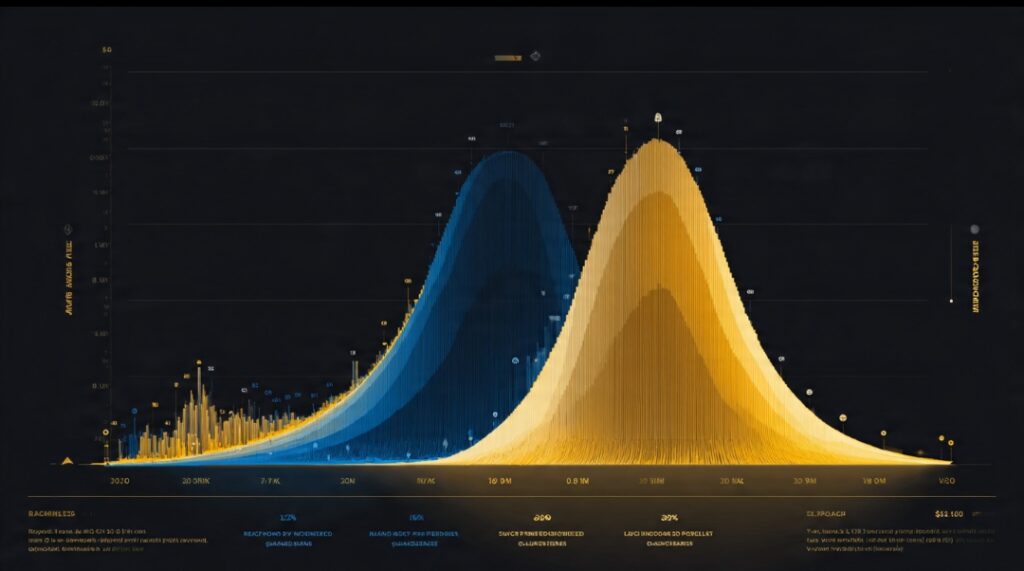
According to Upwork’s 2026 data, the average freelancer income is approximately $99,230, with about 50% of U.S. freelancers reporting annual income between $50,500 and $128,500, and top specialists earning as much as $275,000 per year. That is a useful range — but notice how wide it is. The gap between the bottom and top of that range is the entire story of freelance income. Where you land in it is not random. It is determined by specific, controllable factors.
So forget the single average. The question is not “what does the average freelancer make?” The question is “what does someone with my skill, my positioning, my region, and my effort level realistically make?” That question has an answer. Let us find yours.
— Data Pips Team
The Real Numbers: Freelance Income by Skill in 2026
Here is where the data gets useful. Income varies enormously by skill — and the gap between high-demand and low-demand skills is widening every year. These are realistic 2026 hourly ranges for skilled freelancers with direct clients or strong platform profiles:
| Skill Category | Hourly Range (USD) | Annual Potential (Full-Time) |
|---|---|---|
| AI / Machine Learning Engineering | $120–$300 | $130,000–$190,000+ |
| Blockchain / Smart Contracts | $100–$200 | $120,000–$180,000 |
| Cybersecurity Consulting | $80–$180 | $100,000–$170,000 |
| Full-Stack Development | $50–$150 | $85,000–$160,000 |
| SEO Specialist | $40–$120 | $60,000–$170,000 |
| UX / UI Design | $60–$120 | $70,000–$140,000 |
| Frontend Development (React, Vue) | $45–$120 | $65,000–$130,000 |
| Graphic Design | $30–$75 | $40,000–$90,000 |
| WordPress / CMS Development | $30–$80 | $45,000–$95,000 |
| Content Writing | $25–$75 | $35,000–$85,000 |
| Social Media Management | $25–$70 | $35,000–$80,000 |
| Virtual Assistant | $13–$35 | $20,000–$50,000 |
Notice the pattern. AI and machine learning engineering commands the highest rates, with senior specialists earning $120–$300/hour, followed closely by prompt engineering, blockchain development, and cybersecurity consulting. At the other end, commodity skills like basic data entry and transcription are not just low-paying — they are actively declining as AI absorbs them.
This is the value-first principle in action. The world pays in proportion to the value you deliver and how hard that value is to replace. A skill that thousands of people have and AI can partially automate commands low rates. A skill that few people have and that directly affects a client’s revenue commands premium rates. Choose your skill with this in mind — not based on what looks easy, but on what delivers value that is hard to replace.
The Factor That Beats Skill: Specialization
Here is something the data makes brutally clear, and most beginners ignore: a specialist earns 2–4 times what a generalist earns — within the exact same skill.
Two web developers. Same technical ability. One markets themselves as “web developer.” The other markets themselves as “Shopify developer for fashion e-commerce brands.” The second one earns dramatically more. Why? Because specialization signals expertise, reduces the client’s perceived risk, eliminates price competition with generalists, and generates referrals within a tight niche.
The data backs this without ambiguity. Specialisation compounds exponentially, producing a 40–130% premium over generalists. That is not a marketing claim — it is what the rate data across hundreds of thousands of projects shows. The “riches in niches” principle is not motivational fluff. It is measurable economics.
This is why every freelancing guide worth reading hammers the same point: pick a niche, go narrow, become known as “the person who does X for Y.” The generalist competes with everyone and wins on price. The specialist competes with almost no one and wins on expertise. For a deeper look at how specialization builds compounding income over time, read our guide on compounding skill into a wealth-building system.
The Factor Nobody Wants to Talk About: Region
Here is the uncomfortable truth that most freelancing content avoids: where you live affects your income more than your experience does.
The same skill, the same quality of work, the same effort — pays radically different amounts depending on the freelancer’s region. North American rates average 4.2 times South and Southeast Asian rates for the same services — a gap that has widened from 3.8 times in 2020.
According to freelance statistics for 2026, the global average freelance rate is $28/hour, but this varies enormously by geography — US freelancers average $44/hour, while rates in South Asia average $12/hour.
Now — here is what matters. This regional gap is a challenge for freelancers in lower-rate regions, but it is also the single biggest opportunity in modern freelancing. Because the work is remote, a skilled freelancer anywhere in the world can serve clients in high-rate markets. A developer in a low-cost country who positions themselves correctly and serves North American or European clients directly can earn rates far above their local market — while enjoying a cost of living that makes those earnings go much further.
The strategy is clear: do not anchor your rates to your local market if your local market is low-rate. Anchor them to the market your clients are in. A freelancer who builds direct relationships with clients in high-rate regions captures the income of those regions regardless of where they physically sit. This is the genuine democratizing power of remote freelance work — and most freelancers in lower-rate regions never take advantage of it because they price based on where they live instead of where their clients are.
Real Pattern: Two Freelancers, Same Skill, Different Income
Consider two content writers with identical skill levels. Both write well. Both understand SEO. Both can produce a quality 2,000-word article.
Writer A markets as a “freelance writer,” works through low-cost gig platforms, accepts whatever work comes, and charges $0.03 per word because that is what the platform race-to-the-bottom dictates. At 30,000 words per month, that is $900/month.
Writer B specializes as a “SaaS content writer for B2B software companies,” builds direct relationships with companies in high-rate markets, charges $0.30 per word backed by case studies showing their content drives signups, and produces 15,000 words per month. That is $4,500/month — five times Writer A’s income, for half the writing volume.
Same skill. Same hours of actual writing. The difference is entirely positioning, specialization, and client targeting — not talent.
Lesson: Your income is not determined by how well you do the work. It is determined by how you position the work, who you sell it to, and whether you compete on price or on value.
Experience Level: What You Can Expect at Each Stage
Freelance income follows a predictable progression — but it is not linear, and it is not based purely on time. It is based on proof. Here is the realistic trajectory:
Beginner (0–12 months): Building Proof
This is the hardest and lowest-paying stage. You have no reviews, no case studies, no track record. Realistically, expect modest income here — possibly $500–$2,000/month depending on skill and effort. Many beginners earn very little in the first few months. This is normal. You are not earning money yet — you are buying proof. Your first clients, even low-paying ones, are giving you the testimonials and case studies that unlock the next stage. Do not measure success by income here. Measure it by proof accumulated.
Intermediate (1–3 years): The Climb
Once you have proof — a portfolio, testimonials, repeat clients — your income climbs steeply. This is where most freelancers reach $2,000–$6,000/month, and skilled specialists reach higher. The key transition in this stage is moving from competing for work to having work come to you through referrals and reputation. According to platform data, the jump from intermediate to expert is where the money is, and it is bought with proof, not time.
Expert (3+ years): Premium Positioning
At this stage, your rate reflects outcomes, not tasks. You are no longer paid for hours — you are paid for the value you create. Expert freelancers in high-demand skills routinely exceed $100,000/year, and top specialists in AI, blockchain, and strategy command $200,000–$275,000+. The defining shift here is psychological as much as practical: you stop selling your time and start selling your results. Positioning as the outcome, not the task, is what unlocks the top of the market.
Notice the pattern across all three stages: this is the long game in action. The beginners who quit in the first stage never see the intermediate climb. The ones who delay gratification, build proof patiently, and play for where they will be in 3–5 years are the ones who reach the expert tier. What matters is not who is earning the most in month three — it is who is still building in year three.
— Data Pips Team
The AI Factor: Threat or Multiplier?
No honest discussion of 2026 freelance income can skip AI. It is reshaping the market — but not the way the fear-mongers claim.
Here is what the data actually shows. AI-enabled freelancers earn roughly 40% more per hour than traditional freelancers, save an estimated 8 hours per week on average, and 84% of skilled freelancers are excited about AI tools reshaping their workflows.
Read that again. Freelancers who use AI earn more, not less. Because AI is not replacing skilled freelancers — it is making them faster. The writer who uses AI to research and draft produces three times the output. The developer who uses AI to handle boilerplate ships projects faster. The designer who uses AI for ideation iterates more quickly. AI multiplies the productivity of skilled people.
What AI is doing is killing commodity work. Basic transcription, simple data entry, generic content writing — these rates are dropping fast because AI does them adequately for free. If your entire value was doing repetitive tasks that required no judgment, AI is a threat. If your value is judgment, strategy, creativity, client relationships, and outcomes — AI is the best assistant you have ever had.
The lesson is the same one that applied to every previous technology shift: the technology does not take your job. The person who uses the technology better than you takes your job. Position yourself as an AI-enabled professional, not an AI competitor. The 40% premium is waiting for those who adapt.

The Hidden Math: What Freelancers Actually Take Home
Here is a reality check that the income statistics hide: gross freelance income is not take-home income. Before you compare a freelance number to a salary, you need to understand the deductions.
Platform Fees
If you work through platforms, they take a cut. Upwork uses tiered fees (20% on the first $500 per client, 10% up to $10,000, 5% above), while Fiverr charges a flat 20% on all transactions. A $50/hour rate on a 20% platform nets you $40. This is why building direct client relationships — off-platform — is so valuable. The same work, billed directly, keeps the full amount.
Self-Employment Costs
Freelancers cover their own taxes, health insurance, retirement, equipment, and software. There is no employer matching your contributions. As a rule of thumb, you generally need to earn 25–40% more gross as a freelancer to match the total compensation of an equivalent salaried position. A $80,000 freelance income is roughly equivalent to a $55,000–$60,000 salary once you account for benefits you now pay yourself.
Income Instability
This is the cost that does not show up in any rate table. The biggest freelancing challenges remain income instability, cited by 63% of freelancers, and health insurance access. Freelance income fluctuates. Some months are strong, some are slow. This is why building a cash buffer and multiple income streams is not optional for freelancers — it is survival infrastructure. For a complete framework on building income stability, read our guide on how to build multiple income streams without quitting your job.
What Nobody Tells You About Freelance Income
1. Direct Clients Pay 20–30% More Than Platforms
The same skill, the same work, billed directly to a client instead of through a platform, earns 20–30% more — partly from avoiding platform fees, partly because direct clients perceive higher value than platform-shopped freelancers. Platforms are excellent for building your first reviews and case studies. But the freelancers with the highest incomes have all moved the majority of their work off-platform to direct relationships. Use platforms as a launchpad, not a permanent home.
2. Project Rates Beat Hourly Rates as You Improve
When you bill hourly, getting faster reduces your income — you are penalized for efficiency. When you bill per project, getting faster increases your effective hourly rate. A 30-hour project at $85/hour is $2,550. The same project priced at $5,000 fixed, completed in 30 hours, is an effective $167/hour. As your skill grows, shift from hourly to project-based pricing. It is one of the biggest income levers available, and most freelancers never make the switch.
3. Your Income Has a Ceiling If You Only Sell Time
There are only so many hours in a week. If your income depends entirely on your active hours, you have a hard ceiling no matter how high your rate. The freelancers who break past six figures comfortably do it by adding leverage: retainer relationships, productized services, digital products, or building a small team. Selling time is how you start. Building leverage is how you scale. Plan for the second from the beginning.
4. Earning Well Is Not the Same as Building Wealth
This is the trap that catches high-earning freelancers. You can earn $120,000 a year and have nothing to show for it five years later if every dollar that comes in goes back out. High income without savings, investment, and asset-building is just an expensive lifestyle. The freelancers who build real, lasting wealth treat their freelance income as the engine — and then deliberately convert that income into assets that generate returns independent of their labor. For more on this critical distinction, read our guide on earning well versus building wealth.
5. Most High Earners Found Clients Through Referrals, Not Platforms
According to industry data, most freelancers find clients through referrals and their own network — not through platform job boards. The highest-earning freelancers spend less time bidding on platform jobs and more time nurturing relationships that generate repeat work and referrals. Every satisfied client is a potential source of three more. The freelancers who understand this stop chasing one-off gigs and start building a referral engine — which is the most reliable path to consistent, high income that exists.
So — What Can YOU Realistically Earn?
Let us bring it all together into something actionable. Your realistic freelance income in 2026 is a function of five things, and you control most of them:
| Factor | Impact on Income | Do You Control It? |
|---|---|---|
| Skill chosen | Massive — 5x+ range between skills | Yes — fully |
| Specialization | 2–4x premium over generalists | Yes — fully |
| Client region targeted | Up to 4x for same work | Mostly — through positioning |
| Experience / proof | 2.5–3x from beginner to expert | Yes — over time |
| AI adoption | ~40% per-hour premium | Yes — fully |
Look at that last column. Four of the five biggest income factors are fully within your control. You choose your skill. You choose to specialize. You choose to adopt AI. You build proof over time. Only the regional rate environment is partly outside your direct control — and even that, you can largely overcome by targeting clients in higher-rate markets.
This is the real answer to “how much can a freelancer earn.” Not a number — a set of decisions. A beginner in a commodity skill competing on price in a low-rate market will earn very little. A specialist in a high-demand skill, AI-enabled, serving clients in high-rate markets, with a few years of proof behind them, can comfortably exceed six figures. Same label — “freelancer” — completely different outcomes, driven almost entirely by choices.
Quick Action Steps
Now It’s Your Move
- Choose a high-value skill, not an easy one. Look at the income table above. Commodity skills decline. High-demand skills grow. Pick based on value and durability, not on what looks simplest to start.
- Niche down immediately. Do not be “a freelancer.” Be “the [skill] person for [specific client type].” The 2–4x specialist premium is the easiest income increase available to you.
- Target clients in high-rate markets. If your local market pays low, do not anchor your rates to it. Position yourself to serve clients in North America, Western Europe, or the Gulf — wherever the rates are highest for your skill.
- Adopt AI tools now. The 40% productivity premium is real. Learn to use AI as a multiplier in your workflow. Refusing to adapt is the only way AI actually costs you income.
- Build proof before chasing rates. Your first clients buy your future rate increases through testimonials and case studies. In year one, optimize for proof, not income.
- Move off-platform as soon as you can. Use platforms to build initial reviews, then transition to direct clients who pay 20–30% more and let you keep 100%.
- Convert income into assets. Earning well is the start, not the goal. From your first stable month, begin converting freelance income into savings and assets that build wealth independent of your hours.
Frequently Asked Questions
In the U.S., the average freelancer income is approximately $99,230, but this figure is misleading because it averages micro-gig earners with senior specialists. A more useful range: about 50% of U.S. freelancers earn between $50,500 and $128,500 annually, with top specialists exceeding $275,000. Globally, the average hourly rate is around $28, though this varies enormously by skill and region. The single “average” matters far less than your specific skill, specialization, region targeting, and experience level.
The highest-paying freelance skills in 2026 are AI and machine learning engineering ($120–$300/hour), blockchain and smart contract development ($100–$200/hour), and cybersecurity consulting ($80–$180/hour). These are followed by full-stack development, SEO for AI-hybrid strategies, and UX/UI design. The common thread is that these skills are in high demand, hard to replicate, and difficult for AI to fully automate — which is exactly why they command premium rates.
Realistically, the first year is the lowest-earning stage for most freelancers — often $500–$2,000/month — because you are building proof rather than commanding premium rates. This is normal and expected. The first year’s real value is not income but the testimonials, case studies, and reputation that unlock significantly higher rates in years two and three. Beginners who measure success by first-year income often quit before reaching the steep income climb that comes with established proof. Optimize year one for proof, not money.
Many do — around 60–70% of freelancers who transitioned from traditional employment report earning more. However, the comparison requires adjustment. Freelancers cover their own taxes, health insurance, retirement, and equipment, with no employer contributions. As a rule of thumb, you need to earn 25–40% more gross as a freelancer to match the total compensation of an equivalent salary. So a freelancer earning the same gross number as their old salary is actually earning less in real terms — but skilled, specialized freelancers often earn well beyond that adjustment threshold.
For commodity skills like basic transcription, data entry, and generic content writing — yes, AI is driving those rates down significantly. For skilled, judgment-based work, the opposite is happening: AI-enabled freelancers earn roughly 40% more per hour than those who do not use AI tools, because AI multiplies their productivity. The lesson is consistent across every technology shift — the technology does not replace skilled professionals; professionals who use the technology better replace those who refuse to adapt. Position yourself as an AI-enabled professional and AI becomes an income advantage, not a threat.
Because freelance work is remote, a skilled freelancer anywhere can serve clients in high-rate markets like North America, Western Europe, or the Gulf. The key is to price based on where your clients are, not where you live. Build direct relationships with clients in high-rate regions, specialize in a high-demand skill, develop strong English communication, and create a portfolio that demonstrates results. A freelancer in a low-cost region serving high-rate clients captures premium income while benefiting from lower living costs — one of the biggest opportunities in modern freelancing.
It varies widely, but most full-time freelancers bill around 25–35 hours per week of actual client work, with additional non-billable time spent on client acquisition, admin, and skill development. Notably, billable hours do not scale linearly with income — a freelancer charging $100/hour on project-based pricing can out-earn one charging $40/hour working twice the hours. As skill and pricing improve, the most successful freelancers work fewer billable hours at higher effective rates, freeing time for higher-value activities like building leverage and acquiring premium clients.

Now It’s Your Move
So how much can a freelancer earn in 2026? Anywhere from almost nothing to over a quarter of a million dollars a year. And the difference between those two outcomes is not luck. It is not talent. It is decisions.
The freelancer earning $900 a month and the freelancer earning $12,000 a month might have the exact same underlying skill. What separates them is everything around the skill — the specialization, the positioning, the client targeting, the pricing model, the AI adoption, the willingness to build proof patiently and play the long game instead of chasing quick money.
Every one of those is a choice you can make starting today. You do not need permission. You do not need a perfect plan. You need to pick a high-value skill, niche down hard, target the right clients, use the tools available to you, and commit to building proof over the next few years.
The data is clear: the opportunity is enormous and growing. The global freelance services market is valued at over $1.5 trillion annually, and the number of freelancers continues to climb every year. There is room. There is demand. There is money.
The only question is whether you position yourself for the bottom of the range or the top. That is not the market’s decision. It is yours.
If you are ready to choose a high-value path, explore our breakdowns of specific freelance services: freelance SEO services, freelance web development, social media management, and content writing with no experience. Pick one. Go narrow. Start building.