Key Takeaways
- Setting your first freelancing rate is less about guessing a number and more about following a clear process: research, costs, value, and confidence.
- The most common beginner mistake is charging far too little out of fear, which attracts bad clients and traps you in low-paying work.
- Your rate should cover your real costs and time, match the market for your skill level, and reflect the value you deliver, not just “what feels safe.”
- You can charge per hour, per project, or per value, and the right model depends on the work and the client.
- Rates are not permanent. You start at a sensible point and raise them deliberately as your skills, portfolio, and confidence grow.
You are about to send your first freelancing proposal, your cursor is hovering over the price field, and your mind goes blank. What do you charge? Too high and you will scare the client away. Too low and you will work for almost nothing. This single question paralyzes more beginner freelancers than almost anything else, and most people end up just picking a low number out of fear and hoping for the best.
Here is the problem with guessing: the number you set does not just determine what you earn on one project. It shapes the kind of clients you attract, how seriously you are taken, and how trapped or free you feel in your freelancing journey. Charge out of fear, and you build a business that barely pays. Charge with a clear method, and you build something that can actually grow. The difference is not confidence alone, it is having a process.
The Data Pips Team is going to give you that process. By the end of this guide, you will know exactly how to arrive at a freelancing rate you can state without flinching, one that covers your costs, matches your market, reflects your value, and leaves room to grow. No more guessing. Let us get into it.

First, Kill the Biggest Beginner Mistake
Before we get to the method, we have to address the single most damaging mistake new freelancers make: charging far too little out of fear. Almost every beginner does this, and it feels safe, but it is a trap.
The logic seems sound: “I’m new, so I should charge very little to get clients.” But here is what actually happens. Rock-bottom rates do not attract good clients, they attract the worst ones. Clients hunting for the cheapest possible freelancer are typically the most demanding, the least respectful of your time, and the quickest to disappear or complain. You end up overworked, underpaid, and miserable, doing huge amounts of work for almost nothing.
Worse, charging too little signals low value. Price is a signal. When you charge almost nothing, clients unconsciously assume your work is worth almost nothing. You actually make yourself less attractive to the good clients, the ones who associate fair pricing with quality and reliability. Underpricing does not just cost you money, it positions you at the bottom of the market.
And then there is the trap: once you are known for rock-bottom rates, it is very hard to climb out. Your early clients expect those prices, your reviews anchor you there, and you spend ages stuck in low-value work instead of building toward something better. So the first rule of setting your rate is this: do not let fear set it for you. A sensible, fair rate is safer for your business than a desperate, tiny one. With that mindset corrected, let us build your actual number.
— Data Pips Team
Step 1: Research Your Market
You cannot price in a vacuum. The first concrete step is to find out what freelancers in your specific field and skill level actually charge. This gives you a realistic range to work within, so your rate is grounded in reality rather than fear or fantasy.
Look at what others in your niche charge across freelancing platforms and communities. Pay attention to people at a similar experience level to you, not the absolute top earners with years of reputation, but those a step or two ahead of where you are now. Notice the range: there is usually a low end, a middle, and a high end for any given skill. Your job at this stage is simply to understand that range.
Be specific about your niche, because rates vary enormously between fields and even sub-fields. A general “writer” and a specialized technical writer command very different rates; a basic video editor and a motion-graphics specialist are priced differently. The more specific and in-demand your skill, the higher the range tends to be. Our guide on becoming a freelance video editor shows how specializing within a field affects your earning potential.
One important note: as a beginner, you do not automatically start at the very bottom of the range. You start at a sensible beginner-appropriate point within it, usually the lower-middle, not the rock bottom. The bottom of the range is often a race that is not worth winning. Knowing the full range simply tells you where the realistic boundaries are, so the number you eventually choose is informed rather than invented.
Step 2: Calculate Your Real Costs and Needs
A rate that does not cover your actual costs and time is not a business, it is a slow way to lose money. So the next step is to understand your real numbers, the floor beneath which your rate cannot sensibly go.
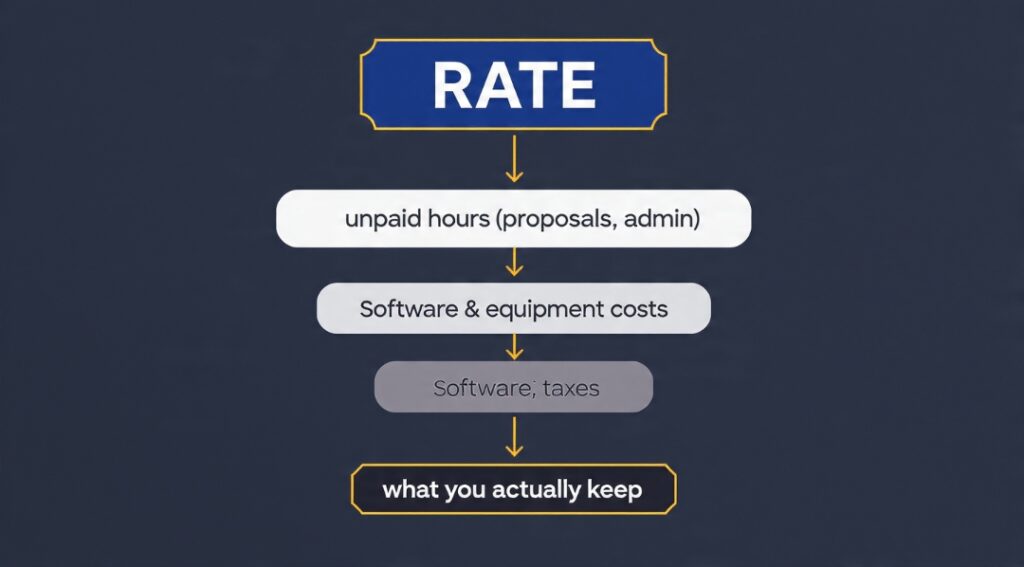
Start with what you need to earn. Think about your living costs and financial goals, and how many hours you can realistically work on paid client projects. Crucially, not every working hour is a paid hour. Freelancers spend significant time on unpaid work, finding clients, writing proposals, admin, revisions, learning. So if you want to earn a certain amount, your rate on actual paid hours has to account for all those unpaid hours too.
Then factor in your costs, your overhead. Software subscriptions, equipment, platform fees that take a cut of your earnings, internet, taxes you will owe, and so on. These all come out of what you charge, so your rate must be high enough to cover them and still leave you with the income you actually need. A rate that looks fine on the surface can leave you with very little once fees, costs, and unpaid hours are subtracted.
This calculation gives you your floor, the minimum your rate must be to make freelancing financially worthwhile. It is not your final rate, but it is the line you must stay above. Many beginners skip this step entirely and set rates that, after costs and unpaid time, barely pay anything. Doing this simple math puts you ahead of them and protects you from the painful discovery that you have been working hard for almost nothing. This is part of respecting your own work financially, a mindset we explore in our guide on the psychology of money and respecting your capital.
Step 3: Factor In the Value You Deliver
Costs and market research give you a sensible range, but the highest-earning freelancers add one more crucial element: the value they deliver to the client. This is where pricing becomes less about your time and more about your impact.
The idea behind value-based thinking is simple: the more valuable your work is to the client’s goals, the more you can justifiably charge. A piece of work that helps a client make or save significant money is worth more than the same hours spent on something trivial. Two tasks that take the same time can be worth very different amounts, depending on what they actually achieve for the client.
As a beginner, you will not lead with pure value-based pricing yet, that comes with experience and proof. But you can start factoring value into how you think. Ask yourself: what does this work actually do for the client? If you are helping a business attract customers, save time, look professional, or grow, your work has real value beyond the hours it takes. Understanding this stops you from pricing purely on time and helps you see why certain skills and certain clients can pay much more.
This value mindset also guides which work to pursue. Work that delivers clear, measurable value to clients tends to pay better and attract better clients than low-value, commodity work. Over time, moving toward higher-value work is one of the main ways freelancers increase their income, by delivering more valuable outcomes, not just working more hours. This connects directly to how businessmen think about money, judging things by what they produce, not just what they cost.
— Data Pips Team
Step 4: Choose How You’ll Charge
Once you know your range, your floor, and your value, you need to decide the structure of how you charge. There are three main models, and each suits different situations.
Hourly Rate
You charge for each hour worked. This is simple, transparent, and protects you when a project’s scope is unclear or likely to change, since you are paid for all the time you put in. The downside is that it ties your income directly to your hours and can penalize you for being fast and efficient, you earn less precisely because you got better and quicker. Hourly works well early on and for open-ended or unpredictable work.
Per-Project (Fixed) Rate
You charge one set price for the whole project, regardless of hours. Clients often prefer this because they know the total cost upfront. It also rewards your efficiency, if you finish faster, you effectively earn more per hour. The risk is “scope creep,” where the project grows beyond what was agreed, so clear boundaries on what is included are essential. Per-project pricing works well for defined, predictable work.
Value-Based Pricing
You price based on the value the work delivers to the client, rather than time. This can be the most lucrative model, but it requires experience, confidence, and the ability to demonstrate your impact, so it is usually something you grow into rather than start with. As a beginner, it is enough to understand it exists and to begin factoring value into your thinking.
For most beginners, starting with hourly or simple per-project pricing makes sense. As you gain experience and proof of your results, you can move toward project and value-based pricing, which typically pay better. The right model is not fixed forever, it evolves as you do. When you have that proof, it is worth reading the full comparison — our guide on hourly vs value-based pricing for freelancers walks through the maths, when each model wins, and how to make the switch safely.
Step 5: Set Your Starting Rate and Say It With Confidence
Now you bring it together. You have your market range, your cost floor, a sense of your value, and a charging model. Your starting rate sits at the intersection: above your cost floor, within the realistic market range for your level (aim for the lower-middle, not the bottom), and adjusted for the value of the specific work.
Here is the part that matters as much as the number itself: state your rate with calm confidence. How you communicate your price affects how it is received. If you apologize for your rate, hedge, or immediately offer to lower it, you signal that you do not believe in it, and the client will not either. State your rate plainly, as a simple fact, the way a professional states the price of their service. You do not need to justify or apologize for a fair rate.
Confidence does not mean arrogance. It means stating your price clearly and then letting the client decide, without nervously talking yourself down. Many beginners lose money not because their rate was too high, but because they presented it so weakly that they invited the client to negotiate them downward. The same number, stated confidently versus apologetically, lands completely differently.
Remember too that not every client will be the right fit, and that is fine. If a client cannot afford a fair rate, they are often not a client worth chasing. You are looking for clients who value your work enough to pay a reasonable price, not trying to win everyone by being cheapest. Setting a fair rate and stating it confidently naturally filters toward better clients and away from the draining, low-paying ones.
Two Beginners, Same Skill, Different Outcomes
Picture two people starting out with the same skill level in the same field. Watch how their pricing choices send them down completely different paths.
Freelancer A is terrified of charging too much, so they set the lowest rate they can, far below the market floor. They win clients quickly, but they are the cheapest-seeking, most demanding clients. A works enormous hours for tiny pay, has no energy left to improve, and is locked into rock-bottom prices by their reviews and reputation. A year later, exhausted and barely earning, A is stuck.
Freelancer B does the research, calculates their real costs, factors in value, and sets a sensible lower-middle rate, then states it with calm confidence. B wins clients a little more slowly at first, but they are better clients who respect B’s time and pay fairly. B earns enough to breathe, has energy to keep improving, and raises rates steadily as their portfolio grows. A year later, B is earning well and moving upward.
The lesson: Same skill, same starting point. The difference was entirely in how they set and presented their rates. A let fear decide and got trapped at the bottom; B used a process and built something that grows. Your starting rate is not just a number, it sets the trajectory of your entire freelancing journey.
What Nobody Tells Beginners About Freelance Rates
1. Your Rate Is Not Permanent
Beginners agonize over their first rate as if it is locked in forever. It is not. Your rate is a starting point you raise deliberately as your skills, portfolio, results, and confidence grow. Successful freelancers increase their rates regularly over time. So set a sensible starting rate without overthinking it, knowing you will raise it as you improve. The first number matters far less than your willingness to keep raising it.
2. Raising Rates Is a Skill You Must Practice
Many freelancers get stuck because they never raise their rates, out of fear of losing clients. But raising rates as you grow is essential to building real income. You can raise rates with new clients first, where it feels less risky, and gradually with existing ones as your value to them grows. Losing a few price-sensitive clients when you raise rates is often a good thing, it makes room for better-paying ones. Treat rate-raising as a normal, necessary part of the business.
3. Charging More Can Make You More Attractive
Counterintuitively, a higher rate can sometimes win more good clients, not fewer. Quality clients often associate fair or higher pricing with better work and reliability, while being suspicious of suspiciously cheap freelancers. So pricing yourself too low can actually repel the clients you most want. A confident, fair rate positions you as a professional worth hiring, not a risky bargain.
4. The First Few Clients Are About More Than Money
When starting out, your very first clients also give you something valuable beyond payment: portfolio pieces, reviews, testimonials, and experience. It can sometimes make sense to take a strategic early project at a slightly lower rate specifically to build these, as long as it is a deliberate choice, not a permanent habit. The key is to treat it as an intentional investment in your portfolio, then raise your rates once you have the proof you need.
5. Your Rate Reflects Your Whole Business, Not Just Your Time
A professional rate is not just payment for hours, it accounts for your skill, your reliability, the value you deliver, your costs, and the unpaid work behind every project. When you understand that your rate represents your entire professional operation, not just minutes worked, you stop underpricing and start charging like the business owner you actually are. This shift in self-perception is one of the most important steps in growing as a freelancer.
Beginners almost always undercharge — and raising your prices can increase sales, not just protect your margins.
Quick Action Steps
Now It’s Your Move
- Reject fear-based pricing. Do not set a rock-bottom rate out of fear. It attracts bad clients, signals low value, and traps you at the bottom.
- Research your market. Find the realistic rate range for your specific niche and skill level, paying attention to those a step or two ahead of you.
- Calculate your floor. Work out your real costs, fees, taxes, and unpaid hours to find the minimum rate that makes freelancing financially worthwhile.
- Factor in value. Consider what your work actually achieves for the client, not just the time it takes. Higher-value work justifies higher rates.
- Pick a charging model. Start with hourly or simple per-project pricing; grow toward project and value-based pricing as you gain experience.
- Set a lower-middle starting rate. Place it above your floor, within market range, not at the rock bottom. Then state it with calm confidence, no apologizing.
- Plan to raise it. Treat your first rate as a starting point, and raise it deliberately as your skills, portfolio, and confidence grow.
Frequently Asked Questions
Set your rate by following a clear process rather than guessing. First, research the realistic rate range for your specific niche and skill level. Second, calculate your real costs, including fees, taxes, equipment, and unpaid hours like proposals and admin, to find your minimum viable rate. Third, factor in the value your work delivers to the client, not just the time it takes. Fourth, choose a charging model (hourly or per-project works well for beginners). Finally, set a starting rate in the lower-middle of your market range, above your cost floor, and state it with calm confidence. Avoid the common mistake of charging rock-bottom rates out of fear, which attracts bad clients and traps you in low-paying work.
No, charging rock-bottom rates is one of the biggest mistakes beginners make. While it feels safe, very low rates attract the worst clients, the most demanding, least respectful, and quickest to complain, because clients hunting for the cheapest freelancer are usually the most difficult. Low rates also signal low value, making you less attractive to good clients who associate fair pricing with quality. And once you are known for rock-bottom rates, it is hard to climb out, since your reviews and early clients anchor you there. Instead, set a sensible beginner-appropriate rate in the lower-middle of your market range. It is fine to occasionally take a strategic early project at a lower rate to build your portfolio, but do not make rock-bottom pricing your permanent default.
Both work, and the right choice depends on the situation. Hourly pricing is simple and transparent, and it protects you when a project’s scope is unclear or likely to change, since you are paid for all your time. Its downside is that it ties income to hours and can penalize efficiency. Per-project (fixed) pricing gives clients a known total cost upfront, which they often prefer, and it rewards your efficiency since finishing faster means earning more per hour; the risk is scope creep, so clear boundaries on what is included are essential. For beginners, starting with hourly or simple per-project pricing makes sense. As you gain experience and proof of results, you can move toward project and value-based pricing, which typically pay better.
Value-based pricing means setting your price based on the value your work delivers to the client, rather than on the time it takes. The idea is that the more your work helps the client’s goals, like making or saving them money, attracting customers, or growing their business, the more you can justifiably charge. Two tasks that take the same hours can be worth very different amounts depending on what they achieve. Value-based pricing can be the most lucrative model, but it requires experience, confidence, and the ability to demonstrate your impact, so it is usually something freelancers grow into rather than start with. As a beginner, it is enough to understand it exists and to begin factoring value into how you think about pricing, which helps you see why certain skills and clients pay much more.
Calculate your minimum (floor) rate by accounting for everything that comes out of what you charge. Start with the income you actually need based on your living costs and goals. Then recognize that not every working hour is a paid hour, freelancers spend significant unpaid time finding clients, writing proposals, doing admin, and revisions, so your paid-hour rate must cover those unpaid hours too. Next, subtract your costs and overhead: software, equipment, platform fees that take a cut, internet, and taxes you will owe. What remains must still leave you with the income you need. This gives you the minimum rate below which freelancing is not financially worthwhile. Many beginners skip this and discover too late they have been earning almost nothing after costs, so doing this simple math protects you.
You should raise your rates deliberately as your skills, portfolio, results, and confidence grow, and successful freelancers do this regularly. Your first rate is a starting point, not a permanent number. The easiest way is to raise rates with new clients first, where it feels less risky, since they have no prior price expectation. With existing clients, you can raise rates gradually as your value to them grows. Do not fear losing some price-sensitive clients when you raise rates, this is often a good thing, as it makes room for better-paying ones. Many freelancers stay stuck precisely because they never raise their rates out of fear. Treat rate-raising as a normal, necessary part of running your freelance business and growing your income over time.
Not the clients you actually want. Counterintuitively, a higher, fair rate can win more good clients, not fewer, because quality clients often associate fair or higher pricing with better work and reliability, while being suspicious of suspiciously cheap freelancers. Pricing yourself too low can actually repel the clients you most want. It is true that a fair rate may filter out the cheapest-seeking clients, but those are usually the most demanding and least profitable anyway, so losing them is rarely a real loss. The key is to state your rate with calm confidence, without apologizing or immediately offering to lower it, since how you present your price strongly affects how it is received. A confident, fair rate positions you as a professional worth hiring rather than a risky bargain.
Now It’s Your Move
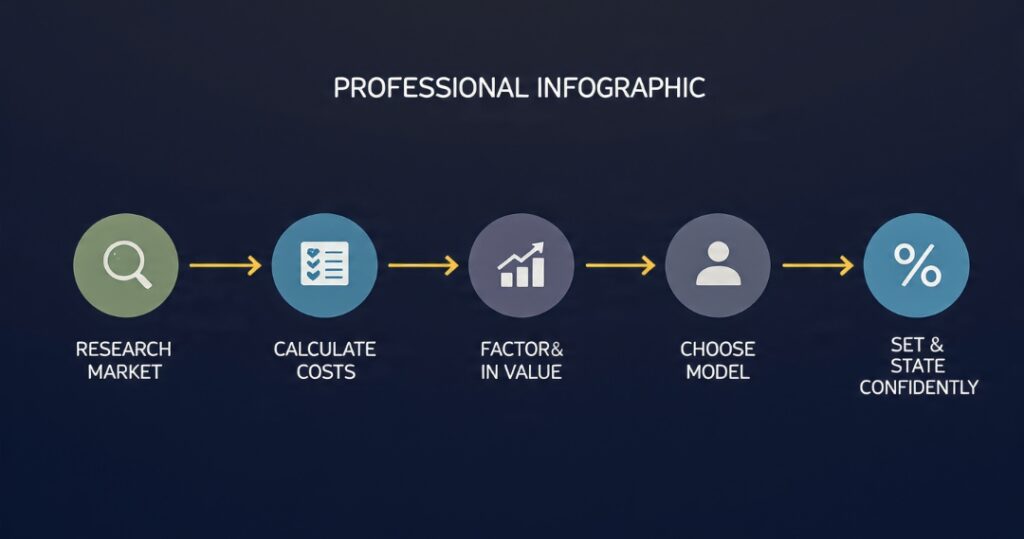
That blank price field that paralyzed you at the start? You now have everything you need to fill it in with confidence. Setting your freelancing rate was never meant to be a nervous guess, it is a process: research your market, calculate your real costs, factor in the value you deliver, choose how you will charge, and set a sensible starting rate that you state without apology. Follow that process, and the terror of the price field disappears.
Remember the biggest lesson of all: do not let fear set your rate. Rock-bottom pricing feels safe but quietly traps you, attracting the worst clients, signaling low value, and locking you at the bottom of the market. A fair, sensible rate, stated with calm confidence, does the opposite, it attracts clients who respect your work and pay you properly, and it gives you the room to grow. The number itself matters less than the thinking and confidence behind it.
And never forget that your rate is not permanent. The first number you set is just a starting point. As your skills sharpen, your portfolio fills, and your confidence builds, you raise your rates deliberately and steadily. The freelancers who thrive are not the ones who picked the perfect first rate, they are the ones who set a sensible rate, did good work, and kept raising their prices as they grew. Your trajectory matters far more than your starting point.
So do the research, run your numbers, think about your value, and set a rate you can state plainly and proudly. Then go win the clients who value what you do, the ones worth building a real freelancing business around. You are not just picking a number, you are setting the direction of your entire freelancing journey.
For your next steps, explore how specializing affects your earning power in our guide on becoming a freelance video editor, learn to turn freelancing into lasting wealth with compounding skill into a wealth machine, and see how to build stability through multiple income streams.