Key Takeaways
- Traditional AI models were built narrowly — one model trained from scratch for one specific task. Foundation models are built broadly — one general model adapted to many tasks.
- The core shift: from “one model, one job” to “one model, many jobs.” This changed how AI gets built, who can build it, and how fast it develops.
- Traditional models are specialized and efficient for their narrow task but cannot generalize. Foundation models are flexible and reusable but large and resource-intensive.
- Foundation models did not make traditional models obsolete — narrow, specialized models are still widely used where they fit best.
- Understanding this shift explains why AI suddenly seemed to explode in capability and accessibility in recent years.
For decades, building an AI meant building a specialist — a narrow system trained to do one specific job and nothing else. Then, fairly recently, something changed that turned this whole approach on its head, and the result was the explosion of AI capability you have witnessed. That change was the rise of foundation models, and understanding how they differ from the traditional AI models that came before reveals exactly why AI suddenly seemed to leap forward.
This is more than a technical comparison — it is the story of a fundamental shift in how artificial intelligence gets built. The Data Pips Team will walk you through what traditional AI models were, what foundation models changed, how the two genuinely differ, and why this shift matters so much. Plain language, no technical background assumed.
By the end, you will understand both approaches, see clearly what changed and why it was such a big deal, and appreciate why traditional models still have their place even in the age of foundation models. Let us look at the before and after of this transformation.
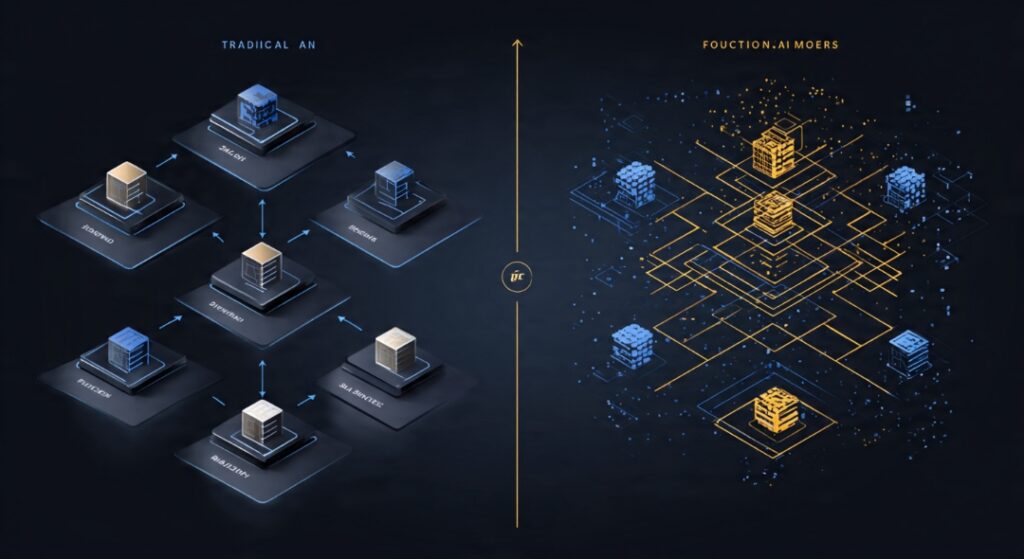
The Old World: Traditional AI Models
To understand the shift, you first need to understand how AI was built before foundation models. For most of AI’s history, the approach was fundamentally narrow and specialized.
A traditional AI model was built for one specific task, trained from scratch on data for just that task. If you wanted an AI to detect spam, you gathered spam data and trained a model specifically for spam detection. If you wanted an AI to translate languages, you gathered translation data and trained a completely separate model just for translation. If you wanted image recognition, that was yet another separate model, built from zero for that single purpose.
Each model was a dedicated specialist. It did its one job, often quite well, but it could do nothing else. The spam detector could not translate. The translator could not recognize images. Each was trained narrowly, knew only its specific domain, and had no ability to generalize beyond the task it was built for. This is the defining characteristic of traditional AI: one model, one job.
This approach worked, and it powered many useful applications over the years through machine learning techniques. But it had significant downsides. Every new task meant starting over — gathering new data, training a new model from scratch, requiring fresh expertise and resources for each application. It was slow, expensive, and repetitive. Building AI was like having to forge a brand-new specialized tool, from raw metal, for every single job. That repetition and cost was the bottleneck that foundation models would eventually break.
— Data Pips Team
The New World: Foundation Models
Foundation models flipped the entire approach. Instead of building a narrow specialist for each task, the idea became: build one powerful, general-purpose model trained on broad data, then adapt that same model to many different tasks.
A foundation model is trained on enormous, broad data to develop wide, flexible capabilities — not for one narrow job, but as a general base. Then, rather than building from scratch, developers take that existing foundation and adapt it to whatever specific task they need. The same foundation model can be adapted for translation, for question-answering, for writing assistance, for many purposes. This is the defining characteristic of the new approach: one model, many jobs.
According to Wikipedia, foundation models are trained on broad data and can be adapted to a wide range of downstream tasks — a sharp contrast to the narrow, single-task models that preceded them. The key enabling idea is sometimes called transfer learning: the broad capabilities the model learned can be “transferred” and applied to many specific tasks, rather than each task requiring its own from-scratch training.
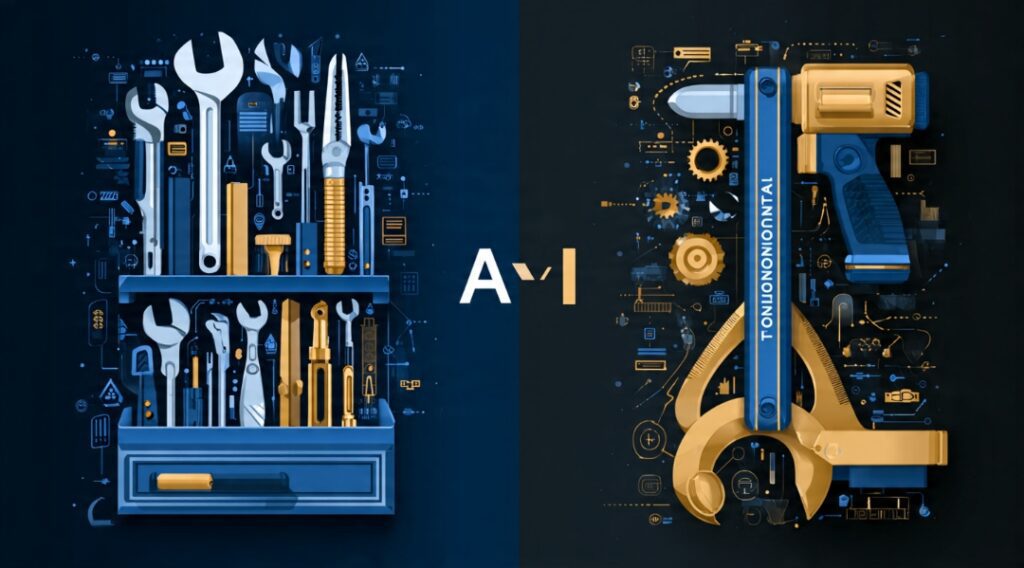
Returning to the tool metaphor: if traditional AI was forging a new specialized tool from raw metal for every job, foundation models are like having one extraordinarily versatile master tool that can be quickly adjusted for many different jobs. You build the versatile base once, at great effort, then adapt it endlessly. This is the shift that transformed AI — and our guide on how foundation models are trained details the demanding process of building that versatile base.
The Core Differences, Side by Side
Let us lay out the genuine differences clearly, across the dimensions that matter most. This comparison captures the essence of the shift.
| Aspect | Traditional AI Models | Foundation Models |
|---|---|---|
| Scope | Narrow — one specific task | Broad — many tasks |
| Building approach | Trained from scratch per task | Built once, adapted many times |
| Flexibility | Rigid — can’t generalize | Flexible — adapts to new tasks |
| Size | Often smaller, focused | Very large, general |
| Data needed per task | Lots, specific to each task | Little, adapts from broad base |
| Cost to start new task | High — build from zero | Lower — adapt existing base |
| Who can build | Many (smaller models) | Few build them; many adapt them |
The pattern is clear. Traditional models are narrow, rigid, and built fresh per task, but focused and often efficient for their specific job. Foundation models are broad, flexible, and reusable, but large and resource-intensive to build. The shift traded narrow efficiency for broad flexibility — and that trade unlocked enormous capability and accessibility.
What Actually Changed Because of This Shift
The move from traditional to foundation models was not just a technical curiosity — it had massive real-world consequences. Here is what genuinely changed.
AI Development Got Much Faster
When every task required building a model from scratch, AI development was slow. With foundation models, new applications can be created quickly by adapting an existing foundation rather than starting over. This dramatically accelerated how fast new AI tools could appear, which is a big part of why AI seemed to suddenly explode with new capabilities and products in a short time.
Building AI Became More Accessible
Traditional AI often required significant data and expertise to build each specialized model. Foundation models lowered this barrier enormously: you no longer need to train a model from scratch, you can build on an existing powerful foundation, often with relatively little task-specific data. This opened AI development to far more people and organizations who could not have trained powerful models themselves. According to IBM, this reusability is a key reason foundation models became so transformative.
Capabilities Became More General
Traditional models were locked into their single task. Foundation models, trained broadly, can handle a wide and sometimes surprising range of tasks, including some they were not explicitly built for. This generality is qualitatively different from the narrow competence of traditional models, and it is part of what makes foundation models feel so much more capable and flexible.
The Industry Structure Changed
Building foundation models requires enormous resources, so the most powerful ones are built by a few well-resourced organizations, while a vast ecosystem builds applications on top of them. This created a new structure: foundation-builders at the base, application-builders on top. Traditional AI, with its smaller per-task models, was more distributed in who could build what. The foundation model era concentrated the hardest work while democratizing the building of applications.
The Same Goal, Two Eras
Imagine a company that wants to build several AI features: a translation tool, a customer support assistant, and a content summarizer. Watch how the two eras handle this differently.
In the traditional AI era: The company would need to build three separate models, each from scratch. For translation, they gather translation data and train a translation model. For support, they gather support data and train a separate support model. For summarization, yet another model trained from zero on summarization data. Three projects, three datasets, three from-scratch training efforts, each requiring significant time, data, and expertise. Expensive and slow.
In the foundation model era: The company takes one powerful foundation model and adapts it three ways — prompting or lightly fine-tuning it for translation, for support, and for summarization. One foundation, three adaptations. Far faster, requiring far less task-specific data, and accessible even to a smaller team. The hard part (building the foundation) was already done by someone else.
The point: The same business goal that once required three separate from-scratch AI projects can now be accomplished by adapting a single foundation model multiple ways. This is the practical, concrete difference the shift made — and it is exactly why AI applications proliferated so rapidly once foundation models arrived.
Important: Traditional Models Aren’t Obsolete
Here is a crucial point that beginners often miss: foundation models did not make traditional, narrow AI models obsolete. Specialized single-task models are still widely used, and for good reasons. Understanding this prevents an oversimplified “newer is always better” view.
Traditional narrow models have real advantages in many situations. They are often smaller, faster, cheaper to run, and more efficient for their specific task than a giant foundation model would be. If you only need to do one well-defined task, a focused model built for exactly that can be the better, more practical choice — using a massive foundation model for a simple narrow task can be overkill, wasting resources.
Narrow models can also be easier to understand, control, and predict, since they do one thing. For certain applications, especially where efficiency, reliability, and simplicity matter, a specialized model is genuinely preferable. The arrival of foundation models added a powerful new approach to the toolkit; it did not delete the old one.
So the real picture is not “foundation models replaced traditional models.” It is “foundation models added a new, powerful, flexible option alongside traditional models.” The best choice depends on the task: broad, flexible, or complex needs often favor foundation models, while narrow, well-defined, efficiency-critical tasks may still favor traditional specialized models. This nuanced reality is part of the broader landscape covered in our guide on AI vs machine learning vs deep learning.
— Data Pips Team
What Nobody Tells Beginners About This Shift
1. The Shift Explains Why AI “Suddenly” Got So Good
Many people wonder why AI seemed to leap forward so dramatically in a short time, after decades of slower progress. The foundation model shift is a big part of the answer. By enabling one powerful model to be adapted to countless tasks, it unlocked a wave of capability and applications that the slow, narrow, build-from-scratch approach never could. The “sudden” explosion was largely the foundation model approach reaching maturity.
2. Bigger and More General Isn’t Free
Foundation models’ flexibility comes at a cost: they are large, expensive to build and run, and resource-intensive. A traditional narrow model can be far more efficient for its specific task. So the shift to foundation models traded efficiency for flexibility — a worthwhile trade in many cases, but not free. This is why, for some narrow tasks, the older specialized approach remains more practical and economical.
3. “Traditional AI” Is Still Genuinely AI
Sometimes the excitement around foundation models makes it sound like older approaches were not “real” AI. That is not true. Traditional machine learning models that do narrow tasks are fully legitimate AI, and they power an enormous amount of useful technology you rely on every day. Foundation models are a newer, more flexible approach, but they did not retroactively make traditional AI any less valid or valuable.
4. The Two Approaches Often Work Together
In real systems, foundation models and traditional models are frequently combined. A complete application might use a foundation model for flexible, general tasks and traditional specialized models for narrow, efficiency-critical ones. It is not always an either/or choice; the most effective systems often blend approaches, using each where it fits best. Thinking in terms of the right tool for each part of the job is more sophisticated than picking one approach for everything.
5. Understanding This Makes the Whole AI Landscape Clearer
Grasping the shift from traditional to foundation models is a key that unlocks much of the modern AI landscape — why tools appear so fast, why a few organizations hold such influence, why AI seems so much more capable than before, and how applications get built. This structural understanding makes you a far more informed observer of a technology reshaping the world, and that kind of clear comprehension is exactly the sort of foundational literacy that compounds into real opportunity as AI spreads.
Quick Recap: The Two Approaches
The Shift in a Nutshell
- Traditional AI: One model, one job. Built narrowly from scratch for each specific task. Specialized, often efficient, but rigid and unable to generalize.
- Foundation models: One model, many jobs. Built broadly once, then adapted to many tasks. Flexible and reusable, but large and resource-intensive.
- The core shift: From building a new specialist for every task, to building one versatile base and adapting it endlessly.
- What changed: AI development got faster, building became more accessible, capabilities got more general, and the industry structure shifted toward few foundation-builders and many application-builders.
- The nuance: Traditional models aren’t obsolete — narrow specialists are still better for many efficiency-critical, well-defined tasks. The best approach depends on the job.
Frequently Asked Questions
The core difference is “one model, one job” versus “one model, many jobs.” Traditional AI models were built narrowly — each one trained from scratch for a single specific task, like spam detection or translation, and unable to do anything else. Foundation models are built broadly — one powerful, general-purpose model is trained on vast data, then adapted to many different tasks rather than building each from scratch. Traditional models are specialized, often efficient, but rigid and unable to generalize. Foundation models are flexible and reusable, but large and resource-intensive. The shift from narrow specialists to adaptable general models transformed how AI gets built, who can build it, and how fast it develops.
Traditional AI models were built for one specific task, trained from scratch on data for just that task. If you wanted spam detection, you gathered spam data and trained a model specifically for that. If you wanted translation, you gathered translation data and trained a completely separate model just for translation. Each model was a dedicated specialist that did its one job, often well, but could do nothing else and could not generalize beyond its narrow domain. This “one model, one job” approach worked and powered many useful applications, but every new task meant starting over — gathering new data and training a new model from scratch, which was slow, expensive, and repetitive. That bottleneck is what foundation models eventually broke.
Foundation models are not universally “better” — they are more flexible and reusable, which is a major advantage for many uses, but they are not better for everything. Their strengths: one foundation can be adapted to many tasks instead of building each from scratch, which makes AI development faster, lowers the barrier to building applications, and produces more general capabilities. However, foundation models are large, expensive, and resource-intensive, while traditional narrow models are often smaller, faster, cheaper, and more efficient for their specific task. For a single well-defined task, a focused traditional model can be the better, more practical choice. So foundation models added a powerful flexible option, but the best approach genuinely depends on the task at hand.
Yes, absolutely — foundation models did not make traditional narrow AI models obsolete. Specialized single-task models are still widely used for good reasons. They are often smaller, faster, cheaper to run, and more efficient for their specific task than a giant foundation model would be. Using a massive foundation model for a simple narrow task can be overkill, wasting resources. Narrow models can also be easier to understand, control, and predict since they do one thing. For applications where efficiency, reliability, and simplicity matter, a specialized traditional model is often genuinely preferable. The arrival of foundation models added a powerful new approach to the toolkit rather than deleting the old one, and in practice the two approaches are frequently combined.
The shift from traditional to foundation models is a big part of why AI seemed to leap forward so dramatically after decades of slower progress. In the traditional approach, every task required building a model from scratch, which made AI development slow and limited. Foundation models changed this by enabling one powerful model to be adapted to countless tasks, unlocking a wave of capability and applications that the narrow, build-from-scratch approach never could. New AI tools could suddenly appear quickly by adapting existing foundations rather than starting over, and the models themselves became far more general and capable. So the “sudden” explosion of AI was largely the foundation model approach reaching maturity, combined with advances in computing power and data availability.
No — a foundation model represents a different, newer approach rather than a type of traditional AI model. Both are forms of AI built using machine learning, but they differ fundamentally in scope and design. Traditional AI models are narrow, built from scratch for a single task. Foundation models are broad, built once on vast data and adapted to many tasks. So they are better understood as two different approaches to building AI, with foundation models being the newer, more flexible one. That said, both fall under the broader umbrella of artificial intelligence and machine learning — they are different strategies within the same overall field, not one being a subtype of the other.
Yes, and in real systems they frequently do. It is not always an either/or choice. A complete application might use a foundation model for flexible, general tasks where its adaptability shines, and traditional specialized models for narrow, efficiency-critical tasks where a focused model is faster and cheaper. The most effective systems often blend approaches, using each where it fits best — the right tool for each part of the job. This combined approach is more sophisticated than picking one method for everything. So rather than thinking of foundation models and traditional models as rivals where one must win, it is more accurate to see them as complementary tools that skilled builders combine to create the best overall system.
The Bottom Line
The story of foundation models versus traditional AI models is really the story of a transformation that changed everything. For decades, building AI meant building narrow specialists — one model trained from scratch for one specific job, capable of nothing else. Then foundation models flipped the approach: build one powerful, general model once, then adapt it to many tasks. The shift from “one model, one job” to “one model, many jobs” is the essence of the whole difference.
This shift had enormous consequences. AI development got dramatically faster, since new applications could be created by adapting an existing foundation rather than starting from zero. Building AI became far more accessible, opening it to many who could never have trained powerful models themselves. Capabilities became more general and flexible. And the industry restructured around a few foundation-builders supporting a vast ecosystem of application-builders. This transformation is a big part of why AI seemed to suddenly explode in capability after decades of slower progress.
But the clearest-eyed understanding holds an important nuance: foundation models did not make traditional models obsolete. Narrow specialized models remain widely used and genuinely preferable for many efficiency-critical, well-defined tasks, and the two approaches often work together in real systems. Newer is not automatically better — the best choice depends on the job. Foundation models added a powerful new option to the toolkit rather than replacing what came before.
You now understand one of the most important shifts in the history of AI — the move that turned narrow specialists into adaptable generalists and unlocked the AI age you are living through. That understanding makes the entire modern AI landscape clearer, from why tools appear so fast to why a few organizations hold such influence.
For your next steps, deepen your foundation-model knowledge with our guides on what a foundation model is, foundation models vs LLMs, and how foundation models are trained — together they complete your picture of these transformative systems.