Key Takeaways
- A multimodal foundation model is an AI that can understand and work with multiple types of data — like text, images, and audio — together, instead of just one.
- “Modal” refers to a mode or type of data. “Multimodal” means handling several types at once, the way humans use multiple senses together.
- A regular language model handles only text. A multimodal model might read text, “see” images, and “hear” audio — and connect them.
- This lets it do things single-type models cannot, like describing a photo in words, answering questions about an image, or generating images from text.
- Multimodal models represent a major step toward more flexible, human-like AI that perceives the world through more than one channel.
Think about how you understand the world. You do not rely on just one sense — you see, hear, and read all at once, blending these streams of information together effortlessly. When someone points at a picture and asks a question, you combine what you see with what you hear to understand. For most of AI’s history, models could not do this. They were stuck with one type of data at a time. Multimodal foundation models changed that, and the result is AI that feels dramatically more capable and human-like.
If you have noticed AI tools that can look at a photo and describe it, answer questions about an image, or turn a text description into a picture, you have seen multimodal models at work. The term sounds technical, but the idea is intuitive once explained clearly. The Data Pips Team will walk you through what multimodal foundation models are, how they differ from single-type models, what they can do, and why they matter. No technical background needed.
By the end, you will understand this important and rapidly growing type of AI — one that brings machines a step closer to perceiving the world the way we do, through multiple channels at once. Let us get into it.
What Does “Multimodal” Actually Mean?
Let us start by decoding the word itself, because it explains the whole concept.
In AI, a “modality” or “mode” refers to a type of data — a particular kind of information. Text is one modality. Images are another. Audio is another. Video is another. Each represents a different “channel” of information, a different form that data can take.
“Multimodal” simply means handling multiple modalities — multiple types of data — at once. So a multimodal model is one that can work with several types of data together, rather than being limited to just one. According to Wikipedia, multimodal learning involves AI that processes and relates information from multiple types of data, or modalities.
Now combine this with what you know about foundation models. A foundation model is a large, general-purpose AI that serves as a reusable base. So:
A multimodal foundation model is a large, general-purpose AI base that can understand and work with multiple types of data — such as text, images, and audio — together.
The everyday comparison is human senses. You do not experience the world through only one channel; you combine sight, sound, and language seamlessly. A multimodal model moves toward this — taking in and connecting multiple types of information, rather than being confined to a single type. This is what makes it feel more flexible and capable than models locked into one modality.
— Data Pips Team
Single-Modal vs Multimodal: The Key Difference
To really understand multimodal models, contrast them with the single-type models that came before. This comparison makes the leap clear.
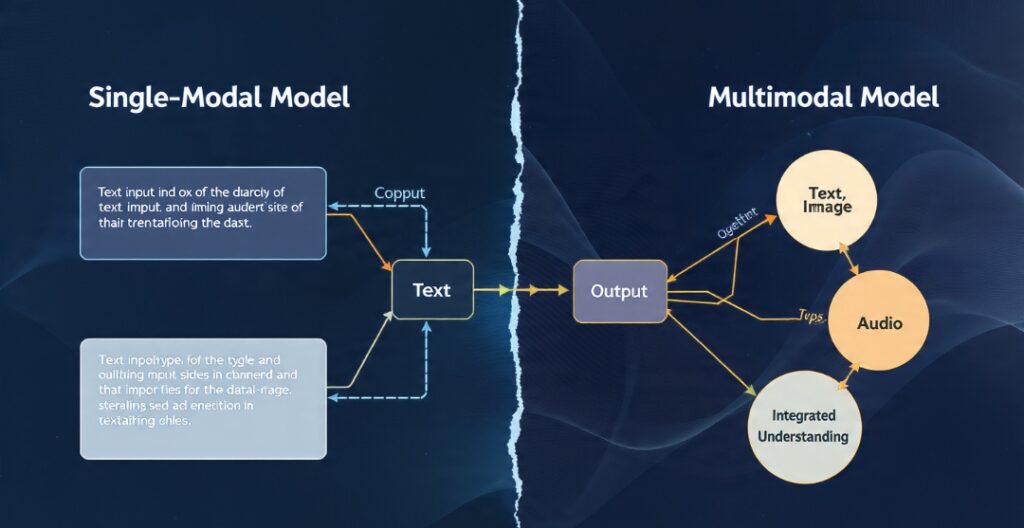
A single-modal model handles only one type of data. A standard large language model works only with text — it reads text and produces text, and that is its entire world. An image-only model works only with images. Each is confined to its single modality, unable to cross over into other types of data. It is like a person who could only read, or only see, but never combine the two.
A multimodal model handles several types of data and connects them. It might read text, “see” images, and “hear” audio — and crucially, understand the relationships between them. It can take an image and describe it in words (connecting visual and text modalities), or take a text description and generate a matching image, or answer spoken questions about a picture. The ability to bridge different data types is what sets multimodal models apart.
That bridging is the real magic. A single-modal model lives in one world; a multimodal model connects worlds. The capacity to relate an image to words, or sound to text, opens up entirely new abilities that no single-type model could achieve. As IBM notes, multimodal AI can process and integrate multiple data types to produce richer, more contextual understanding than single-modality systems. This is why multimodal models represent such a meaningful advance — they break AI out of the single-channel limitation.
What Can Multimodal Models Actually Do?
The abstract idea becomes exciting when you see the concrete abilities multimodal models unlock. Here are the kinds of things they can do that single-type models cannot.
Describe and Understand Images
A multimodal model can look at a photo and describe what is in it, answer questions about it, or explain what is happening. You could show it a picture and ask “what is unusual about this image?” and it can connect its visual understanding to a text answer. This ability, drawing on computer vision combined with language, is something pure text models simply cannot do.
Generate Images From Text
Many multimodal models can take a text description and create a matching image. You describe what you want in words, and the model generates a picture that fits — bridging from the text modality to the image modality. This powers many of the AI image-creation tools that have become popular, a form of generative AI spanning multiple modalities.
Answer Questions That Combine Types
Multimodal models can handle requests that mix data types — like analyzing a chart image and explaining it in words, reading a document that contains both text and pictures, or responding to a question that references something visual. They handle the kind of mixed-input tasks that mirror how real-world information often comes to us, blended across types.
Work Across Audio and Text
Some multimodal models connect audio and text — understanding spoken words, generating speech, or relating sound to language. This enables more natural voice-based interactions and applications that blend listening and language.
The unifying theme is that multimodal models handle tasks involving more than one type of data, and especially tasks that require connecting types — relating what is seen to what is said, or what is described to what is shown. This flexibility makes them suited to a far wider range of real-world situations than single-modal models, because the real world rarely comes neatly packaged in just one data type.
Example: Asking About a Photo
Let us make multimodal ability concrete with a simple scenario. Imagine you show an AI a photograph of a kitchen and ask, “What ingredients do you see that I could use to make breakfast?”
A single-modal text model cannot help at all — it only handles text and cannot “see” your photo. The image is invisible to it. You would have to describe everything in the photo yourself in words first, defeating the purpose.
A multimodal model handles this naturally. It “sees” the photo (processing the image modality), identifies the items in the kitchen, understands your text question (the text modality), connects the two, and responds in words: “I can see eggs, bread, butter, and tomatoes — you could make scrambled eggs with toast.” It bridged your visual input and your text question to give a useful answer.
This single example captures the essence of multimodal power. The model combined seeing and language to do something neither a text-only nor an image-only model could accomplish alone. It connected the modalities, just as you would if a friend pointed at the photo and asked you the same question.
The point: Multimodal models shine precisely where tasks blend data types — which is most real-world situations, since we rarely encounter information in just one neat format.
How Do Multimodal Models Work? (The Simple Idea)
You do not need technical depth to grasp the core idea of how multimodal models manage to handle different data types together. Here is the approachable version.
The fundamental challenge is that text, images, and audio are very different kinds of data on the surface. Text is words; images are visual patterns; audio is sound waves. To work with them together, a multimodal model needs a way to bring these different types into a common form it can connect.
The key idea is that the model learns to translate each type of data into a shared internal “language” of patterns — a common representation where text, images, and audio can all be understood and related to each other. Once different data types are converted into this shared internal form, the model can connect them: linking the visual patterns of a photo to the word patterns describing it, for instance. This shared representation is what allows the model to bridge modalities.
This learning happens during training, where the model is shown examples that connect different data types — like images paired with their text descriptions. By learning from many such paired examples, it figures out how the modalities relate, building the connections that let it bridge them. Our guide on how foundation models are trained covers the broader training process, and multimodal training extends it to include these cross-type connections.
The takeaway: multimodal models work by learning to represent different data types in a shared internal form and learning the connections between them, so they can understand and relate text, images, and audio together. You do not need the technical details to appreciate the elegant core idea — translate everything into a common representation, then connect.
— Data Pips Team
Multimodal Models and the Bigger Picture
Let us place multimodal foundation models within the AI landscape you have been learning about, so the connections are clear.
Multimodal models and LLMs: A standard LLM handles only text. A multimodal model goes beyond this, handling text plus other types. In fact, many modern AI systems blur the old line between “LLM” and “multimodal model,” because language models are increasingly being extended to handle images and other data too. Our guide on foundation models vs LLMs touches on how multimodal models complicate the neat “LLM equals language only” picture.
Multimodal models as foundation models: A multimodal foundation model is still a foundation model — a large, general-purpose, reusable base. It just happens to be one that handles multiple data types rather than one. So it has all the qualities of a foundation model (broad, adaptable, built once and used many times) plus the multimodal ability to span several data types.
The direction of progress: Multimodal capability represents a significant direction in AI’s development — toward models that perceive and work with the world through multiple channels, more like humans do. As AI advances, the trend is increasingly toward multimodal models, because handling multiple data types makes AI far more flexible and applicable to the messy, mixed-format real world. Understanding multimodal models therefore gives you insight into where AI is heading, not just where it is.
What Nobody Tells Beginners About Multimodal Models
1. They Make AI Feel More “Human-Like”
Part of why multimodal models feel like such a leap is that they bring AI closer to how humans naturally process information — through multiple senses at once. A model that can see and discuss an image feels qualitatively more capable and intuitive than one limited to text. This human-like multi-channel ability is a big reason multimodal AI feels so impressive, even though it is still pattern-processing rather than genuine human perception.
2. “Multimodal” Is a Spectrum of Abilities
Not all multimodal models handle the same combination of data types. Some handle text and images; others add audio; others handle video too. The specific modalities a model supports vary. So “multimodal” tells you a model handles more than one type, but not exactly which types — that depends on the specific model. Being aware of this helps you understand that multimodal capabilities differ from model to model rather than being a single uniform feature.
3. They Inherit the Same Limitations as Other Models
Multimodal models are still foundation models, which means they carry the same fundamental limitations — they can make mistakes, reflect biases, and lack true understanding. A multimodal model can misidentify what is in an image just as a text model can state false facts. The added ability to handle images or audio does not make them immune to the usual AI limitations; it just extends those limitations across more data types. Critical, verifying use remains as important as ever.
4. Connecting Modalities Is Genuinely Hard
Making a model understand the relationships between completely different data types — linking what a photo shows to what words mean — is a genuinely difficult technical achievement. The fact that multimodal models work as well as they do represents significant progress. This difficulty is also why multimodal capabilities have developed somewhat later than single-type abilities, and why they continue to be an active area of advancement.
5. They Expand What AI Can Be Used For
Because the real world is full of mixed data — documents with images, videos with sound, situations combining sight and speech — multimodal models dramatically expand the range of practical applications for AI. Tasks that were impossible for single-type models become achievable. This expanding range of uses is part of why understanding AI’s capabilities is increasingly valuable, the kind of practical literacy that compounds into real opportunity as these tools become more versatile and widespread.
Quick Recap: Multimodal Models at a Glance
The Essentials
- What it is: A foundation model that understands and works with multiple types of data — like text, images, and audio — together, rather than just one.
- The word: “Modal” means a type of data; “multimodal” means handling several types at once, like humans using multiple senses.
- The key difference: Single-modal models handle one data type; multimodal models handle several and connect them.
- What it can do: Describe images, generate images from text, answer questions combining data types, and work across audio and text.
- How it works: It translates different data types into a shared internal form and learns the connections between them.
- Why it matters: It makes AI more flexible and human-like, expands what AI can be used for, and represents a major direction in where AI is heading.
Frequently Asked Questions
A multimodal foundation model is a large, general-purpose AI base that can understand and work with multiple types of data — such as text, images, and audio — together, rather than being limited to just one type. The word “multimodal” comes from “modality,” which means a type or mode of data: text is one modality, images another, audio another. “Multimodal” means handling several of these at once. The everyday comparison is human senses — just as you combine sight, sound, and language to understand the world, a multimodal model takes in and connects multiple types of information. This makes it far more flexible than single-type models that are confined to working with only one kind of data.
A standard LLM (large language model) handles only text — it reads text and produces text, and that is its entire world. A multimodal model goes beyond this, handling text plus other data types like images and audio, and connecting them. So an LLM is single-modal (text only), while a multimodal model spans several modalities. That said, the line is increasingly blurry, because many modern language models are being extended to handle images and other data too, making them effectively multimodal. A multimodal model is still a foundation model with all the usual qualities (broad, reusable, general-purpose), but with the added ability to work across multiple data types rather than being limited to language alone.
Multimodal models can do things single-type models cannot, especially tasks that combine or connect data types. They can describe and understand images (look at a photo and explain what is in it, or answer questions about it), generate images from text descriptions, answer questions that combine types (like analyzing a chart image and explaining it in words, or reading a document with both text and pictures), and work across audio and text (understanding speech or relating sound to language). The unifying theme is handling tasks that involve more than one data type, particularly those requiring connections between types — relating what is seen to what is said. This makes them suited to real-world situations, where information rarely comes in just one neat format.
The core idea is approachable. Text, images, and audio are very different on the surface — words, visual patterns, and sound waves. To work with them together, a multimodal model learns to translate each data type into a shared internal “language” of patterns, a common representation where all the types can be understood and related. Once different data types are converted into this shared internal form, the model can connect them — linking the visual patterns of a photo to the words describing it, for example. This happens during training, where the model is shown examples connecting different data types, like images paired with text descriptions. By learning from many such paired examples, it figures out how the modalities relate. So the elegant core idea is: translate everything into a common representation, then learn the connections between them.
In AI, a “modality” (or “mode”) refers to a type of data — a particular kind of information or channel. Text is one modality, images are another, audio is another, and video is another. Each represents a different form that data can take and a different channel through which information flows. The term is borrowed from the idea of sensory modalities in humans (sight, hearing, etc.). So when AI is described as “single-modal,” it handles one type of data, and when it is “multimodal,” it handles multiple types at once. Understanding “modality” as simply “a type of data” makes terms like “multimodal” immediately clear — it just means working with several types of data together rather than only one.
Multimodal models are more flexible and capable in handling diverse, mixed-format tasks, which is a major advantage, but “better” depends on the need. For tasks involving multiple data types or connecting them — like describing images or answering questions about photos — multimodal models can do things single-type models simply cannot. However, for a task involving only one data type, a focused single-modal model might be perfectly sufficient and sometimes more efficient. Multimodal models also still carry the same fundamental AI limitations — they can make mistakes, reflect biases, and lack true understanding, just across more data types. So multimodal models expand what AI can do and suit the mixed-format real world well, but they are an expansion of capability rather than universally “better” for every single task.
Multimodal models are important because they represent a significant direction in AI’s development — toward systems that perceive and work with the world through multiple channels, more like humans do. The real world is full of mixed data: documents with images, videos with sound, situations combining sight and speech. Multimodal models can handle this mixed reality, dramatically expanding the range of practical applications beyond what single-type models allow. As AI advances, the trend is increasingly toward multimodal capability, because handling multiple data types makes AI far more flexible and applicable. So multimodal models give insight into where AI is heading — toward more general, flexible, human-like systems that are not confined to a single channel of information but can perceive and connect across many.
The Bottom Line
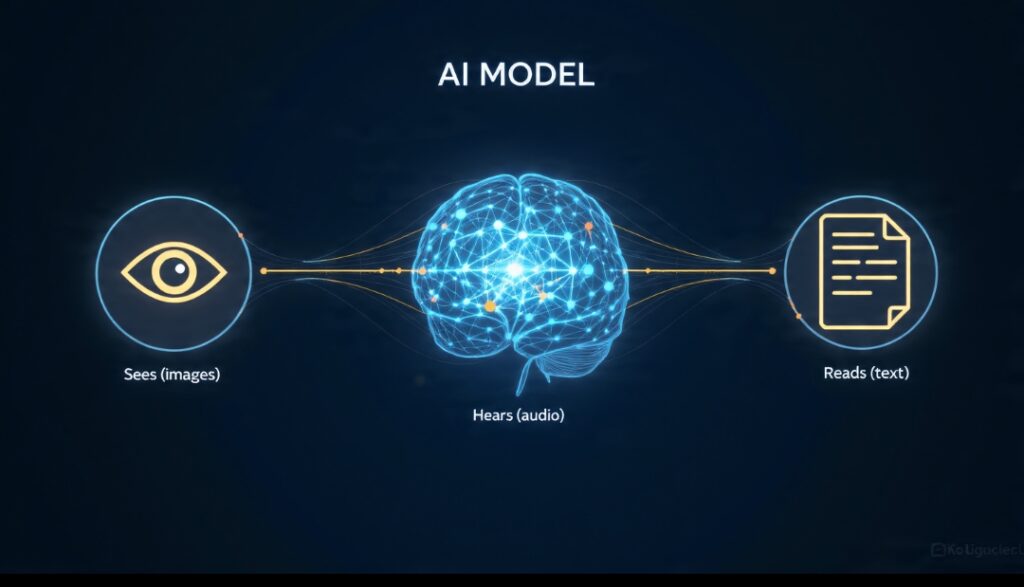
You understand the world by blending your senses — seeing, hearing, and reading all at once — and now you understand the AI that moves toward doing the same. A multimodal foundation model is a general-purpose AI base that can understand and work with multiple types of data, like text, images, and audio, together. Where a standard language model is confined to text alone, a multimodal model perceives through several channels and, crucially, connects them.
That connecting ability is the heart of it. By translating different data types into a shared internal form and learning how they relate, a multimodal model can bridge worlds — describing a photo in words, generating an image from a description, answering a question that combines what it sees and what it reads. These are things no single-type model can do, and they open AI to the mixed, messy, multi-format reality we actually live in, where information rarely arrives in just one neat package.
Multimodal models are still foundation models, carrying the same broad, reusable nature and the same fundamental limitations as other AI. But by extending AI across multiple data types, they represent a meaningful step toward more flexible, capable, human-like systems. The clear direction of AI’s progress is increasingly multimodal, which means understanding these models gives you a window into not just where AI is, but where it is going.
You now understand one of the most important and rapidly growing types of AI — the kind that brings machines a step closer to perceiving the world the way you do, through more than one channel at once. That understanding rounds out your grasp of the foundation model landscape and points toward AI’s future.
For your next steps, deepen your foundation-model knowledge with our guides on what a foundation model is, foundation models vs LLMs (where the multimodal distinction matters), and what generative AI is (which multimodal models often power).