Key Takeaways
- Foundation models power a huge and growing range of real-world tools — from the chatbots and writing assistants you use to specialized systems in healthcare, business, and beyond.
- Because one foundation model can be adapted to many tasks, the same underlying technology shows up across wildly different applications.
- Common uses include content creation, customer support, coding assistance, search and information tools, education, and analysis of text, images, and data.
- Foundation models are increasingly embedded invisibly inside products you already use, not just standalone AI apps.
- Understanding where and how these models are applied reveals just how deeply this technology is woven into modern life — and where it may go next.
You have learned what foundation models are, how they are built, and how they differ from other AI. Now comes the question that makes all of it matter: what are they actually used for? Because the truth is that foundation models are not some distant or experimental technology — they are already woven into tools you use, industries you interact with, and products you may not even realize contain AI. This is where the theory meets the real world.
The Data Pips Team is going to take you on a practical tour of how foundation models are actually applied — across everyday tools, major industries, and the products quietly being transformed behind the scenes. This is not abstract speculation about the future; it is a grounded look at where this technology is genuinely being used right now. Plain language, no technical background needed.
By the end, you will see just how broadly foundation models have spread into real life, understand the major categories of how they are applied, and appreciate why this single technology has had such a wide-reaching impact. Let us tour the real world of foundation models.
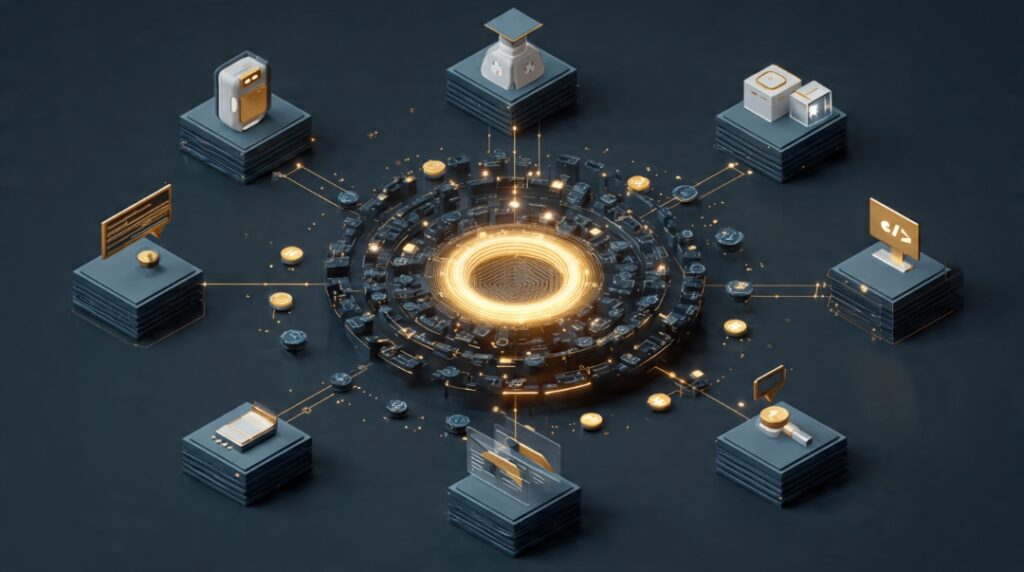
The Big Idea: One Technology, Countless Uses
Before touring specific applications, hold onto the core reason foundation models appear in so many places: because one foundation model can be adapted to many different tasks, the same underlying technology powers an enormous variety of applications. This is the defining quality we covered in our guide on what a foundation model is — built once, adapted endlessly.
This is why you find foundation models behind tools that seem completely unrelated. A writing assistant, a customer service bot, a coding helper, and a medical analysis tool might all be built on foundation models, each adapting the same kind of underlying technology to its specific purpose. According to IBM, this adaptability across diverse tasks is precisely what makes foundation models so widely applicable and transformative.
So as we tour the applications, keep this in mind: you are not seeing many different technologies, but rather one flexible technology showing up in many different outfits. That single insight explains the astonishing breadth of what follows. Let us start with the uses you most likely encounter every day.
— Data Pips Team
Everyday Uses You Already Encounter
Let us start close to home, with the foundation model applications most people interact with regularly, often without thinking about the technology underneath.
Chatbots and AI Assistants
The most visible use: conversational AI assistants that answer questions, hold discussions, and help with tasks. These are built on large language models, adapted to be helpful conversational assistants. When you ask an AI a question and get a thoughtful response, you are using a foundation model directly.
Writing and Content Assistance
Tools that help draft emails, documents, articles, and other writing, or that improve and edit existing text. Foundation models excel at language tasks, making them ideal for assisting with writing of all kinds — from professional communication to creative work.
Content Creation and Generative Tools
Tools that generate images from descriptions, create various media, or produce creative content. These are forms of generative AI built on foundation models, often multimodal ones that bridge text and images. They have made content creation accessible to people without specialized skills.
Search and Information Tools
Increasingly, search and information tools use foundation models to understand questions more naturally and provide more helpful, synthesized answers rather than just lists of links. This makes finding and understanding information faster and more conversational.
Translation and Language Tools
Foundation models power translation between languages and other language tools, handling the nuance and context of human language better than older approaches. This breaks down language barriers in communication and access to information.
These everyday uses are just the most visible tip. Notice that they cluster around language and content — which makes sense, since language-focused foundation models (LLMs) are the most mature and widely deployed. But the applications extend far beyond these familiar tools, into specialized professional and industry uses.
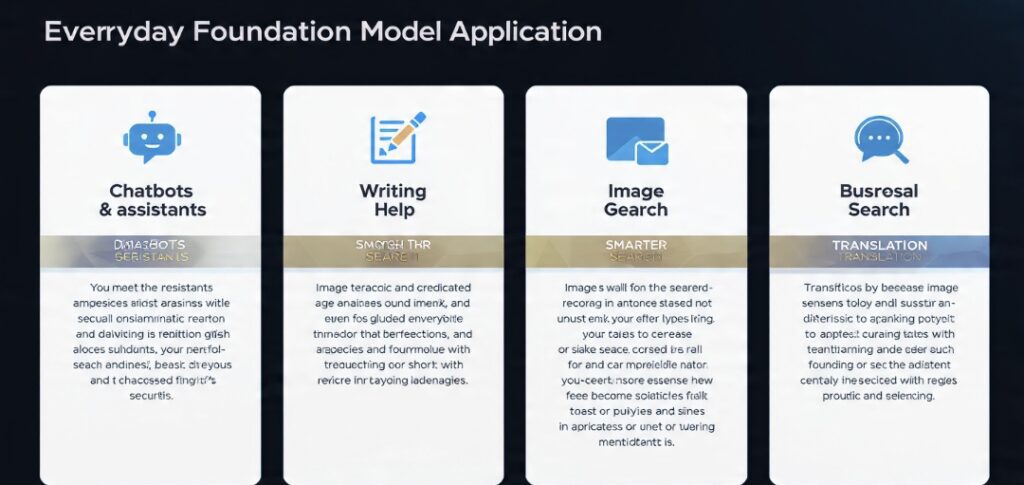
How Industries Use Foundation Models
Beyond everyday consumer tools, foundation models are being applied across major industries, often in specialized ways adapted to each field’s needs. Here is a tour across several sectors. (Note: these describe general categories of how the technology is being applied, not specific products.)
Business and Customer Service
Businesses use foundation models for customer support (handling inquiries, answering common questions), drafting and analyzing documents, summarizing information, assisting employees with tasks, and automating routine text-based work. By adapting a foundation model to their specific needs and knowledge, companies can deploy capable AI assistance without building AI from scratch. This is one of the broadest areas of real-world adoption.
Healthcare
In healthcare, foundation models are being explored and applied for tasks like summarizing medical information, assisting with documentation, analyzing medical text and images, and supporting research. Multimodal models that can work with both text and medical images are particularly relevant here. Importantly, in such high-stakes fields, these tools are used to assist qualified professionals rather than replace their judgment, given the limitations we will discuss.
Software and Coding
Foundation models adapted for code help programmers write, explain, debug, and understand code, acting as powerful coding assistants. They have meaningfully changed how software gets written, helping both experienced developers work faster and newcomers learn. Some tools even help non-programmers create simple programs through natural language.
Education and Learning
In education, foundation models power tutoring tools, help explain concepts, assist with learning at an individual’s pace, generate practice material, and support both learners and educators. Their ability to explain things clearly and adapt to questions makes them useful learning aids, though they are best used alongside human teaching rather than replacing it.
Research and Analysis
Across many fields, foundation models help analyze large amounts of text, summarize research, identify patterns, draft and review documents, and accelerate knowledge work. By processing and synthesizing vast amounts of information, they assist researchers and analysts in many domains, speeding up tasks that involve large volumes of text or data.
Creative Industries
In creative fields, foundation models assist with writing, idea generation, image and media creation, design, and other creative tasks. They serve as tools that augment human creativity — generating drafts, options, and starting points that creators refine. This has sparked both excitement about new possibilities and important discussions about creativity and originality.
The breadth here is the point. The same foundational technology, adapted differently, is being applied across business, healthcare, software, education, research, and creative work. This wide applicability across the broader landscape of AI applications is exactly what makes foundation models so significant.
One Foundation Model, Three Industries
To see the “one technology, many uses” reality concretely, follow a single type of foundation model as it gets adapted across three very different fields.
In a business setting: The foundation model is adapted into a customer support assistant. It is connected to the company’s product information and tuned to answer customer questions helpfully and politely. Here, it serves commerce.
In an educational setting: The same kind of foundation model is adapted into a tutoring tool. It is guided to explain concepts patiently, adapt to a student’s questions, and support learning. Here, it serves education.
In a software setting: The same kind of foundation model, perhaps fine-tuned on code, becomes a coding assistant. It helps programmers write and debug code, explaining as it goes. Here, it serves software development.
The insight: Three completely different applications — customer service, tutoring, coding — all built by adapting the same underlying foundation model technology. None of these required building an AI from scratch; each adapted a shared foundation to its purpose. This is precisely why foundation models have spread so far and so fast: the same powerful base can be dressed up for almost any text-based task, across almost any industry.
The Invisible Uses: AI Embedded in Products You Already Use
Here is something many people miss: foundation models are increasingly embedded invisibly inside products you already use, not just in obvious standalone AI apps. This quiet integration is one of the most significant ways the technology is spreading.
Features powered by foundation models are being added into existing software, apps, and services — often appearing as helpful new capabilities rather than being labeled as “AI.” A writing feature in your document software, a smart suggestion in your email, an assistant inside a business tool, an enhanced search in an app — many of these are quietly powered by foundation models working behind the scenes.
This means your exposure to foundation models is likely far broader than the times you deliberately open an AI chatbot. The technology is becoming an invisible layer woven into the tools of daily life, enhancing them from within. As this trend continues, foundation models increasingly resemble electricity — a powerful capability quietly powering countless things, rather than a single visible product you use directly.
This invisible integration is important to understand because it reveals the true scale of the technology’s spread. Foundation models are not just a category of apps; they are becoming infrastructure, embedded across the digital tools you already rely on. The impact is broader and deeper than the visible AI tools alone would suggest.
— Data Pips Team
An Honest Note: Real Uses Come With Real Limits
A grounded look at real-world use must include an honest caveat: foundation models are powerful and widely applied, but they are not flawless, and their real-world deployment must account for their limitations. This is not a contradiction of their usefulness — it is part of using them responsibly.
As we covered in our guide on the risks and limitations of foundation models, these systems can make mistakes, produce false information, reflect biases, and lack true understanding. This is exactly why, in serious real-world applications — especially high-stakes fields like healthcare, law, or finance — foundation models are typically used to assist qualified humans rather than to replace human judgment entirely. The technology augments people; it does not responsibly operate unchecked in consequential decisions.
This is why you will notice a pattern in responsible deployment: foundation models handle drafting, summarizing, suggesting, and assisting, while humans review, verify, and make the final calls on anything important. The most successful real-world uses pair the model’s speed and capability with human oversight and judgment. Understanding this balance is part of understanding how the technology is actually applied well, rather than naively.
What Nobody Tells Beginners About Real-World Use
1. The Same Model Powers Competitors
Because so many applications are built on a relatively small number of foundation models, competing products in the same industry are often built on the same underlying technology, just adapted differently. Two rival writing tools or support systems might run on the same foundation model. This means the real differentiation often comes from how a product adapts and applies the foundation, not from the foundation itself, which many share.
2. Adaptation Quality Makes a Huge Difference
Two products built on the same foundation model can be wildly different in quality, depending on how well they adapt it — how thoughtfully they fine-tune, connect it to the right information, design the experience, and add safeguards. The foundation provides raw capability, but skillful adaptation determines whether the final product is genuinely useful or frustrating. The “last mile” of adapting a foundation to a real need is where much of the real value gets created.
3. Real Value Often Comes From Connecting to Specific Data
Many of the most useful real-world applications come from connecting a foundation model to specific, relevant information — a company’s own knowledge, a particular set of documents, specialized data. A general foundation model becomes far more valuable for a specific use when grounded in the right specific information. This is why techniques for connecting models to data are so important in practical deployment.
4. The Biggest Impact May Be the Invisible Integration
While flashy AI apps get attention, the quiet embedding of foundation models into everyday tools may ultimately have the broadest impact. Small AI-powered enhancements across countless widely-used products can collectively transform how people work and live, even more than standalone AI apps. The revolution is partly happening invisibly, inside tools you already use, which is easy to overlook but enormously significant.
5. Understanding This Helps You Spot Opportunity
Knowing how broadly foundation models are applied — and that the value often lies in skillful adaptation and connection to specific needs — helps you see where opportunities exist. As this technology spreads across every industry, those who understand how to apply it usefully to real problems hold a genuine advantage. This practical understanding is exactly the kind of literacy that compounds into real opportunity as AI continues reshaping how work gets done across the economy.
Quick Recap: Where Foundation Models Show Up
The Real-World Map
- Everyday tools: Chatbots, writing assistants, image generation, smarter search, translation — the visible AI you use directly.
- Business: Customer support, document drafting and analysis, summarizing, automating text-based work.
- Healthcare: Summarizing medical information, assisting documentation, analyzing text and images — assisting professionals, not replacing them.
- Software: Coding assistants that help write, explain, and debug code.
- Education: Tutoring tools, concept explanation, personalized learning support.
- Research & creative work: Analyzing information, summarizing, generating drafts and creative content.
- Invisible integration: Embedded quietly inside products you already use, becoming an invisible layer like electricity.
Frequently Asked Questions
Foundation models power a huge and growing range of real-world applications. Everyday uses include chatbots and AI assistants, writing and content help, image generation, smarter search, and translation. Across industries, they are applied in business (customer support, document work, summarizing), healthcare (summarizing medical information, analyzing text and images to assist professionals), software (coding assistants), education (tutoring and concept explanation), research (analyzing and summarizing information), and creative work (writing and media generation). They are also increasingly embedded invisibly inside products people already use. Because one foundation model can be adapted to many tasks, the same underlying technology shows up across these wildly different applications, which is why foundation models have spread so broadly.
Foundation models are being applied across many industries, often adapted to each field’s specific needs. Business and customer service use them for support, document drafting and analysis, summarizing, and automating text-based work. Healthcare explores them for summarizing medical information, assisting documentation, and analyzing medical text and images. Software development uses them as coding assistants. Education uses them for tutoring and explaining concepts. Research and analysis fields use them to process and summarize large amounts of information. Creative industries use them for writing, idea generation, and media creation. The same underlying foundation model technology, adapted differently, appears across all these sectors, which is a major reason the technology is considered so transformative and widely impactful.
Very likely, yes. Beyond the obvious AI chatbots people deliberately open, foundation models are increasingly embedded invisibly inside products you already use. Features powered by foundation models are being added into existing software, apps, and services — often appearing as helpful new capabilities rather than being labeled “AI.” A writing feature in your document software, a smart suggestion in your email, an enhanced search in an app, or an assistant inside a business tool may all be quietly powered by foundation models working behind the scenes. This means your exposure to the technology is likely far broader than just the times you intentionally use an AI tool. Foundation models are becoming an invisible layer woven into everyday digital tools, much like electricity powers countless devices.
This happens because of the defining quality of foundation models: one general-purpose model can be adapted to many different tasks, rather than building a separate AI from scratch for each use. A single foundation model is trained on broad data to develop wide capabilities, then developers adapt it — through prompting, fine-tuning, or connecting it to specific information — for whatever specific task they need. So the same underlying technology can become a customer support bot, a writing assistant, a coding helper, or a tutoring tool, each adapting the shared foundation to its purpose. This is why you find foundation models behind tools that seem completely unrelated. You are not seeing many different technologies, but one flexible technology showing up in many different applications.
Foundation models can be valuable in important fields, but they must be used carefully because of their limitations — they can make mistakes, produce false information, reflect biases, and lack true understanding. This is why, in high-stakes fields like healthcare, law, or finance, foundation models are typically used to assist qualified professionals rather than to replace human judgment. The technology handles tasks like drafting, summarizing, and analyzing, while qualified humans review, verify, and make the final decisions on anything important. The most responsible real-world deployments pair the model’s speed and capability with essential human oversight and judgment. So foundation models can be used in important fields, but responsibly — as tools that augment skilled professionals, not as unchecked replacements for human expertise in consequential decisions.
Because the quality of how a foundation model is adapted makes an enormous difference. Two products built on the same foundation model can be wildly different in quality depending on how skillfully they adapt it — how thoughtfully they fine-tune it, connect it to the right relevant information, design the user experience, and add appropriate safeguards. The foundation provides the raw capability, but the “last mile” of adapting it to a specific real need is where much of the real value gets created. A product that connects the model to the right specific data, handles its limitations well, and designs a good experience will outperform one that simply uses the raw foundation poorly. So differentiation often comes from adaptation quality, not the underlying foundation, which competitors may share.
This is a complex and debated question. Foundation models are powerful tools that can automate or assist with many text-based and creative tasks, which is changing how work gets done across many fields. In responsible real-world use, they most often function as tools that augment human capability — handling drafting, summarizing, and routine work while humans direct, review, and make important decisions. Rather than wholesale replacement, the more common pattern so far is transformation of how work is done, with people using these tools to work faster and handle more. That said, the impact on different types of work varies, and the broader effects on employment are genuinely uncertain and actively discussed. What seems clear is that understanding how to use these tools effectively is becoming increasingly valuable across many kinds of work.
The Bottom Line
From the chatbots you ask questions to, to the writing features in your documents, to specialized tools quietly transforming healthcare, software, education, and business — foundation models are not a distant or experimental technology. They are already deeply woven into the real world, and now you can see exactly where and how. This is where everything you learned about these models pays off: in understanding their genuine, far-reaching impact on daily life and entire industries.
The unifying thread through all of it is the defining quality of foundation models: one general technology, adapted countless ways. The same kind of underlying model becomes a customer support assistant, a coding helper, a tutor, a creative tool, or a research aid, depending on how it is adapted. This is why a single technology has spread so astonishingly far, appearing behind tools that seem completely unrelated. You are seeing one flexible foundation wearing many different outfits.
Two things are especially worth remembering. First, much of the technology’s spread is invisible — embedded quietly inside products you already use, becoming an infrastructure-like layer rather than just standalone apps, much like electricity. Second, responsible real-world use always accounts for the models’ real limitations, pairing their capability with human oversight, especially in high-stakes fields. The best applications augment people rather than replacing their judgment.
Understanding all of this does more than satisfy curiosity. It reveals how deeply this technology is woven into modern life, where it may go next, and where opportunities lie for those who understand how to apply it well. As foundation models continue spreading across every industry, that understanding becomes genuinely valuable.
You have now completed the full picture of foundation models — what they are, how they work, how they are built, how they differ from other AI, their limitations, and finally how they are used in the real world. That complete understanding puts you well ahead of most people in making sense of the technology reshaping our world.
For your next steps, revisit the foundations with our guides on what a foundation model is, explore the models bridging multiple data types in what a multimodal foundation model is, and understand the important caveats in the risks and limitations of foundation models.