One percent. Say it out loud and it sounds like a rounding error, the kind of number you’d wave through without a second thought. Nobody has ever walked away from an investment because of a 1% fee. It’s the most agreeable number in finance — small enough to ignore, respectable enough to seem fair, invisible enough that you’ll never actually watch it leave your account. And over a working lifetime, that one percent can quietly take more money from you than you ever deposited. Not a share of your gains. More than everything you personally contributed. Here’s the math nobody puts on the brochure.
Why “1%” Doesn’t Sound Like Anything
Your brain files 1% next to sales tax and tipping — a small slice off the top, paid once, forgotten immediately. That framing is completely wrong, and the wrongness is what makes it expensive.
A fee isn’t a one-time slice. It’s charged every single year, on your entire balance, for as long as you hold the investment. And because your balance grows, the fee grows with it. Year one it takes a small amount from a small pot. Year thirty it takes a much larger amount from a much larger pot. Worse, every dollar it removes is a dollar that stops compounding forever — so you don’t just lose the fee, you lose everything that dollar would have become over the remaining decades. The fee compounds against you at exactly the same speed your money compounds for you. It’s the same mechanism, running in reverse, and we’re spectacularly bad at seeing it because our brains are wired to underestimate compounding in both directions.
The Numbers That Should Ruin Your Afternoon
Take a straightforward case: you invest $500 a month for 40 years, and the underlying investment earns 8% a year before costs. Over those four decades you personally contribute $240,000. Here’s what different fee levels leave you with:
| Annual Fee | Net Return | Final Balance | Cost of the Fee |
|---|---|---|---|
| 0% | 8.0% | $1,757,141 | — |
| 0.5% | 7.5% | $1,521,361 | $235,780 |
| 1.0% | 7.0% | $1,320,062 | $437,078 |
| 2.0% | 6.0% | $1,000,724 | $756,417 |
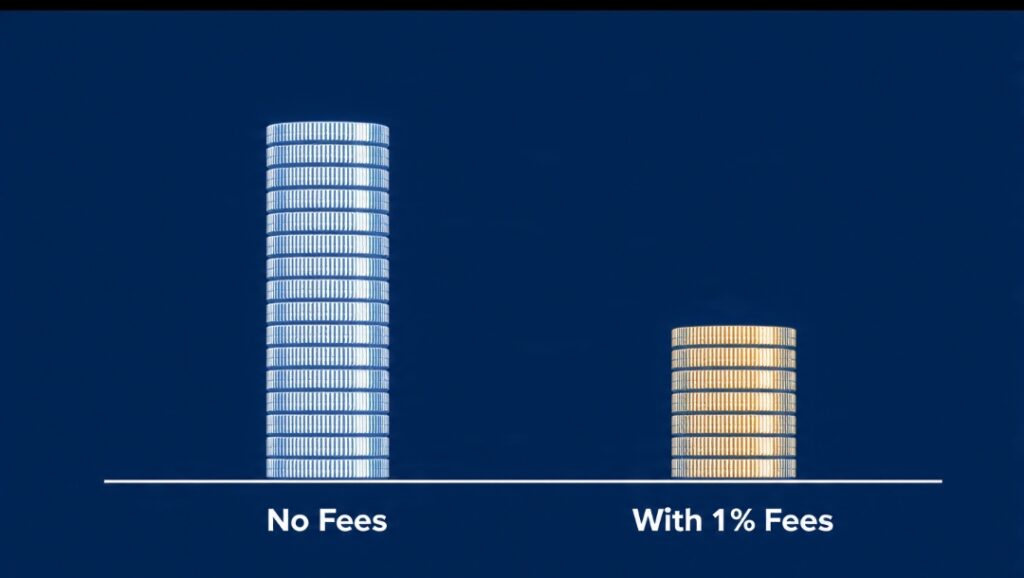
Sit with the 1% row for a second. That “negligible” fee took $437,078. Which means it did not take 1% of your money. It took 24.9% of your final wealth — a quarter of everything you built, gone to a number you rounded off in your head as nothing.
And 2%? That takes 43%. Nearly half. From a fee most people would still describe as “pretty standard.”
The Stat That Actually Breaks People
Here’s the comparison that reframes everything. Over those 40 years, you contributed $240,000 of your own hard-earned money. Every one of those deposits was real: money you didn’t spend, holidays you didn’t take, things you went without.
The 1% fee took $437,078.
The fee cost you 1.8 times more than everything you ever put in. Averaged out, it took roughly $10,900 a year while you were contributing $6,000 a year. You were, functionally, saving harder for the fee than for yourself — and you never once saw a bill.
Look at it as a share of profit and it’s just as brutal. Without the fee, your $240,000 grows into $1,517,141 of pure gains. With the 1% fee, your gains are $1,080,062. That single percentage point consumed 28.8% of your entire lifetime profit. Nearly three out of every ten dollars your money earned went somewhere else.
Why a 1% Fee Costs 25%, Not 1%
The gap between “1%” and “a quarter of your wealth” isn’t a trick of presentation. It’s the arithmetic of compound interest, and three things drive it:
- It’s charged annually, not once. Forty years of a 1% haircut is not a 1% haircut. It’s forty of them, each on a bigger base than the last.
- Every dollar taken stops compounding forever. A dollar removed in year five doesn’t just cost a dollar — it costs whatever that dollar would have become by year forty, which at 8% is more than twenty times as much.
- It’s charged on your balance, not your gains. This is the part almost nobody registers. You pay the fee in flat years. You pay it in losing years. Your investment can fall 20% and the fee still comes out, calmly, on schedule. There is no bad year for the fee.
That third point deserves emphasis: your returns are uncertain, but the fee is not. It is the one perfectly reliable component of the entire arrangement, and it’s reliable in the wrong direction.
Put It in Time Instead of Money
Dollar figures that large stop feeling real, so here’s the same damage measured in something you can actually feel.
To reach that fee-free $1,757,141 while paying a 1% fee, you’d need to keep contributing $500 a month for 43.9 years instead of 40. That one percent costs you nearly four extra years of working and saving. Four years of your life, handed over, to undo a number you thought was too small to matter.
Notice that this is the exact mirror image of why starting early is so powerful. Everyone understands that a few extra years at the start creates enormous wealth. A 1% fee is that same lever pulled backwards — quietly deleting years from your timeline while you sit there thinking your money is working for you at full strength. It’s working, but a meaningful share of the output is being diverted before it ever reaches you. This is precisely how small amounts build big wealth in reverse: small drags build big losses.

Where the Fees Actually Hide
Almost nobody consciously agrees to hand over a quarter of their wealth. It happens because the costs are scattered, individually small, and often not presented as a single number anywhere. Depending on how and where you invest, you might be paying several of these at once:
- Fund costs — the annual percentage a fund charges to run itself, often called an expense ratio. Deducted automatically from the fund, so you never see it leave.
- Management or advisory fees — a percentage of your assets charged for managing them, on top of whatever the underlying funds already charge.
- Platform or account fees — a percentage or flat charge just for holding the account.
- Transaction costs — charged each time something is bought or sold, which is why a frequently-traded portfolio bleeds more than a patient one.
- Currency conversion — for international investing, often the most-ignored cost of all, buried inside an unfavourable exchange rate rather than shown as a fee.
Stack two or three of these and you’re at 2% without ever seeing a bill for 2%. The critical habit is to add every cost into one honest total — the “all-in” number — because that total, not any individual line, is what the table above is quietly doing to you. Fee structures and available options vary enormously by country, so this is about knowing what to look for, not about any particular product.
The Trader’s Version of This Problem
If you’re active in markets rather than passively invested, the same law applies with a different mask. Your fees are spreads, commissions, swap costs, and slippage — and they’re charged per trade, which means your fee rate is a direct function of how often you trade.
This is the part that stings: a trader with a genuine edge can still lose to costs purely through frequency. Trade ten times as often and you pay ten times the friction, while your edge stays the same size. Overtrading doesn’t just add risk; it converts your edge into someone else’s revenue, one small deduction at a time. It’s a specific, unglamorous case of the broader pattern where investors sabotage their own compounding — and it’s usually driven by the emotional need to be *doing* something, which is exactly the impulse behind revenge trading. The market doesn’t have to beat you when your own activity level will do the job for free.
What to Actually Do About It
The good news is that this is one of the very few variables in investing that you control. You cannot control returns. You cannot control the market’s timing, or the next crash, or which decade turns out to be flat. You can control what you pay, and it’s the single most reliable lever available to you.
- Find your all-in number. Not one fee — every fee, added up, expressed as one annual percentage. Most people have never calculated this and are shocked when they do.
- Judge the cost against what it delivers. A fee isn’t automatically bad; it’s bad when it isn’t buying anything. Ask what you actually receive for it, and whether that’s worth roughly a quarter of your lifetime wealth.
- Treat cost as a decision criterion, not a footnote. When comparing two similar options, the cheaper one has a mathematical head start that compounds for as long as you hold it.
- Cut friction from your own behaviour. Trading more often, switching frequently, and constant tinkering all generate costs on top of whatever you’re already paying.
- Reduce it once, benefit for decades. This is a rare one-time action with a permanent payoff. Fix your costs today and every year afterwards is quietly better, forever.
Before any of this matters, the basics have to be in place — knowing how much to save before investing comes first, because a low-fee portfolio you had to liquidate in an emergency isn’t a low-fee portfolio at all.

The Quietest Thief in Finance
Almost everything in investing is uncertain. Returns are unknown, timing is unknowable, and the next decade will do whatever it wants regardless of your plan. The fee is the only part of the arrangement that is completely certain — and it’s certain in the direction that costs you.
That’s what makes it the quietest thief in finance. There’s no dramatic moment, no crash, no obvious mistake to learn from. It never announces itself. It simply removes a small amount, faithfully, every year, from a number you never watch closely, and at the end you’re a quarter poorer than you should have been, with no memory of ever agreeing to it. Compounding is genuinely the most powerful force available to an ordinary person building wealth. Nothing else turns $240,000 into $1.7 million. It’s worth understanding that the same force, pointed slightly against you by a number as small as one percent, will take a quarter of the result — and it will do it in total silence, while you congratulate yourself on being invested.
- A 1% annual fee isn’t a 1% cost — over 40 years it can consume around 25% of your final wealth and nearly 29% of your lifetime profit.
- In the example ($500/month, 40 years, 8% gross), a 1% fee cost $437,078 while total contributions were only $240,000 — the fee took 1.8x everything ever deposited.
- Fees compound against you: each dollar removed stops compounding forever, and the fee is charged annually on a growing balance.
- Fees are charged on your balance, not your gains — you pay them in flat and losing years too. Returns are uncertain; the fee never is.
- Measured in time, a 1% fee costs roughly four extra years of working and saving to reach the same target.
- Costs hide across fund fees, advisory fees, platform fees, transaction costs, and currency conversion — calculate one honest all-in number.
Frequently Asked Questions
How much do fees really affect compound interest?
Far more than the headline number suggests. In an illustrative case of $500 a month for 40 years at an 8% gross return, a 1% annual fee reduces the final balance from about $1,757,000 to about $1,320,000 — a loss of roughly 25% of total wealth, not 1%.
Why does a small 1% fee cost so much over time?
Because it’s charged every year on a growing balance, and every dollar it removes stops compounding permanently. You don’t just lose the fee itself, you lose everything that money would have earned over all the remaining years.
Are investment fees charged on my gains or my whole balance?
Typically on your entire balance, not just your profits. This means the fee is still deducted in flat years and losing years — your returns are uncertain, but the fee is charged reliably regardless of performance.
How much of my profit does a 1% fee take?
In the example above, a 1% fee consumed about 28.8% of lifetime investment profit — nearly three out of every ten dollars the money earned. The fee also cost roughly 1.8 times more than the investor’s total contributions over the whole period.
What types of investment fees should I look for?
Fund running costs (expense ratios), management or advisory fees, platform or account fees, transaction costs on each trade, and currency conversion costs on international investing. Add them all into one all-in annual percentage, since several small ones stack quickly.
Do trading costs work the same way as investment fees?
Yes, with a different mask. For active traders, spreads, commissions, swap costs, and slippage are charged per trade, so the effective cost rate rises with trading frequency. A trader with a real edge can still lose to costs purely by trading too often.
What can I actually control about investment fees?
Almost everything about them, which is rare in investing. You can’t control returns, timing, or market conditions, but you can calculate your all-in cost, compare similar options on cost, reduce unnecessary trading, and ask whether each fee is buying you anything of real value.