- You do not need a film degree to become a freelance video editor in 2026 — you need a portfolio, a niche, and the discipline to deliver on deadline.
- The biggest income jump comes from picking a specific niche, not from being a generalist editor who can do “everything.”
- AI editing tools are not replacing video editors — they are replacing editors who refuse to learn how to use them.
- Your first three clients matter more than your first three months of learning software tutorials.
Becoming a freelance video editor in 2026 is one of the most accessible, highest-demand paths into freelancing — but most people approach it completely wrong. They spend months perfecting transitions and color grading in private before ever showing their work to a single potential client. By the time they feel “ready,” someone with half their technical skill and a real portfolio of paid work has already taken the clients they were waiting to impress.
Video content has not slowed down. Every business, creator, and brand needs video edited — short-form content, YouTube videos, ads, podcasts repurposed into clips, course content. The demand is real. What is missing for most aspiring editors is not opportunity. It is a clear, practical path from zero to paid client work.
This guide is built on real freelancing experience from the Data Pips Team — including direct, hands-on work in video editing for international clients — not theory pulled from a course sales page. No fluff, no “follow your passion” nonsense. Just the exact steps to become a freelance video editor in 2026 and start getting paid.
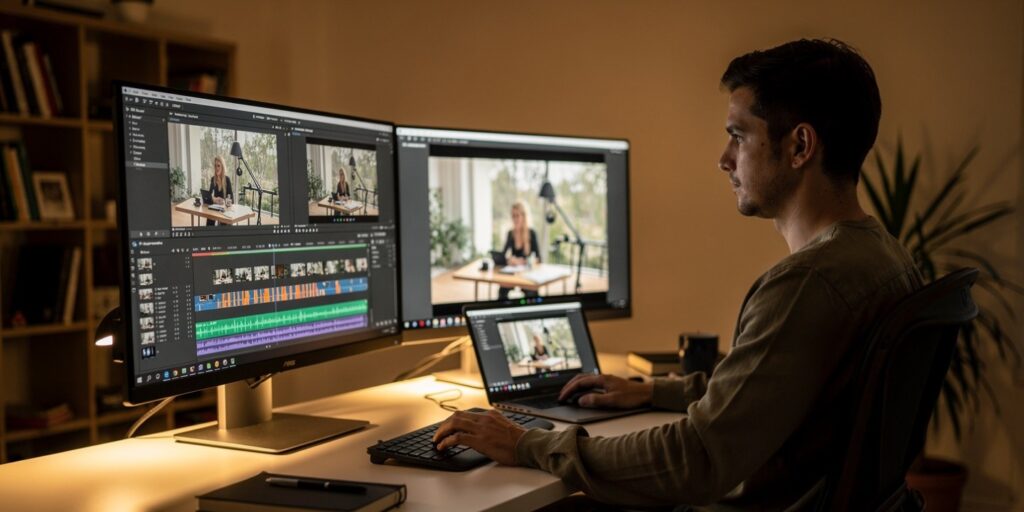
Why Freelance Video Editing Is Still a Strong Path in 2026
Every platform that grew over the last several years runs on video. Short-form content, YouTube, brand marketing, online courses, podcasts repurposed into clips — none of it edits itself completely, even with AI tools in the mix. Businesses and creators need someone who can take raw footage and turn it into something that holds attention, tells a story, and looks professional.
This demand has not slowed down. If anything, the volume of video content being produced has increased every year, which means the demand for editors who can work efficiently and reliably has increased alongside it.
Investopedia’s overview of freelancing notes that freelance work continues to grow as a share of the overall workforce, driven largely by remote-friendly, skill-based services like design, writing, and video production — exactly the category freelance video editing falls into.
The opportunity is real. The question is whether you build the right system to capture it, or spend months stuck in tutorial mode while other editors with less polished skills but better client systems take the work.
Step 1 — Learn the Software That Actually Gets You Hired
You do not need to master every editing software that exists. You need to be genuinely competent in one or two, and aware of the rest.
For most freelance video editing work in 2026, the two software choices that dominate client requests are Adobe Premiere Pro and DaVinci Resolve. Premiere Pro is the industry standard for most agencies and businesses. DaVinci Resolve has a powerful free version and is increasingly popular, especially for colorists and editors working with cinema-grade footage.
For short-form, social-first content — which represents a massive share of current freelance demand — CapCut has become a legitimate professional tool, not just a beginner app, particularly for fast turnaround content creator work.
Pick one primary tool. Get genuinely skilled in it — not “I watched some tutorials” skilled, but “I can solve problems when something breaks” skilled. You can expand to additional software later once you have paying clients and real project demands pulling you in that direction.
Design skills stack directly onto video work — and learning graphic design for free follows the same principle: a structured sequence toward a portfolio, not random tutorials.
Step 2 — Choose a Niche Instead of Trying to Edit Everything
This is the single biggest factor separating freelance video editors earning a few hundred dollars a month from those earning several thousand. Niche focus.
A generalist editor competes with every other generalist editor on price. A specialist editor — someone known specifically for podcast editing, or YouTube long-form content, or short-form vertical content for brands, or wedding videography, or course content editing — becomes the obvious choice for clients in that specific space, and can charge accordingly.
| Niche | Typical Client | Demand Level |
|---|---|---|
| Short-form / vertical content | Brands, influencers, agencies | Very High |
| YouTube long-form | Creators, educators | High |
| Podcast video editing | Podcasters, media companies | High |
| Corporate / course content | Businesses, coaches, educators | Moderate, higher pay |
| Wedding / event videography | Individuals, couples | Moderate, seasonal |
Pick the niche that overlaps with what you are already drawn to watching and editing. Specialization is not a limitation — it is what makes you findable, referable, and worth a premium rate. Our complete guide on choosing a freelancing niche breaks this decision down further.
“Nobody pays premium rates for ‘I can edit anything.’ They pay premium rates for ‘I am exactly who you need for this specific kind of video.'”
— Data Pips Team
Step 3 — Build a Portfolio Before You Have Clients
This is where most aspiring editors get stuck. They believe they need real client projects before they can build a portfolio, and they need a portfolio before they can get real clients. This is a false trap.
Use existing footage. Re-edit clips from public domain content, YouTube creators who openly share raw footage for editing practice, or even your own phone-shot content. Create three to five strong sample edits in your chosen niche. Quality over quantity — three excellent, polished samples beat fifteen mediocre ones every time.
Host this portfolio somewhere clean and accessible — a simple website, a YouTube channel, or even a well-organized Google Drive folder shared as a portfolio link. The platform matters far less than the quality and relevance of the work shown.
Once you land your first one or two real client projects — even at a discounted or low rate — replace your practice samples with real, results-driven client work as soon as you are able to.
Step 4 — Find Your First Clients the Right Way
Waiting for clients to find you is the slowest possible path. Manual, direct outreach is faster and more reliable, especially in your first 90 days.
Freelancing platforms. Upwork and Fiverr remain strong entry points for new freelance video editors, particularly because international clients on these platforms are actively searching for editors and have built-in trust mechanisms through reviews and ratings.
Direct outreach to small creators and businesses. Identify YouTubers, podcasters, or small businesses producing video content without a dedicated editor. A short, specific, no-fluff message showing you understand their content and offering a clear value proposition outperforms generic cold messages by a wide margin.
Content communities and Discord servers. Many creator and freelancer communities have dedicated channels where people post editing job requests directly. These often have less competition than major freelancing platforms.
The Data Pips Team’s own approach to early freelancing work followed exactly this manual outreach model — direct, specific, and persistent — rather than waiting passively for inbound interest. Our complete freelance roadmap for landing your first client through manual outreach walks through this process step by step.
Freelance video editing work for international clients began with minimal formal training — built primarily through self-teaching and direct, hands-on project work rather than expensive courses. The early breakthrough did not come from technical mastery. It came from consistent, direct outreach to potential clients and a willingness to take on early projects at lower rates specifically to build a track record of delivered, reliable work. That track record became the foundation that allowed rates to increase steadily as real client results accumulated.
Step 5 — Pricing Your Work Without Underselling Yourself
New freelance video editors consistently underprice their work out of fear that charging more will lose them clients. This fear costs far more money over time than it protects.
Most freelance video editors price in one of three ways: per project, per minute of finished footage, or hourly. Per-project pricing is generally the strongest model once you have enough experience to estimate turnaround time accurately, because it rewards efficiency rather than penalizing you for working faster.
Start with rates that reflect your current experience level honestly, but build in planned increases. A simple, disciplined approach: raise your rates by 15–20% after every five to seven successfully delivered projects. This steady increase, paired with growing portfolio quality, moves you toward premium pricing without a single dramatic, risky jump that could scare off your current client base.
Avoid the trap of constantly discounting to win work. Clients who only respond to the cheapest price are rarely the clients who stay long-term or refer you to others. Value-based clients — the ones who demand quality and pay for it — are worth more in the long run than high-volume, low-price churn.
What Nobody Tells You About Becoming a Freelance Video Editor
1. AI tools are a threat only if you refuse to use them. AI-assisted editing features — auto-captioning, scene detection, rough-cut assembly — are becoming standard in professional workflows. Editors who learn to use these tools to speed up repetitive tasks end up more competitive and more profitable, not less. The editors losing work are the ones ignoring these tools entirely, not the ones using them.
2. Client communication matters more than editing skill in the first year. Most freelance video editors lose clients not because of editing quality, but because of missed deadlines, poor communication during revisions, or unclear project scope discussions upfront. A moderately skilled editor who communicates clearly and delivers on time will out-earn a highly skilled editor who is unreliable.
3. Revisions will eat your profit if you do not set boundaries early. Without a clear revision policy stated upfront — typically two to three rounds included, additional rounds billed separately — clients will request unlimited changes, turning a profitable project into an unpaid time sink. Set this boundary in writing before the project starts, every time.
4. Your equipment matters far less than people assume. A capable laptop and a stable internet connection are enough to start. Expensive workstation upgrades should come after client income justifies them, not before you have a single paying project. Spending heavily on equipment before validating demand for your work is a common, avoidable mistake.
5. The slow months will happen, and they do not mean you have failed. Freelance income, including video editing, is rarely linear. There will be slow stretches between projects, especially in the first year. This is normal across freelance work generally, not a sign that the path is not working. Building this alongside a stable income source, at least initially, removes the financial pressure that makes these slow stretches feel catastrophic instead of simply temporary.

Building This Into a Long-Term Income Stream
Freelance video editing does not have to remain a single-client, hourly grind forever. As your skills, reputation, and client base grow, this can evolve into a small editing agency, a productized service with fixed packages, or a stepping stone into related, higher-paying creative and marketing work.
The skill demand for video editing sits within the broader freelancing landscape that continues to expand year over year. Our breakdown of the top freelancing skills in demand for 2026 shows exactly where video editing fits within that bigger picture, and how it can be combined with adjacent skills like motion graphics or content strategy for higher-value client work.
Whatever direction you take it, the foundation stays the same: real skill, a clear niche, reliable delivery, and consistent outreach. That combination beats talent alone, every time.
Quick Action Steps: Start Your Freelance Video Editing Path This Week
Step 1: Choose one primary editing software — Premiere Pro, DaVinci Resolve, or CapCut — and commit to learning it deeply over the next 30 days.
Step 2: Pick a specific niche from the comparison table above based on the content you naturally enjoy watching and editing.
Step 3: Create three to five strong portfolio samples using practice footage, even before you have paying clients.
Step 4: Set up a profile on at least one major freelancing platform, and send five direct outreach messages to potential clients in your niche this week.
Step 5: Set your starting rate honestly based on your current experience, and commit to a clear revision policy before taking your first project.
For a complete foundation on freelancing as a whole, read our beginner’s guide to freelancing and our complete step-by-step freelancing roadmap for 2026.
Frequently Asked Questions
Do I need a degree to become a freelance video editor?
No. Freelance video editing is one of the most skill-based, portfolio-driven fields in freelancing. Clients care almost exclusively about the quality of your work and your reliability, not formal education or certifications.
How long does it take to become a profitable freelance video editor?
With consistent effort, most beginners can land their first paid project within 30 to 60 days, and build a stable, meaningful income stream within 6 to 12 months. This timeline depends heavily on time invested, niche selection, and consistency of outreach during the early months.
Is DaVinci Resolve good enough, or do I need Premiere Pro?
DaVinci Resolve’s free version is genuinely powerful and used professionally, including for high-end color grading. Premiere Pro remains the more common requirement among agencies and larger clients due to its widespread industry adoption. Many successful freelance editors use both depending on the project.
Will AI tools replace freelance video editors?
AI tools are automating specific repetitive tasks like auto-captioning and rough cuts, but they are not replacing the creative judgment, storytelling, and client communication that skilled editors provide. Editors who learn to incorporate AI tools into their workflow tend to become faster and more competitive rather than replaced.
How much should I charge as a beginner freelance video editor?
Beginner rates vary by niche and platform, but starting modestly to build a track record of delivered projects is a reasonable strategy, paired with planned rate increases every five to seven completed projects. Avoid pricing so low that it signals low quality, but also avoid starting at premium rates before you have proof of reliable delivery.
Should I specialize in one video niche or stay a generalist?
Specializing in one niche, such as short-form content, podcast editing, or YouTube long-form, typically leads to faster growth and higher rates than staying a generalist. Niche specialists become the obvious, memorable choice for clients in that specific space, which reduces price competition.
Can I become a freelance video editor while working a full-time job?
Yes, and it is generally a smart approach for beginners. Building freelance video editing skills and an initial client base during evenings and weekends removes financial pressure during the learning and early client-acquisition phase, allowing for better long-term decisions about pricing and client selection.
Disclaimer: This article is for educational and informational purposes only and does not constitute professional career or financial advice. Freelance income and career outcomes vary significantly based on individual skill, effort, market demand, and circumstances. The Data Pips Team makes no guarantees regarding income or career outcomes from applying the strategies described in this article.