My Journey and Your Success
“With over 7 years of experience in the trading world, I have seen the highs and lows of the market firsthand. In this article, my goal is to share the deep-rooted knowledge and psychological insights I’ve gained over the years—knowledge that I believe will be truly transformative for your trading journey.”
In the world of financial markets, there is a famous saying: “Cut your losses short and let your profits run.” While this sounds simple in theory, almost every trader struggles with its execution. We often find ourselves exiting winning trades too early out of fear, while holding onto losing positions for far too long in hope.
Becoming a profitable trader isn’t just about having a technical strategy; it’s about mastering the psychological triggers that cause us to sabotage our own success. Here is an in-depth look at why traders fail to hold winners and how to fix it permanently.
The Four Pillars of Trading Failure
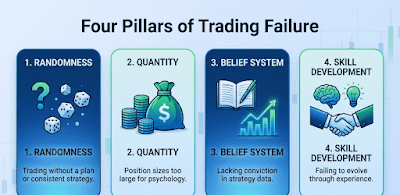
To solve the problem of premature exits, we must first identify the root causes. There are four major psychological pillars that disrupt a trader’s mindset:
1. Eliminating Randomness
The biggest enemy of consistency is randomness. Many traders enter the market without a predefined plan, a fixed strategy, or clear exit rules. When you trade randomly—switching from options to spot, or jumping between different setups—you never develop a deep understanding of how a specific model behaves.
The Fix: Stick to one or two setups. Over time, you will learn to recognize signs of a high-probability “expansion phase” versus a choppy, “sideways market,” giving you the confidence to stay in the trade.
2. Managing Quantity and Greed
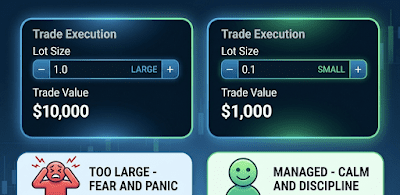
Often, traders fail to hold winners because they are trading with inappropriate position sizes (over-leveraging). If your mind is conditioned to be satisfied with a specific dollar amount—say $100—you will instinctively close your trade as soon as you see that number, regardless of the market’s actual target potential.
The Fix: Focus on the process and the percentage or R:R (Risk to Reward) captured rather than the daily monetary profit. Reduce your position size to a level where minor price fluctuations do not trigger emotional panic.
3. Building a Robust Belief System
Belief doesn’t come from motivational quotes; it comes from hard data. If you don’t objectively know that your strategy can deliver a major move, your brain will always force you to exit at the first sign of a minor retracement.
The Fix: Maintain a rigorous trading journal. Even if you exit early, record what the price did afterward. When your journal proves multiple times in a row that holding would have resulted in a massive profit, your brain will naturally develop the conviction to stay execution-focused next time.
4. Developing Skill Through Conviction
True skill is the culmination of the first three points. Conviction in a live market trade only comes when you have achieved similar results multiple times in the past. It is an evolutionary process where you transition from a market gambler to a disciplined, skilled professional.
Practical Steps for Long-Term Improvement
If you find yourself stuck in a frustrating cycle of taking small profits and large losses, implement these actionable steps immediately:
- Stop the Mixed Strategy Approach: Don’t blend unrelated setups. Isolate your variables so you can measure exactly what is working in current market conditions.
- Reframe Your Losses: Understand that a loss is simply a standard business expense, provided it was executed within your predefined risk parameters.
- The Power of Active Observation: Watch the market even after you have closed your position. Learn the specific “personality” of your chosen trading pairs to understand their true expansion phases.
Why Your Brain Is Wired to Exit Early
Here is the uncomfortable truth: exiting winners early is not a discipline problem. It is a wiring problem. Your brain was not built for trading — it was built for survival, and survival rewards taking the sure thing right now.
Psychologists call it the disposition effect. Researchers studying real brokerage accounts found that investors sell winning positions far too early and hold losing positions far too long — the exact pattern this article addresses. The mechanism behind it is prospect theory: a gain feels good, but the fear of watching that gain evaporate feels roughly twice as strong. So the moment your trade turns green, your brain starts negotiating: “Take it now before it disappears.”
There is a second force at work: the endowment effect. The second your position shows a profit, your brain quietly reclassifies that unrealized money as yours. A pullback no longer feels like “giving back some potential profit” — it feels like someone reaching into your pocket. That is why a 2% retracement on a winning trade triggers more panic than a 2% loss on a fresh entry ever would.
And then there is the dopamine loop. Closing a winning trade delivers a small chemical reward — relief, validation, a hit of “I was right.” Your brain learns fast: exit early, feel good now. Holding through discomfort for a bigger payoff requires overriding a reward system that has been training you since childhood to grab the cookie in front of you. If you want to understand the deeper mechanics of this, read my breakdown of the real reason traders exit too early — it maps the exact moment the urge to close hijacks your plan.
None of this means you are broken. It means you are normal. The traders who hold winners are not fearless — they have just built systems that make the rational choice easier than the emotional one. Which brings us to the most practical of those systems.
The Partial Exit: A Middle Path That Actually Works
Most trading advice on exits is binary: either hold the full position to the final target or you lack discipline. That framing fails because it fights your brain instead of working with it. The partial exit is the compromise that actually survives contact with real emotions.
Here is how it works in practice. Suppose your plan targets a 3R move. When price reaches 1.5R, close half the position and move your stop loss to breakeven on the remainder. Two things happen instantly: you bank a real, locked-in profit — which satisfies the part of your brain screaming for the dopamine hit — and your remaining position is now risk-free, which dramatically lowers the emotional cost of holding it.
Notice what this does to the psychology. The urge to exit early comes from fear of losing what you have. Once half the profit is secured and the rest cannot lose money, there is almost nothing left to fear. Traders who could never hold a full position to target routinely hold the second half to target, because the emotional math changed.
A few rules keep partial exits honest. First, define the scale-out levels before entry — deciding mid-trade invites the same emotional bargaining you are trying to escape. Second, never move your stop away from breakeven to “give it room”; that reintroduces the exact risk you just eliminated. Third, track your partial exits in your journal separately. Over twenty or thirty trades, the data will show you whether your second halves are earning their keep — and that evidence becomes the conviction the third pillar demands.
The partial exit is not a crutch. It is training wheels with a purpose: each time you watch a risk-free runner reach a target you would previously have abandoned, you collect one more piece of proof that holding works. Eventually, the proof accumulates enough that you may not need the compromise at all.
Build Your Exit Plan Before You Enter
Every premature exit I have ever taken had the same root cause: I entered the trade with a clear entry and a vague exit. “I will see how it goes” is not an exit plan — it is permission for your emotions to improvise later, and they will always improvise in favor of comfort.
A complete exit plan has three components, decided before you click buy or sell. First, the invalidation point: the exact price where your thesis is wrong and you leave, no debate. Second, the profit targets: one or two predefined levels based on market structure — previous swing points, liquidity zones, measured moves — not round numbers that “feel nice.” Third, the management rules: under what conditions you scale out, trail your stop, or exit on time rather than price.
Write these three down for every single trade. Not in your head — on paper or in your journal template. The physical act of writing converts a fuzzy intention into a commitment, and commitments are harder for mid-trade emotions to renegotiate. When price is moving and your palms are sweating, you do not want to be deciding; you want to be executing a decision your calm self already made.
One more element most traders skip: the time stop. Some trades are right in direction but wrong in timing — price chops sideways for days, tying up your capital and your attention. A simple rule like “if this has not moved toward target in X sessions, I exit regardless” frees both. Stale trades are where discipline quietly bleeds out, because every sideways hour is another opportunity for doubt to talk you into an early, poorly-reasoned exit.
If building this kind of pre-trade structure feels mechanical and unromantic, good — that is the point. Professional trading is boring by design. The excitement you feel mid-trade is usually the sound of your plan missing a piece. If you want that structure turned into a daily routine, here is how to build trading psychology with five trainable reps — a step-by-step training plan, not another lecture on discipline.
Frequently Asked Questions
Should I ever exit a winning trade early on purpose?
Yes — when the reason for the trade no longer exists. If you entered on a breakout and the breakout fails, exit, even in profit. If major news invalidates your thesis, exit. What you should never do is exit early because of discomfort alone. Learn to distinguish “my thesis broke” from “my nerves broke” — the first is discipline, the second is the exact problem this article solves.
What if I hold and the winner turns into a loser?
That will happen, and it is supposed to happen sometimes. A strategy that wins 40% of the time with a 1:3 risk-to-reward ratio is wildly profitable — which means 60% of your trades lose, including some that were green first. The question is never “did this one work out.” The question is “did I follow the plan across the last fifty?” Judge the system, not the single trade.
Does position size really matter that much for holding winners?
More than almost anything else. An oversized position turns every normal fluctuation into a threat, and a threatened brain cannot hold anything. If you consistently exit early, your first experiment should not be a mindset hack — it should be cutting your size in half. Most traders discover their “psychology problem” was a position-size problem wearing a costume.
How long does it take to rewire the urge to exit early?
Longer than a week, shorter than you fear. In my experience, traders who journal every exit — especially what price did after they left — start feeling the shift within 30 to 50 documented trades. The journal is the accelerator: without written evidence, your brain conveniently forgets all the winners it abandoned. With it, the pattern becomes undeniable, and undeniable patterns change behavior.
Conclusion
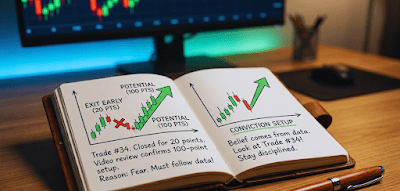
Holding winning trades is 10% technical strategy and 90% psychology. By removing randomness, optimizing your position sizing, and backing your execution with a data-driven journal, you can successfully rewire your brain to stay calm during major market swings. Remember, the market doesn’t pay you simply for being right—it pays you for your patience and discipline.
“Which of these four pillars do you struggle with the most? Share your experience in the comments below, and let’s discuss how to overcome it together!”