- Year one of trading should be treated as a tuition phase — the goal is skill development, not profit, even though that feels deeply unsatisfying to hear.
- A structured four-phase approach — broad learning, filtering, specialization, psychological work — compresses years of random trial and error into twelve focused months.
- The final and hardest phase of the year has nothing to do with charts. It is entirely about controlling your own behavior under financial pressure.
- A side income stream is not a distraction from trading. It is what removes the desperation that causes most emotional trading mistakes.
Financial trading gets sold as a shortcut to fast wealth, but anyone who has actually survived long enough to become consistently profitable knows a completely different story — one built on patience, psychological resilience, and a real learning curve that most people are not willing to commit to. While many traders spend years stuck in a loop of inconsistent gains followed by heavy losses, it is genuinely possible to compress that painful, scattered process into a single, disciplined year.
This is not a promise of guaranteed profit by month twelve. It is a structured roadmap for what actually needs to happen, in what order, for a trader to go from random guessing to genuine skill. Most traders fail not because the market is impossible to understand, but because they skip stages, chase shortcuts, or quit right before the slow, unglamorous work would have paid off.
This guide from the Data Pips Team lays out exactly that roadmap — four clear phases across twelve months, built on real trading experience in gold and forex markets, not theoretical course material.
The Mindset Shift That Has to Happen First: Skills Over Dollars
The single biggest obstacle for most new traders is an obsession with immediate financial growth. To build something that lasts, the first year needs to be treated as a tuition phase — the same way a medical student does not expect to perform surgery for a salary during their first year of training, a new trader should not expect to get rich while still building foundational skill.
The real goal for year one is simple to state and hard to accept: by the end of twelve months, the account balance might look roughly similar to where it started, but the underlying skill set should be unrecognizable. The rule that makes this possible is focusing on process quality, not on profit and loss as the primary scorecard during this period.
This reframe matters because it removes the desperation that drives most catastrophic early mistakes. A trader chasing immediate profit takes oversized risks to accelerate results. A trader focused on skill development takes the time genuinely required to build a repeatable, sustainable edge.
Phase One: The Broad Exploration Period (Months 1–3)
The first quarter is entirely about exploration, without narrowing too early. This is the one phase where casting a genuinely wide net is the correct approach, rather than a mistake.
Study broadly across methodologies. Explore price action trading, Smart Money Concepts, traditional technical indicators, and order flow analysis. Each of these represents a different “language” for describing the same underlying market behavior, and understanding multiple languages early prevents premature attachment to a single, potentially poor-fit approach.
Consume a wide range of educational material. Reading established trading literature and exploring diverse educational content during this period builds a foundation of how global markets actually move and what tools different types of traders use to track that movement.
The objective of this phase is not mastery. It is exposure — building enough familiarity with the landscape of trading approaches to make an informed choice in the next phase, rather than picking a strategy randomly based on whichever video appeared first in a search result.
Phase Two: The Filtration Process (Months 4–6)
Information overload, left unaddressed, leads directly to analysis paralysis. The second quarter requires becoming a genuine critic of everything absorbed during the exploration phase.
Backtest everything seriously. Start applying what has been learned against historical price data. Investopedia’s explanation of backtesting describes this process as testing a trading strategy against historical data to evaluate how it would have performed — an essential step before any strategy gets applied to real capital.
Filter aggressively. A realistic expectation is that the large majority of indicators or strategies explored in phase one will not genuinely fit your personality, risk tolerance, or lifestyle. Discard them deliberately rather than holding onto every tool out of fear of missing something.
Find your actual fit. Are you naturally suited to fast, frequent scalping, or to slower, patient swing trading? Does the structured precision of Smart Money Concepts suit your thinking style, or does the relative simplicity of pure price action feel more natural? This decision should be based on genuine personal fit, not on which approach looks most impressive online.
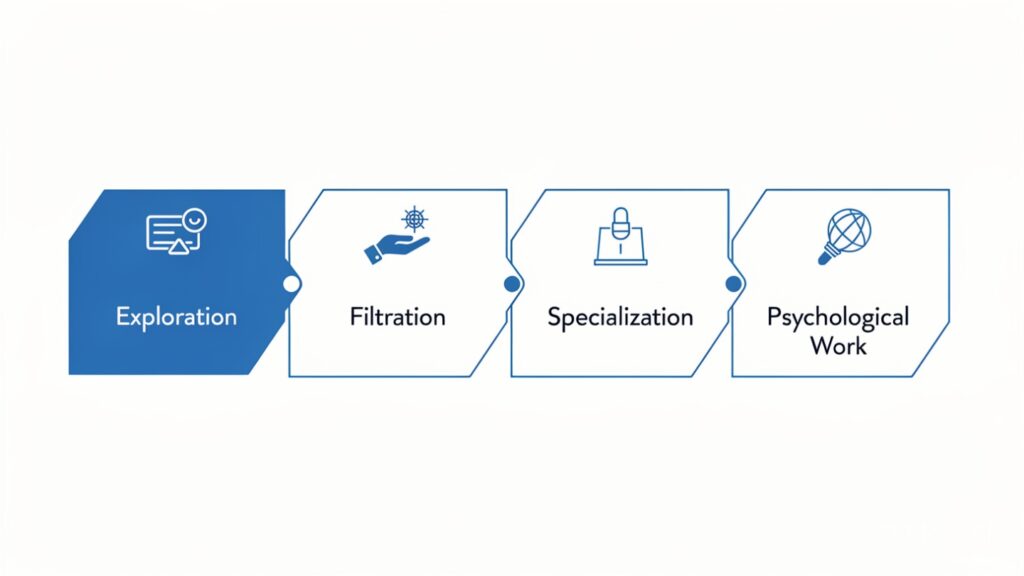
| Phase | Timeframe | Primary Focus |
|---|---|---|
| Exploration | Months 1–3 | Broad exposure to multiple methodologies |
| Filtration | Months 4–6 | Backtesting and eliminating poor-fit strategies |
| Specialization | Months 7–9 | Deep mastery of one or two setups |
| Psychological Work | Months 10–12 | Discipline, journaling, emotional control |
“Most traders never run out of strategies to try. They run out of patience to master just one.”
— Data Pips Team

Phase Three: Deep Specialization (Months 7–9)
Once a genuine edge has been identified through the filtration phase, the third quarter is about depth, not breadth. This phase is where actual mastery begins to form through repetition and refinement rather than continued exploration.
Narrow your focus deliberately. Stop researching new strategies entirely during this period. Master one or two high-probability setups thoroughly rather than maintaining a scattered familiarity with many. Our complete guide on order blocks and fair value gaps is an example of the kind of single, deep methodology worth specializing in during this stage, rather than treating it as one item on a long list of techniques to sample.
Shift from external validation to internal trust. This is the period to move away from following external signals or personalities and start trusting personal chart analysis built through hundreds of hours of focused study. Our guide on mastering ICT and Smart Money Concepts covers exactly the kind of structured methodology that rewards this deep, internalized specialization.
Prioritize nuance over new information. The questions worth asking during this phase shift from “what is this concept” to “how does price actually react at these specific levels, and what are the common traps within this specific strategy.” This level of detail only becomes visible after sustained, focused repetition.
Phase Four: Psychological Fortification (Months 10–12)
The final stretch of the year is the most difficult, precisely because it has almost nothing to do with charts anymore. It is entirely about the trader’s own behavior under real pressure.
Cut the comparison noise. Social media comparison is one of the most damaging influences during this stage — comparing a genuine “year one” of disciplined learning against someone else’s curated “year ten” highlight reel creates unrealistic expectations and pressure to skip steps that cannot actually be skipped.
Let the trading journal become the primary teacher. By this stage, a detailed trading journal becomes more valuable than any external course or mentor. Reviewing documented mistakes, patterns of FOMO-driven entries, and any recurring revenge trading habits reveals exactly what needs to change — data that no outside source can provide as precisely as a trader’s own history.
Build internal insight from personal performance data. The goal of this phase is generating genuine self-knowledge based on actual trading results, rather than continuing to absorb external opinions. This shift from external learning to internal learning is one of the clearest markers of a trader approaching real consistency.
Investopedia’s research on trading psychology confirms that mechanical, rule-based decision-making consistently outperforms subjective, in-the-moment judgment — exactly the kind of discipline this final phase is designed to build.
An early approach to trading gold and forex skipped directly to live trading with real capital before any meaningful filtration or specialization had taken place — jumping between strategies every few weeks based on whichever approach had recently produced a few winning trades. The result was a scattered, inconsistent track record that took far longer to correct than it would have taken to build properly from the start. The eventual shift to a structured, phase-based approach — genuinely committing to backtesting before live trading, and specializing in two setups rather than constantly searching for a third — produced more consistent results within months than the previous scattered approach had produced across years.
The Bonus Strategy Most Traders Ignore: A Financial Side Income
One of the most underrated factors in a successful first year of trading has nothing to do with charts or strategy. It is having a secondary income stream or financial cushion separate from trading capital entirely. Trading requires a calm, regulated mind, and when essential living expenses depend directly on the outcome of a single trade, emotional mistakes become almost guaranteed.
Building a side skill — freelancing, content creation, or any other reliable income source — during this same twelve-month period provides the financial breathing room and mental space needed to trade objectively rather than desperately. Our guide on building multiple income streams without quitting your job covers exactly how to structure this alongside a demanding learning process like trading.
Chronic financial stress measurably impairs decision-making capacity. The American Psychological Association’s research on stress documents how sustained financial pressure affects cognitive function in ways that directly undermine the calm, patient decision-making trading actually requires.

What Nobody Tells You About the First-Year Trader Roadmap
1. The hardest phase is rarely the technical one. Most new traders assume learning chart patterns and strategies will be the difficult part. In practice, phase four — the psychological work of months ten through twelve — is consistently the hardest stage, because it requires confronting personal behavior patterns rather than absorbing external information.
2. Twelve months is a guideline, not a guarantee. Some traders move through these phases faster, others need significantly longer, particularly during the specialization and psychological phases. The value of the roadmap is in the order and structure of the process, not in a rigid, one-size-fits-all timeline that applies identically to everyone.
3. Backsliding between phases is normal, not a failure. A trader who has reached phase three will still occasionally make phase-one mistakes — chasing a new strategy out of frustration during a losing streak, for example. This does not invalidate the progress made; it reflects how skill development actually works, in spirals rather than straight lines.
4. The side income recommendation gets dismissed far too often. Many new traders treat building a financial cushion as a distraction from “real” trading focus, when in reality it is one of the most direct levers available for improving trading psychology. Our breakdown of why even smart traders fail their first attempt covers this exact connection between financial pressure and trading decision quality in more depth.
5. Most traders quit during phase two, right before the real value of the process appears. The filtration phase, months four through six, is often the least exciting stage — it involves discarding strategies and confronting how much of the initial excitement from phase one was not actually useful. This is precisely the point where many traders abandon the structured approach entirely and revert to randomly chasing the next promising-looking strategy, restarting the cycle instead of pushing through it.
Why Structure Beats Talent in a Trader’s First Year
Natural aptitude for pattern recognition or risk-taking can accelerate parts of this roadmap, but it cannot replace the roadmap itself. Traders without a structured process — regardless of natural talent — tend to repeat the same cycle of excitement, overconfidence, loss, and frustration indefinitely, because nothing in that cycle forces genuine skill development.
A structured twelve-month approach forces the exact sequence that skill development actually requires: broad exposure before narrowing, rigorous testing before live deployment, deep specialization before psychological work, and finally, genuine self-confrontation before consistency becomes possible. Our complete guide on trading patience and risk management reinforces exactly this discipline-over-talent principle in more depth.
Skipping stages does not save time. It almost always extends the total timeline, because the skipped stage’s lessons eventually get learned anyway, usually at a higher financial cost than if they had been addressed in the proper order from the start.
Quick Action Steps: Start Your Year One Roadmap This Week
Step 1: If you are in your first three months, commit to broad exploration across at least three different trading methodologies before choosing a primary focus.
Step 2: If you are entering months four through six, start backtesting your current strategy seriously, and be willing to discard approaches that do not genuinely fit your personality.
Step 3: If you are entering months seven through nine, stop researching new strategies entirely and commit to mastering one or two specific setups in depth.
Step 4: Regardless of which phase you are in, start a detailed trading journal this week if you have not already, tracking both the technical setup and your emotional state for every trade.
Step 5: Evaluate whether financial pressure outside of trading is influencing your decisions. If so, begin building a side income stream this month to create the financial breathing room your trading psychology needs.
For the discipline framework that supports this entire roadmap, especially during the hardest final phase, read our complete guide on stopping revenge trading.
Frequently Asked Questions
Can I really become a profitable trader in just one year?
One year is realistic for building genuine foundational skill and discipline through a structured process, but consistent profitability timelines vary significantly by individual. The roadmap is designed to compress years of unstructured, random trial and error into a focused, sequential year — not to guarantee profit by a specific date.
Should I trade with real money during the first three months?
Generally, no. The first quarter is meant for broad learning and exploration, with backtesting beginning in the second quarter before live capital is seriously deployed. Risking significant real money before completing the filtration and backtesting phases substantially increases the likelihood of costly, avoidable mistakes.
What if I find my edge faster than the suggested timeline?
The four-phase structure is a guideline, not a rigid schedule. If genuine, tested confidence in a specific strategy develops faster than expected, moving into deeper specialization earlier is reasonable, as long as the filtration and backtesting work behind that confidence was genuinely thorough rather than rushed.
Why does the roadmap recommend a side income stream during trading education?
Trading decisions made under genuine financial desperation are consistently worse than decisions made from a position of financial stability. A side income stream removes the pressure to “make rent” from trading specifically, which directly reduces the emotional, fear-driven decision-making that damages most new trading accounts.
What should I do if I keep jumping between strategies and can’t settle on one?
This pattern usually indicates skipping the filtration phase, months four through six, where rigorous backtesting should eliminate poor-fit strategies based on data rather than excitement. Returning to disciplined backtesting of two or three candidate strategies, rather than continuing to sample new ones, typically resolves this cycle.
Is the psychological phase really more important than the technical phase?
Both are necessary, but a large share of trading account failures trace back to psychological and behavioral issues rather than a lack of technical knowledge. A trader can understand a strategy perfectly and still fail to execute it consistently under real emotional pressure, which is exactly why the final phase of this roadmap focuses entirely on behavior rather than charts.
Disclaimer: This article is for educational and informational purposes only and does not constitute financial or trading advice. Trading forex, gold, and other leveraged instruments carries substantial risk of loss and is not suitable for all investors. Individual timelines and outcomes vary significantly. The Data Pips Team makes no guarantees regarding trading outcomes from applying the strategies described in this article. Always trade with capital you can afford to lose and consult a licensed financial professional before making trading decisions.