There’s a moment — maybe you’ve felt it — when you realize technology has crossed a line.
Not a scary line. Not a sci-fi line. Just a line where something shifts, and the world feels different than it did yesterday.
That moment is happening right now. And the thing causing it has a name: Agentic AI.
Most people haven’t heard of it yet. But they’re already feeling its effects — in their inboxes, in their hospitals, in the apps they use every single day.
This guide is for anyone who wants to understand what’s really happening — before everyone else does.

First, Let’s Be Honest About Something
Most articles about AI are written to impress you, not inform you. They throw around terms like “large language models” and “neural networks” and leave you more confused than when you started.
That’s not what this is.
This is a plain, honest explanation — written for real people, not engineers. Because this technology is too important to be locked behind jargon.
So… What Is Agentic AI?
Let’s start with what you already know.
You’ve probably used ChatGPT, or something like it. You type a question. It give you an answer. Simple. Clean. Useful.
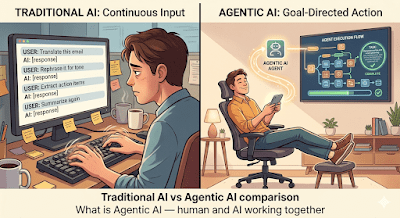
But here’s the thing — that’s still a conversation. You’re still in control of every single step. You ask, it answers. You ask again, it answers again. It’s reactive. It waits for you.
Agentic AI is different.
Agentic AI doesn’t wait. You give it a goal — and it goes off on its own to achieve that goal. It plans. It makes decisions. It uses tools. It adapts when things go wrong. And it comes back to you with the work done.
Think of it this way:
Old AI is like a calculator. You press buttons, it gives you numbers.
Agentic AI is like a brilliant colleague who you hand a project to on Monday morning and find a completed report on your desk by Tuesday afternoon — without you doing anything in between.
The Five Things That Make It “Agentic”
The word agentic comes from the word agency — the ability to act independently. Here’s what that actually means in practice:
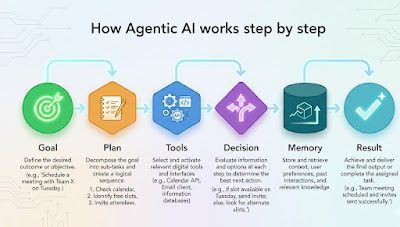
1. It Understands What You Actually Want
Not just your words — your intent. If you say “sort out my travel for next week,” it doesn’t ask you 12 follow-up questions. It figures it out.
2. It Breaks Big Goals Into Steps
On its own. Without your help. It maps out the path from where things are to where you want them to be — and then starts walking that path.
3. It Uses Real Tools
It can browse the internet. Send emails. Read files. Book appointments. Run calculations. It reaches out into the world and does things — not just says things.
4. It Makes Decisions Along the Way
When it hits a choice, it doesn’t freeze and come back to you every five minutes. It decides, based on what it knows about your goal, and keeps moving.
5. It Remembers
Unlike older AI that forgets everything the moment a conversation ends, Agentic AI can carry memory across time. It learns your preferences. It knows your patterns. It gets better at helping you the more you use it.
Agentic AI vs Generative AI — The Difference That Actually Matters
You’ve heard of generative AI. ChatGPT is generative. DALL-E is generative. Midjourney is generative. Here’s the simplest way to understand the difference:
Generative AI creates things. Give it a prompt, and it makes something — a paragraph, an image, a piece of code. Every time, it needs you to start it.
Agentic AI does things. Give it a goal, and it works toward it — independently, persistently, across multiple steps and tools — until it’s done.
If generative AI is a brilliant artist waiting for your next instruction, Agentic AI is a brilliant employee who manages their own workload.
| Generative AI | Agentic AI | |
|---|---|---|
| Needs you to: | Prompt every step | Just define the goal |
| Can use tools? | Limited | Yes — web, email, files, apps |
| Remembers context? | Usually no | Yes |
| Works independently? | No | Yes |
| Example: | ChatGPT writing an email | AI agent sending the email after writing it |
What Does It Actually Look Like in Real Life?
This is the part that makes it real.
For a Small Business Owner
Imagine you run a small online store. Every day you deal with customer questions, refund requests, inventory updates, and promotional emails. That’s hours of your life — every single day.
With an Agentic AI, you describe what you need once. It monitors your inbox. It handles routine queries. It flags the complicated ones for you. It updates your inventory automatically. It drafts your weekly promo email based on what’s selling.
You get your evenings back.

For a Student
You’re studying for exams. An AI agent tracks your progress, identifies the topics you’re weakest on, generates practice questions specifically for those areas, and adjusts your study plan week by week — automatically, based on how you’re actually doing.
It’s not just a tutor. It’s a tutor that never sleeps, never gets frustrated, and never charges by the hour.
For a Patient in a Hospital
Behind the scenes, AI agents are already monitoring patient vitals in real time, flagging early warning signs, scheduling follow-up appointments, and alerting doctors — before a problem becomes a crisis. This isn’t the future. This is happening now, in hospitals across the world.
For You, at Home
Your smart home is getting smarter. Not just responding to your voice commands — but anticipating your needs. Learning that you like the house cooler at night. Noticing that your grocery list is running low. Scheduling the maintenance check you keep forgetting to book.

Why 2026 Is the Year This Changes Everything
This isn’t hype. The numbers are real.
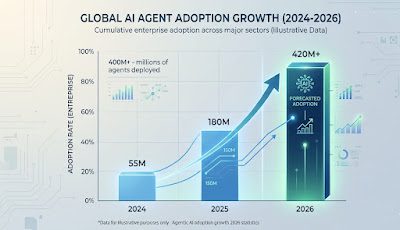
Research firm Gartner predicts that 40% of enterprise applications will include AI agents by 2026 — compared to less than 5% just twelve months earlier. That’s not gradual adoption. That’s a tidal wave.
Microsoft’s chief AI officer recently described the coming shift as an era where a three-person team will be able to launch a global campaign in days — with AI agents handling the execution while humans handle the vision.
IBM researchers have said plainly: “It’s such a crazy time — and it’s only accelerating.”
The companies, the professionals, and the individuals who understand Agentic AI now — before the crowd catches up — will have an extraordinary advantage. Not because they’re smarter. Just because they moved first.
The Part Nobody Wants to Talk About — The Risks
It wouldn’t be honest to tell you only the good parts.
Agentic AI is powerful precisely because it acts independently. And that independence — if it’s not managed carefully — creates real risks.
What if it does something you didn’t intend?
When an AI agent has the ability to send emails, make purchases, or modify files, a misunderstanding isn’t just an awkward conversation. It can have real consequences. Clear boundaries and human oversight aren’t optional — they’re essential.
Who’s responsible when it makes a mistake?
This is a question that governments, legal systems, and companies are still actively working out. There’s no clean answer yet — but it’s a conversation that needs to happen before the technology outpaces the regulation.
What about security?
Every AI agent needs to be treated like a human employee — with a clear identity, limited access to sensitive information, and protection against outside attacks. Microsoft’s security chief has said every agent should have the same protections as a human. That’s how seriously the industry is taking this.
And bias?
AI agents learn from data. If the data they learned from was biased, their decisions will be too. Ongoing monitoring isn’t just good practice — it’s a responsibility that belongs to everyone using these systems.

How to Start — Even If You’re Not Technical
You don’t need to be a programmer. You don’t need to understand machine learning. You just need to start.
Step 1: Write down three things in your work or daily life that eat up your time but don’t require your judgment — just your effort. Those are your first targets for automation.
Step 2: Try one AI agent tool this week. Claude by Anthropic, Microsoft Copilot, and Google Gemini all have agent-style features built in now, and most have free tiers.
Step 3: Give it one small, low-stakes task. See what it does. Review the output. Get comfortable with the dynamic before expanding.
Step 4: Gradually expand. Trust is built through experience — with humans and with AI. Start small and scale as your confidence grows.
Step 5: Stay curious. This field is moving fast. The people who stay informed aren’t overwhelmed by the changes — they’re the ones shaping them.
A Final Thought
There’s something quietly profound about this moment we’re living in.
For most of human history, tools have been passive. A hammer doesn’t decide where to strike. A calculator doesn’t choose what to calculate. They wait, obediently, for human hands.
Agentic AI is something different. It is, in a small but meaningful way, the first technology that acts in the world on our behalf — not just when we tell it to, but toward the goals we care about.
That’s worth taking seriously. Worth understanding. Worth approaching with both excitement and wisdom.
Because the question was never really “what can AI do?”
If this article opened your eyes to something new — share it with someone who needs to read it.