- Rehearsing a loss mentally before it happens removes the element of surprise that causes panic in the actual moment.
- There is a real difference between setting a stop-loss and genuinely accepting one — if a loss spikes your heart rate, your position is too large, regardless of what your rules say.
- The same instinct that holds losing trades too long causes winning trades to be closed too early — both come from the same fear of loss.
- Small, unprocessed frustration after a minor loss is what causes the much larger, more damaging loss that usually follows it.
Every serious trader has heard some version of the same statement: trading success is roughly 20% technical skill and 80% psychology. Yet most beginners spend nearly all of their time hunting for the perfect indicator or the ideal setup, while almost none of their time training the mind that has to actually execute that setup under real financial pressure.
The uncomfortable truth is that a trader can have the most statistically sound strategy available and still finish in the red consistently, simply because their mind was never trained to handle risk in real time. Strategy gets all the attention. Psychology decides the outcome.
This guide from the Data Pips Team breaks down the specific mental habits — starting with negative visualization — that separate traders who survive long enough to become consistent from traders who keep repeating the same emotional cycle of panic, regret, and overcorrection.

The Power of Visualizing the Worst-Case Scenario First
Most traders enter a position thinking exclusively about the profit they expect to make. The moment the market moves against them, panic sets in — not because the loss itself is unmanageable, but because it was never genuinely anticipated. This is exactly where negative visualization becomes one of the most underused tools in trading psychology.
Before the market opens, in a quiet space away from any screens, deliberately visualize the stop-loss getting hit. Picture the P&L turning red. Picture the numbers reaching the daily loss limit that has already been set. Then, critically, visualize calmly closing the laptop and walking away without chasing the loss through revenge trading.
By mentally experiencing the loss before it happens in reality, the element of surprise gets removed entirely. When the actual loss occurs during live trading, the nervous system responds with far less shock, because on some level it has already rehearsed this exact scenario and survived it. This is not a vague mindset trick — it mirrors documented psychological techniques used in high-stakes performance fields, where mentally rehearsing failure scenarios in advance measurably reduces panic responses when those scenarios occur for real.
“If your mind has already survived the loss once, in a quiet room before the market even opened, it will not panic when that same loss happens for real.”
— Data Pips Team
Emotional Digestion: The Gap Between Setting a Stop-Loss and Accepting One
There is a significant, often overlooked difference between technically setting a stop-loss and genuinely, emotionally accepting it. A trader might set a defined risk amount on a trade, but if their pulse starts racing and their stomach tightens once the loss reaches less than half of that defined limit, the position size itself is too large — regardless of how reasonable the percentage looks on paper.
A useful rule of thumb: if a loss is significant enough to disrupt sleep that night, or causes irritability toward people who have nothing to do with trading, it is not a genuinely “digestible” amount for that trader’s current psychology, regardless of what the account balance can technically absorb.
The fix is direct, even if it feels unsatisfying: lower the position size until a loss feels closer to a routine business expense than a personal emergency. Psychology Today’s research on loss aversion confirms that losses are felt significantly more intensely than equivalent gains — which means the position sizing that “feels right” on a calm day is almost always too large once real emotional weight enters the equation.
| Signal | What It Means |
|---|---|
| Heart rate rises before the stop-loss is hit | Position size is too large for current risk tolerance |
| Difficulty sleeping after a defined, planned loss | The loss amount is not genuinely “digestible” yet |
| Closing winning trades far before the planned target | Fear of losing unrealized profit, not technical signal |
| Increasing size immediately after a loss | Emotional “fender bender” pattern beginning to form |
Holding Winners Too Short: The Fear of Losing What You Already Have
One of the most common and most expensive patterns in trading is holding losing positions far too long while closing winning positions far too early. This happens because of a single underlying instinct: the drive to protect what currently exists, even when that instinct works against the actual trading plan.
Professional traders address this specifically with what can be called positive visualization — mentally rehearsing not just the win, but the realistic path the win is likely to take. Imagine price reaching the first target, then retracing slightly in a normal pullback, before eventually continuing toward the final take-profit level. Without rehearsing that pullback specifically, a trader is far more likely to panic-sell the moment a green candle simply turns slightly smaller than the one before it — mistaking normal price behavior for a reversal.
Our complete breakdown of why traders exit trades too early covers this exact pattern in significantly more depth, including the specific psychological mechanism behind it.
The Founder’s Real Lesson: The “Fender Bender” Effect in Trading
In trading, one bad decision frequently triggers another almost immediately afterward. The pattern resembles a minor car scratch — getting frustrated and losing composure after a small fender bender significantly increases the odds of a much more serious accident within the next few minutes, simply because emotional regulation has already been compromised.
The same mechanism plays out constantly in gold and forex trading. A small, planned, entirely normal loss can spiral into a much larger emotional blow-up if the trader is not mentally prepared for that initial frustration to pass on its own. The moment a rising pulse or tightening chest is noticed after a loss, that is the signal to engage a personal “kill switch” — stepping away from the screen entirely rather than immediately attempting to recover the loss with another trade.
This lesson came directly from years of trading XAUUSD and major forex pairs — the trades that caused the most lasting damage were rarely the first loss of the day. They were almost always the second or third trade taken in the minutes immediately following that first loss, while frustration was still actively distorting judgment.
A recurring pattern emerged across months of trading gold: a small, well-managed loss on the first trade of a session was frequently followed by a much larger, poorly managed loss on a second trade taken within the next thirty minutes. Reviewing the journal made the pattern undeniable — the second trade was almost never based on a genuinely valid setup. It was driven by frustration disguised as opportunity. Introducing a strict rule — a mandatory fifteen-minute pause away from the charts after any loss, regardless of how small — eliminated the vast majority of these compounding losing streaks within a few months of consistent application.
Building Daily Mental Habits That Actually Stick
None of these psychological tools work as a one-time exercise. They function as habits, built through daily repetition, the same way a technical setup gets internalized through repeated chart review.
Pre-market visualization. Spend five to ten minutes before the trading session begins, away from any charts, mentally rehearsing both the worst-case loss scenario and the realistic path a winning trade is likely to take, including its pullbacks.
A defined kill switch rule. Decide in advance — during a calm state, not during a losing streak — exactly what physical or emotional signal triggers a mandatory break from trading. A racing pulse, a specific dollar amount lost, or a certain number of consecutive losses are all valid triggers, as long as the rule is decided before it is ever needed.
Position sizing based on emotional digestibility, not just account percentage. Standard risk management formulas focus purely on percentage of capital. A more complete approach also tests whether that percentage genuinely feels manageable on a personal, emotional level, adjusting size downward when it does not.
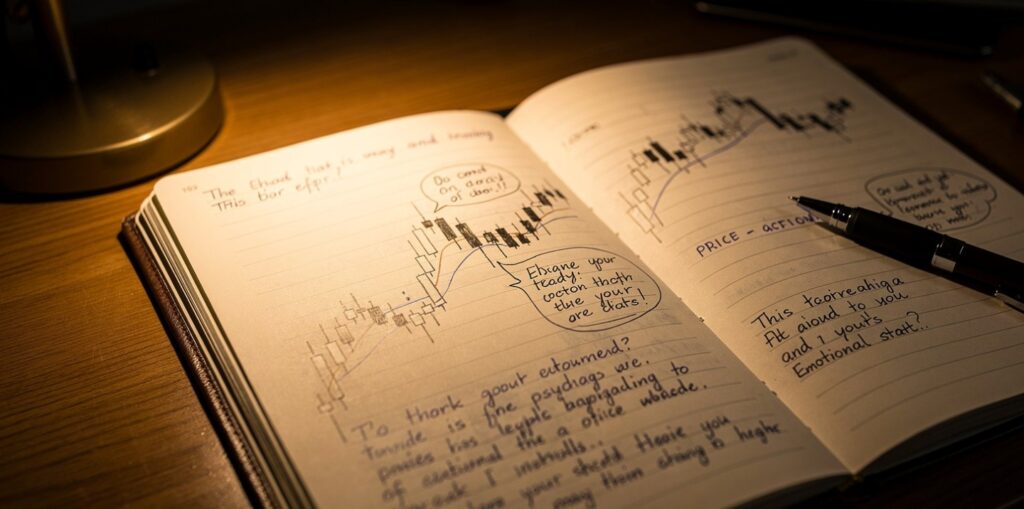
Daily psychological journaling alongside technical journaling. Recording the emotional state during each trade — not just entry, exit, and outcome — reveals patterns that pure technical review consistently misses. Our complete guide on trading patience and risk management covers how to build this kind of comprehensive journaling system in more detail.
According to Investopedia’s research on trading psychology, a trader’s beliefs and emotional discipline play a significantly larger role in long-term outcomes than raw technical analysis skill — reinforcing why these mental habits deserve daily, deliberate practice rather than occasional attention.

What Nobody Tells You About Trading Psychology Habits
1. Negative visualization feels uncomfortable, and that discomfort is the entire point. Many traders avoid this practice because deliberately imagining a loss feels pessimistic or counterproductive. In reality, the discomfort of rehearsing it in a calm, controlled setting is precisely what reduces the much sharper discomfort of experiencing it unprepared during live trading.
2. The “fender bender” pattern is rarely visible without a journal. Without documented review, most traders genuinely believe their losses are isolated, unrelated events. Reviewing a journal with emotional state included almost always reveals tight clusters of compounding losses immediately following an initial, smaller loss — a pattern invisible without that specific documentation.
3. Physical symptoms are more reliable risk signals than mental confidence. A trader can convince themselves intellectually that a position size is reasonable while their body — racing pulse, shallow breathing, tense shoulders — is already signaling otherwise. The American Psychological Association’s research on stress and the body confirms that physical stress responses often precede conscious awareness of the underlying stressor, which is exactly why physical signals deserve more trust than internal justification during live trading.
4. Visualization without a written kill switch rule rarely works under real pressure. Mental rehearsal alone is a strong foundation, but without a specific, pre-written rule defining exactly when to step away, the same emotional override that causes panic in the first place tends to override good intentions formed in a calm state.
5. These habits decay without consistent practice. Mental discipline built through visualization and journaling is not a permanent state achieved once and kept forever. Like physical fitness, it requires ongoing, consistent practice — a few weeks away from these habits during a winning streak is often when the next major emotional mistake quietly begins forming.
Why Discipline, Not Intelligence, Defines the Elite Few
The traders who consistently perform well in gold and forex markets over years are rarely the smartest or most technically sophisticated people in the room. They are simply more disciplined, having built the specific neural pathways that come from repeated, deliberate mental practice rather than relying on raw analytical talent alone.
This connects directly to broader mental toughness — the capacity to function calmly and make sound decisions under sustained pressure rather than avoiding pressure entirely. Our complete guide on mental toughness and resilience expands on this same principle beyond trading specifically.
Trading should be approached like running an actual business, not a series of isolated bets. Visualize the risks honestly, accept genuine uncertainty as a permanent feature of the markets rather than a temporary obstacle, and remember that the market itself has no awareness of how a trade feels emotionally — it only responds to disciplined, consistent execution over time. Our guide on stopping revenge trading reinforces exactly this principle for the moments discipline is tested most directly.
Quick Action Steps: Build These Habits Into Your Trading This Week
Step 1: Before your next trading session, spend five minutes in a quiet space visualizing your stop-loss getting hit and yourself calmly walking away without chasing the loss.
Step 2: Test your current position size against the emotional digestibility rule — if a defined loss disrupts your sleep or mood, reduce the size until it genuinely feels manageable.
Step 3: Write a specific, personal kill switch rule today, during a calm state, defining exactly what signal triggers a mandatory break from trading.
Step 4: Add an emotional state column to your trading journal this week, tracking how you felt during entry, mid-trade, and exit for every position.
Step 5: Review your last 20 trades specifically for the fender bender pattern — losses that occurred within 30 minutes of a previous loss — and note what triggered each one.
To build this into a complete first-year framework for developing real trading discipline, read our complete 12-month trader roadmap.
Frequently Asked Questions
What is negative visualization in trading?
Negative visualization is the practice of mentally rehearsing a losing trade before the market opens — imagining the stop-loss getting hit and calmly accepting it — so that when a real loss occurs, the brain has already processed a version of that scenario and reacts with less panic.
How do I know if my position size is too large emotionally, not just technically?
If a defined, planned loss causes a racing heartbeat, disrupted sleep, or irritability toward people unrelated to trading, the position size is too large for your current emotional tolerance, regardless of how small the percentage looks against your total account balance.
Why do traders close winning trades too early?
This typically happens because of the same instinct that holds losing trades too long — the fear of losing something already gained. Without mentally rehearsing the normal pullbacks a winning trade often goes through, traders mistake a routine retracement for a signal to exit early.
What is the “fender bender” effect in trading psychology?
It refers to the pattern where a small, manageable loss leads to emotional frustration, which then causes a much larger, poorly considered loss shortly afterward — similar to how a minor car scratch can lead to a more serious accident if frustration affects subsequent decisions.
How long does it take to build these mental trading habits?
Meaningful improvement is commonly reported within a few weeks of consistent daily practice, though deeper, more automatic discipline typically continues developing over several months. These habits also require ongoing maintenance, since periods of inconsistent practice — often during winning streaks — can allow old emotional patterns to resurface.
Is journaling emotional state really necessary alongside technical trade data?
Yes. Technical journaling alone often misses the patterns that actually cause repeated losses, such as clusters of poor decisions following an initial loss. Tracking emotional state alongside entry, exit, and outcome consistently reveals psychological patterns that pure price-based review cannot detect on its own.
Disclaimer: This article is for educational and informational purposes only and does not constitute financial or trading advice. Trading forex, gold, and other leveraged instruments carries substantial risk of loss and is not suitable for all investors. Past performance and behavioral patterns described in this article do not guarantee future results. The Data Pips Team makes no guarantees regarding trading outcomes from applying the strategies described in this article. Always trade with capital you can afford to lose and consult a licensed financial professional before making trading decisions.