Introduction to Time-Based Algorithmic Trading
In the world of professional financial speculation, a profound paradigm shift occurs when a trader finally realizes that price action does not move in a vacuum. In the realm of algorithmic trading, Time is the primary filter, and Price is the secondary. While the vast majority of retail traders spend years focusing on price patterns, lagging indicators, and candlestick formations in isolation, institutional algorithms operate on a strict, time-bound schedule. The Interbank Price Delivery Algorithm (IPDA) does not hunt liquidity continuously throughout the day without purpose; it works on a precision clock.
The ICT New York Lunch Algorithmic Theory beautifully unveils how specific time windows act as a mandatory daily schedule for institutional liquidity distribution. The New York Lunch period—occurring strictly between 12:00 PM and 2:00 PM EST—is almost universally dismissed by retail market participants as a low-probability, messy consolidation phase where setups go to die. Because volume drops as human traders step away from their desks, the general consensus is to avoid this window entirely.
However, as Michael J. Huddleston (the Inner Circle Trader) demonstrates, this structural lull is far from empty. The pricing inefficiencies carved out during these two hours frequently serve as the ultimate “Event Horizon” for the following day’s expansion or a massive intraday reversal. When volume thins, the algorithm prints highly precise institutional signatures. This comprehensive guide breaks down exactly how to identify these “Projected Inefficiencies,” read the institutional footprint left during the lunch hour, and utilize them to catch high-probability, zero-heat entries that run with explosive momentum.
1. The New York Lunch Algorithm (The “New” PD Array)
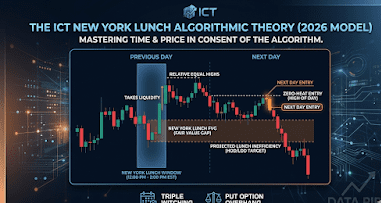
To successfully weaponize this theory, we must completely redefine how we view the Premium/Discount (PD) Array matrix during low-volume conditions. The New York Lunch hour acts as a unique incubation period where IPDA stores critical order flow data. Instead of looking for random setups across the entire day, we focus our attention on this specific institutional footprint.
- The Specific Time Window: The New York Lunch algorithm strictly tracks price action inside the two-hour window between 12:00 PM and 2:00 PM EST (New York Local Time). Anything that occurs at 11:59 AM or 2:01 PM falls outside this core mathematical script. This is the exact period when the morning trend stabilizes, and the smart money sets the stage for the afternoon PM session and the subsequent day’s opening.
- The Core Algorithmic Theory: The operational mechanic requires you to analyze the previous day’s lunch window with extreme precision. You must look for a specific sequence: price action enters the 12:00 PM – 2:00 PM EST window, engineering a targeted raid on a short-term liquidity pool (either sweeping old Buy-side Liquidity or purging Sell-side Liquidity), and immediately undergoes a sharp, aggressive displacement or reversal. Once this structural shift is identified, your sole task is to find the specific Fair Value Gap (FVG) or volume imbalance that printed right before that liquidity sweep occurred. This is your “Projected Inefficiency.”
- The Practical Application: Draw a horizontal zone across this specific lunch hour FVG and extend it directly forward into the next trading day. ICT mechanics show that when the algorithm transitions into a new day’s cycle, it treats this old lunch inefficiency as a magnetic price level. Price will frequently embark on a violent, highly targeted run back to this exact level to form either the absolute High of the Day (Short setup) or the Low of the Day (Long setup).
Why does IPDA do this? During lunch, major institutions match orders and clear internal books. Gaps formed right before a liquidity purge represent deep unmitigated order blocks where huge institutional positions remain unfilled. The algorithm remembers these mathematical reference points, using them as structural anchors to re-balance the market before initiating the next macro trend expansion.
2. High-Impact News Delivery: CPI Reaction & Execution
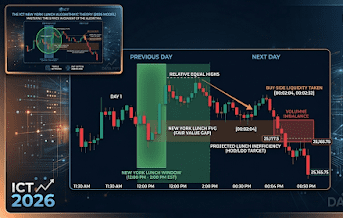
The true power of mapping out the New York Lunch algorithm becomes screamingly obvious during high-impact macroeconomic news releases like the Consumer Price Index (CPI). Most retail traders view CPI as sheer, unreadable chaos—a dangerous gamble where prices spike erratically up and down, blowing past stops on both sides of the market. To the algorithmic trader, however, news acts simply as an acceleration catalyst for IPDA to hit its pre-scheduled technical targets.
This teaches us a profound rule: High-impact news releases do not create random price targets. The volatility generated by CPI simply provides the massive energy required for the market to rapidly reprice back to the deep, historical inefficiencies left behind during the thinned-out New York Lunch script.
3. Advanced Algorithmic Glossary & Technical Signatures
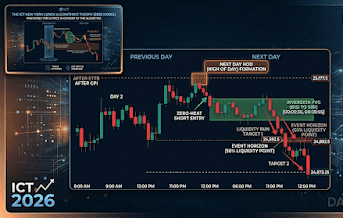
To build a truly professional trading plan around the ICT Lunch Theory, you must move beyond basic retail terminology and fully internalize the advanced technical signatures utilized by institutional market makers. If you cannot correctly name what the algorithm is doing, you cannot execute with precision.
4. Macro Market Sentiment & Algorithmic Outlook
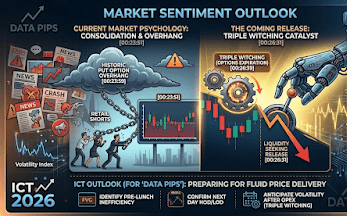
When we zoom out from intraday charts to analyze macro market structure, the interplay between options positioning, institutional manipulation, and quarterly cycles becomes deeply fascinating. The algorithm does not just deliver price day-to-day; it coordinates multi-week campaigns to distribute risk for global banking syndicates.
5. Professional Mentorship: Developing Precision via Micro Contracts

The path to becoming a consistently profitable, elite institutional trader does not lie in securing massive funding accounts overnight or flaunting oversized lot sizes on social media. The true mark of a professional is the mastery of mathematical execution precision and ironclad psychological discipline.
To build an unstoppable foundation, ICT firmly emphasizes trading exclusively with Micro contracts during your developmental years. This invaluable advice is designed to shift your focus away from the emotional high of monetary gains and place it entirely on the technical mastery of price delivery. Trading Micro contracts provides an exceptional sandbox environment where you can prove your technical precision across hundreds of setups without risking devastating capital drawdowns.
By learning to compound a small account size using disciplined, high-probability setups like the New York Lunch algorithm, you systematically remove greed from your workflow. Once your execution model is flawless and your mind is completely immune to FOMO or revenge trading, scaling up your capital becomes a simple, stress-free operational step. Focus heavily on mastering the clock, mapping out daily time filters, and treating trading as an elite scientific discipline.