- Global uncertainty — geopolitics, inflation, oil shocks — is not a temporary phase to wait out. It is the permanent operating condition of every market, every year.
- Trying to predict the next headline event and trade around it is a losing strategy for almost everyone who attempts it consistently.
- A genuinely diversified portfolio is built specifically to survive uncertainty you cannot predict, not to profit from guessing it correctly.
- The investors who do well during chaotic periods are usually the ones with a written plan made before the chaos started, not during it.
Investing during global uncertainty is not a special skill reserved for rare, chaotic years. It is the actual, permanent condition every investor operates in, every single year, regardless of how calm a particular quarter might feel. Geopolitical tension, inflation spikes, oil price shocks, currency instability — these are not interruptions to normal market conditions. They are normal market conditions.
The mistake most investors make is treating uncertainty as something to wait out before “really” investing, or as a signal to make dramatic portfolio changes based on the latest headline. Both approaches consistently underperform a simpler, less emotionally satisfying strategy: building a portfolio and a decision-making process specifically designed to function regardless of which geopolitical story dominates the news cycle this month.
This guide from the Data Pips Team lays out a practical, timeless framework for investing through genuine global uncertainty — without trying to predict the next crisis, and without letting headline anxiety drive portfolio decisions that a calmer version of yourself would not make.

Why Global Uncertainty Is the Rule, Not the Exception
Every year brings a new version of the same story: a geopolitical flashpoint, an inflation surprise, a central bank decision, a supply chain disruption, an energy price shock. The specific headline changes constantly. The underlying pattern — markets reacting to genuine unpredictability — never goes away.
This matters because investors who treat uncertainty as temporary keep waiting for a clearer, calmer moment to commit capital seriously. That moment does not arrive, because markets are never genuinely free of meaningful uncertainty. Investors who internalize this early build strategies that work continuously, rather than strategies that only work during imaginary calm periods that rarely materialize for long.
Accepting this reality is not pessimism. It is simply accurate, and it removes the false premise that better information or a calmer news cycle would eventually make investing decisions easy or risk-free.
Why Predicting the Next Headline Event Is a Losing Game
It is tempting to believe that closely following geopolitical developments, supply chain news, or central bank commentary provides a genuine edge in predicting market direction. For the overwhelming majority of individual investors, this belief is more costly than helpful.
Markets move on the combined expectations of millions of participants, many with access to information and analysis far beyond what any individual investor can process in real time. By the time a geopolitical development becomes clear enough to act on confidently, that information is typically already reflected in asset prices. Acting on it at that point usually means buying or selling at a price that has already adjusted, rather than capturing the move before it happened.
This does not mean ignoring global events entirely. It means recognizing the specific limit of what reacting to headlines can realistically achieve, and building a strategy that does not depend on consistently outguessing professional analysts and algorithmic trading systems with access to far more resources.
“By the time a crisis is clear enough to feel confident about, the market has usually already finished pricing it in.”
— Data Pips Team
The Core of an Uncertainty-Proof Framework: Genuine Diversification
Diversification is frequently mentioned but rarely applied with real discipline. True diversification means holding assets that do not all respond to the same triggers in the same direction — so that a single geopolitical event, inflation surprise, or sector-specific shock cannot meaningfully damage an entire portfolio at once.
According to Investopedia’s explanation of diversification, spreading investments across different asset classes, sectors, and geographies reduces the impact that any single negative event can have on overall portfolio performance, because losses in one area are more likely to be offset by stability or gains elsewhere.
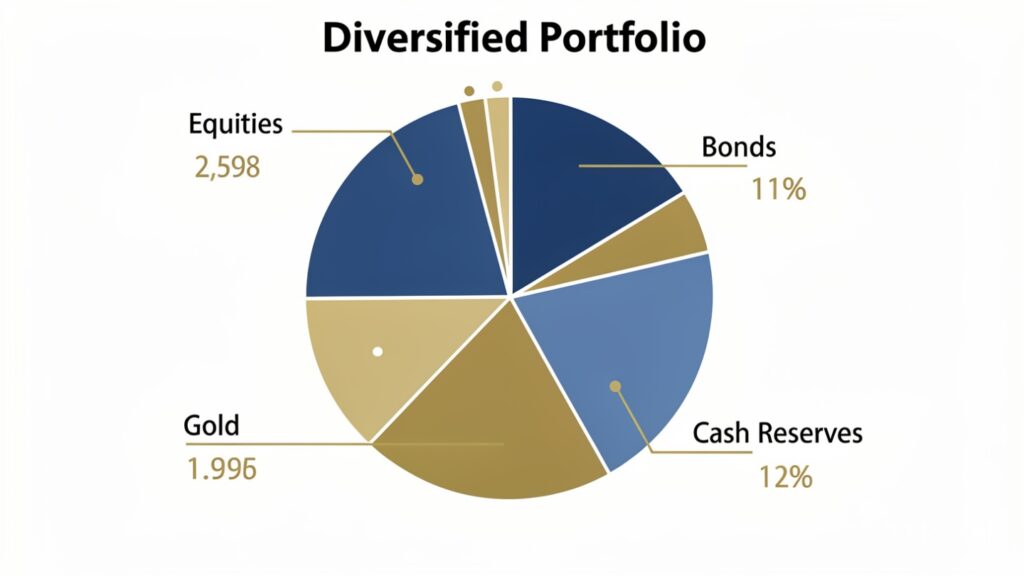
This typically includes a mix of equities across different sectors and regions, fixed income or bonds for relative stability, and a measured allocation to traditional safe-haven assets. Investopedia’s overview of safe-haven assets describes how holdings like gold have historically maintained or increased value during periods of market stress, which is exactly why they play a specific defensive role within a broader portfolio rather than functioning as a complete strategy on their own.
| Investor Behavior | During Calm Markets | During Uncertain Markets |
|---|---|---|
| Reactive investor | Feels confident, takes on more risk | Panics, sells low, chases headlines |
| Framework-based investor | Follows the same written plan | Follows the same written plan |
The Founder’s Real Lesson: Why Reacting to Every Headline Destroys Returns
Years of trading gold and forex markets directly through multiple periods of genuine geopolitical and economic uncertainty taught a consistent lesson: the instinct to adjust a position or a portfolio every time a significant headline breaks is almost always more damaging than helpful. Each reaction adds transaction costs, tax consequences, and emotional fatigue, while rarely improving long-term outcomes compared to a disciplined, pre-decided plan.
The investors and traders who performed most consistently across volatile periods were not the ones who reacted fastest to news. They were the ones who had already decided, in calmer moments, exactly how much risk they were willing to carry and exactly which assets they trusted to weather different kinds of shocks — and then simply followed that plan when the inevitable uncertain period arrived.
Our complete guide on smart investing strategies and risk management expands on building this kind of pre-decided framework in significantly more practical detail.
During an earlier period of active trading through significant geopolitical tension, a recurring pattern emerged: positions adjusted in direct reaction to breaking news consistently underperformed positions held according to a pre-set plan based on technical levels and risk parameters decided in advance. Reviewing months of trading data made this undeniable — the trades made from genuine analysis, set up before any specific headline appeared, outperformed the trades made reactively in the hours immediately following major news. The lesson that followed into all later investing decisions was direct: a plan made in a calm state consistently outperforms a decision made in a reactive one, regardless of how urgent the news feels in the moment.
Building a Practical Framework for Uncertain Periods
A genuinely useful framework for investing through uncertainty does not require predicting specific events. It requires structure that holds regardless of which specific event occurs.
Decide your asset allocation before the next crisis, not during it. Determine in a calm state what percentage of a portfolio belongs in equities, fixed income, safe-haven assets, and cash reserves. This decision, made without the pressure of a specific unfolding headline, tends to be far more rational than any adjustment made mid-crisis.
Use dollar-cost averaging instead of trying to time entries. Investopedia’s explanation of dollar-cost averaging describes investing a fixed amount at regular intervals regardless of price, which removes the impossible task of identifying the “perfect” entry point during volatile, headline-driven price swings.
Maintain a genuine emergency fund separate from investment capital. Money needed for near-term expenses should never be exposed to market volatility, regardless of how confident a particular investment thesis feels. Our complete guide on building an emergency fund covers exactly how to structure this protective layer before uncertainty arrives.
Limit how often portfolio performance gets checked during volatile periods. Frequent monitoring during uncertain stretches increases the temptation to react emotionally to short-term fluctuations that are statistically normal and frequently reverse without intervention.
Rebalance on a fixed schedule, not based on headlines. Adjusting portfolio weightings back to target allocations on a predetermined quarterly or annual basis maintains discipline without requiring any prediction about which specific event will move markets next.

What Nobody Tells You About Investing During Uncertainty
1. The anxiety from financial news consumption has a real cost. Constant exposure to alarming headlines does more than inform — it measurably affects stress levels and decision-making quality. The American Psychological Association’s research on stress and the body confirms that chronic stress exposure impairs cognitive function in ways that directly undermine calm, rational financial decision-making, which means limiting news consumption during volatile periods is a legitimate investment strategy, not just a wellness suggestion.
2. Safe-haven assets are not a complete strategy on their own. Gold and similar assets play a genuine defensive role within a diversified portfolio, but concentrating heavily in any single asset class — even one historically associated with stability — recreates the same concentration risk diversification is meant to solve in the first place.
3. Most “uncertainty-driven” investment opportunities are already priced by the time retail investors hear about them. Specific narratives tied to a single commodity, geopolitical chokepoint, or supply disruption circulate widely in financial media well after institutional investors have already positioned around that exact information, which significantly reduces the realistic edge available to an individual acting on the same narrative later.
4. A written plan only works if it survives contact with real fear. Many investors create a reasonable plan during calm periods and then abandon it the moment genuine uncertainty arrives — precisely when the plan was designed to matter most. The value of a written framework comes specifically from following it under pressure, not from having written it at all.
5. Uncertainty eventually resolves, but the next one is already forming. Every period of global tension eventually gives way to relative calm, which can create a false sense that uncertainty itself has been “solved.” In reality, a new source of unpredictability is typically already forming in the background, which is exactly why a permanent framework matters more than a temporary reaction to whichever crisis is currently dominating headlines.
Why Discipline Outperforms Prediction Over the Long Run
The investors who build genuine long-term wealth are rarely the ones who correctly predicted a specific geopolitical outcome or commodity supply shock. They are far more often the ones who built a disciplined, diversified framework early, stuck to it through multiple uncertain periods, and let consistent, patient execution compound over years rather than chasing each new crisis narrative as it appeared.
Our complete guide on the rules of money and wealth building reinforces this same discipline-over-prediction principle from a broader personal finance perspective, and our breakdown of wealth mindset and money psychology covers the underlying emotional discipline this kind of framework actually requires to maintain consistently.
Quick Action Steps: Build Your Uncertainty Framework This Week
Step 1: Write down your target asset allocation across equities, fixed income, safe-haven assets, and cash today, while markets feel relatively calm.
Step 2: Confirm your emergency fund is fully separate from investment capital and covers at least three to six months of essential expenses.
Step 3: Set a fixed schedule — quarterly or annually — for reviewing and rebalancing your portfolio, rather than reviewing it reactively after major news events.
Step 4: Identify your personal news consumption limit during volatile periods, and commit to checking portfolio performance no more often than your fixed review schedule allows.
Step 5: If you currently hold a concentrated position based on a specific geopolitical or commodity narrative, evaluate honestly whether it fits within a genuinely diversified framework or represents an oversized, speculative bet.
For the broader risk management principles that support this framework across both investing and trading, read our complete personal finance rules guide.
Frequently Asked Questions
Should I sell my investments when geopolitical tensions rise?
Generally, no, if your portfolio is already properly diversified according to a pre-decided plan. Selling in direct reaction to geopolitical headlines frequently means selling after a price decline has already occurred, locking in losses that a longer-term, diversified strategy would have weathered without intervention.
Is gold a good investment during periods of global uncertainty?
Gold has historically served as a defensive, safe-haven asset during periods of market stress, but it works best as one component within a broader diversified portfolio rather than as a complete standalone strategy. Concentrating too heavily in any single asset, including gold, recreates concentration risk.
How often should I check my portfolio during volatile market periods?
Less frequently than the anxiety of an uncertain period might suggest. Following a fixed review schedule, such as quarterly, rather than checking daily or after every major headline, reduces the temptation to make emotional, reactive decisions based on short-term fluctuations that are often statistically normal.
Can following financial news help me invest better during uncertain times?
Staying broadly informed has value, but trying to trade or invest based on rapidly reacting to individual headlines is generally unproductive for most investors, since markets typically price in significant information faster than any individual can realistically act on it. A pre-decided framework tends to outperform headline-driven decision-making over time.
What is dollar-cost averaging and why does it help during uncertainty?
Dollar-cost averaging means investing a fixed amount of money at regular intervals regardless of current price. This removes the difficult, often impossible task of identifying a perfect entry point during volatile markets, and naturally results in buying more shares when prices are lower and fewer when prices are higher.
How do I stop feeling anxious about my investments during global crises?
Having a written, pre-decided investment framework created during a calm period significantly reduces anxiety during uncertain times, because decisions do not need to be made under pressure. Limiting news consumption and checking portfolio performance on a fixed schedule rather than constantly also meaningfully reduces stress during volatile periods.
Disclaimer: This article is for educational and informational purposes only and does not constitute financial or investment advice. Investment outcomes depend on individual circumstances, risk tolerance, and market conditions, all of which vary significantly. The Data Pips Team makes no guarantees regarding financial outcomes from applying the strategies described in this article. Consult a licensed financial advisor before making investment decisions.