Key Takeaways
- Loss aversion means losses hurt about twice as much as equivalent gains feel good — your brain runs a rigged emotional scale.
- It’s an evolutionary survival instinct, not a flaw — but it’s badly miscalibrated for modern money decisions.
- It makes you hold losers too long and sell winners too early, the exact opposite of what builds wealth.
- It triggers panic selling in downturns, locking in losses at the worst possible moment.
- It makes you play not-to-lose instead of to-win — and over a long enough horizon, not-to-lose loses.
- You beat it by zooming out, pre-committing rules, and reframing loss as the unavoidable cost of any gain.
Try a quick experiment in your head. Imagine you find a $100 note on the street — a small, pleasant surprise. Now imagine instead that you reach into your pocket and discover $100 you had is gone. Same amount of money. But notice the difference in how each one feels. The lost $100 stings far more sharply than the found $100 delights. If both happened on the same day, you’d go to bed feeling like you’d had a bad day, even though, mathematically, you broke exactly even.
That lopsided feeling isn’t a quirk of yours. It’s one of the most powerful and well-documented forces in the entire human mind, and it’s quietly distorting nearly every financial decision you make. Your brain treats losses and gains on a rigged scale, where losses weigh roughly twice as much as identical gains. And because your money decisions are driven by feeling far more than by math, that rigged scale leads you, again and again, to do the precise opposite of what would build your wealth. It’s called loss aversion, and it might be the single most important money bias to understand — because it sits underneath so many of the others.
So let’s understand the rigged scale — why your brain weighs loss so heavily, how it sabotages you, and how to stop letting the fear of losing run your financial life. This is the final piece of the puzzle.
What Loss Aversion Actually Is
Loss aversion is the well-documented tendency for the pain of a loss to feel significantly more intense than the pleasure of an equivalent gain. Research into prospect theory, the Nobel-winning work that reshaped how we understand financial decision-making, suggests that a loss is felt roughly twice as powerfully as a gain of the same size. Losing $100 hurts about as much as winning $200 feels good. The scale isn’t balanced — it’s tilted heavily toward the pain of losing.
This single asymmetry, which behavioral scientists call loss aversion, has enormous consequences, because it means your decisions aren’t actually optimized for making money — they’re optimized for avoiding the pain of losing it. And those are not the same goal. A mind trying to grow wealth and a mind trying to dodge the feeling of loss will make very different choices, and the loss-dodging mind will usually make the worse ones. You’re not playing to win the game; you’re playing to avoid the sting, and the sting is leading you straight into the traps.
“Your brain isn’t trying to make you money. It’s trying to protect you from the pain of losing it. Those feel like the same goal — and they lead to opposite decisions.”
Why You’re Wired This Way
Loss aversion isn’t a personal weakness or a sign you’re bad with money — it’s ancient survival software, and once you understand why it exists, you can stop blaming yourself and start managing it. For most of human history, the stakes were brutally asymmetric. Losing what you had — your food store, your shelter, your safety — could mean death. Missing out on a potential gain usually just meant you tried again tomorrow. In that world, an instinct that screamed loudly to protect against losses and stayed quieter about chasing gains kept you alive. The cautious, loss-fearing ancestors survived and passed on their wiring. The reckless, loss-indifferent ones often didn’t.
So you inherited a brain finely tuned to treat losses as life-threatening emergencies and gains as nice-to-haves. The problem is that this calibration, perfect for surviving on the savanna, is wildly miscalibrated for building wealth in the modern world. Losing money in an investment is not the same as losing your last meal, but your ancient brain processes it with the same alarm. It reacts to a dip in your portfolio the way an ancestor reacted to a predator at the cave mouth — with panic, with an overwhelming urge to make the threat stop now. That mismatch between ancient wiring and modern money is where loss aversion does its damage. It’s the same kind of emotional override we explored in how emotional interference quietly kills your compound growth — feeling hijacking math at exactly the wrong moment.

How Loss Aversion Sabotages Your Money
The rigged scale doesn’t stay abstract — it produces a set of specific, predictable, costly behaviors. Once you can name them, you can catch yourself doing them.
Holding losers too long, selling winners too early. This is the classic, and it’s called the disposition effect. When an investment drops, selling means accepting the loss and feeling that doubled pain, so you hold on, hoping to avoid it. When an investment rises, you rush to sell and lock in the gain, terrified of “losing” the profit you’re now up. The result is exactly backwards from what works: you cling to your losers and dump your winners, the opposite of the “let winners run, cut losers” discipline that actually builds wealth. We dug into one half of this in the real reason you exit trades too early — and loss aversion is the engine underneath it.
Panic selling at the worst possible time. When markets fall, loss aversion turns a temporary paper dip into an unbearable emotional emergency. The doubled pain of watching losses grow screams at you to make it stop, so people sell during downturns — converting a temporary, recoverable dip into a permanent, locked-in loss, often right before a recovery. They sell low out of fear, the single most expensive mistake in investing, driven entirely by a brain that can’t tolerate the feeling of loss long enough to let it pass.
Avoiding good risks and hiding in cash. Because potential losses feel twice as heavy as equal gains, people become irrationally risk-averse, refusing sensible opportunities where the upside genuinely outweighs the downside. They leave money sitting in cash, slowly eroded, because the fear of any loss outweighs the rational case for reasonable growth. Loss aversion doesn’t just make people lose money on bad moves — it makes them forgo the good moves entirely, which over decades is its own enormous, invisible loss.
Making quitting feel impossible. Loss aversion is the very engine of the sunk cost trap we just examined. The reason you can’t walk away from a failing investment, subscription, or venture is that quitting forces you to feel the loss, and your brain will do almost anything — including pour in more money — to avoid that feeling. Loss aversion is what gives the sunk cost trap its grip.
What Nobody Tells You: Playing Not-to-Lose Is How You Lose
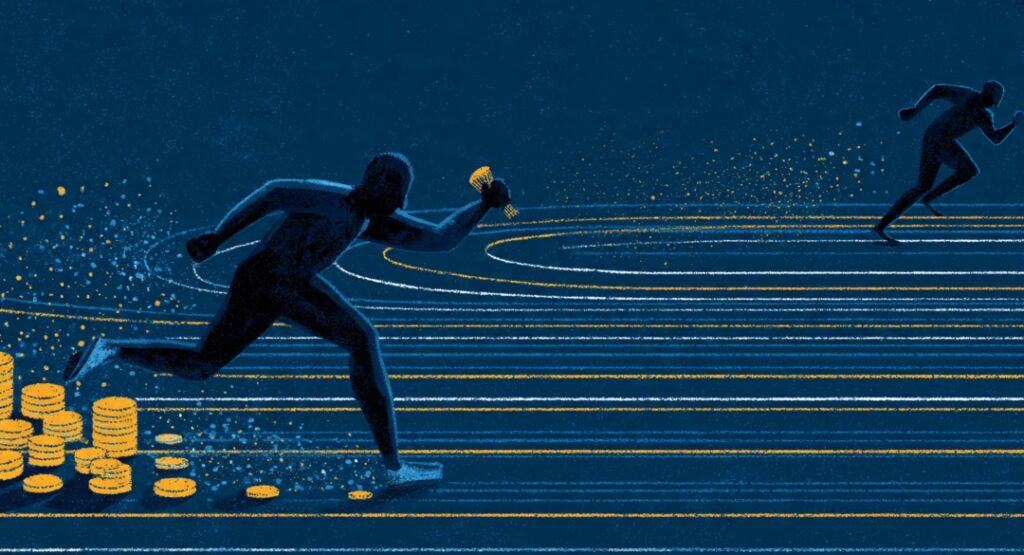
Here’s the deepest cost of loss aversion, the one almost nobody names. It quietly switches your entire financial strategy from playing to win to playing not to lose — and over a long enough horizon, playing not to lose is itself how you lose.
Think about what a loss-averse mind optimizes for: avoiding the pain of any setback. So it dodges reasonable risks, bails at the first sign of a dip, hoards cash, and clings to comfort. Each of those choices feels safe in the moment, because each one avoids an immediate loss. But wealth isn’t built by avoiding every loss — it’s built by accepting small, survivable losses in exchange for far larger gains over time. The person playing not-to-lose never takes the swings that compound into real wealth, and meanwhile inflation and missed opportunity quietly drain them anyway. They avoided every visible loss and walked straight into the biggest invisible one: a life of standing still while the world compounds past them.
This connects directly to why the slow, volatile middle of any wealth-building journey feels so unbearable. Every dip in the long compounding climb is felt at double intensity, so loss aversion is constantly screaming at you to abandon ship during exactly the periods you most need to hold on. The very bias that makes you flee losses is the one that ensures you never stay invested long enough to win.
“Loss aversion makes you optimize for never feeling a loss. But you cannot win a game you’re too afraid to lose at — and over a lifetime, the refusal to risk anything is the most expensive risk of all.”
There’s a hard-won truth that anyone who has operated in genuinely high-stakes arenas — trading, business, building anything real — eventually learns in their bones: loss is not the enemy. Loss is the cost of entry. Every meaningful gain you will ever make is purchased with the acceptance of some risk of loss. The professional doesn’t fear losses the way the amateur does; the professional has made peace with the fact that small, controlled losses are simply the price of doing business, the unavoidable tax on every pursuit of a larger gain. The amateur, ruled by loss aversion, tries to avoid every loss — and in doing so, refuses every stop loss, blames the strategy after every setback, abandons sound plans the moment they hurt, and ends up taking the one loss that actually matters: the catastrophic one they were too afraid to prevent with a small one. Making peace with small losses is precisely what separates the disciplined from the gambler, the exact line we drew in moving from gambler to professional through mechanical discipline.
How to Beat Loss Aversion
You can’t delete a survival instinct, but you can build systems and reframes that stop it from running your money. Here’s how.
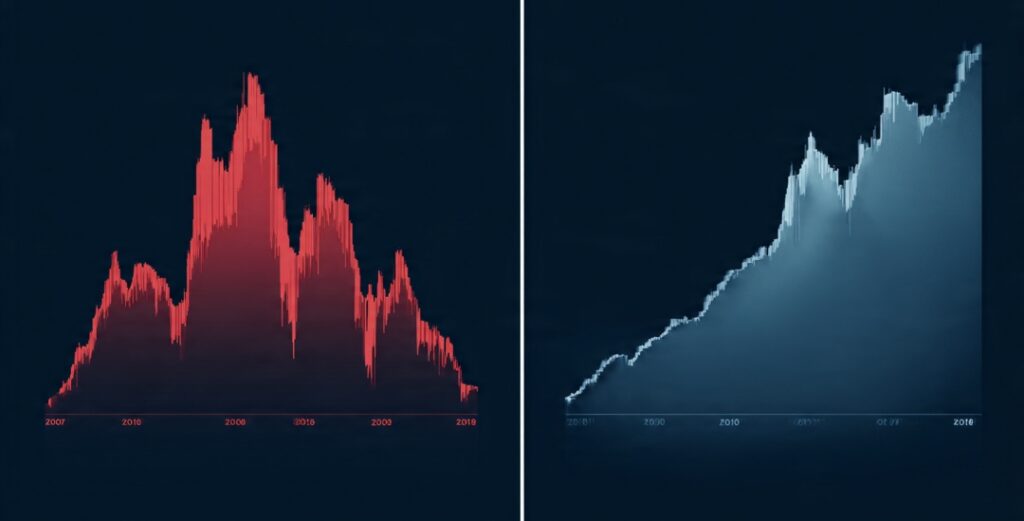
1. Zoom out — judge the forest, not the tree. Loss aversion lives in the individual moment: this dip, this trade, this loss. Defeat it by widening your frame. Don’t look at any single investment’s daily move; look at your whole portfolio over years. A loss that feels catastrophic up close often vanishes into noise when you zoom out to the long-term trend. The wider your time frame, the quieter the rigged scale gets, because most short-term losses simply don’t matter at the scale that does.
2. Pre-commit your rules while you’re calm. The doubled pain of loss only strikes in the heat of the moment, so make your decisions in advance, when you’re rational. Set your exit points, your “I will not sell during downturns” rule, your rebalancing schedule — before the emotion hits. Then follow the rules mechanically, overriding the panicked in-the-moment self with the wise pre-committed one. This is the same principle that defeats present bias: take the decision out of the emotional moment entirely.
3. Reframe loss as the cost of playing. Stop treating every loss as a failure or a wound, and start seeing it as the entry fee for the possibility of gain. No loss, no gain — they’re a package deal. When you genuinely accept that some losses are simply the price of being in the game, they stop feeling like emergencies and start feeling like a normal, budgeted cost of building wealth. The pain doesn’t vanish, but it loses its power to make you act.
4. Automate to remove the emotional moment. The single most reliable defense: don’t be present for the decision. Automatic, scheduled investing means you keep building through downturns without a panicked human deciding to stop. You can’t loss-avert your way out of an automated contribution you never see or approve in the moment. Removing yourself from the emotional decision point is how you stay invested when fear says flee, the same structural fix behind the automated reverse-budgeting system.
5. Focus on process, not individual outcomes. A good decision can lead to a loss, and a bad decision can luck into a gain — so judging yourself by individual results just feeds loss aversion. Instead, judge whether you followed a sound process. If your process is good, accept that some individual losses are inevitable and meaningless in isolation. This shift, from outcome-obsession to process-discipline, is what lets you tolerate the losses that any good long-term strategy must occasionally produce.
| Loss-averse behavior | Rational behavior |
|---|---|
| Holds losers, sells winners early | Cuts losers, lets winners run |
| Panic-sells in downturns | Holds or buys through the dip per plan |
| Hides in cash, avoids all risk | Takes sensible risks with good odds |
| Judges each loss in isolation | Judges the whole portfolio over years |
| Plays not to lose | Plays the long game to win |
One illustration makes the irrationality vivid. Imagine a coin flip: heads you win $150, tails you lose $100. The math is clearly in your favor — over many flips you’d come out well ahead. Yet most people refuse the bet, because the $100 potential loss looms larger than the $150 potential gain, even though the gain is bigger. That refusal is loss aversion in pure form: turning down a genuinely good deal purely because the brain over-weights the downside. Learn to spot that moment — when you’re rejecting something good only because the loss feels scarier than the equal-or-larger gain feels exciting — and you’ve caught the rigged scale in the act.
Now It’s Your Move
Loss aversion is the deep current running beneath so much of what we’ve explored across this whole series — the panic, the holding on, the inability to quit, the fear that keeps people standing still. Together with lifestyle creep and every other trap we’ve mapped, it forms the hidden machinery that quietly keeps capable people broke. It’s ancient, it’s powerful, and it will never fully switch off, because it’s wired into what it means to be human. But you don’t have to obey it. The moment you understand that your brain is weighing loss on a rigged scale, you can start consciously correcting for the tilt.
- Name the rigged scale. When you feel the urge to flee a loss, pause and say it: “This is loss aversion. The pain is doubled, but the math hasn’t changed.” Naming it shrinks its power.
- Zoom out before any loss decision. Before reacting to a loss, widen your view to the whole portfolio over years. Ask whether this will matter at all in a decade.
- Pre-commit your downturn rule now. Decide today, while calm, exactly what you’ll do when markets fall — and commit to following it mechanically when fear arrives.
- Automate your investing. Take yourself out of the emotional moment so you keep building through the dips that loss aversion would make you flee.
- Reframe one loss as a cost, not a wound. Pick a past loss and consciously relabel it: the price of playing the game, not a failure. Practice making peace with it.
The found $100 and the lost $100 are worth exactly the same. Your brain will never quite believe that — but you can. And in that gap, between what your ancient wiring feels and what the math actually says, lives the difference between the people who let the fear of losing run their lives, and the people who calmly accept small losses as the price of building something real. This is where the whole money mind comes together: not in never feeling the fear, the craving, the pull of the present, or the sting of loss — but in seeing each one clearly for what it is, and choosing, anyway, to build for the future instead of obeying the moment. That choice, made again and again, is what quietly separates the people who stay broke from the people who don’t.
Loss aversion is the well-documented tendency for the pain of a loss to feel significantly more intense than the pleasure of an equivalent gain. Research into prospect theory suggests a loss is felt roughly twice as powerfully as a gain of the same size, so losing $100 hurts about as much as winning $200 feels good. This rigged emotional scale means people often make decisions optimized for avoiding the pain of loss rather than for actually growing their wealth.
Because of ancient survival wiring. For most of human history losing what you had, like food or shelter, could be fatal, while missing a potential gain usually just meant trying again. A brain that reacted strongly to losses and more mildly to gains kept our ancestors alive, so we inherited that asymmetry. The instinct that was perfect for survival is now badly miscalibrated for money, making the brain treat an investment dip with the same alarm as a life-threatening emergency.
It drives several costly behaviors. People hold losing investments too long to avoid feeling the loss while selling winners too early to lock in gains, a pattern called the disposition effect. It triggers panic selling in downturns, turning temporary dips into permanent losses, and it makes people irrationally avoid sensible risks and hide in cash. It also powers the sunk cost trap, since quitting anything forces you to feel the loss your brain is desperate to avoid.
The disposition effect is the loss-aversion-driven tendency to sell winning investments too early while holding losing ones too long. Selling a loser means accepting the doubled pain of the loss, so people cling to it hoping to avoid that feeling, while selling a winner locks in a gain they are afraid of losing. The result is exactly backwards from sound strategy, which is to cut losers and let winners run, and it quietly erodes returns over time.
Zoom out and judge your whole portfolio over years rather than reacting to individual losses, and pre-commit your rules while calm so the panicked in-the-moment self cannot override them. Reframe losses as the unavoidable cost of playing rather than as failures, automate your investing so you are not present for the emotional decision, and judge yourself on following a sound process rather than on individual outcomes. Together these correct for the rigged scale without requiring you to feel no fear.
Because wealth is built by accepting small survivable losses in exchange for larger gains over time, and a mind optimized only to avoid losses never takes the swings that compound into real wealth. Playing not to lose feels safe in each moment, but it leads to dodging good opportunities, hiding in cash, and fleeing every dip, while inflation and missed growth drain you anyway. Over a long horizon, the refusal to risk anything becomes the most expensive risk of all.
Yes. Every meaningful gain is purchased with the acceptance of some risk of loss, so loss is better understood as the cost of entry rather than the enemy. Professionals make peace with small, controlled losses as the normal price of doing business, while those ruled by loss aversion try to avoid every loss and often end up taking the catastrophic one they refused to prevent with a small one. Accepting that some loss is inevitable is essential to long-term success.
Disclaimer: This article is for educational and informational purposes only and does not constitute financial, investment, or psychological advice. The numerical examples shown are simplified arithmetic illustrations, not predictions, promises, or guarantees of any specific return. All investing involves risk, including the loss of capital, and individual circumstances vary. Always do your own research and consult a qualified financial professional before making money decisions.