You asked an AI a question, and it gave you a confident, detailed, perfectly worded answer — complete with a specific statistic and a cited source. There was just one problem: the statistic was wrong, and the source did not exist. The AI made it up, and it did so with total confidence. Welcome to one of the strangest and most dangerous quirks of modern AI: the hallucination.
AI hallucinations confuse and alarm people, because they seem to contradict everything we expect from a computer. Computers are supposed to be precise. They are supposed to either know something or return an error — not confidently invent a plausible-sounding lie. And yet that is exactly what AI language models do, sometimes, and understanding why is essential for anyone using these tools for anything that matters.
This guide explains AI hallucinations in plain language — what they are, why they happen at a fundamental level, when they are most likely, how to spot them, and how to protect yourself. The Data Pips Team will show you that hallucinations are not a random glitch but a predictable consequence of how AI actually works. Once you understand the mechanism, you will use AI far more safely and wisely. Let us get into it.

What Is an AI Hallucination — In Plain English?
Let us define it simply.
An AI hallucination is when an AI confidently states something false as if it were true — generating facts, details, sources, or quotes that are wrong or completely made up.
The term “hallucination” is borrowed from human psychology, where it means perceiving something that is not really there. For AI, an AI hallucination means the model produces output that sounds coherent and plausible but is not grounded in reality or in any real source. The AI is not lying in the human sense — it does not intend to deceive. It simply generates text that fits the pattern of a good answer, regardless of whether that text is actually true.
Hallucinations come in several forms:
- Fabricated facts — stating a wrong date, statistic, or piece of information as if it were correct.
- Made-up sources — citing books, studies, articles, or websites that do not exist, often with convincing-looking titles and authors.
- Invented details — adding specific-sounding details to fill out an answer, even when the AI has no basis for them.
- False confidence — presenting all of the above with the same calm authority it uses for correct answers.
That last point is what makes hallucinations genuinely dangerous. A hallucinated answer does not come with a warning label. It sounds exactly as confident, fluent, and authoritative as a correct answer. There is no flashing sign saying “this part is made up.” This is why people get fooled — the lie is indistinguishable from the truth on the surface.
— Data Pips Team
Why Hallucinations Happen: The Core Reason
To understand hallucinations, you have to understand what an AI language model is actually doing when it answers you. And the truth surprises most people.
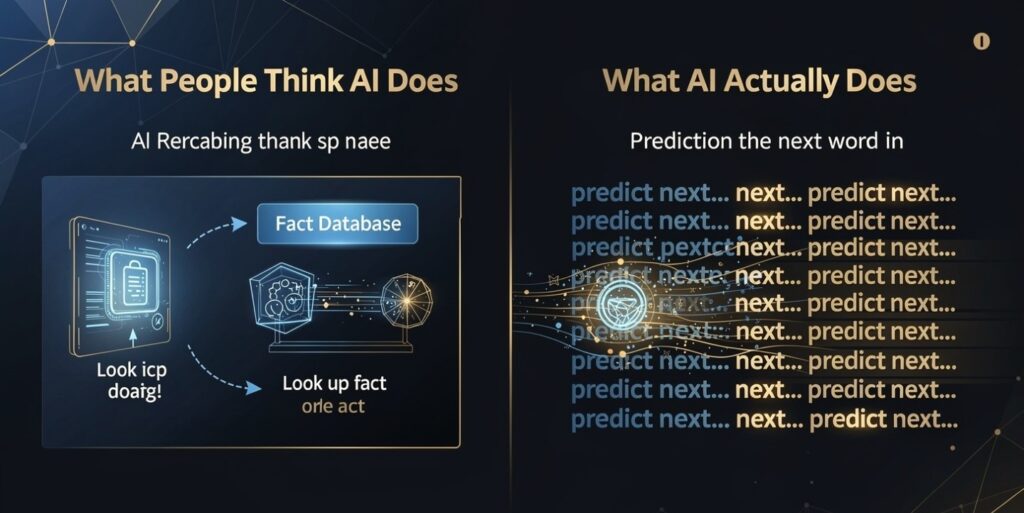
An AI language model is not a fact database. It is a prediction engine. When you ask it a question, it is not looking up the answer in some internal encyclopedia. Instead, it is predicting what words should come next, based on patterns it learned from massive amounts of text during training. As large language models work, they generate text one piece (one token) at a time, each time predicting the most plausible next piece based on everything before it.
Think about what this means. The AI’s fundamental job is to produce text that sounds right — text that fits the patterns of fluent, plausible language. It is optimized for plausibility, not for truth. Most of the time, plausible and true happen to line up, because the AI learned from largely accurate text. But when they diverge — when the most plausible-sounding continuation is not actually true — the AI will happily produce the plausible falsehood, because producing plausible text is exactly what it was built to do.
This is the core reason hallucinations happen: the AI is a fluency machine, not a fact machine. It generates language that sounds like a good answer. It has no built-in mechanism to check whether what it is saying is actually true. When it does not have the real information, it does not stop — it fills the gap with whatever sounds most plausible, and presents it with the same confidence as everything else.
According to IBM, hallucinations occur because these models generate responses based on statistical patterns rather than factual verification, meaning they can produce convincing but incorrect information when the patterns lead them astray. Understanding this single fact — that AI predicts plausible text rather than retrieving verified facts — explains almost everything about why hallucinations happen.
The Confident Student Analogy
Here is the analogy that makes hallucinations click. Imagine a very articulate student taking an oral exam.
This student has read enormously and speaks beautifully. When asked a question they know, they give a brilliant, fluent answer. But here is the catch: this particular student has been trained their whole life to always give a confident, well-spoken answer, and to never say “I don’t know.” Saying “I don’t know” feels like failure to them.
So what happens when they are asked something they do not actually know? They do not pause or admit uncertainty. Instead, they smoothly generate an answer that sounds exactly like the kind of answer that would be correct — drawing on the general patterns of what such answers usually look like. They might invent a plausible-sounding date, a reasonable-sounding statistic, a citation that fits the style of real citations. And they deliver it with the same confidence as their genuine knowledge, because confident delivery is what they were trained to do.
That student is an AI language model. It has absorbed vast patterns of language and knowledge, and it produces fluent, confident answers. But it has no internal “I don’t know” reflex that reliably kicks in when it lacks real information. When it does not know, it does what it was built to do: it generates the most plausible-sounding answer and delivers it confidently. The result is a hallucination — a confident, fluent, plausible answer that happens to be false.
This is why hallucinations are not a bug in the usual sense. They are a direct, predictable consequence of building a machine optimized to always produce plausible, confident language rather than to verify truth or admit ignorance.
Hallucinations are one item on a longer list — for the full catalog of the broader risks and limitations of foundation models, from bias and frozen knowledge to concentration of power, this is the overview to read.
When Are Hallucinations Most Likely?
Hallucinations are not equally likely for every question. Understanding the high-risk situations helps you know when to be extra careful.
1. Questions Beyond the AI’s Training
When you ask about something the AI never learned well — obscure topics, very recent events after its training cutoff, or highly specialized niche information — it is far more likely to hallucinate, because it is filling a genuine gap in its knowledge with plausible invention. The less the AI actually knows about something, the more likely it is to make things up about it.
2. Requests for Specific Facts: Dates, Numbers, Citations
Asking for precise specifics — exact dates, statistics, quotes, study citations, page numbers, names — is a classic hallucination trigger. These require precise factual recall, which is exactly where a pattern-predicting machine is weakest. The AI knows what a citation looks like, so it can generate a convincing fake one. Fabricated sources and statistics are among the most common and most dangerous hallucinations.
3. Leading or Loaded Questions
If you ask a question that assumes something false, or that pushes the AI toward a particular answer, it will often go along with your premise rather than correcting it. Ask “Why did [event that never happened] occur?” and the AI may well invent reasons for the non-existent event, because it is predicting the kind of answer your question seems to want. The AI tends to be agreeable, which means leading questions can pull it into hallucination.
4. Topics Where Plausible and True Diverge
In areas full of common misconceptions, or where the “obvious-sounding” answer is actually wrong, the AI is more prone to hallucinate — because the most plausible-sounding answer (what it is optimized to produce) is the incorrect one. The AI can confidently repeat a popular myth because the myth “sounds right” in the patterns it learned.
Real Example: The Citation That Didn’t Exist
Imagine someone using an AI to help write a research-backed article. They ask the AI to provide studies supporting a particular claim. The AI responds confidently with three citations — each with a real-sounding author name, a plausible study title, a journal name, and a year. It looks perfect.
The person, trusting the confident output, includes these citations in their work. Later, someone tries to look up the studies — and discovers that none of them exist. The author names are real-sounding but fictional. The study titles were never published. The AI fabricated all three, because it knows exactly what academic citations look like and generated convincing fakes to fill the request.
The AI was not malfunctioning. It was doing precisely what it does: generating plausible-sounding text. The request for specific citations hit a perfect hallucination trigger — a demand for precise facts the AI did not actually have, which it filled with convincing inventions delivered confidently.
Lesson: Never trust AI-provided specific facts — especially citations, statistics, and quotes — without independent verification. The more specific and authoritative a detail looks, the more important it is to check, because that is exactly where convincing hallucinations live.
How to Spot and Protect Against Hallucinations
You cannot fully eliminate hallucinations, but you can dramatically reduce their impact with the right habits. Here is how to protect yourself.
Verify Anything That Matters
The single most important habit: independently verify any important fact, figure, citation, or claim the AI gives you, especially before relying on it or sharing it. Treat AI output for factual matters as a confident draft that needs checking, not as verified truth. For anything consequential — medical, legal, financial, factual claims in published work — verification is non-negotiable.
Be Especially Suspicious of Specifics
Exact dates, precise statistics, citations, quotes, and names are the highest-risk outputs. The more specific and authoritative-looking a detail is, the more you should verify it. Paradoxically, the impressive specificity that makes an answer feel trustworthy is exactly what should raise your guard.
Use Tools That Ground AI in Real Sources
Techniques like RAG (Retrieval Augmented Generation) dramatically reduce hallucinations by making the AI retrieve and base its answers on real documents rather than its frozen memory. AI tools that search the web or reference specific documents before answering are far less prone to hallucination on factual matters. Our guide on what RAG is and how it works explains exactly how this grounding reduces made-up answers.
Avoid Leading Questions
Ask neutral, open questions rather than questions that assume a premise or push toward a desired answer. Instead of “Why is [claim] true?”, ask “Is [claim] true, and what is the evidence?” Giving the AI room to say “this is not actually correct” reduces the chance it goes along with a false premise.
Ask the AI to Express Uncertainty
You can prompt the AI to flag when it is unsure or to distinguish between what it is confident about and what it is guessing. While not perfect, explicitly inviting uncertainty can reduce confident fabrication. Asking “How confident are you, and what might you be wrong about?” sometimes surfaces the AI’s own shaky areas.
— Data Pips Team
What Nobody Tells Beginners About Hallucinations
1. Hallucinations Cannot Be Fully Eliminated
Because hallucinations stem from the fundamental way AI works — predicting plausible text rather than verifying truth — they cannot be completely eliminated, only reduced. Newer models hallucinate less than older ones, and grounding techniques like RAG help significantly, but no AI is hallucination-proof. Anyone who tells you a particular AI “never hallucinates” is overselling. Treat every AI as capable of confident error, and build your habits around that reality rather than hoping for a perfect model.
2. More Fluent Does Not Mean More Accurate
It is natural to trust answers that are well-written, detailed, and confident. But fluency and accuracy are completely separate things in AI. An AI can produce a beautifully written, perfectly structured, utterly false answer. The polish of the writing tells you nothing about the truth of the content. Train yourself to separate “this sounds good” from “this is correct” — they are not the same, and conflating them is how people get fooled.
3. The AI Genuinely Doesn’t Know It’s Wrong
When an AI hallucinates, it is not knowingly deceiving you and then hiding it. At the moment it produces a hallucination, it has no internal awareness that the output is false — it is generating plausible text the same way it always does. This is why you cannot simply ask “are you sure?” and trust the answer; the AI may confidently confirm a hallucination because it has no reliable internal truth-check. The absence of genuine self-awareness about correctness is central to the problem.
4. Hallucinations Are Worst Exactly Where You Can Least Afford Them
The high-risk triggers — specific facts, citations, niche expertise, precise data — often coincide with exactly the situations where accuracy matters most: research, professional work, important decisions. This cruel overlap means the moments you most need the AI to be right are often the moments it is most likely to invent. This is precisely why human verification remains essential for anything consequential, and why blindly trusting AI for high-stakes factual matters is risky.
5. Understanding This Makes You a Far More Valuable AI User
As AI becomes embedded in more work, the people who understand its limitations — who know when to trust it and when to verify — are far more valuable than those who either blindly trust AI or dismiss it entirely. Knowing how to use AI critically and effectively, getting its benefits while guarding against its failures, is a genuinely marketable skill. This kind of clear-eyed AI literacy is exactly the sort of capability that compounds into real opportunity as AI reshapes how work gets done.
Quick Action Steps
Now It’s Your Move
- Remember: AI is a fluency machine, not a fact machine. It predicts plausible-sounding text, not verified truth. This single fact explains every hallucination.
- Verify anything that matters. Treat AI factual output as a confident draft to check, not as truth. For consequential matters, independent verification is non-negotiable.
- Be most suspicious of specifics. Exact dates, statistics, citations, and quotes are the highest-risk outputs. Impressive detail should raise your guard, not lower it.
- Watch the high-risk triggers. Questions beyond the AI’s training, requests for precise facts, and leading questions are where hallucinations cluster. Be extra careful there.
- Use grounding tools like RAG. AI that retrieves real documents or searches the web before answering hallucinates far less on factual matters than AI answering from memory alone.
- Ask neutral, not leading, questions. Give the AI room to say “that’s not correct” instead of pushing it toward a premise it will fabricate support for.
- Separate “sounds good” from “is true.” Fluency and accuracy are different. A beautifully written answer can be completely false. Judge content, not polish.
Frequently Asked Questions
An AI hallucination is when an AI confidently states something false as if it were true — generating facts, details, sources, or quotes that are wrong or completely made up. The term is borrowed from human psychology, where it means perceiving something that is not really there. For AI, it means the model produces output that sounds coherent and plausible but is not grounded in reality. The AI is not lying in the human sense; it does not intend to deceive. It simply generates text that fits the pattern of a good answer, regardless of whether that text is actually true, and delivers it with the same confidence as a correct answer.
AI models hallucinate because they are fundamentally prediction engines, not fact databases. When you ask a question, the AI is not looking up the answer in an internal encyclopedia — it is predicting what words should come next based on patterns it learned during training. Its core job is to produce text that sounds plausible and fluent, not text that is verified as true. Most of the time, plausible and true line up, but when they diverge, the AI will happily produce the plausible falsehood because producing plausible text is exactly what it was built to do. It has no built-in mechanism to check whether what it says is actually true, so it fills knowledge gaps with confident invention.
AI is most likely to hallucinate in several situations: when asked about topics beyond its training (obscure subjects, very recent events, or highly specialized niches), when asked for specific facts like exact dates, statistics, citations, or quotes (which require precise recall where a pattern-predictor is weakest), when given leading or loaded questions that push it toward a particular answer or assume a false premise, and on topics full of common misconceptions where the plausible-sounding answer is actually wrong. Requests for precise specifics — especially citations and statistics — are among the most common and dangerous hallucination triggers, because the AI knows what such things look like and can generate convincing fakes.
The difficult truth is that you often cannot tell just by looking, because a hallucinated answer sounds exactly as confident and fluent as a correct one — there is no warning label. This is what makes hallucinations dangerous. The best approach is to be suspicious of high-risk outputs: specific dates, statistics, citations, quotes, and claims about niche or recent topics. Independently verify these against reliable sources. Be aware that fluency and polish tell you nothing about accuracy — a beautifully written answer can be completely false. You also cannot simply ask the AI “are you sure?” and trust the answer, since it may confidently confirm a hallucination because it has no reliable internal truth-check.
No. Because hallucinations stem from the fundamental way AI works — predicting plausible text rather than verifying truth — they cannot be completely eliminated, only reduced. Newer models hallucinate less than older ones, and grounding techniques like RAG (which makes the AI retrieve and base answers on real documents) help significantly. AI tools that search the web before answering are also less prone to factual hallucination. But no AI is hallucination-proof, and anyone claiming a particular AI “never hallucinates” is overselling. The realistic approach is to treat every AI as capable of confident error and build verification habits around that reality, rather than hoping for a perfect, error-free model.
RAG (Retrieval Augmented Generation) dramatically reduces hallucinations but does not completely stop them. RAG works by making the AI retrieve real, relevant information from a knowledge source before answering, so it bases its response on actual documents rather than its frozen, sometimes-faulty memory. This grounding in real sources significantly cuts down on made-up facts. However, the AI can still occasionally misinterpret the retrieved information or fill gaps with invention, and RAG is only as good as the quality of its knowledge base. So RAG is a powerful safeguard against hallucinations — one of the best available — but it is a major reduction, not a perfect guarantee. Verification of important claims remains wise even with RAG.
AI sounds confident even when wrong because it was trained to always produce fluent, well-formed, confident-sounding answers, and it has no reliable internal mechanism to detect when it lacks real information. Unlike a careful human who might pause and say “I’m not sure,” the AI generates a hallucinated answer the same smooth way it generates a correct one — it does not have genuine self-awareness that the output is false at the moment it produces it. The confidence is a feature of how it writes, not a reflection of how accurate the content is. This disconnect between confident delivery and actual accuracy is precisely what makes hallucinations so easy to fall for and so important to guard against.

Now It’s Your Move
That confident, detailed, perfectly-worded AI answer with the fabricated statistic and the citation that does not exist? Now you understand exactly why it happened. The AI was not malfunctioning, and it was not trying to deceive you. It was doing precisely what it was built to do: generate plausible-sounding text. It is a fluency machine, not a fact machine — and when it lacked the real answer, it filled the gap with confident invention, because that is its fundamental nature.
This is the key insight that changes how you use AI forever: hallucinations are not a random glitch to be surprised by. They are a predictable consequence of how AI actually works. The AI predicts the most plausible next words rather than retrieving verified facts, and it has no reliable internal sense of when it is wrong. Once you truly absorb this, AI stops being mysterious and becomes a tool you can use wisely — powerful, but requiring your judgment.
The danger was never that AI makes mistakes — all tools have limitations. The danger is that AI makes mistakes that sound exactly like the truth, with no warning. So the responsible approach is simple: get the enormous benefits of AI while never outsourcing your judgment to it. Verify what matters. Be suspicious of impressive specifics. Use grounding tools like RAG. Ask neutral questions. And always separate “sounds good” from “is true.”
This is not about fearing AI or avoiding it. It is about using it like a skilled professional — leveraging its speed and fluency while guarding against its predictable failure. The people who understand AI’s limitations are far more valuable than those who blindly trust it or dismiss it entirely. That clear-eyed literacy is a genuine edge in a world increasingly run on these tools.
You now understand one of the most important truths about modern AI — one that protects you from the confident, fluent, convincing errors that fool everyone who does not know the mechanism. Use AI boldly, but verify wisely.
For your next steps, learn how hallucinations get reduced in practice with our guide on what RAG is and how it works, and understand the mechanics of how AI processes information in what AI tokens and context windows are. Both deepen your understanding of why AI behaves the way it does.